by Jean Marie Carey | 2 Jan 2018 | Art History, Contemporary Art
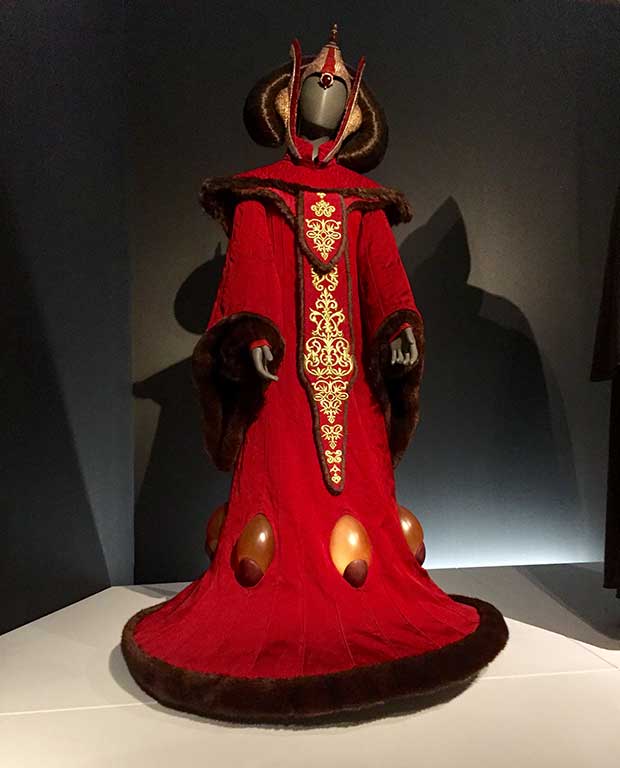
Padmé Amidala’s throne room robes
This is a “locally-coloured” version of this exhibition review. See the “professional” iterations at Humanities Commons or on the Museum Bookstore website.
On view through the spring, this exhibition features 60 costumes representing characters from the Star Wars film saga from A New Hope in 1977 through The Force Awakens in 2015. These outfits are accompanied by selected accessories: props such as light sabers and artists’ sketches of how the costumes, and characters were originally envisioned and evolved. As a group the costumes highlight the intricacy of theatrical and cinematic clothing design. Membership in the cult of Star Wars is not a prerequisite for their appreciation.
These costumes and the drawings giving their background illustrate the evolution from storyboard to screen, and then of the characters who wear these ornaments and attributes. The earlier pieces from the original trilogy – The Empire Strikes Back (1980) and Return of the Jedi (1983) followed A New Hope – are closely allied to the vaguely fascistic, neo-classical iconography favoured by creator George Lucas. These styles – Reich-referencing Imperial officer and Stormtrooper uniforms, the togas and cloaks for Jedi masters Obi-Wan Kenobi and Luke Skywalker – tend to be simplified and literal. As the series progressed with Episodes I, II, and II I – The Phantom Menace (1999), Attack of the Clones (2002), and Revenge of the Sith (2005) – the prequels that appeared fourth, fifth, and sixth in order of release – costumes for both the Republic officials such as Bail Organa and Imperial minion Darth Sidious tend to be highly decorated while more referentially abstract. Particularly the scarlet robe and ornate crown for Princess-Senator Padmé Amidala Naberrie’s Phantom Menace throne room garb, which greets visitors at the exhibit’s entrance, is a marvel. The dazzling effect of the wardrobe of Padmé, portrayed in the films by Natalie Portman, was achieved by the imaginative and subtle use of beads, paillettes, layers of leggings and petticoats, and embedded electronics. Her trains of shimmering brocade and elaborate ceremonial gowns and headdresses show strong influences from feudal Mongolia and Shōgun era Japan. I was astonished to see the level of handicraft and detail given to each garment, having assumed that costumes in a fantasy epic were embellished by computer-generated animations such as those that brought Katniss Everdeen’s “flame” gown to the screen in The Hunger Games: Catching Fire (2013).
(more…)
by Jean Marie Carey | 5 Mar 2015 | August Macke, Expressionismus, Franz Marc, German Expressionism / Modernism, Re-Enactments© and MashUps
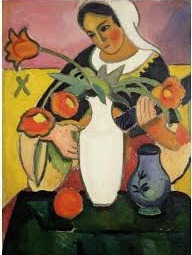
Die Lautenspielerin, August Macke, 1910
“Recent publications” is in quotes because all of the great opportunities to preach the gospel of Marc lately have come to me strictly through the generosity of other people, so I will quickly get to the point of thanking Trang Vu Thuy and the curatorial staff at the Lenbachhaus and Janine Arnold of Notes About Art. (Please click through the links to view the articles themselves.)
My post (which is present entirely owing to the patience of Vu Thuy) “Ein Manifest der Freundschaft” is in honor of the August Macke und Franz Marc: Eine Künstlerfreundschaft exhibition (on through 3 May 2015 in the Lenbachhaus Kunstbau) and concerns one of my favorite subjects, the Paradies mural.
“Von »Köstlichen Figürchen« und »Wunderherlichen Farben«” by assistant curator Monika Bayer-Wermuth is actually the most wonderful post, though, on the gifts sent by the Marcs to the Mackes and is told in the same thoughtful, personal vein as are many of the chapters in the companion catalogue.
Thanks to the generous invitation of Arnold, I have two entries on her Notes About Art website, one called “Confrontations & Reconciliations” about my interpretation of Franz Marc’s gift of the painting Blaues Pferdchen, Kinderbild to August Macke and the other a bit about the history of Marc’s two Turm der blauen Pferde.
I am very happy to see art historians collaborating across distance and language just because we like the art and want for other people to be able to know about and appreciate the work of Der Blaue Reiter. (more…)

by Jean Marie Carey | 3 Mar 2015 | Animals in Art, Art History, August Macke, Franz Marc
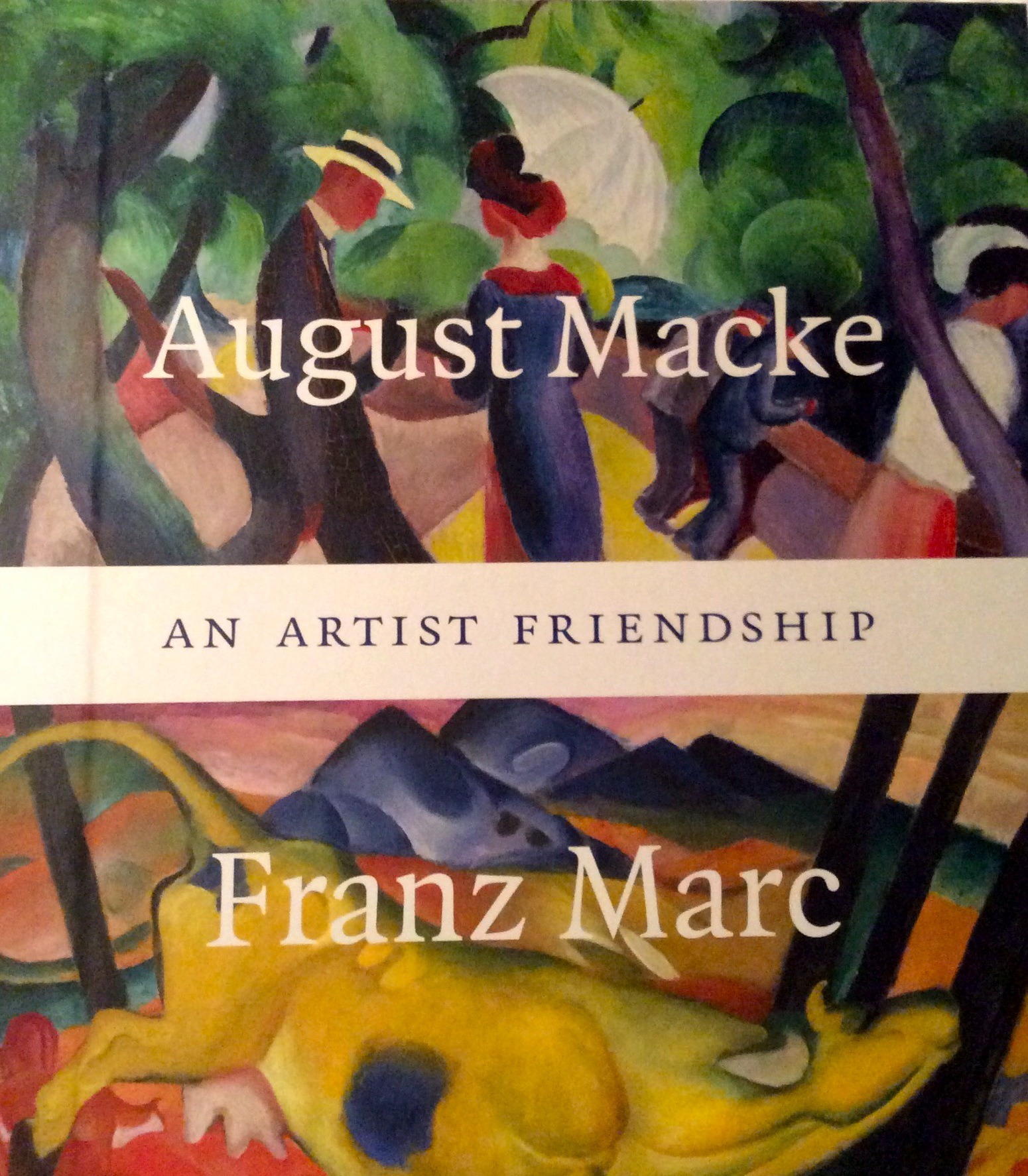
Today is the 99th anniversary of the death of Franz Marc. (Marc would have really liked someone who also died this week, Leonard Nimoy and Nimoy’s Mr. Spock character from Star Trek.) I didn’t write my normal “Franz Marc’s Birthday” post (Marc’s birthday is 8 February) this year because the idea of the grief we feel for Marc and August Macke has been much on my mind. This is partly owing to my own research, but also to do with the publication of the catalogue attendant to the Lenbachhaus’s current exhibition, August Macke und Franz Marc: eine Künstlerfreundschaft (August Macke and Franz Marc: An Artist Friendship in English).
The catalogue is, not surprisingly, a tour-de-force of editing and research by longtime Lenbachhaus Blaue Reiter curator Annegret Hoberg and Volker Adolphs of Kunstmuseum Bonn. What is unexpected is that the editors and included authors bring to bear not just a wealth of knowledge but so much compassion to these essays, confronting directly the loss and sadness we naturally feel over the too-short lives of Marc and Macke.
This is not to say the entries are not impeccably scholarly; Hoberg’s “August Macke and Franz Marc / Ideas for a Renewal of Painting” and Adolphs’ “Seeing the World and Seeing Through the World / Nature in the Work of August Macke and Franz Marc” are classic art historiography based in peerless analysis. Gregor Wedekind’s “The Masks of the Savages / Primitivism and Cultural Critique in the Work of August Macke and Franz Marc” was of particular interest to me as it underscores how the work of the avant-gardes was received in its time as a shocking departure from what the world then considered “civilized” painting. There are a few small errors marring Klara Drenker-Nagels’ otherwise illuminating discussion of the relationship between Maria Marc and Elisabeth Erdmann-Macke that I’m sure will be corrected in subsequent editions.
Of special delight in terms of the arrangement and presentation of the catalogue are some shorter, data-packed chapters on the Paradies (1912) mural and other anecdotes about Marc’s and Macke’s overlapping but very different lives.
Of course the catalogue is rich with the paintings, weavings, sketches, and photos that grace the exhibition itself. As a discrete publication, this is one that must truly be enjoyed as a book – I received it on a Friday afternoon and spent the entire weekend poring over every image, footnote, and phrase, alternately smiling and wiping away tears. Turning the last page, I was filled with admiration for this Lenbachhaus-Kunstmuseum Bonn collaboration, every word written with love.
by Jean Marie Carey | 14 Aug 2012 | Art History
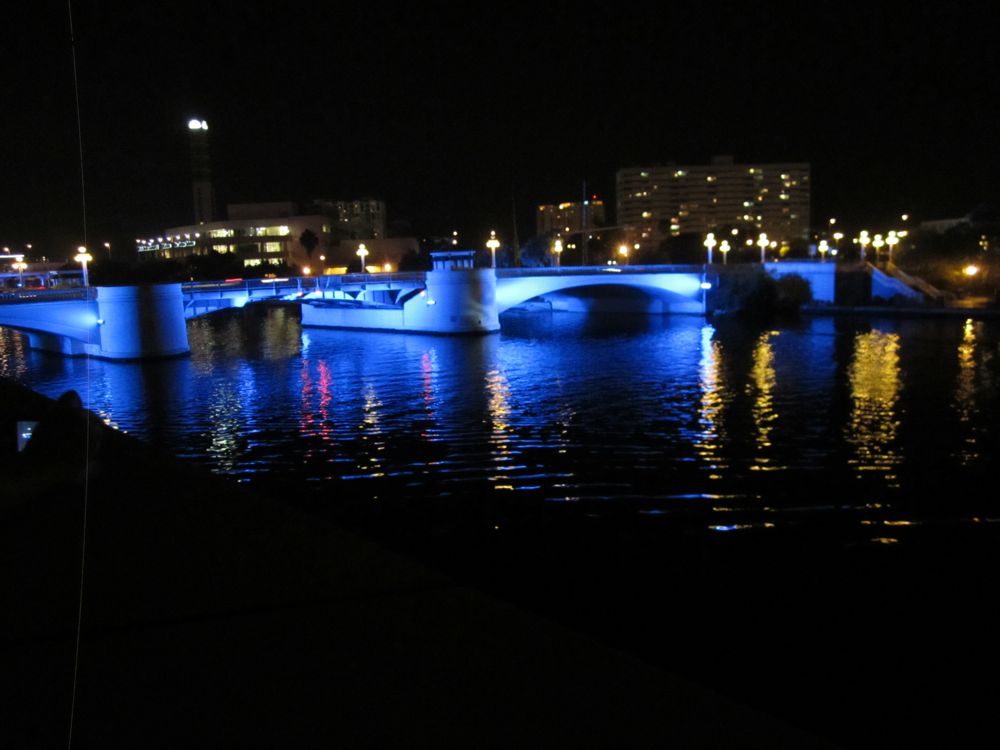
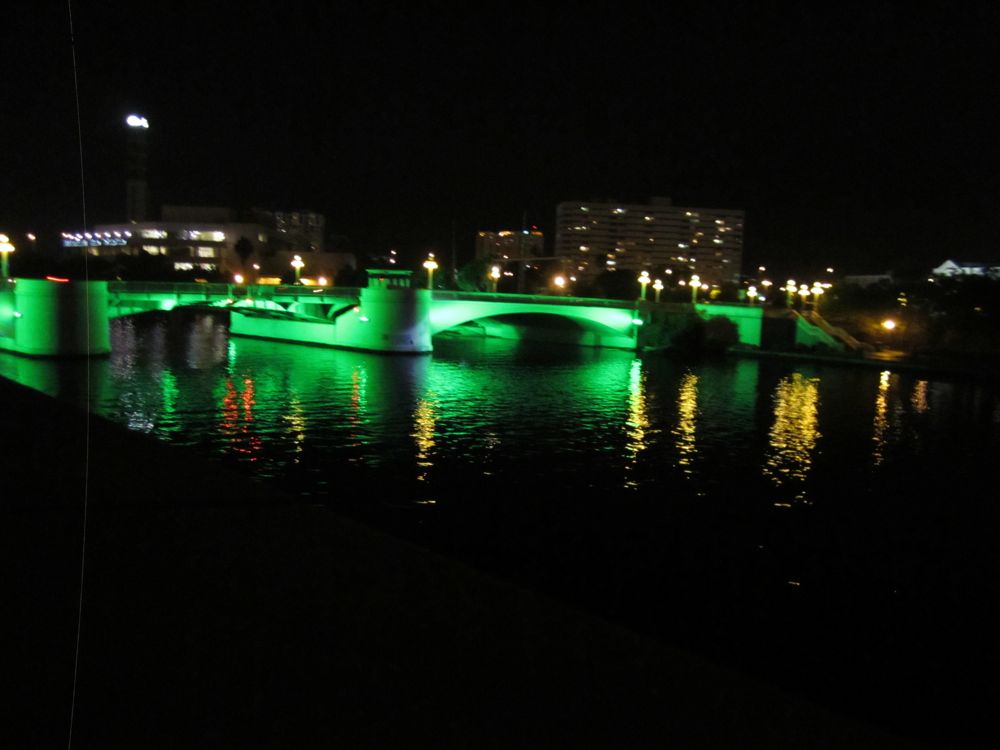
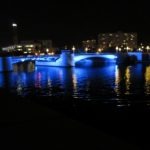
I was trying to think of the most hyperbolic way possible to describe the failure of the vague downtown Tampa “bridge lighting” from this past Friday (10 August 2012) but I can’t really think of anything that describes the underwhelmingness of the dead city this evening except that it was pretty much like any other summer, 100+ degree night downtown only with a few hipsters and scenesters. In terms of metrics I learned that 1000 people will not put in a dent in the cavernous space from the Tampa Museum of Art through Kiley Garden to Kennedy Boulevard.
The bridge lighting (the actual name of the event was “Agua Luces”) itself alternated monochrome projections, as if someone was turning one of those rotating color Christmas tree lighting wheels (I’m not explaining it very well; one of these) at an exceedingly slow speed (with about the same wattage), rhythmically, as in, with some kind of timing system, and yet not in the least hypnotically or soothingly.
It would have been more dynamic to have projected The Wizard of Oz, which was being shown in the park, onto the bridges. If someone had given a bunch of kids some laser pointers and they pointed them at the bridges, that would have been more interesting. A Mac desktop or even a Windows desktop. Someone making shadow puppets without even a real puppet, like, rabbit ears or something. Literally anything involving lights, bridges, the reflection from water, and being outside…
What do people think? What are your projection ideas?
UPDATE
Thank you for the many emailed questions and comments about this post. Please feel free to share these concerns as comments here so other people can see them.
In response to the question about the cost of Agua Luces / Bridge Lighting, I was not easily able to discover a dollar figure, though this information is posted on the lightsontampa Website with respect to the origin of the project: “Lights On Tampa is a public/private partnership between the City of Tampa’s Art Programs Division and the Public Art Alliance, a 501(c)3 organization. The Program began in 2006 with the desire to bring something bold, of high quality and “on the moment” to Tampa…” noting that the Agua Luces was originally scheduled to commence in 2006 but did not, and “The City of Tampa hopes that with continued private sector support Agua Luces will be extended to the remaining bridges in downtown by 2014. Lighting all nine bridges, as well as the Lee Roy Selmon Expressway which intersects with the Tampa Riverwalk, is a fundamental vision for the City of Tampa. Chicago-based lighting artist Tracey Dear who lit the bridges in Chicago as well as the Wrigley Building, was chosen for the installation.”
This is very telling information if you hack through it. I think “on the moment” must be one of those flack phrases (which I see sprinkled throughout that Website, along with photos of the bridges from the Tampa Club or wherever — places not even the most determined first-generation social climbers have access to let alone the public) that has a vague meaning, but seemingly by any definition, in 2012, we are no longer “on the moment” in the art world of 2006. Still you can’t fault the artist for accepting the commission although clearly there is more pedestrian traffic and people in general around the bridges in Chicago.
And it is also not surprising that “a fundamental vision” for Tampa from civic leaders is for something bland and shiny, as opposed to making the “light” rail happen, refurbishing the John Germany library a few blocks away from all the bridges, or whatever.