Foreword I was asked to write an article for the Otago German Studies journal on Germanophone Surrealism a while ago, and undertook this challenge while being aware that with a few exceptions, I do not like Surrealism. At the same time as thinking about how to...

Carnal Metamorphosis in Hannibal (2013-2015)
Foreword
I was asked to write an article for the Otago German Studies journal on Germanophone Surrealism a while ago, and undertook this challenge while being aware that with a few exceptions, I do not like Surrealism. At the same time as thinking about how to approach the article, I was rewatching Bryan Fuller’s television series Hannibal.
I remembered the program chiefly for the protagonists’ involvement with animals as direct subjects as well as a running subtext (a one-off archaeozoologist villain is even named “Mr. Tier”) in the show, and for its stunning cinematography, shot composition, and attention to detail. The rewatch revealed some further formal connections to Surrealist paintings and drawings (though I would argue against my own thesis that the nature of both this adaptation of the Thomas Harris characters and the visual style owes more to Expressionism), and, of course, the titular character is an actual psychiatrist (among other pursuits) who often paraphrases Freudian and Jungian concepts.
There was thus an opportunity to contemporize Teutonic Surrealism while drawing attention to some lesser-known artists in the genre. Owing to the difficulty in reproducing some works in private collections (and because I do not think art history articles can flourish without visuals), I decided to trim the article to concentrate on the convergence of the hybrid figures which appear in both motifs. The link to the OGS version of the article is here. What appears in this post is the full original, with images.

Introduction
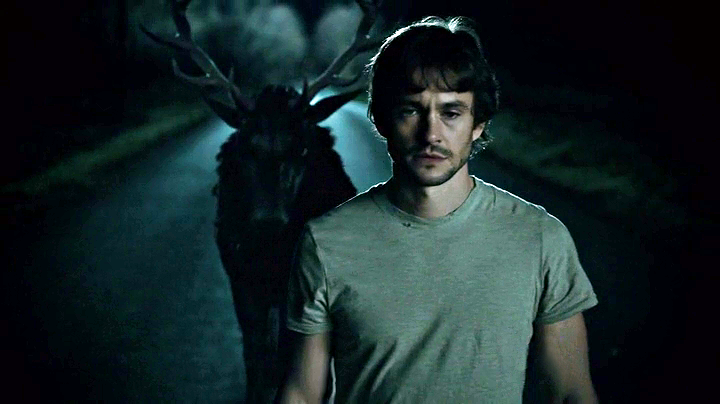
In Bryan Fuller’s Hannibal (2013–2015), animals function as psychological extensions of the characters, embodying themes of identity, power, and transformation. Will Graham’s dogs, the Wendigo, and other faunal representations serve not only as visual metaphors but as integral components of the show’s exploration of human-animal boundaries. Will’s dogs symbolize his empathy and connection to innocence, providing a counterpoint to Hannibal’s predatory influence. At the same time, the recurring raven-stag symbolizes Hannibal’s looming presence in Will’s subconscious, blurring the lines between predator and prey [Fig. 1]. These animals, both living and hallucinatory, deepen the show’s psychological landscape, transforming it into a visual narrative of fragmentation and metamorphosis.
Hannibal’s use of animals extends beyond symbolism into the realm of culinary transformation. The animals the titular antagonist serves at his carefully curated meals – lamb, bird, rabbit, and even human flesh – carry symbolic weight, as their consumption becomes a ritualistic act of dominance and transgression. These meals, with their grotesque beauty, transform food into a reflection of identity and desire, aligning the series with the visual and symbolic traditions of German surrealism.
Hannibal’s visual language draws on German surrealism’s fascination with metamorphosis and the unconscious, themes explored by artists such as Max Ernst, Unica Zürn, and Meret Oppenheim. Fuller’s visual strategy around animals, as symbolic entities, pets, predators, and as food, echoes the surrealist technique of merging reality with dream-like imagery to unsettle and transform. The visual presentation of meals, with their grotesque beauty, evokes Oppenheim’s Le Déjeuner en fourrure, where the demarcation between function, consumption, and identity collapse [Fig. 2]. These motifs, rendered in Hannibal’s elaborate cooking scenes and the recurring raven-stag Wendigo, serve to explore psychological fragmentation, much like the hybrid creatures in Ernst’s paintings or the disquieting distortions in Zürn’s automatic drawings1.

This study explores how Hannibal engages with German surrealist traditions by using animal “main characters” as both visual symbols and culinary metaphors. Through comparative analysis, I demonstrate how Fuller’s mise-en-scène effectively uses animals and food to philosophically reflect on the nature of power, desire, and transformation. The ambitious television series – surprisingly broadcast on NBC in the United States within the editorial constraints of a conventional public commercial network – bridges aesthetic traditions of German surrealism with contemporary themes of psychological and physical consumption, positioning Hannibal as a continuation of Modernism’s preoccupation with the expression of the unconscious2.
Hannibal is a psychological horror television series developed by American screen writer Bryan Fuller (1969-), which aired from 2013 to 2015. The series is based on the characters and events from Thomas Harris’s novels, particularly Red Dragon (1981) and Hannibal (1999), both of which explore the mind of the iconic fictional psychiatrist and cannibal, Dr. Hannibal Lecter. Lecter first appeared in Harris’s 1981 novel, but it was the 1991 film adaptation of The Silence of the Lambs (1988) that catapulted the character into the public consciousness, with Anthony Hopkins’ portrayal of Lecter becoming a cultural touchstone. Fuller’s project, however, takes a markedly different approach to the characters, with Mads Mikkelsen’s Hannibal Lecter and Hugh Dancy’s Will Graham offering nuanced, emotionally complex performances that depart from their previous iterations. Mikkelsen’s portrayal, in particular, trades Hopkins’ overtly menacing Lecter for a more restrained, elegant predator whose sophistication and calm demeanor mask his malevolent nature. Likewise, Dancy’s interpretation of FBI profiler and investigator Will Graham delves more deeply into the character’s mental fragility and empathic abilities, enhancing the tension between Will and Hannibal3. Fuller’s television program therefore not only explores the spark of connection between the two but also layers it with a visually rich, often surreal aesthetic that draws from the artistic and philosophical traditions of German surrealism, embedding the show within a cultural and artistic lineage far from the sight of pop culture memes.
German Surrealism and Psychoanalysis
German surrealism, though often overshadowed by its French counterpart, established a distinct visual and intellectual tradition rooted in the unique intellectual landscape of Germany, Switzerland, and Austria. While André Breton’s Surrealist Manifesto (1924) provided the formal framework for the movement, the Germanic iteration was heavily shaped by its inheritance from Romanticism and the psychoanalytic theories of Sigmund Freud and Carl Jung. This fusion of Romanticism’s interest in nature and its relationship to interior states of perception allowed German surrealists to explore the unconscious through complex symbols, often involving metamorphic animals and hybrid creatures4.
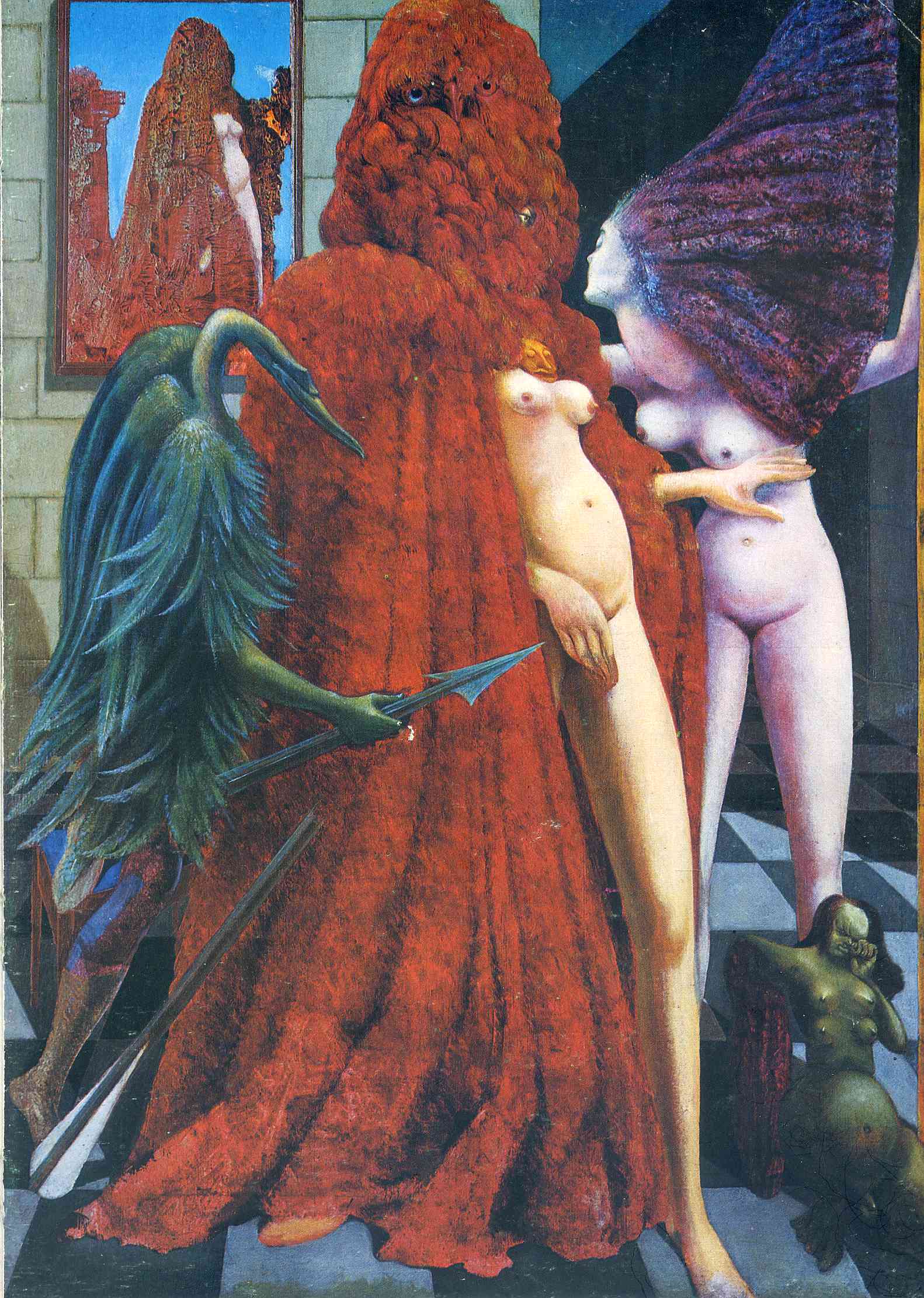
The painter Max Ernst (1891–1976) remains in general one of the most prominent figures of surrealism. His works frequently engage with birds as avatars of freedom, transformation, and the unquiet mind – a notable divergence from the popular association of Ernst with the horse, which is more superficial to his oeuvre. Ernst’s recurring use of bird imagery, particularly in La Toilette de la mariée, (1940) [Fig. 3], establishes the animal as a totem of psychological and spiritual metamorphosis5. The bird, often shown in anthropomorphic form, aligns with surrealism’s interest in blurring boundaries between human and animal, dream and reality. This avian symbolism finds clear resonance in Hannibal. Birds appear in several episodes as distinctive motifs. For example, in “Sakizuki” (2×02), one of Hannibal’s victims is found inside a preserved human mural, with birds circling overhead. The birds represent freedom and escape, contrasting with the human subjects who are immobilized by death.
The most iconic animal motif in Hannibal is the raven-stag, which appears repeatedly in Will Graham’s dreams and hallucinations. It symbolizes his connection to Hannibal Lecter, representing both Hannibal’s predatory nature and Will’s growing entanglement with Hannibal’s psyche. This Wendigo creature appears in many episodes over the show’s three-season run, notably in Season 1’s “Savoureux” (1×13) and Season 2’s “Kaiseki” (2×01). It is an apt surrealist metaphor for Will’s shifting identity under Hannibal’s influence (though, in a reflection of his very name, Will is ultimately able to resist Hannibal’s allure, though at great personal cost)6.
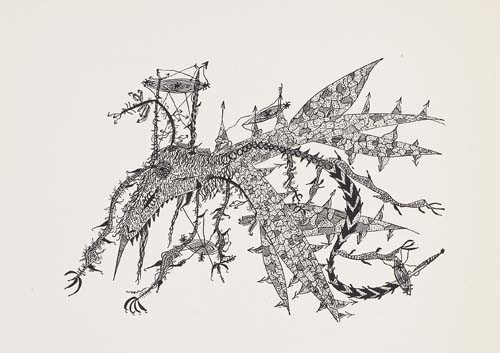
Unica Zürn (1916–1970), who remains under-explored in many studies of surrealism, offers a compelling parallel to the psychological fragmentation and bodily distortion seen in Hannibal7. Her automatic drawings and anagrams, deeply entwined with her struggles with mental illness, frequently present fragmented human and animal figures. Zürn’s series of drawings and anagrams Hexentexte (1954) [Fig. 4] offers a visual language where metamorphosis is not simply a theme but a method, reflecting her tactics for addressing the deep dislocations she experienced8. Zürn’s photographic collaboration with Hans Bellmer (1902-1975) in Les Jeux de la Poupée (1950s) extends this notion of fragmentation to the human body itself, a theme mirrored in Hannibal‘s exploration of human vulnerability and the breakdown of identity, particularly in the relationship between Hannibal and Will9. The series’ surreal dreamscapes and animal avatars – such as the raven-stag and Will’s dogs – act as symbols of these same fractures that Zürn visualized10.
Psychoanalytic theory, particularly Freud’s Totem and Taboo (1913), deeply influenced German surrealism, with animals functioning as totemic representations of repressed desires and fears11. Freud’s concept of the totemic animal as a mediator between the conscious and unconscious mind is central to Hannibal, where animals serve as both symbols and catalysts of transformation12. The raven-stag, in particular, operates as a totem for Will Graham, symbolizing his psychological entanglement with Hannibal and his descent into moral ambiguity. Likewise, Hannibal’s preparation of food, which frequently involves animal flesh, propels the act of consumption into a ritual of domination, echoing Freud’s ideas of totemic sacrifice13.
The historical grounding in Romanticism, especially the work of Novalis (1772–1801), informs these artworks’ focus on the dissolution of reality and the yearning for transcendence14. Novalis’s articulation of Sehnsucht – a deep, almost ineffable longing for the infinite – resonates in the dream-like sequences of Hannibal, where characters oscillate between the real and the surreal, their identities shifting with each encounter15. This sense of longing is particularly visible in Will, whose empathetic connection to animals, particularly his dogs, offers a momentary reprieve from the predatory world in which he finds himself enmeshed. The dogs, symbols of loyalty and innocence, stand in stark contrast to the raven-stag, illustrating the battle between Will’s humanity and his darker instincts under Hannibal’s influence.
The shift from early 20th Century Expressionism’s concern with vitality and unity to post-war surrealism’s interest in the grotesque and morbid is reflected visually in Hannibal as well. In the episode “Coquilles” (1×05), the killer selects victims based on their perceived sinfulness and simultaneously mutilates and decorates their bodies with angel-like wings extracted from their lungs. The visual imagery of snails crawling over the corpses during these apotheoses suggests a slow, methodical process of metamorphosis and decomposition. The snails visually represent both the persistence of decay and the idea of transformation, common themes in both surrealism and Hannibal. The slow-moving snails are also reminiscent of the methodical, incremental way Hannibal “nurtures” his relationships, gradually consuming their humanity.
Animals as Metaphors
Beyond the physical and emotional comfort offered by Will’s pet dogs, animals serve not only as literal representations but also as rich metaphors that illustrate the complex interplay between predator and prey. The raven-stag is a prominent symbol in Will’s psyche, representing both his deep connection to nature – he lives in an actual cabin in the woods and is often depicted wandering in the forest – and his struggle with the darker aspects of his identity. This Wendigo creature, revealed in successive episodes to be an enormous stag clothed in glossy black feathers, echoes the surrealistic elements found in German art and Märchen, where beings appearing as beasts often reveal hidden truths about the human condition16. The raven-stag embodies Will’s internal conflict, as it is both majestic and menacing, reflecting his dual nature as an empath and a hunter17.
Moreover, the culinary preparations of Hannibal Lecter often feature animals as central components, transforming them into elaborate dishes that challenge the viewer’s perception of morality and aesthetics. The act of preparing and consuming animal flesh becomes a ritualistic practice that underscores themes of domination and subversion. Hannibal’s choice of ingredients is not merely about sustenance and veiled entertainment as the arbiter of taste in every sense of the word; it is a statement on power dynamics and the consumption, and thus annihilation, of identity18. The grotesque beauty of these meals can be linked to the visual language of German surrealism, where the grotesque prompts rumination upon decay and serves to unsettle the viewer and provoke thought.
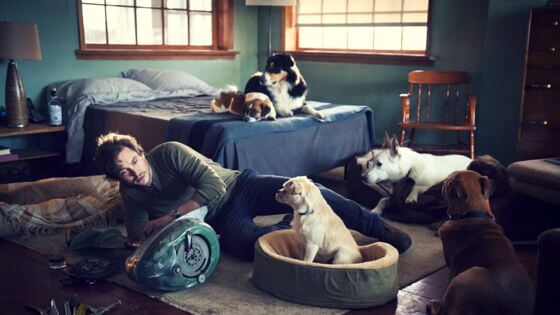
The appearance of canines in the series also warrants attention. Will’s bond with his dogs serves as a grounding force in his life, contrasting sharply with the predatory nature of Hannibal. The dogs symbolize loyalty, innocence, and the primal instincts that often clash with the sophisticated brutality of Hannibal [Fig. 5]. In this way, the dogs act as reminders of Will’s humanity amidst his increasingly complicated relationship with Hannibal. A still from Hannibal that captures Will’s dogs in a moment of repose reinforces their role as emotional anchors for Will, countering the predatory symbolism of the raven-stag. In the episode “Sorbet” (1×07), Will is shown caring for his dogs, which serves as a counterpoint to his disruptive, more disturbed interactions with Hannibal. The lighting in these scenes tends to be softer, and the dogs are framed in close, intimate compositions, emphasizing their symbolic role as Will’s connection to innocence and empathy. Paradoxically, in the episode “Shiizakana” (2×09), a literal and metaphorical connection to predatory animals is explored through the character of Randall Tier, who uses a mechanical wolf suit to carry out murders in which the victims are torn to pieces. The wolf serves as an extension of Tier’s primal instincts and aligns with Hannibal’s philosophy of valorizing one’s true predatory nature. The wolf imagery, as a symbol of raw, animalistic aggression, ties into Hannibal’s manipulation of his “patients,” encouraging them to embrace their violent, brutal selves19.
The visual and symbolic use of animals in Hannibal reaches its most complex form through the figure of the raven-stag, a recurring motif that haunts Will Graham’s visions. The raven-stag operates as a multifaceted symbol, representing both Hannibal Lecter’s pervasive influence over Will and the deeper entanglement of their predator-prey relationship. This animal avatar, part raven, part stag, suggests a hybrid creature that blends associations of death, darkness, and power (the raven) with nobility and sacrifice (the stag)20. As the series progresses, this figure becomes the visual embodiment of Will’s psychological metamorphosis as he gradually succumbs to Hannibal’s manipulation and moral ambiguity. Fuller’s careful staging and framing of the raven-stag evokes visual elements of German surrealism, particularly the hybrid creatures found in Ernst and Zürn’s works.

In Ernst’s Oedipus Rex (1922) [Fig. 6], the bird emerges as a central figure, transformed into a human-animal hybrid that symbolizes psychological conflict and unconscious desire. Ernst’s birds are not merely symbolic representations but embodiments of inner turmoil. In Hannibal, the raven-stag operates similarly, existing simultaneously as a hallucination and as an externalization of Will’s growing identification with Hannibal. Both figures embody the see-saw between freedom and entrapment, self and other, predator and prey, a tension crucial to the psychological dynamics of the series. Fuller’s visual language, particularly in scenes where the raven-stag appears in shadow or silhouette, echoes the formal properties of Ernst’s paintings, which use light and shadow to amplify the eerie, otherworldly quality of the hybrid figure. A still from Hannibal showing the raven-stag in its fully realized form highlights the careful use of lighting, with the creature often appearing in dark, dreamlike spaces that emphasize its otherworldly presence. This visual treatment recalls Ernst’s hybrid creatures, whose forms often appear suspended between realities, much like the raven-stag in Will’s subconscious.
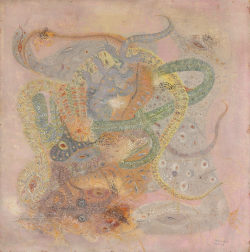
The role of Unica Zürn’s fragmented creatures in her automatic drawings, such as La Serpenta (1957) [Fig. 7], is also reflected in the raven-stag’s symbolism. Zürn’s works, characterized by their disjointed forms and combinations of human and animal features, evoke a sense of distorted, untrustworthy sensory perception and identity dissolution, much like Will Graham’s mental state as he grapples with his connection to Hannibal21. What has in our time become a near-taboo subject itself – the violence associated with extreme mental illness – was not off limits for these surrealist artists, nor in Hannibal. In “Takiawase” (2×04), a murder victim is placed inside a bear suit, linking the killer’s psychological need for empathy and protection with a monstrous exterior. The bear, symbolizing both strength and ferocity in the German tradition – it is the longtime totemic animal of Berlin – here becomes a mask for vulnerability, a frequent theme in Hannibal, where human and animal traits are interchanged to express psychological conflict.
Psychological Symbolism
The psychological dimensions of Hannibal draw heavily on surrealist principles, particularly the exploration of the unconscious mind and the symbolic representations of inner turmoil. The series employs visual motifs that challenge viewers to understand what they are seeing, and whether sight is a good indicator of reality. This dream-like quality serves to emphasize the instability of identity and the fluidity of human experience, mirroring the psychological theories of Freud and Jung22.

Freud’s concepts of the unconscious and dream interpretation resonate throughout Hannibal, not the least of which through Hannibal’s ostensible therapeutic practice as an actual psychiatrist who often speaks, albeit with an overt air of facetiousness, in diagnostic terminology. However, it is the depictions of Will’s hallucinations and dreams as windows into his psyche, revealing the conflict between his moral compass and his darker urges, that resonate more closely with Jungian practices23. The raven-stag, as a recurring motif, symbolizes the fractured nature of Will’s identity – caught between his empathetic tendencies and the influence of Hannibal, who represents a more primal, predatory aspect of existence. Hannibal’s elaborate visual aesthetic, characterized by rich colors and disturbing imagery, exemplifies the psychological symbolism within the series. As a mentor and predator, Hannibal manipulates Will’s vulnerabilities, drawing him deeper into a world of moral ambiguity. This relationship serves as a microcosm of the struggle between civilization and primal instincts, echoing the themes prevalent in surrealist art, where the unconscious mind often battles with societal norms.
Ritualized Consumption: Food, Animals, and Transfiguration
In Hannibal, the preparation and consumption of food is elevated to the sacramental – it is ritual, ceremony, and a bodily process of transfiguration. Hannibal’s carefully prepared meals, often involving animal flesh, blend the grotesque with the sublime, much like surrealist art, where objects and organic materials are repurposed to unsettle, provoke, and evoke the unconscious. The highly controlled tableaux of these meals reflect deeper themes about identity, power, and transgression, aligning with the surrealist tradition’s fascination with the collapse of boundaries between human and animal, predator and prey, and ultimately between reality and fantasy24.
In Meret Oppenheim’s Le Déjeuner en fourrure (1936) [Fig. 2], a teacup covered in fur transforms an everyday object into something uncanny, evoking both sensuality and revulsion. The surreal fusion of domesticity and animality in this small sculptural tabletop object finds its parallel in Hannibal’s meals, where the consumption of animal flesh, often artfully disguised, becomes a reflection of both physical and psychological domination. Hannibal’s presentation of these meals operates as an aesthetic statement as much as a philosophical one, reflecting the tension between beauty and horror that characterizes surrealism.
A close-up showing one of Hannibal’s elaborately presented meals echoes this surreal/ist approach. The food is displayed with the same care and attention as a canonical work of art, but the knowledge that human flesh may be involved imbues it with a sense of the forbidden, and of disquiet. Like Oppenheim’s transformation of the teacup, Hannibal’s meals challenge the viewer’s perception of boundaries and propriety25.
The animal flesh served at Hannibal’s table also resonates with Freudian psychoanalysis, particularly the concept of the totemic meal, as discussed in Totem and Taboo (1913). Freud’s totemic theory posits that primitive communities would consume the totem animal in a ritual of identification and internalization, blurring the lines between the eater and the consumed. This ritualistic consumption is central to Hannibal’s philosophy, where the line between consumer and consumed is deliberately collapsed.
In Ernst’s The Barbarians (1937) [Fig. 8], the figures of two monstrous hybrid creatures suggest both predation and ritual, embodying the tension between domination and submission. The grotesque yet majestic figures in the painting mirror Hannibal’s approach to food, where the act of consumption is transformed into a performative ritual of power. Fuller’s visual treatment of these meals, with their slow-motion shots and meticulous close-ups, reinforces their ritualistic nature, aligning them with the symbolic and unsettling aesthetic of surrealism.
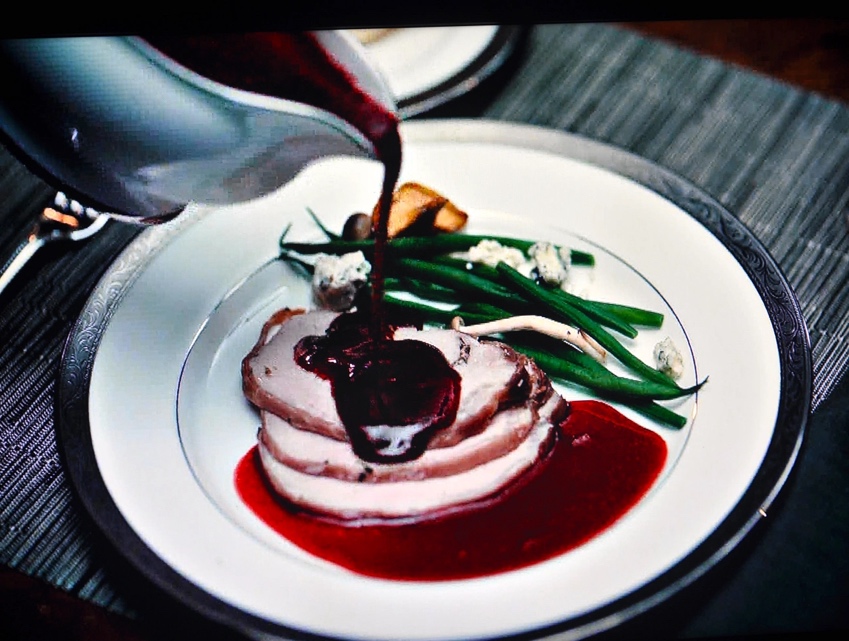
Hannibal’s presentation of food also reflects Surrealist art’s engagement with materiality. The food itself, often depicted in extreme close-up, highlights its texture, form, and color in a manner that recalls Oppenheim’s tactile, fur-covered objects. In a key scene from “Sorbet” (1×07) [Fig. 9], a dish of finely arranged meat, glistening with sauce, invites both desire and revulsion, much like Oppenheim’s fur-covered cup challenges the viewer’s sensory expectations. In both cases, the transformation of the object (whether food or a teacup) disrupts conventional associations, encouraging the viewer to confront their own preconceptions about consumption, pleasure, and transgression.
Hannibal often serves animal flesh alongside human flesh, leaving his guests – and the audience – unsure of what they are consuming, which also provides for a further examination of the postmodern concern regarding the questionable beneficence of the host as gift-giver26. Hannibal transforms his gastronomy into an art form that is as visually stunning as it is psychologically complex. Each meal meticulously prepared serves as a canvas for exploring themes of control, bodily violation, and intrusion into the psyche of Hannibal’s guests.
In the spirit of those that seek to disrupt the ordinary, the work of Richard Oelze (1900-1980), known for his hauntingly detailed paintings that evoke a sense of dread and melancholy, can provide a relevant comparison. Oelze’s Expectation (1936) depicts figures in a degraded landscape, their faces obscured, creating a sense of unease – a similar sensation occurs when Hannibal presents his dishes, which, while beautiful, hide a darker truth beneath their surfaces.
This aspect of Hannibal’s interactions mimics the surrealist approach to everyday objects, transforming them into something unfamiliar and disturbing. The culinary presentations in Hannibal challenge the diners’ ethical and aesthetic boundaries, compelling them to confront their own complicity in the macabre ritual unfolding before them27. Each meal crafted is not merely a dish but a statement on the nature of the human condition, reflecting the series’ broader narrative exploration into the darkness that lies beneath the façade of civility.
Surrealism, Metamorphosis, and Identity: Broader Themes
In Hannibal, surrealism is not merely an aesthetic choice but a framework through which the series articulates complex themes of identity, transformation, and the unconscious. This adaptation of the familiar characters recontextualizes the surrealist movement within a contemporary setting, employing its core themes to explore the psychological landscapes of its main characters.
The series intricately weaves elements reminiscent of German Surrealists such as Hans Bellmer and Kurt Seligmann, using their immediately recognizable styles to deepen the narrative’s exploration of psychological and corporeal fragmentation. Bellmer’s art, particularly his series La Poupée (1935), with its grotesquely disarticulated and reconfigured life-size dolls, echoes through the meticulously staged tableaux of human bodies that Lecter crafts28.

These scenes serve not merely as visual shock but as profound inquiries into the nature of humanity and monstrosity, challenging the viewers’ discomfort with the uncanny and the abject.
Kurt Seligmann’s (1900-1962) lesser-known but equally potent work, such as Evocation (1955) [Fig. 10], offers a panorama filled with arcane symbols and mythical creatures, mirroring Hannibal’s frequent use of haunting, dream-like sequences where reality and hallucination blur29. These elements are strategically employed to visualize Will Graham’s disintegrating psyche and his perilous flirtation with his own dark urges, orchestrated under Lecter’s manipulative presence.
The series’ approach to these transformations is reflective of surrealist objectives – dislocating the familiar to reveal the layers beneath. The uncanny is a regular motif, achieved not through mere gore, but through a sophisticated layering of narrative and character development that challenges the viewer’s perception of the protagonists as either heroes or villains.
The exploration of identity and metamorphosis in Hannibal extends beyond the immediate psychological entanglement between Hannibal Lecter and Will Graham. The series uses animal avatars, food, and surreal imagery to probe deeper questions about the nature of identity, blurring the lines between human and animal, predator and prey, self and other. This fluidity, central to both the visual and thematic elements of the show, resonates with the broader concerns of German surrealism, which sought to challenge fixed notions of identity and reality.
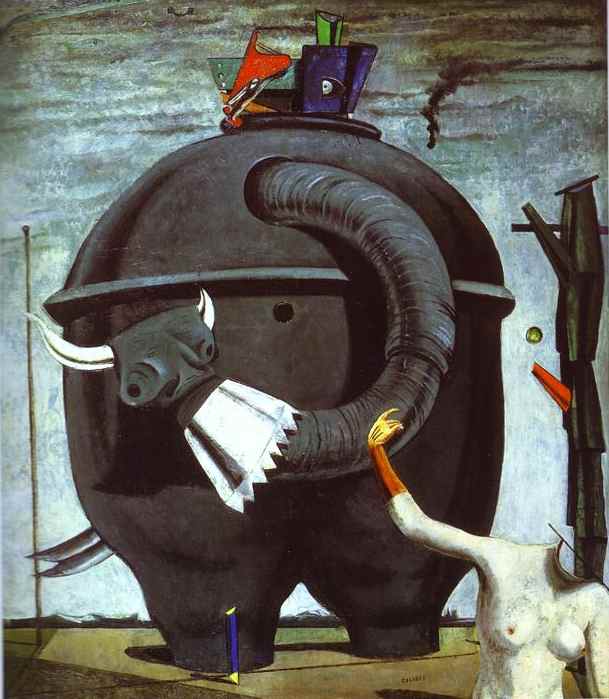
Ernst’s paintings often explore the theme of metamorphosis, particularly through hybrid creatures that exist in liminal states between different forms. In The Elephant Celebes (1921) [Fig. 11 above], for example, Ernst presents a surreal fusion of machinery and elephant, creating a monstrous, hybrid figure that seems to be caught in the process of becoming as a mutilated human figure bears sightless witness. The creature’s unsettling presence – neither fully machine nor animal – mirrors the fluid identities in Hannibal, particularly the psychological metamorphosis of Will Graham as he navigates his shifting roles as investigator, predator, and prey.
A scene from “Mizumono” (2×13), [Fig. 12 above] depicts Will in the midst of one of his hallucinations, where his body appears to dissolve and merge with the raven-stag. This visual metaphor for metamorphosis parallels Ernst’s surreal approach to hybrid forms, where transformation is both psychological and physical, reflecting the characters’ evolving identities. The imagery in Hannibal uses the same surrealist techniques of juxtaposition and distortion to destabilize the viewer’s perception of reality, much like Ernst’s paintings.
Unica Zürn’s interest in bodily fragmentation and transformation is also key to appreciating the themes of metamorphosis in Hannibal. In works such as the Untitled (Metamorphic Figures) (1961) that appear in her sketchbook-diary, Zürn creates disjointed forms that, like Fuller’s visual storytelling, reflects the idea that identity is not fixed but is continually shifting, often in unsettling and disorienting ways.
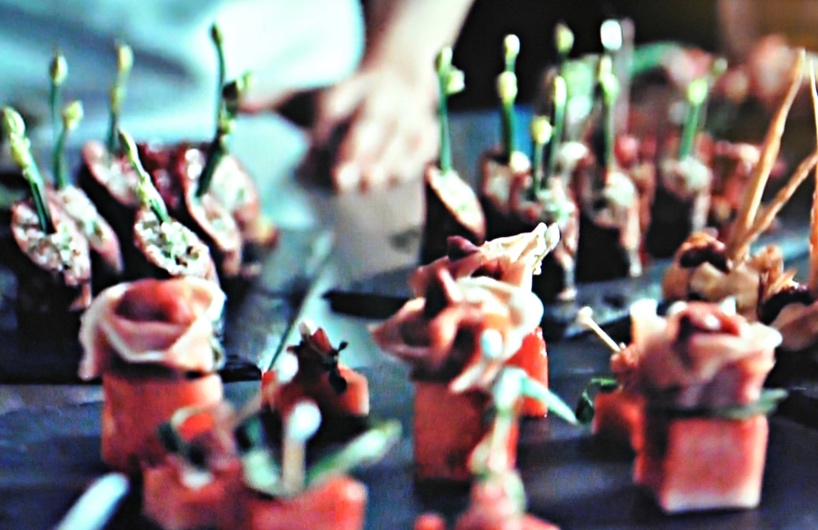
This concept of perpetual metamorphosis is further reinforced in Hannibal through the recurring theme of food as transformation. Hannibal’s meals, which often feature animal flesh artfully disguised as something else, symbolize the fluidity of identity and the collapse of boundaries. In a scene from the episode “Futamono” (2×06) [Fig. 13], Hannibal prepares a dish that resembles a delicately sprouting botanical arrangement, but the viewer is left to wonder whether the meal contains human or animal ingredients. This blurring of distinctions between food sources parallels the broader theme of identity dissolution in the series, where characters themselves become metaphors for consumption, transformation, and predation30.
The surrealist notion of metamorphosis is not limited to the physical transformation of bodies; it extends to the transformation of reality itself. In Hannibal, reality is constantly shifting, often blending with dream and hallucination in ways that challenge the viewer’s perception of what is real. This surreal blurring of boundaries between the conscious and unconscious is central to the show’s aesthetic. Scenes such as Will’s hallucinations of the raven-stag, or his vision of himself becoming a predator, illustrate the fluidity of identity and the instability of reality – both key concerns of German surrealism.
Conclusion
Hannibal serves as a modern exploration of German surrealism, utilizing animals as multifaceted symbols that reflect the complexities of human identity and desire. The series intricately weaves together elements of psychological symbolism, Animalisierung, culinary art, and surrealistic imagery to challenge the viewer’s understanding of morality and the nature of existence31.
Since despite its highly original vision Hannibal has been excoriated for its aestheticization of violence and thus has been little seen (and indeed was cancelled before Fuller could complete his intended narrative arc), it is thus helpful to view this criticism through the lens of Surrealist art, which often embraced shocking and transgressive material to jolt viewers into a new understanding of reality32. The series, much like the artworks of Ernst and Oppenheim, uses its medium to force a confrontation with the disturbing aspects of the human psyche, challenging viewers to reconsider their perceptions of beauty, horror, male friendship, and morality.
Hannibal does not simply use Surrealist techniques for visual engagement but integrates them into the very structure of its storytelling. By doing so, it offers a complex critique of identity, morality, and what constitutes “humanity,” making a significant contribution to the landscape of contemporary media, and, as Hal Foster predicted in “Who’s Afraid of the Neo-Avant-Garde,” allowing the namesake artistic movements of the 20th Century to have a vibrant continuance in the 21st33. It invites viewers to delve into a psychological labyrinth, much like that which surrealism sought to explore, making the series a modern continuation of the movement’s exploration of the dark recesses of the human mind.
The raven-stag, as a central motif, encapsulates Will Graham’s internal struggle and transformation, while Hannibal’s culinary creations serve as reminders of the grotesque beauty that can arise from the act of consumption. This intricate interplay of visual and psychological elements positions Hannibal as a significant continuation of Surrealist exploration, inviting audiences to reflect on the boundaries of identity, morality, and the primal instincts that drive us all.
Notes
- Alberto N. García, “‘Tell Me, What Are You Becoming?’ Hannibal and the Inescapable Presence of the Grotesque,” Horror Studies 11, no. 1 (2020): 55–71, https://doi.org/10.1386/host_00012_1. ↩
- Reinhard Knöbl, Filmische Avantgarde: Surrealismus und Film in Deutschland und Europa (Weimar: VDG Verlag, 2020). ↩
- Cathy Caruth, Unclaimed Experience: Trauma, Narrative and History. (Baltimore: Johns Hopkins University Press, 1996). https://dx.doi.org/10.1353/book.20656. ↩
- Peter Fischer, Surrealismus in Deutschland 1925–1950: Verborgene Bilder, Ungehörte Töne, Entdeckte Räume (Berlin: Reimer Verlag, 2017). ↩
- Werner Spies, ed., Max Ernst: Retrospektive (Ostfildern: Hatje Cantz, 1996). ↩
- Matthias Vogt, Unbewusste Kräfte: Psychoanalyse, Kunst und das Tier in der Moderne (Berlin: De Gruyter, 2017). ↩
- Kirsten Strom, “Unica Zürn’s Poetics of Madness: Surrealist Authorship, Automatic Writing, and the Unconscious,” Dada/Surrealism 21 (2017): 43–58. https://doi.org/10.17077/0084-9537.1337. ↩
- Andreas Neufert, “The Black Sun of Melancholia: Unica Zürn’s Art and Mental Illness,” Journal of Surrealism and the Americas 10, no. 1 (2016): 27–46. ↩
- Martina Huber, “The Fragmented Body in Unica Zürn’s Hexentexte,” The German Quarterly 85, no. 1 (2012): 36–51. ↩
- Fischer, Surrealismus in Deutschland, 2017. ↩
- Sigmund Freud, Totem und Tabu (Frankfurt: Fischer Verlag, 1913). ↩
- Dan Mills, “Beastly Disruptions: Surrealism, Animals, and Psychoanalysis,” Journal of European Psychoanalysis 22, no. 3 (2015): 87–101. ↩
- Hans Gerber, “Surrealism and Psychoanalysis: An Intersection of Minds,” Art History Today 45, no. 2 (2020): 200-215. ↩
- Novalis, The Disciples at Sais and Other Fragments, trans. F. V. M. Harper (London: Forgotten Books, 1920). ↩
- Frederick C. Beiser, The Romantic Imperative: The Concept of Early German Romanticism (Cambridge: Harvard University Press, 2003). ↩
- Jacob Grimm and Wilhelm Grimm, Deutsche Mythologie (Frankfurt: Insel Verlag, 2000). ↩
- Gernot Böhme, Der Stag als Urbild: Zur Symbolik des Tieres in Mythos und Moderne (Munich: Wilhelm Fink Verlag, 2021). ↩
- Steven M. Wasserstrom, “Surrealism and the Occult: Shamanism, Magic, Alchemy, and the Birth of an Artistic Movement,” Critical Inquiry 21, no. 4 (1995): 738-775. ↩
- Pauline Tedesco, “Surrealism and Psychoanalysis in Postwar German Film,” Film Criticism 41, no. 1 (2020): 55–75. ↩
- Martha J. Smith, “The Symbolism of the Raven in Modern Narrative,” Journal of Modern Mythology 45, no. 2 (2018): 156-162. ↩
- Carrie Asman, “Unica Zürn: The Aesthetics of Fragmentation,” Studies in 20th & 21st Century Literature 36, no. 1 (2012): 51–72. https://doi.org/10.4148/2334-4415.1776. ↩
- Carl G. Jung, Man and His Symbols (New York: Dell Publishing, 1964). ↩
- Alexander Hoch, Psychoanalyse im deutschen Film: Vom Expressionismus zum Surrealismus (Bielefeld: Transcript Verlag, 2019). ↩
- See also: Georges Bataille, The Accursed Share: An Essay on General Economy, trans. Robert Hurley (New York: Zone Books, 1988) and Erotism: Death and Sensuality, trans. Mary Dalwood (San Francisco: City Lights Books, 1986). ↩
- Dagmar Lorenz, Die verspiegelte Wirklichkeit: Psychoanalyse, Literatur und bildende Kunst in der Moderne (Würzburg: Königshausen & Neumann, 2015). ↩
- See: Jacques Derrida, Of Hospitality, trans. Rachel Bowlby (Stanford: Stanford University Press, 2000). ↩
- Jonathan Kellerman, “Culinary Symbolism in Contemporary Media,” Cultural Gastronomy Review 17, no. 1 (2019): 58-76. ↩
- Therese Lichtenstein, Behind Closed Doors: The Art of Hans Bellmer (Berkeley: University of California Press, 2001). ↩
- Stephen Robeson Miller and Barbara Braun, Kurt Seligmann: First Message from the Spirit World of the Object (New York: The Swiss Institute, 2010). ↩
- Leslie S. Klinger, “The Psychological Complexity of Hannibal Lecter,” Journal of Film and Television 29, no. 3 (2021): 112-127. ↩
- See: Jean Marie Carey, How Franz Marc Returns (PhD diss., University of Otago Department of German, 2017). ↩
- Caryn James, “Hannibal: Too Grotesque or a Work of Art?” BBC Culture, June 12, 2015, https://www.bbc.com/culture/article/20150612-hannibal-tv-too-grotesque-or-art. ↩
- Hal Foster, The Return of the Real: The Avant-Garde at the End of the Century. (Cambridge, Mass.: MIT Press. 1996). ↩
Bibliography
Asman, Carrie, “Unica Zürn: The Aesthetics of Fragmentation,” Studies in 20th & 21st Century Literature 36, no. 1 (2012): 51–72. https://doi.org/10.4148/2334-4415.1776.
Assmann, Jan. Das kulturelle Gedächtnis: Schrift, Erinnerung und politische Identität in frühen Hochkulturen. Munich: C.H. Beck, 2018.
Bächtold-Stäubli, Hanns, ed. Handwörterbuch des deutschen Aberglaubens. Berlin: Walter de Gruyter, 1927–1942.
Beiser, Frederick C. The Romantic Imperative: The Concept of Early German Romanticism. Cambridge: Harvard University Press, 2003.
Biedermann, Hans. Dictionary of Symbolism: Cultural Icons and the Meanings Behind Them. New York: Penguin Books, 1996.
Blumenberg, Hans. Arbeit am Mythos. Frankfurt: Suhrkamp, 2015.
Böhme, Gernot. Der Stag als Urbild: Zur Symbolik des Tieres in Mythos und Moderne. Munich: Wilhelm Fink Verlag, 2021.
Carey, Jean Marie. How Franz Marc Returns. PhD diss., University of Otago Department of German, 2017.
Caruth, Cathy. Unclaimed Experience: Trauma, Narrative and History. Baltimore: Johns Hopkins University Press, 1996. https://dx.doi.org/10.1353/book.20656.
Derrida, Jacques. Of Hospitality. Translated by Rachel Bowlby. Stanford: Stanford University Press, 2000.
Eliade, Mircea. The Myth of the Eternal Return: Cosmos and History. Princeton: Princeton University Press, 1954.
Freud, Sigmund. Totem und Tabu. Frankfurt: Fischer Verlag, 1913.
Fischer, Peter. Surrealismus in Deutschland 1925–1950: Verborgene Bilder, Ungehörte Töne, Entdeckte Räume. Berlin: Reimer Verlag, 2017.
Foster, Hal. The Return of the Real: The Avant-Garde at the End of the Century. Cambridge, Mass.: MIT Press, 1996.
Frosh, Stephen. “Psychoanalysis, Colonialism, and Modern German Cinema: Surrealism, Otherness, and the Visual Gaze.” German Studies Review 42, no. 2 (2019): 245–260.
García, Alberto N. “‘Tell me, what are you becoming?’ Hannibal and the Inescapable Presence of the Grotesque.” Horror Studies 11, no. 1 (2020): 55–71. https://doi.org/10.1386/host_00012_1.
Grimm, Jacob, and Wilhelm Grimm. Deutsche Mythologie. Frankfurt: Insel Verlag, 2000.
Hoch, Alexander. Psychoanalyse im deutschen Film: Vom Expressionismus zum Surrealismus. Bielefeld: Transcript Verlag, 2019.
Hofmann, Werner. Die Geburt der Moderne: Kunstgeschichte als Interpretation. Munich: Carl Hanser Verlag, 1984.
James, Caryn. “Hannibal: Too Grotesque or a Work of Art?” BBC Culture, June 12, 2015. https://www.bbc.com/culture/article/20150612-hannibal-tv-too-grotesque-or-art.
Jung, Carl G. Man and His Symbols. New York: Dell Publishing, 1964.
Knöbl, Reinhard. Filmische Avantgarde: Surrealismus und Film in Deutschland und Europa. Weimar: VDG Verlag, 2020.
Köhn, Eckart. Das Surreale und das Politische im deutschen Surrealismus: Zwischen Avantgarde und Sozialkritik. Berlin: De Gruyter, 2020.
Lorenz, Dagmar. Die verspiegelte Wirklichkeit: Psychoanalyse, Literatur und bildende Kunst in der Moderne. Würzburg: Königshausen & Neumann, 2015.
Meyer, Klaus. Surrealismus in der deutschen Literatur: Themen und Motive einer epochalen Bewegung. Frankfurt: Peter Lang, 2003.
Mills, Dan. “Beastly Disruptions: Surrealism, Animals, and Psychoanalysis.” Journal of European Psychoanalysis 22, no. 3 (2015): 87–101.
Novalis. The Disciples at Sais and Other Fragments. Translated by F. V. M. Harper. London: Forgotten Books, 1920.
Rittler, Tobias. Tierische Metaphern: Zur Funktion von Tieren als Symbolträger in der Literatur der Moderne. Würzburg: Königshausen & Neumann, 2020.
Seel, Martin. Die Kunst der Entzweiung: Zum Begriff des Ästhetischen. Frankfurt: Suhrkamp, 2018.
Spies, Werner, ed. Max Ernst: Retrospektive. Ostfildern: Hatje Cantz, 1996.
Tedesco, Pauline. “Surrealism and Psychoanalysis in Postwar German Film.” Film Criticism 41, no. 1 (2020): 55–75.
Ullrich, Wolfgang. Tier und Mensch: Eine Kulturgeschichte. Munich: C.H. Beck, 2018.
Vogt, Matthias. Unbewusste Kräfte: Psychoanalyse, Kunst und das Tier in der Moderne. Berlin: De Gruyter, 2017.
Weidner, Daniel. Das Tier in der Kunst der Moderne: Reflexionen zwischen Mythos und Psychoanalyse. Göttingen: Wallstein Verlag, 2019.
Weis, Elisabeth. “The Surrealist Landscape in Contemporary German Cinema.” Journal of Film and Visual Culture 52, no. 1 (2022): 81–100.
List of Images
Figure 1: Still from Hannibal, Episode “Savoureux” (airdate June 20, 2013), NBC Universal, directed by Michael Rymer.
Figure 2: Meret Oppenheim, Le Déjeuner en fourrure (1936), fur-covered cup, saucer, and spoon, cup: 10.9 cm in diameter, saucer: 23.7 cm in diameter, spoon: 20.2 cm long, overall height: 7.3 cm, Museum of Modern Art, New York, Number 130.1946.a-c, © 2024 Artists Rights Society (ARS), New York / Pro Litteris, Zurich.
Figure 3: Max Ernst, La Toilette de la mariée, 1940, oil on canvas, 129.6 x 96.3 cm, Peggy Guggenheim Collection, Venice. 76.2553 PG 78, © 2024 Artists Rights Society (ARS), New York / ADAGP, Paris
Figure 4: Unica Zürn, “The Trumpets of Jericho” leaf from Hexentexte (1954), ink and pencil on paper, dimensions variable, Berlinische Galerie, Berlin, © Artists Rights Society (ARS), New York / VG Bild-Kunst, Bonn.
Figure 5: Still from Hannibal, Episode “Sorbet” (airdate May 9, 2013), NBC Universal, directed by James Foley.
Figure 6: Max Ernst, Oedipus Rex (1922), oil on canvas, 92 x 73 cm, The Museum of Modern Art, New York, © Artists Rights Society (ARS), New York / ADAGP, Paris.
Figure 7: Unica Zürn, La Serpenta, 1957, oil on panel, (9.8 x 49.8 cm) Ubu Gallery, New York City, © Artists Rights Society (ARS), New York / VG Bild-Kunst, Bonn.
Figure 8: Max Ernst, The Barbarians (1937), oil on canvas, 47.6 x 61 cm, Tate Modern, London, © Artists Rights Society (ARS), New York / ADAGP, Paris.
Figure 9: Still from Hannibal, Episode “Sorbet” (airdate May 9, 2013), NBC Universal, directed by James Foley.
Figure 10: Kurt Seligmann, Evocation (1955), oil on canvas, 182.9 x 124.5 cm, private collection, © Artists Rights Society (ARS), New York / ADAGP, Paris.
Figure 11: Max Ernst, The Elephant Celebes (1921), oil on canvas, 125.4 x 107.9 cm, Tate Modern, London, © Artists Rights Society (ARS), New York / ADAGP, Paris.
Figure 12: Still from Hannibal, Episode “Mizumono” (airdate May 23, 2014), NBC Universal, directed by David Slade.
Figure 13: Still from Hannibal, Episode “Futamono” (airdate April 4, 2014), NBC Universal, directed by Tim Hunter.