by Jean Marie Carey | 16 Mar 2016 | Animals in Art, Art History, August Macke, Dogs!, Expressionismus, Franz Marc, German Expressionism / Modernism
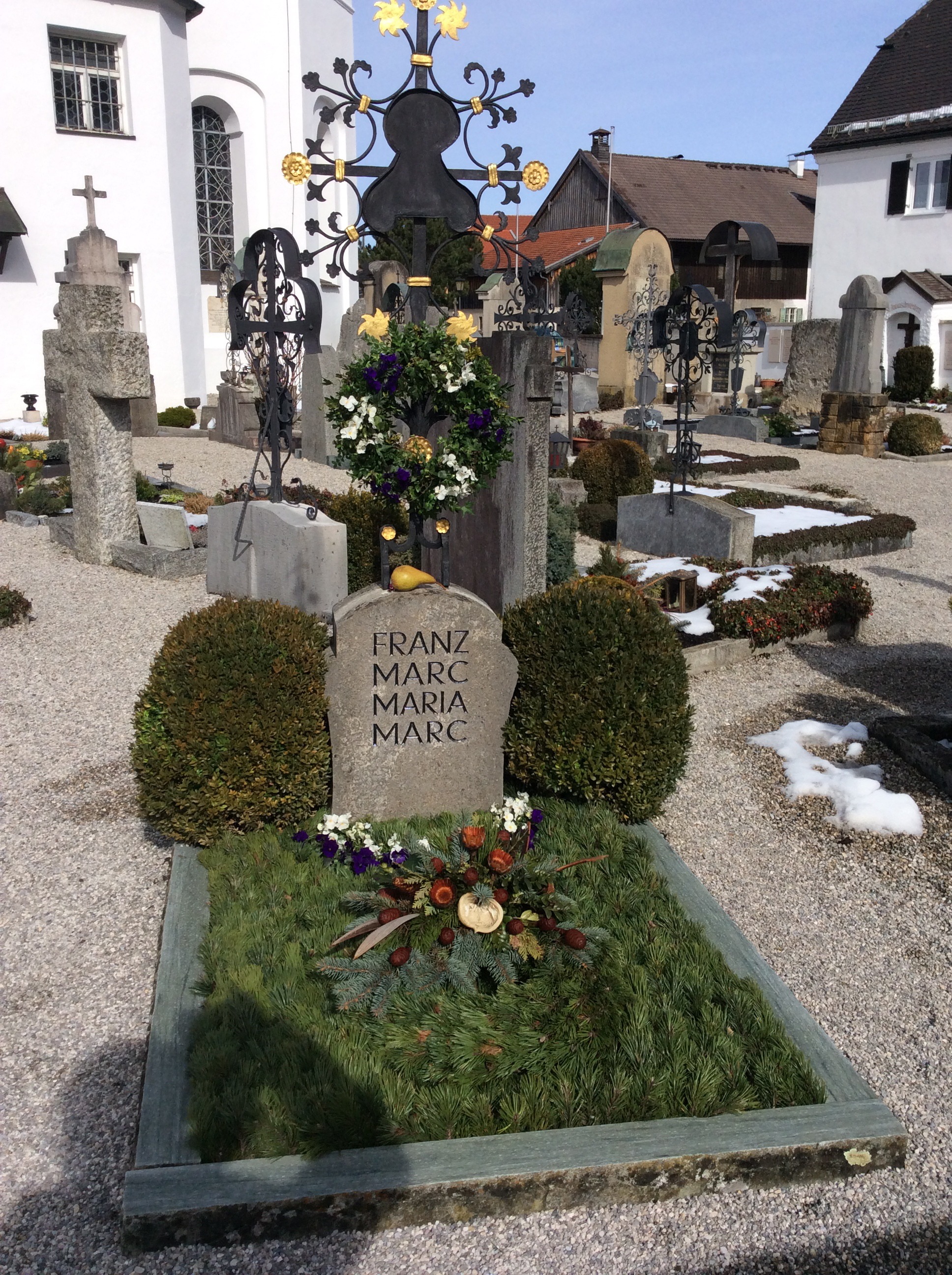
Indexical photo with authorial shadow; graves of Franz and Maria Marc
On 4 March 2016, the 100th anniversary of the death of the painter, animal lover, writer, and ever-elusive person Franz Marc, I visited Marc’s grave in Kochel. Initially I had intended to spend the day between the Lenbachhaus and the Pinakothek der Moderne in München immersed in the paintings I have studied now for many years. But in truth I am devoted to Marc’s life as much as his art, and it seemed more right to take make a pilgrimage and pay respects in the proper sense of the word in the tiny Bavarian town where Marc lived off and on.
This trip was covered on the now-silent Franz Marc Twitter account and received much support and nice wishes from many kind souls.
It was a very emotional experience and had some typical Bavarian humorous adventures as well. I arrived on the regional train at about 11:00 on a dazzling clear, cold day, with most of the snow from the previous week’s blizzard still on the ground. The Ammergau Alps, what Marc called „das blaues Land“, glowed. Inserting itself into this majestic, somber first act was the fact that, in Kochel, Ruhezeit on Fridays apparently begins at 11:00…and this was a very intense Ruhezeit too…everything had abruptly closed, including the flower shop where I had intended to get some violets. I should add that all the flowers and plants were just sitting there outside, and the doors to the shop were open, but the lights were off and the people away being quiet. This was the same at other shops – I have always found it very amusing that in places where Ruhezeit is taken seriously, lunch places also close, even though Ruhezeit is at lunch time, and Kochel takes Ruhezeit quite seriously. In fact it was Friday Ruhezeit the entire time I was there. I stayed until 16:00, the hour of Marc’s death.
(more…)
by Jean Marie Carey | 3 Mar 2016 | Animals, Animals in Art, Art History, Expressionismus, Franz Marc, German Expressionism / Modernism
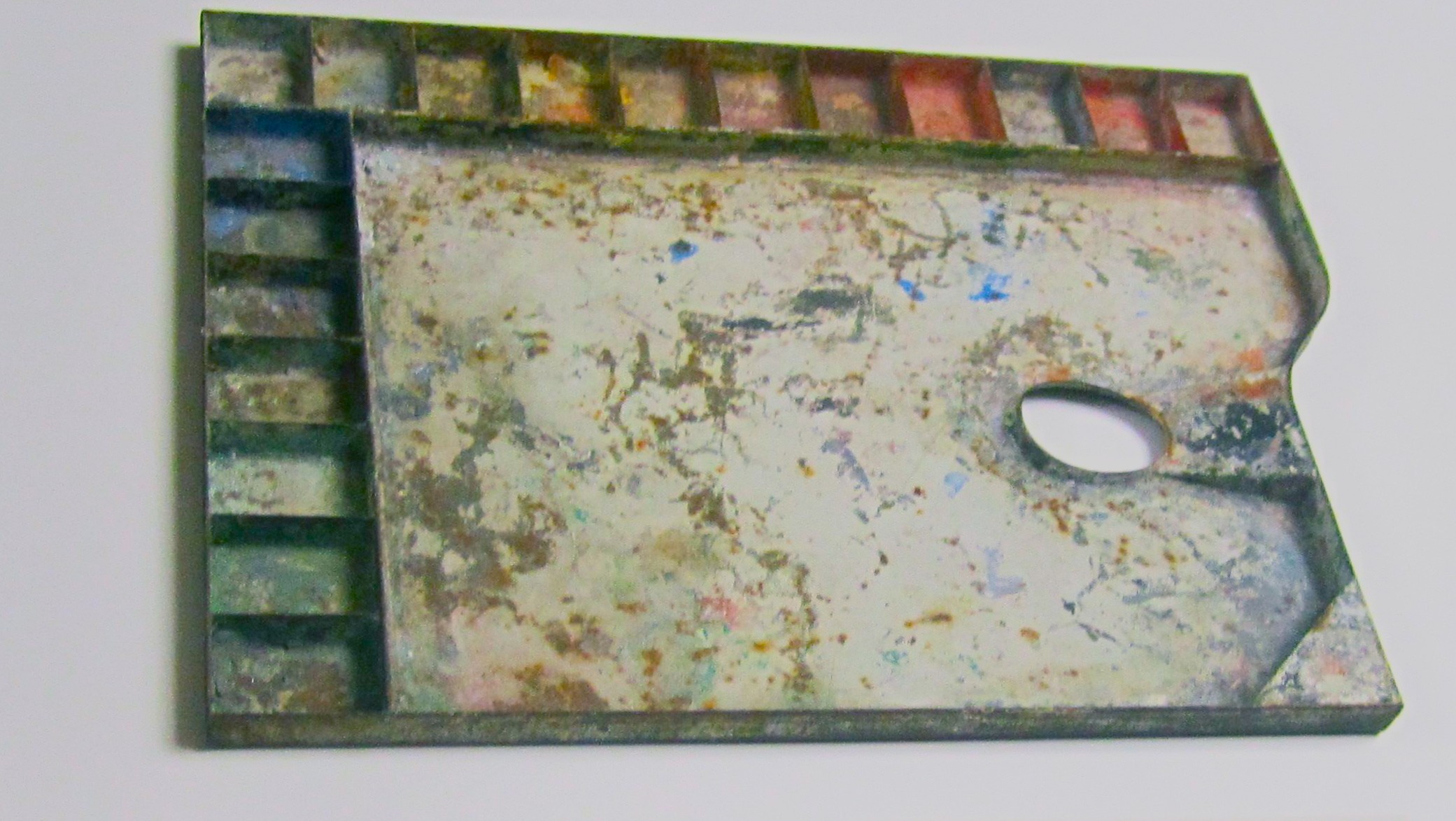
Franz Marc’s palette, from the archives of the Franz Marc Museum, Kochel.
Franz Marc’s “Aphorism 82,” from Die 100 Aphorismen, 1915.
“Ich sah das Bild, das in den Augen des Teichhuhns sich bricht, wenn es untertaucht: die tausend Ringe, die jedes kleine Leben einfassen, das Blau der flüsternden Himmel, das der See trinkt, das verzückte Auftauchen an einem andern Ort, – erkennt, meine Freunde, was Bilder sind: das Auftauchen an einem anderen Ort.”
“I saw what the moorhen sees as it dives: the thousand rings that encircle each little life, the blue of the whispering sky swallowed by the lake, the enraptured moment of surfacing in another place. Know, my friends, what images are: the experience of surfacing in another place.”
by Jean Marie Carey | 24 Nov 2015 | Art History, Expressionismus, Franz Marc, German Expressionism / Modernism, Re-Enactments© and MashUps
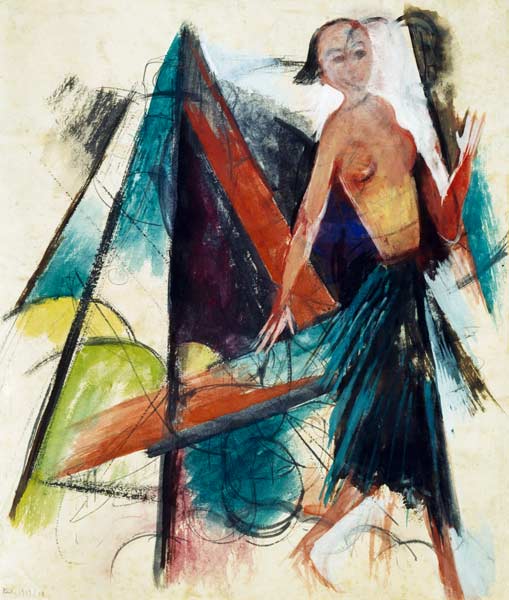
Miranda, 1914
So I am pleased and grateful to report the publication of my first peer-reviewed anthology chapter in the journal Expressionismus in the special issue Der performative Expressionismus. The article is called “‘Der Sturm’ und die Wilden.? Franz Marcs Entscheidungskampf mit der Theatralität,” which translates imperfectly to something like “‘The Tempest’ and the Savages: Franz Marc’s Decisive Encounter with Theatricality.” (Entscheidungskampf can also mean something like Armageddon/scorched earth, which in this case is accurate.)
The article is currently behind the Neofelis Verlag paywall (for a very reasonable €13), but you will soon find it on JSTOR and elsewhere. If you have any questions about how to view article please email me.
This side project to my main research corrects some chronological errors that have consistently been repeated in both Expressionist and Dada literature about the collaboration of Franz Marc and Hugo Ball on a planned production of The Tempest at the Münchner Kammerspiele. Because the story takes place in early 1914, it has been tempting for scholars – some of them quite formidable – to conclude that it was the war that usurped these plans. However, that is not at all the case.
“What really happened” is of course quite interesting on its face and as a reminder that we in fact know very little in the way of actual facts about the historical avant-gardes, who are fast disappearing into hagiography.
More interesting to me, in terms of writing and research, was the analysis of the two small drawings Marc made as character studies of The Tempest’s Miranda and Caliban personalities. This is the first time these drawings, housed in the Kunsthalle Basel, have been subjected to such scholarly scrutiny and each contains many clues and psychological implications.
I was also intrigued to discover that Marc had sent a draft of his June 1914 essay »Das abstrakte Theater,« (also analyzed in the article) about his frustrating foray into the theater to August Macke, and that the two had previously had many exchanges about the performing arts. In fact it is clear that the very precocious Macke – who at only 21 had been the chief set designer for the theater in Düsseldorf – had had a great influence on Marc’s ideas on the subject – ideas being the key word, since Marc had no firsthand dramaturgical knowledge up until this point.
My colleague here at the university, Prof. Dr. August Obermayer, was the very gracious translator but he also provided invaluable editing and advising, and the Neofelis editors were also a pleasure to learn from.
All in all a great experience and I hope readers will find the unraveling of Expressionist mysteries as fascinating as I do.

Caliban, 1914
by Jean Marie Carey | 6 Apr 2015 | Animals, Animals in Art, Art History, August Macke, Dogs!, Expressionismus, Franz Marc, German Expressionism / Modernism, LÖL
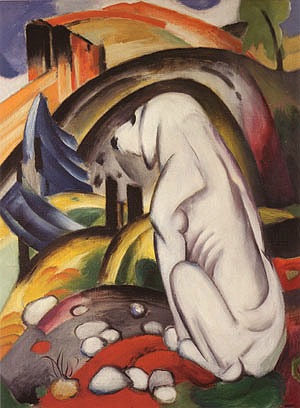
Hund vor der Welt, Franz Marc (1912). Oil on canvas, 118 by 83 centimetres, private collection, Switzerland
I write about this painting a lot – in fact I once, for quite a long time, devoted my academic research solely to this painting – but I realised I don’t often say anything about it in this space. So here is a little excerpt not from my current chapters but from a side project.
§ § §
Franz Marc made an innovative painting – a metaphysical genre portrait of his dog Russi – called Hund vor der Welt in the spring of 1912. The large vertical canvas shows the white hound seated on a hillside, facing the sun and the landscape at an angle across an indeterminate space. We have an account of what Marc had in mind in making this image in particular and Marc’s other thoughts about painting his frequent model.[1] There is also a substantial amount of documentation about Russi, the dog, who, as the artist’s constant companion, was a character who populated the art, photographs, and writing of other people. We even know where Russi was born, how he came as a puppy to live with Marc, and when he died.[2] So despite its slightly whimsical affect, Hund vor der Welt is an image of a real dog about whom much historical information is available. Marc made many paintings in which Russi also appears as a peripheral regular “character;” he leads the way in Im Regen (1912) and leaps after Die gelbe Kuh (1911).
August Macke, who came into frequent contact with Russi and made his own drawings of the dog, prevailed upon Marc to change the name of the painting from the one Marc originally had in mind, So wird mein Hund die Welt sieht.3 We know from Marc that he wanted to show Russi in thought, so the dog’s seated posture suggests that this is what is happening in the stillness. The strange view of the landscape Russi “sees” is nonetheless completely identifiable as a typical one from around Sindelsdorf where Marc lived. By placing buildings in the recognizable, managed farmlands of Bavaria, Marc suggests that people and animals are part of the same ecology, which, for dogs as the primary animal of domestication, is certainly true.
Russi did not have the life of a working dog, instead, with Marc, dividing his time between Munich, Berlin, and the small towns of Sindelsdorf and Ried. Russi lost part of his tail in 1911, an adjustment to his appearance that is reflected in his 1912 portrait. This shows that Marc had a commitment to showing morphologically accurate details even about the animals he painted, even as the paintings themselves broke with academic naturalism.
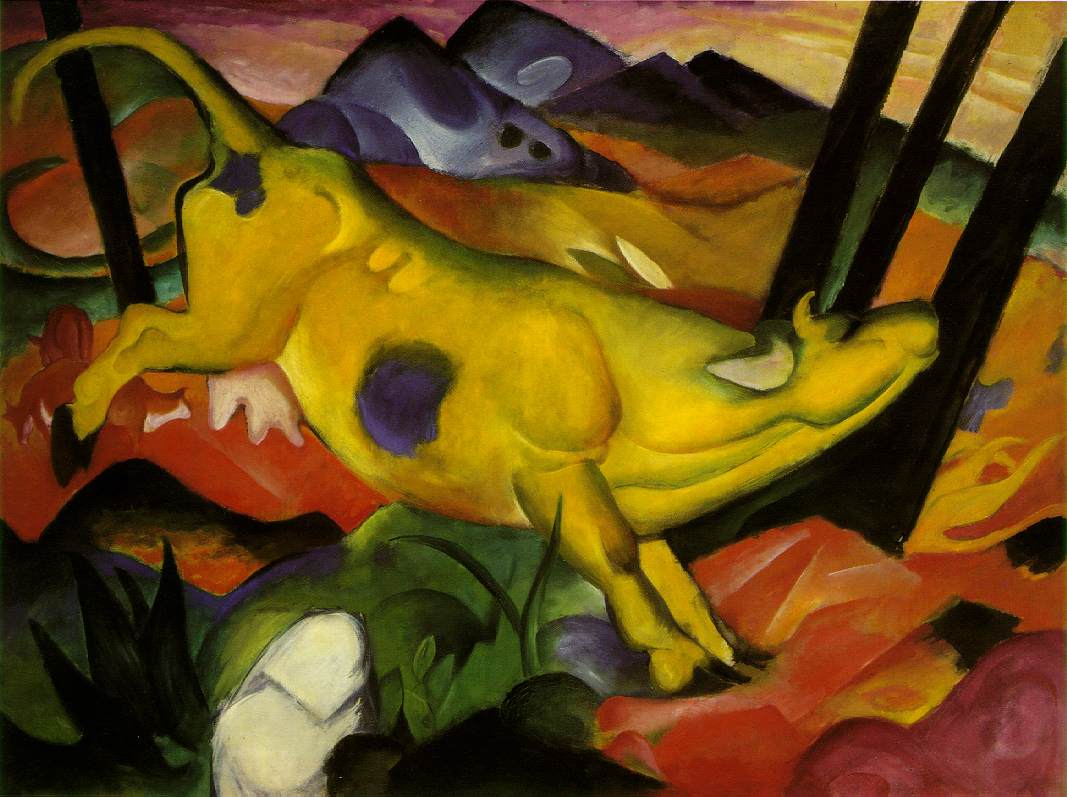
Die gelbe Kuh,
Franz Marc, 1911
189.2 × 140.52 cm
Oil on canvas
Solomon R. Guggenheim Museum, New York. That is Russi Marc in the lower left corner.
[1] Franz Marc, Briefe, Schriften und Aufzeichnungen, (Leipzig: Kiepenheuer, 1989), 11. Observing Russi at this moment, Marc wonders: “Ich möchte mal wissen, was jetzt in dem Hund vorgeht.”
[2] Marc, Briefe, 196-197.
[3] Franz Marc, August Macke, Briefwechsel, (Köln: DuMont, 1964), 124-126.
by Jean Marie Carey | 5 Mar 2015 | August Macke, Expressionismus, Franz Marc, German Expressionism / Modernism, Re-Enactments© and MashUps
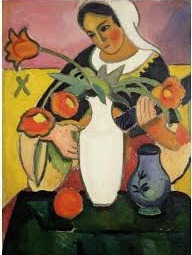
Die Lautenspielerin, August Macke, 1910
“Recent publications” is in quotes because all of the great opportunities to preach the gospel of Marc lately have come to me strictly through the generosity of other people, so I will quickly get to the point of thanking Trang Vu Thuy and the curatorial staff at the Lenbachhaus and Janine Arnold of Notes About Art. (Please click through the links to view the articles themselves.)
My post (which is present entirely owing to the patience of Vu Thuy) “Ein Manifest der Freundschaft” is in honor of the August Macke und Franz Marc: Eine Künstlerfreundschaft exhibition (on through 3 May 2015 in the Lenbachhaus Kunstbau) and concerns one of my favorite subjects, the Paradies mural.
“Von »Köstlichen Figürchen« und »Wunderherlichen Farben«” by assistant curator Monika Bayer-Wermuth is actually the most wonderful post, though, on the gifts sent by the Marcs to the Mackes and is told in the same thoughtful, personal vein as are many of the chapters in the companion catalogue.
Thanks to the generous invitation of Arnold, I have two entries on her Notes About Art website, one called “Confrontations & Reconciliations” about my interpretation of Franz Marc’s gift of the painting Blaues Pferdchen, Kinderbild to August Macke and the other a bit about the history of Marc’s two Turm der blauen Pferde.
I am very happy to see art historians collaborating across distance and language just because we like the art and want for other people to be able to know about and appreciate the work of Der Blaue Reiter. (more…)
