by Jean Marie Carey | 3 Jun 2017 | Animals, Animals in Art, Art History, Franz Marc, German Expressionism / Modernism, Re-Enactments© and MashUps
“Vermisst: Der Turm der blauen Pferde von Franz Marc” at Haus am Waldsee, Berlin
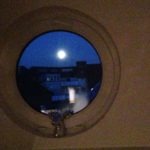
Marcel van Eeden, High Mountains, a Rainbow, the Moon and Stars, 2017
I really wanted to like Haus am Waldsee’s thematic “Vermisst: Der Turm der blauen Pferde von Franz Marc,” but was also nervous about all the expectations of the referenced Franz Marc painting that I would bring to the exhibition. To (un)prepare, I imposed a media blackout upon myself, not reading up on who the artists were or any other reviews,[1] avoiding a seminar and joint show co-sponsored by the Pinakothek der Moderne in München. Vermisst’s concept was to pair some scholarly discussions of Marc’s missing 1913 masterwork with the expansions of contemporary artists upon its theme.
Franz Marc Painting Still Missing
Beyond mild speculation, a purpose of Vermisst did not seem to be to offer any type of meaningful investigation into where the painting might actually be. It is not incumbent upon Haus am Waldsee, where the Franz Marc painting was last seen in 1949, to conduct such an inquiry…and yet the stubborn refusal, still, of German museums and art historians to grapple with the issue of Raubkunst, particularly in a case as famous as that of Turm der blauen Pferde, where someone knows something, is a real problem. (I have an article coming out on this very subject, so I’ll just leave this here for now.)
Of contributions by a dozen artists, one seemed to address both the absent presence of TdbP and also the circumstances of its disappearance. In fact if Marcel van Eeden’s High Mountains, a Rainbow, the Moon and Stars (2017), a series of 26 prints including the text of a short story revealing some fantastical open-ended conclusions about what happened to the painting, had been the only component of the exhibition, that would have been fine. Only two of Eeden’s panels are in color, both reproductions of aspects of TdbP, which makes a nice allusion to the Wizard of Oz (1939), both in temporality and in the vibrancy of the world of dreams, and of lost alternative futures. (more…)
by Jean Marie Carey | 16 May 2017 | Animals, Animals in Art, Art History, Franz Marc, German Expressionism / Modernism, Re-Enactments© and MashUps
This post goes with a book review of the exhibition catalogue Visionaries: Creating a Modern Guggenheim (2017) for Museum Bookstore which is posted here and also follows in a slightly different form below.
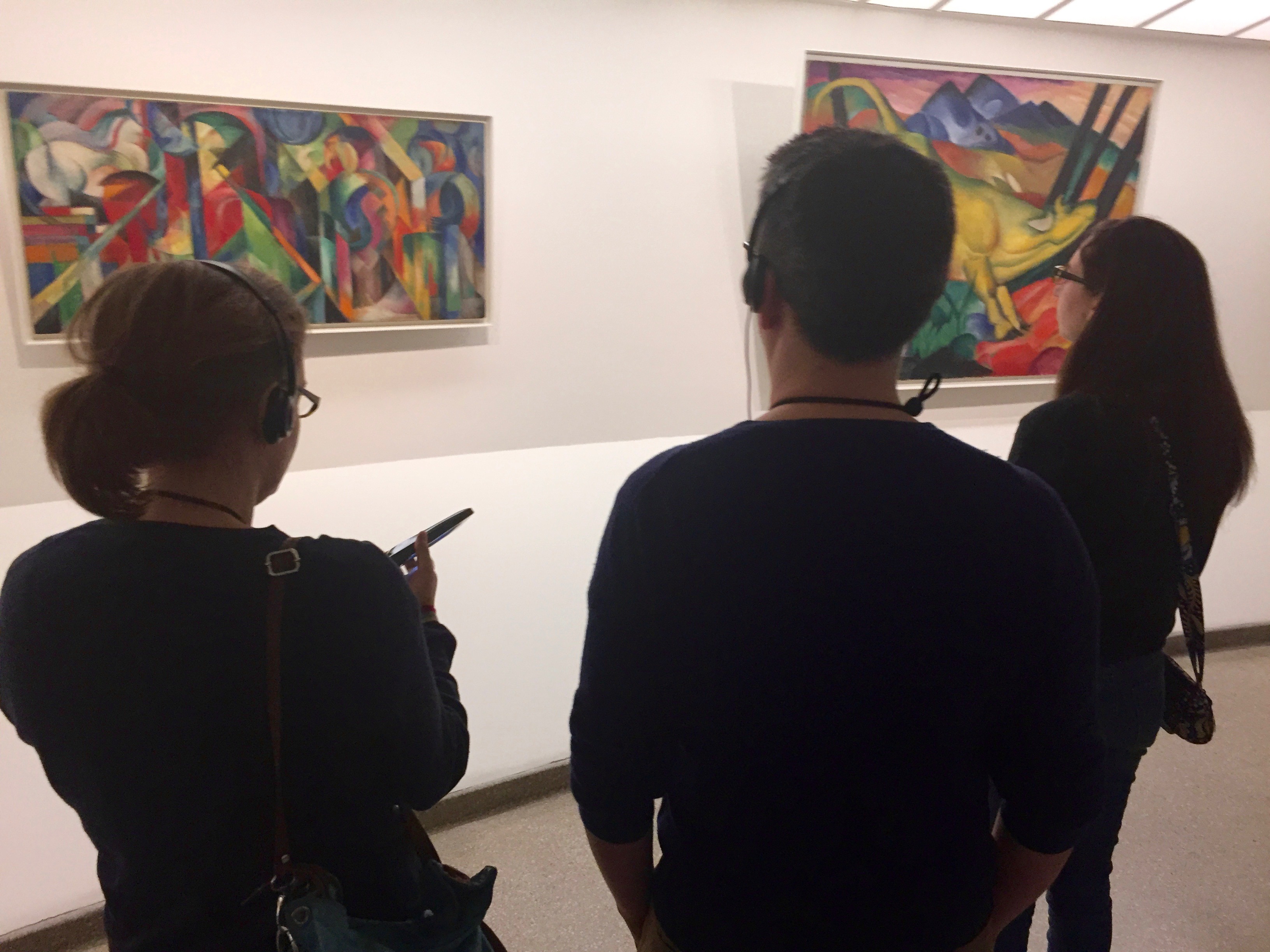
It has been one of life’s great pleasures to see Franz Marc’s Die gelbe Kuh many times over the years at the Solomon R. Guggenheim Museum. Every time I get the same huge surge of joy as the first, and I think other people feel the same way. When the painting is where it lives normally, in the Thannhauser wing, you can sit on a bench in the gallery and watch people come in, weaving their way through some much smaller woodcuts and decorated books, and then turn the corner to be met by this enormous colourful and cheerful painting. Always a lot of oohs and ahhs and delighted small children.
§ § §
People admiring Franz Marc’s Stallungen (1913, l) and Die gelbe Kuh (1911) at the Guggenheim.
Visionaries: Creating a Modern Guggenheim
Edited and introduced by Megan Fontanella with chapters by Vivien Greene, Jeffrey Weiss, Susan Thompson, Tracey Bashkoff, Lauren Hinkson, and Susan Davidson and published by Guggenheim Museum Publications, this catalogue accompanies the eponymous exhibition held at the Solomon R. Guggenheim Museum in New York City, 10 February-6 September 2017; 312 pages with color reproductions of all the paintings and sculptures from the exhibition plus archival photographs, illustrations, letters, and newspaper and magazine notices.
The “modernization” of European art around 1900 is usually associated with the evolution of line, color, and figuration toward abstraction, as manifested by Expressionism and Futurism. The fact that art collectors and dealers played an important role in codifying what we think of now as Modernism is brought to full light in the catalogue Visionaries: Creating a Modern Guggenheim, produced to coincide with the exhibition of the same name.
In fact the catalogue seems, at least at first glance, intent upon driving home the idea that art is a business, opening with the normally blank flyleaf emblazoned with corporate logos and an unprecedented “Sponsor Statement” by Francesca Lavazza, heir to the Lavazza coffee brand, the underwriter of the exhibition. However the scholarly contents are innovatively presented and well-researched, with five sections devoted to each of the “visionaries” (in this case being the collectors, not the artists), paired with a focus on one of the museum’s key acquisitions. An opening essay by the Guggenheim’s curator of collections and provenance, Megan Fontanella, introduces the scope of the exhibition and the historical circumstances that allowed American entrepreneur Solomon Robert Guggenheim to decide in the 1920s, after five decades dominating the U.S. mining industry, to become the world’s foremost collector and exhibitor of what became dubbed “non-objective” art. (42) As in the rest of the book, the introduction offers wisely-selected and superbly reproduced works from both the immediate exhibition and from other sources.
Of great interest are photos of the assorted collectors and dealers in domestic settings, surrounded by their objets, which are very revealing, perhaps beyond what is intended by their inclusion in a book that is an official history of the Guggenheim. It is impossible, for example, not to be vexed by the careless profligacy of Peggy Guggenheim, niece of Solomon and founder of the Guggenheim Collection Venice. She is shown on the terrace of an Île Saint-Louis flat, wearing pearls and sipping an espresso as the Nazi-occupied Paris of the 1940s falls away across the river, Constantin Brancusi’s Maiastra (1912) set perilously on the parapet beside her. (254)
In fact the catalogue is an outstanding exercise for those willing to read between its restrained lines. Taken this way, an excellent contemporized portrait of the Guggenheim’s co-founder and first director, Hilla Rebay, emerges. Fontanella and Susan Thompson dispense with the “female hysteria” characterization of Rebay as the occult-obsessed lover of painter Rudolf Bauer to focus on her acumen as a businesswoman and strategic positioning as a collage artist. Thompson shows Rebay’s collages – figurative portraits for the most part, more like mosaics made with bits of paper than Hanna Höch’s more associative and confrontational critiques of Weimar culture – as a distinct oeuvre outside the canonical avant-garde’s concentration on sculpture and painting.
Equally calculating and less sympathetic is Rebay’s outsize ambition as Guggenheim’s chief advisor and deal-maker. Fontanella reports:
Rebay […] did attend the notorious Entartete Kunst show in Munich in August 1937, fresh from the June establishment of the Solomon R. Guggenheim Foundation. The foundation would make important purchases from the ensuing German-government-sponsored degenerate art sales: [Wassily] Kandinsky’s Der blaue Berg (1908-09) and Einige Kreise (1926), and [Paul] Klee’s Tanze Du Ungeheuer zu meinem sanften Lied (1922) were among the works that entered its holdings this way in 1939 – works that might have been destroyed. (30)
…Or works that might have been returned to their rightful owners.
(more…)
by Jean Marie Carey | 7 Apr 2017 | Art History, Dogs!, Franz Marc, German Expressionism / Modernism, Re-Enactments© and MashUps
Ars Graphica is a group of mostly European scholars who study prints but also photography. The pan-European organization also has a few Gesamtstaaten. Ars Graphica Deutschland recently branched off and began its own activities. The first one was this week, a tour of the In die Dritte Dimension: Raumkonzepte auf Papier vom Bauhaus bis our Gegenwart exhibition at the Städel Museum in Frankfurt given by the curator, Jenny Glaser. You can read more about what transpired here.
Dr. Glaser has organized a really superb show. The low and direct lighting is a bit off-putting at first, but many of the works are cut-outs, collages, incisions, or have subtleties of depth that the creation of shadows augments. The El Lissitzky poster prints from the Bauhaus are the stars of the show and Glaser’s clear favorite, but the less-known miniatures (matchbox sized) by Blinky Palermo placed across from Sol LeWitt’s late (2001) colorful confetti collage are probably more interesting, as is Michael Riedel’s artist book of minute but deep surgical removals.
There was also a look at the Städel’s more traditional Renaissance and Early Modern prints, and we got to visit and share a bit about our research…of course I have a vested interest in something at the Städel that is not a print…
I thought it might be best to just tell the exciting but short story about Liegender Hund im Schnee‘s journey from the Franz Marc estate to entartete to West Palm Beach and back to the Städel. Somehow the actual Germans were able to refrain from exclaiming that “all Germans are Nazis so who really cares if the museum was looted?”*
*Actual crowd responses at two of my last talks. More on this, as I keep promising, shortly; I actually have quite a lot to say about this in reference to the College Art Association in particular and looting apologists in general.

by Jean Marie Carey | 7 Jan 2017 | Art History, August Macke, Expressionismus, Franz Marc, German Expressionism / Modernism
Whatever happens in the future, my time in Münster will be the happiest I can ever remember. I was there for several weeks and finally had a substantial Paradies mural Franz Marc and August Macke made together in Macke’s upstairs atelier in Bonn in 1912.
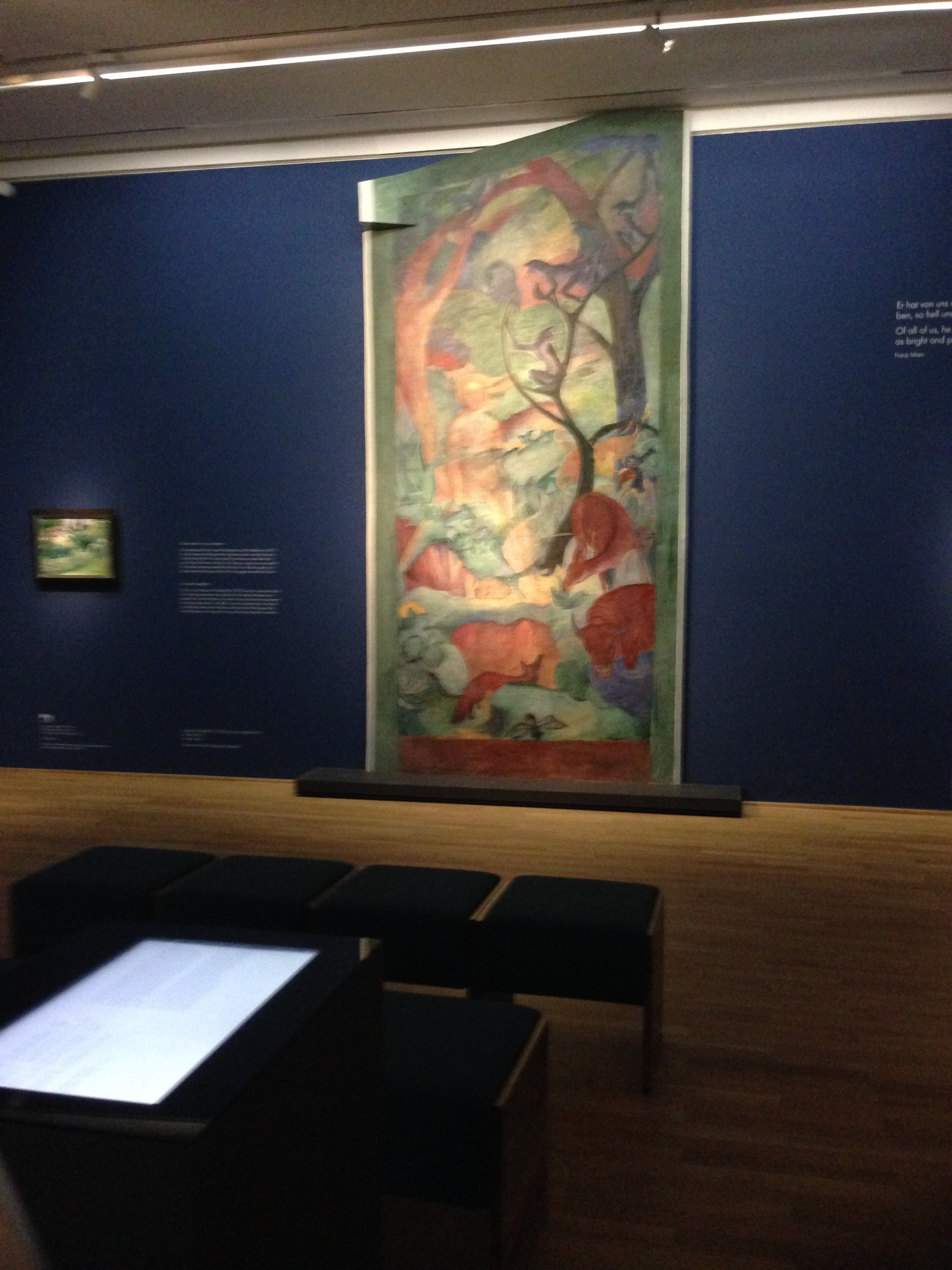
The mural was moved to Münster’s LWL-Museum für Kunst und Kultur in 1984. In a quiet room away from the museum’s main traffic areas, the mural is now the altar of a shrine to Macke and his relationship with his wife Elizabeth but also with Marc, phrases from his many letters to August decorating the blue walls.
The Hanseatic light of the west is stunning and soothing, like a house you’ve lived in your entire life – something almost no one does anymore that seems like a real memory.

by Jean Marie Carey | 16 Oct 2016 | Art History, Franz Marc
Merzbau reimagining at Sprengel Museum, Hannover.
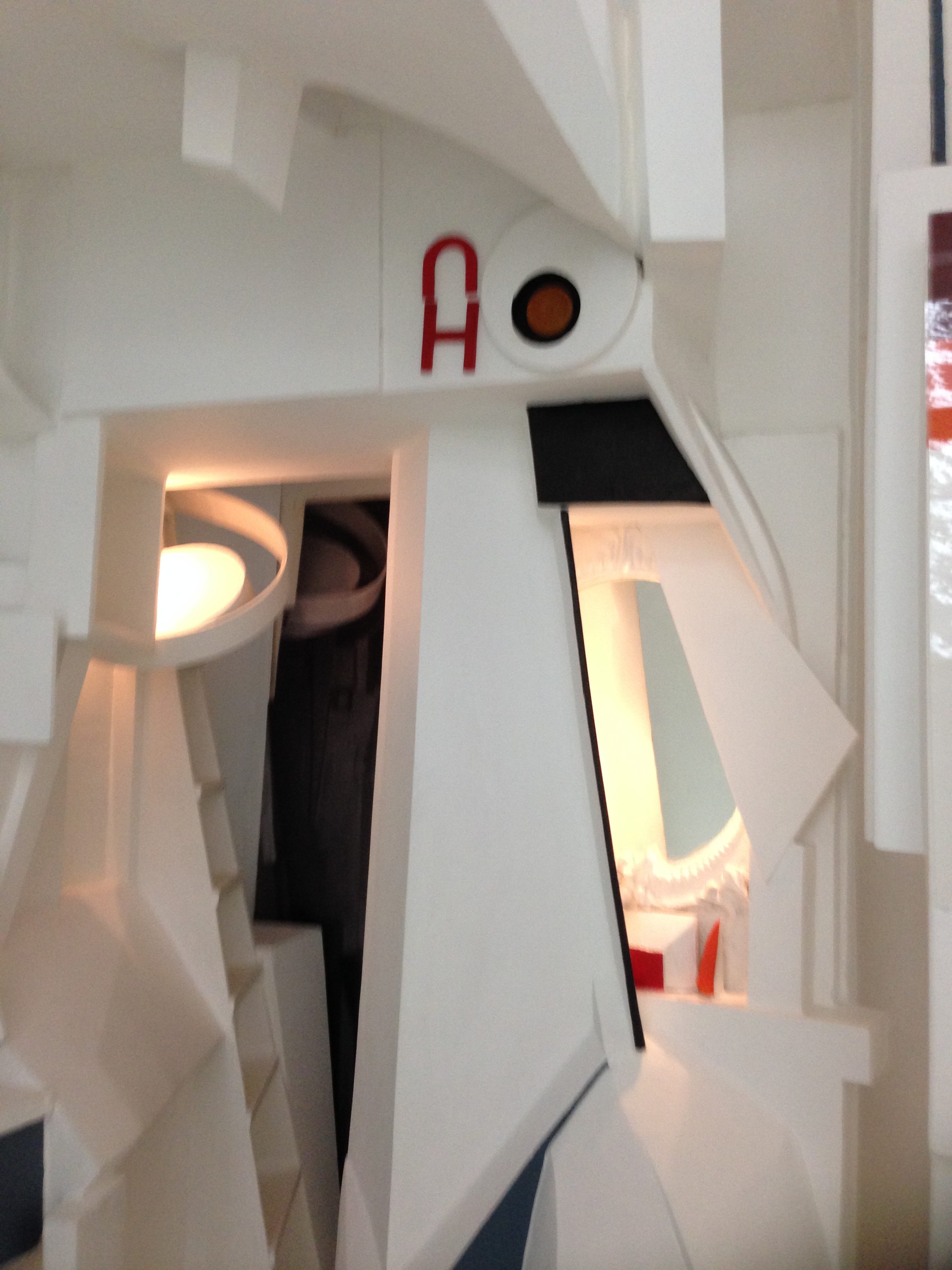
Reconstruction of Kurt Schwitters’ Merzbau.
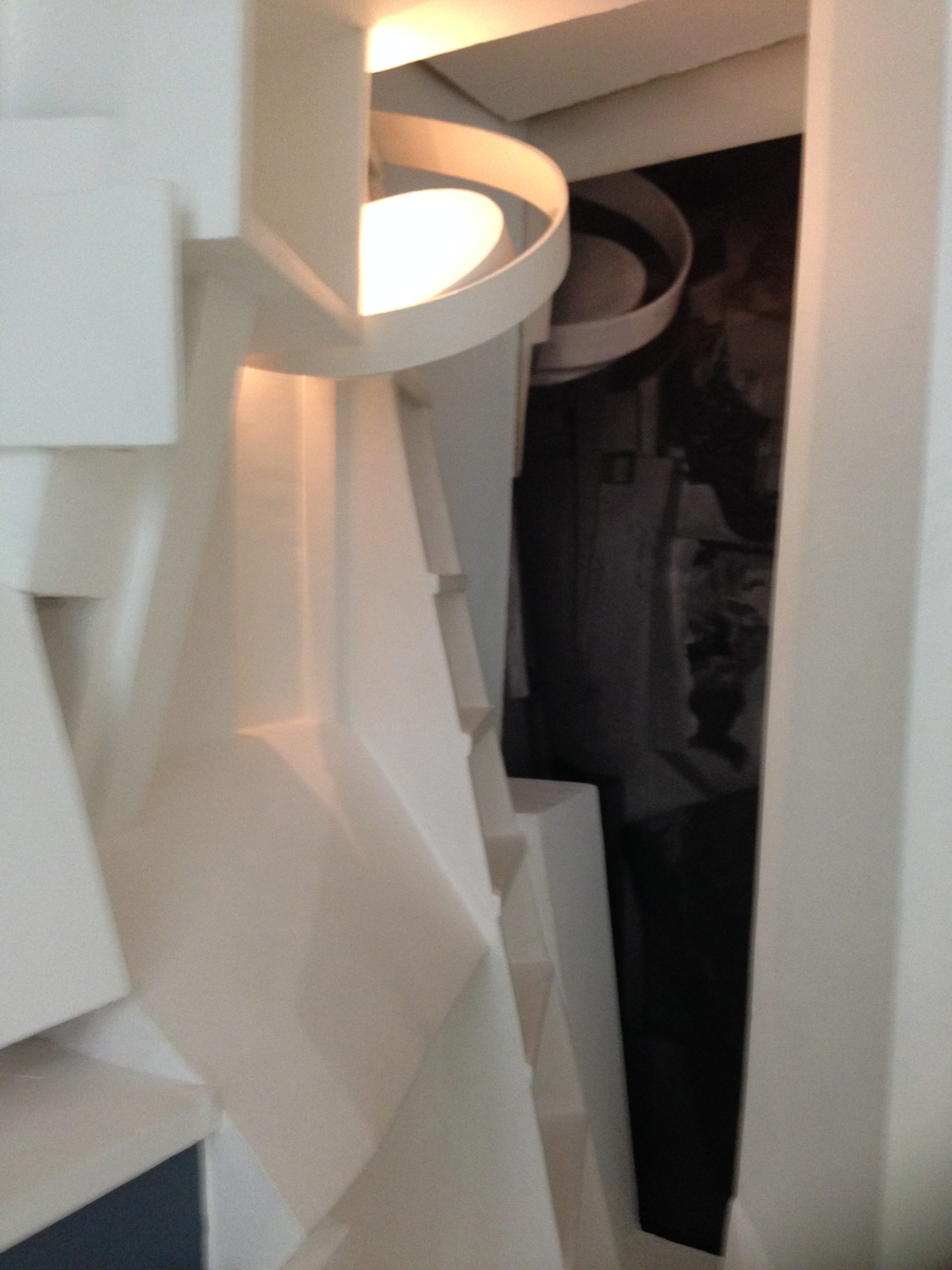
Merzbau Reconstruction at Sprengel Museum Hannover.

Reconstruction of Kurt Schwitters’ Merzbau at Sprengel Museum.
Hannover’s Sprengel Museum is such a fascinating space this most recent visit deserves a series of discrete posts of mostly photos. It was here in 2009 to see the visiting Hund vor der Welt on loan to the Sprengel for “Die Schönheit einer zerbrechenden Welt (1910 – 1914) Franz Marc, August Macke und Robert Delaunay” exhibition that I became very focused on Marc’s portraits of Russi.
The museum still holds some Marcs and Mackes in its permanent collection but there is also much more to see, including a reconstruction the main room of one of Kurt Schwitters’s Merzbauten, created in 1983 by Peter Bissegger. Bissegger, a theatrical designer who has made several Merzbau recreations, based his reconstruction on Wilhelm Redemann’s photographs from the early 1930s. Schwitters lived in Hannover; the apartment building where this version of the Merzbau lived was destroyed in 1943.
Gwendolen Webster has written a wonderful paper full of designs and drawings from Schwitters and information about the Merzbauten in Norway and England call The Reception of the Merzbau which you can read by following the link.