
Franz Marc and a Decisive Moment in Dada-Expressionist Theater

Franz Marc and a Decisive Moment in Dada-Expressionist Theater

My research about the 1914 Franz Marc essay »Das abstrakte Theater« and Marc’s collaboration with Hugo Ball on an intended production of The Tempest has been published in a special arts issue of Empty Mirror. The fun long title of the article is “The Tempest and the Savages: Franz Marc, Hugo Ball, and a Decisive Moment in Dada-Expressionist Theater With a Special Appearance by August Macke,” and this piece contains important breaking historical avant-garde news.

Franz Marc essay

Fig.01: Franz Marc, Fragmentary First Page of „Das abstrakte Theater,“ 1914. Das Archiv für Bildende Kunst im Germanischen Nationalmuseum, Nürnberg, Germany.

Here is the abstract: This article discusses the 1914 Franz Marc essay “Das abstrakte Theater” and the events surrounding an “Expressionist” production of Shakespeare’s Der Sturm planned by Marc and Hugo Ball the same year. Marc’s position in this detour from painting and writing can be understood in terms of his embrace of “die ‘Wilden’” – “the ‘Savages’” – an idea Marc introduces in 1912’s Blaue Reiter Almanac – as a metaphorical aspiration and as a state of being for both artists and the public as patrons of the arts and citizens of modernity. I also bring recognition to August Macke’s background in theatrical theory and design in terms of how this influenced Marc, particularly in analysis of the artists’ collaboration on Macke’s contribution to the Blaue Reiter Almanac, the essay “Die Masken,” and how this relates to the Der Sturm project. I propose a way of understanding how Marc’s beliefs in the paradoxically beneficial power of destruction dovetailed with Ball’s theology. In the context of this background information I give close reading of paintings Marc made of the Caliban and Miranda characters from Der Sturm. I also correct inaccuracies in the record regarding the chronologies of this encounter between these protagonists of Dada and Expressionism, and in our understanding of Marc’s text itself. Viewing this data in a holistic manner allows new interpretations of influences and collaborations amid the historical avant-garde.

It is great working with Denise Enck at Empty Mirror so it would be nice to look at the article on the Empty Mirror website, but if you would like a PDF of the article there is one here and also at Humanities Commons.

Fig.04: Franz Marc, Miranda, 1914. ( Tempera, 46 x 39.5 cm.) Kunstmuseum Basel, Kupferstichkabinett der öffentlichen Kunstsammlung, Switzerland.
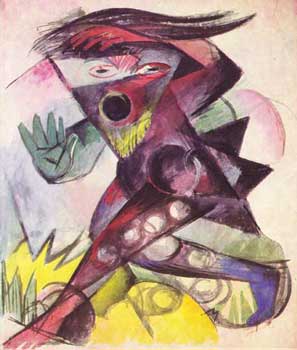
Fig.03: Franz Marc, Caliban, 1914. (Figure for Shakespeare’s „Der Sturm“. Tempera, 46 x 39.5 cm.) Kunstmuseum Basel, Kupferstichkabinett der öffentlichen Kunstsammlung, Switzerland.
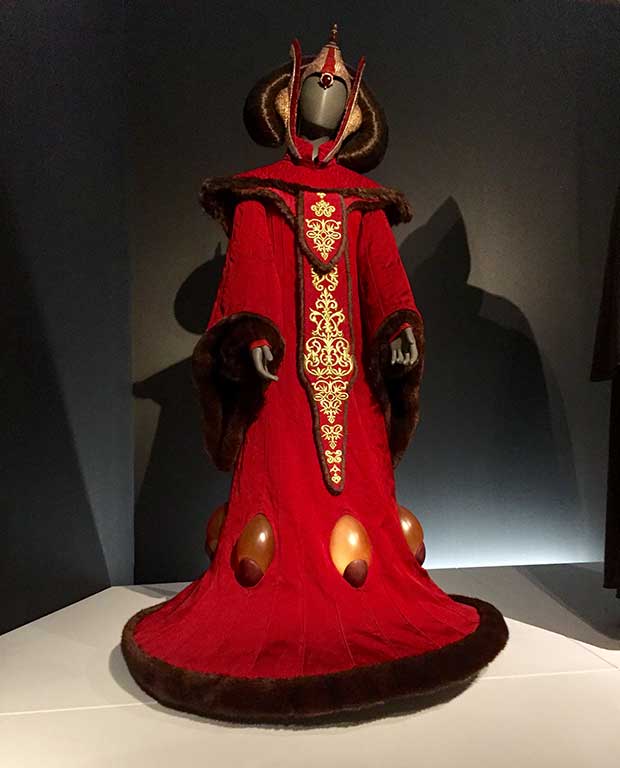
Star Wars and the Power of Costume, Museum of Fine Arts St. Petersburg

Star Wars and the Power of Costume, Museum of Fine Arts St. Petersburg

Padmé Amidala's throne room robes

Padmé Amidala’s throne room robes

This is a “locally-coloured” version of this exhibition review. See the “professional” iterations at Humanities Commons or on the Museum Bookstore website.

On view through the spring, this exhibition features 60 costumes representing characters from the Star Wars film saga from A New Hope in 1977 through The Force Awakens in 2015. These outfits are accompanied by selected accessories: props such as light sabers and artists’ sketches of how the costumes, and characters were originally envisioned and evolved. As a group the costumes highlight the intricacy of theatrical and cinematic clothing design. Membership in the cult of Star Wars is not a prerequisite for their appreciation.

These costumes and the drawings giving their background illustrate the evolution from storyboard to screen, and then of the characters who wear these ornaments and attributes. The earlier pieces from the original trilogy – The Empire Strikes Back (1980) and Return of the Jedi (1983) followed A New Hope – are closely allied to the vaguely fascistic, neo-classical iconography favoured by creator George Lucas. These styles – Reich-referencing Imperial officer and Stormtrooper uniforms, the togas and cloaks for Jedi masters Obi-Wan Kenobi and Luke Skywalker – tend to be simplified and literal. As the series progressed with Episodes I, II, and II I – The Phantom Menace (1999), Attack of the Clones (2002), and Revenge of the Sith (2005) – the prequels that appeared fourth, fifth, and sixth in order of release – costumes for both the Republic officials such as Bail Organa and Imperial minion Darth Sidious tend to be highly decorated while more referentially abstract. Particularly the scarlet robe and ornate crown for Princess-Senator Padmé Amidala Naberrie’s Phantom Menace throne room garb, which greets visitors at the exhibit’s entrance, is a marvel. The dazzling effect of the wardrobe of Padmé, portrayed in the films by Natalie Portman, was achieved by the imaginative and subtle use of beads, paillettes, layers of leggings and petticoats, and embedded electronics. Her trains of shimmering brocade and elaborate ceremonial gowns and headdresses show strong influences from feudal Mongolia and Shōgun era Japan. I was astonished to see the level of handicraft and detail given to each garment, having assumed that costumes in a fantasy epic were embellished by computer-generated animations such as those that brought Katniss Everdeen’s “flame” gown to the screen in The Hunger Games: Catching Fire (2013).
(more…)