
by Jean Marie Carey | 4 May 2019 | Expressionismus, Franz Marc, German Expressionism / Modernism, Raubkunst
Piazzetta Provenance Project CFA: Raubkunst at the Ringling: A Catalogue in Absentia
Circle of Giovanni Battista Piazzetta 1682 -1754), Pastoral Scene, c. 1750. Oil on canvas, (92.1 x 134 cm). The John and Mable Ringling Museum of Art, Object number: SN627.
Raubkunst at the Ringling: Franz Marc’s Schöpfungsgeschichte has got a lot of attention. Surprisingly many responses have come from people who think they might be in possession of some Raubkunst themselves. I confer with trusted colleagues on these tips, but we keep this information to ourselves. We’ve been tantalizingly close to some long-missing works we would all love to see returned to the public view.
I have found though that what most inquirers are seeking is not absolution but verification. I have been asked to authenticate two works by Franz Marc just in the past year. I am reluctant to do so in these conscience cases. For one thing, as the recent book by Stefan Koldehoff and Tobias Timm, Falsche Bilder Echtes Geld: Der Fälschercoup des Jahrhunderts – und wer alles daran verdiente makes clear, art forgers have become increasingly wily and technically proficient. The current interest in Provenienzforschung created almost as many opportunities for grift as the thieves and opportunist of the Third Reich themselves did in the 1930s and 1940s. The well-meaning art historians who mistakenly declared the fakes by Wolfgang Beltracchi to be long-lost works by Georges Braque, Max Ernst and others had their careers and reputations destroyed. There is a movement toward creating a professional standard for authenticating lost works, likely by a panel of experts in the work of the artist in conjunction with the formidable forensics of the Doerner Institut.
But for the moment in this respect we keep a low profile and our ears to the whispers in the wind.
While avalanches roar above, business continues below, on the tasks that can be accomplished: reuniting artworks whose authenticity is unimpeachable with the families or museums to whom they once belonged. To that end, a researcher and writer is being sought to investigate the provenance of a quartet of quirkily shaped, sized, and framed 18th Century oil paintings associated with the work of Venetian artist Giovanni Battista Piazzetta (1682-1754). The genre pastoral scenes are in the collection of the John and Mable Ringling Museum of Art in Sarasota, Florida, having been purchased by the museum in 1949. The destination for this research is the collaborative book project Raubkunst at the Ringling: A Catalogue in Absentia, scheduled for publication in 2020. A worthy publisher and esteemed contributors are already aboard, though like me, their expertise is in Modernist art, hence our quest.
The Piazzetta-esque works were sold to the Ringling by the German-Jewish art, antique, and textiles dealer Adolph Loewi, who operated galleries in the Veneto as well as New York City and Los Angeles. In 1939 Loewi fled Italy with his family, losing some of his files in the process. Whether the documentation for the Piazzetta-adjacent works was among those documents is not clear; in any case, no record of their provenance exists prior to the Ringling purchase.
Circle of Giovanni Battista Piazzetta 1682 -1754), Pastoral Scene, c. 1750. Oil on canvas, (56.5 x 92.7 cm).The John and Mable Ringling Museum of Art, Object number: SN629. Header image: Circle of Giovanni Battista Piazzetta 1682 -1754), Pastoral Scene, c. 1750. Oil on canvas56.5 x 92.7 cm). The John and Mable Ringling Museum of Art, Object number: SN630.
Circle of Giovanni Battista Piazzetta 1682 -1754), Pastoral Scene, c. 1750. Oil on canvas, (92.1 x 134 cm). John and Mable Ringling Museum of Art, Object number: SN627
[1]Recent books such as Simon Goodman’s The Orpheus Clock: The Search for My Family’s Art Treasures Stolen by the Nazis (2016) and The Lady in Gold: The Extraordinary Tale of Gustav Klimt’s Masterpiece, Portrait of Adele Bloch-Bauer (2015) by Anne-Marie O’Connor detail the eventual triumph of the resourceful Goodman and Altmann families pitted against adversaries in museums and galleries over the course of lengthy and expensive court battles. Some cases turn less flamboyantly but more emotionally. The Austrian art dealer Lea Bondi-Jaray lost her beloved Portrait of Wally, a 1912 painting by her friend Egon Schiele, in the Anschluss in 1939. She went to her grave fighting to have the painting returned from private gallerist Rudolph Leopold who had acquired the painting in collusion with the Austrian government in 1954. Bondi-Jaray’s family continued the battle, eventually taking on no lesser adversaries than Ronald Lauder, the Museum of Modern Art, and Austria’s Leopold Museum. The case turned when the family produced pre-war photographs of Portrait of Wally in Bondi-Jaray’s Vienna apartment, convincing the United States Customs Service to seize the painting and United States District Court for the Southern District of New York Judge Loretta A. Preska to allow the case to proceed to trial. The Leopold Museum settled with the family in 2010.
As I’ve noted, because the Modern Art that had been declared entartete – degenerate – by the Third Reich was seized by the Germans from German government-sponsored museums it is – technically – not considered Raubkunst, stolen art, though certainly the Nazis profited from its sale. Works that were stolen from private owners and collectors, or procured through forced sales, are truestolen objects, and subject to return to the families of their original owners.
Even in seemingly clear-cut cases, this process can be challenging. In many instances, entire families were murdered in their homes or in concentration camps, and no heirs exist to lay claim upon what should have been prized heirlooms. The few remaining survivors of Nazi art theft or their descendants must file official claims with the German government or bring private litigation against museums and auction houses. Claims to works must be substantiated by proof of ownership – a paradox that ends many legal proceedings before they begin since receipts, ledgers, diaries, and documentary stamps were often destroyed, dispersed, or concealed by those who had stolen the artworks in the first place.[1]
Because of their appealingly peculiar nature and the seeming completeness of the grouping of four, it seems likely that the Piazzetta workshop paintings came from a private collection. But whose? The task of the writer-researcher who takes on this investigation will be to unravel this mystery. The outcome may be as simple as a lost receipt establishing a chain of custody that puts the Ringling in the clear, or as profound as reuniting the quartet with a family who thought them lost decades ago.
I began this project in 2016 when I discovered two woodblock prints by the Blaue Reiter artist Franz Marc (1880-1916) in the Ringling collection, identified them as Raubkunst, and eventually traced them back to their original owners in Stuttgart and Mannheim. My findings were accepted as a “closed case” this past February by the Commission for Looted Art in Europe. So the investigation has since expanded in scope, to say the least. I would welcome collaboration with, as well as questions and advice from, members of the “Raubkunst Research” community. Contact me and I’ll get back to you.
by Jean Marie Carey | 25 Feb 2019 | Animals in Art, Art History, Expressionismus, Franz Marc, German Expressionism / Modernism, Michelangelost©, Re-Enactments© and MashUps
Raubkunst at the Ringling…
…The Story Continues
Its genesis in 2016 was the glimpse of a fin becoming a feather that ignited a strong intuition at ”Raubkunst als Erinnerungsort,” a research fellowship sponsored by the Zentrum für Historische Forschung der Polnischen Akademie der Wissenschaften in Berlin that same December. Eventually, and with the help of many people, “Raubkunst at the Ringling” ran in the Modernism journal Lapsus Lima on 9 January 2019 and was picked up in the news all the way to the Antipodes that week with, for example, the story “Otago Link to Identifying Art Looted by Nazis.”
On 13 February 2019 I presented this research about Franz Marc’s woodcuts Schöpfungsgeschicte II (1914) and Geburt der Pferde (1913) amid colleagues at the College Art Association conference in New York City. The very next day I learned “Raubkunst at the Ringling” had been formally recognised as a “solved” case of Nazi looted art with the recognition of my findings by the Commission for Looted Art in Europe in the annals of The Central Registry of Information on Looted Cultural Property 1933-1945.
My hope all along has been that the John and Mable Ringling Museum of Art, the State Art Museum of Florida operated by Florida State University, would acknowledge the illicit acquisition of the prints by the American UPI reporter Robert Beattie from the notorious “Kunsthändler to the Third Reich” Bernhard A. Böhmer in 1940, prior to Beattie’s donation of them to the Ringling in 1956, where they have been hidden since, and allow these works to be shared with the public.
But wait: I have subsequently learned that there is potentially even more Raubkunst at the Ringling: Paintings by Christian Rohlfs and George Grosz and bronzes by Ernst Barlach with provenance gaps from 1933-1945 are also locked away at the museum as well as some oils and terracottas from the 16thand 17thcenturies that, while not entartete, were simply stolen or subject to forced “sales” from museums or private owners under the Reich.
To more fully bring this story to light, I would like to compile a volume – half catalogue, half detective story – about these works. Please do contact me if you are interested in working together on this project.
The only social media I participate in; this feed is mostly about art history and animals.
by Jean Marie Carey | 15 Dec 2014 | Franz Marc, German Expressionism / Modernism
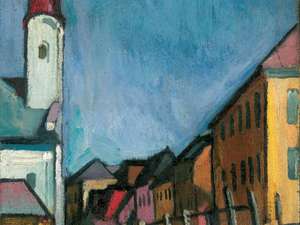
Is this colorful village scene painted by August Macke?
I have been working on a project about authenticating a painting maybe misattributed to one of my Expressionist painters (yet maybe made by another), so I was very interested to see a story crop up over the weekend in the Münchner Merkur online edition (pretty sure Süddeutsche Zeitung, usually so on top of all news Bayern, must be spitting nails!) about a man who thinks he owns a painting by August Macke.
Even more intriguingly, the painting would have been made in 1910, the year Macke spent in Tegernsee during which time Franz Marc often came to visit the Macke family, sometimes walking there through Oberbayern from Sindelsdorf to Tegernsee with Russi Marc. This period of time is recounted with warmth and in detail by Margarethe Jochimsen and Peter Dering in the book August Macke in Tegernsee.
The man who owns the painting, Herbert Spiess, claims to have purchased it from an art dealer in Vienna in 1984. Spiess told the Merkur he became convinced the painting, a small streetscape, was a Macke simply through visual association. (The Westfälische Landesmuseum für Kunst und Kulturgeschichte in Münster says “no” in the Merkur’s story; no comment from the Lenbachhaus or the August Macke Haus in Bonn).
Macke enjoyed his time in Tegernsee. This was a happy year for Macke and his wife, Elizabeth and their first son, Walter, was born in the quiet lakeside village. Macke was more or less amused by his botany-obsessed landlords, whose Bayerische dialect he was able to penetrate with Marc’s help. Stubbornly autodidactic and much more fanciful and imaginative than he appeared at a glance, Macke spent hours doing “copying exercises” with Marc (and doing some other fun stuff too), and experimented with many styles of painting and drawing in 1910.
During this time, despite being in a very attractive location, Macke concentrated on portraiture, making many sketches and paintings of Walter, Elizabeth, and the famous portrait of Marc.
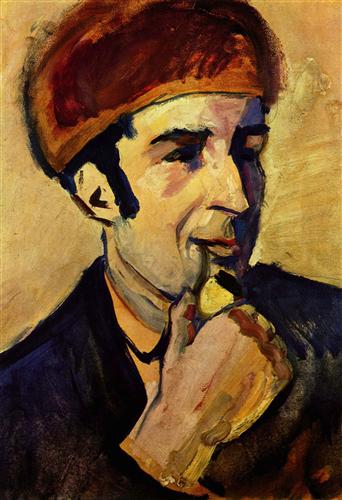
Bildnis Franz Marc, August Macke, 1910
But Macke also was always making all sorts of things, from tapestries to fabric designs to theater decorations. So it’s certainly possible this single painting is something he just knocked out during this period of great productivity – Macke was exceedingly prolific and made more than 200 paintings between 1909 and late 1910, when the young family returned to Bonn, leaving cousin Helmuth Macke to stay with Marc.
So it’s hard to say, from looking alone, if this painting could be Macke’s. I hope it is but (and this is really just a very strong intuition as much as empirical assessment) my feeling is that it might not be. To my eye the painting lacks that little flourish of passion and verve, and of capturing the “inner realities” of the beauty he was in the physical world, that is the beautiful Expressionist hallmark of Macke’s oeuvre. With any luck I’m wrong though, and the world will have a new August Macke painting to admire.
Anyway, the reporter, Vera Markert, asks that if you have any information or ideas about the painting to get in touch with the Merkur via email at kultur@miesbacher-merkur.de wenden.
by Jean Marie Carey | 8 Dec 2013 | Animals, Animals in Art, Art History, Franz Marc, German Expressionism / Modernism
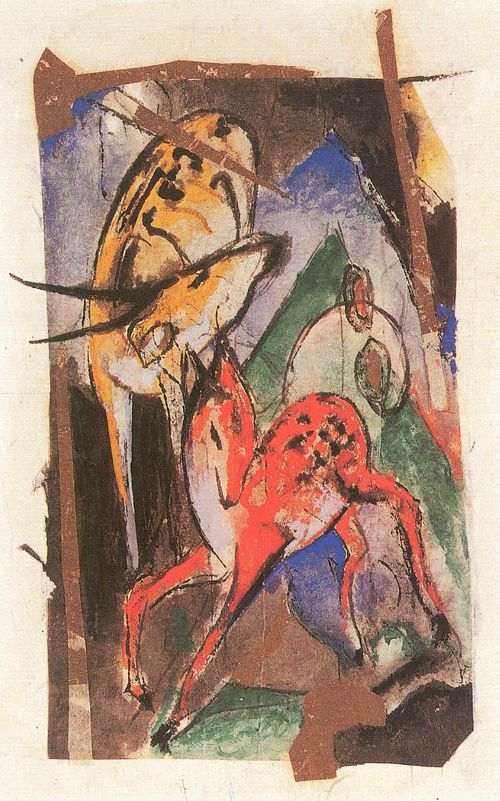
Franz Marc, Rotes Reh und gelbe Antilope, 1913, Mischtechnik und Collage (Silberpapier)
So, Franz Marc always said he was from the future…he amended the amount of how far in the future to 50, then 150, then “about 150 to 500 years” as his own time ran out, and often when saying this was expressing a complaint about his contemporaries that in 2013 we could characterize as: Haters gonna hate.
The recent (and continuing unabated in München) interest over the paintings stolen and hoarded by Hildebrand Gurlitt and his son, Cornelius Gurlitt, has turned to a conversation about the meaning of ‘ownership’ of priceless artworks probably at the very, very, very least obtained via coercive means, and the role of art dealers in the procuring of art and broker of deals for artists.
I began to think about this discussion, in an earlier version though informed by perspicacity, in terms of Marc, who always had a lot to say about art dealers, ranging from the fatalistic to a kind of grudging respect to affection and back, in the case of Hans Goltz, to sputtering but somewhat amused indignation. It seemed beyond the realm of possibility that Marc had encountered the Gurlitts, as Hildebrand Gurlitt was not born until 1895. However I should learn never to ‘bet’ against Marc’s knack for knowing somehow what someday would be meaningful. So, of course he knew the Gurlitts, in the form of the Fritz Gurlitt Gallery, through the eponymous owner and Fritz Gurlitt’s son, Wolfgang (the first cousin of Hildebrand), who had taken over the Berlin gallery and brokerage in 1907.
I was very excited to discover in revisiting Marc’s correspondence with August Macke the followng passage, in which Marc describes his interaction, with Wolfgang Gurlitt (the entire letter follows the break):
Sindelsdorf bei Penzberg, den 12. III. 13 Oberbayern
Lieber August,
… Das Beispiel Pechstein ist für mich typisch. Ich habe kein reines Gefühl mehr vor seiner Persönlichkeit. Mir ist höllisch Angst vor einer Popularität wie der seinen. Nolde tut auch keinesfalls mit, die ›Brücke‹ hat sich bis jetzt auch gesträubt. Aber was die tun, ist mir schliesslich auch nicht ausschlaggebend; wenn sie mittun, ist es ›der Not gehorchend, nicht dem eignen Triebe‹. Meier-Graefe hielt letzthin in München einen Vortrag, in dem er uns alle als Geschäftsmacher bezeichnete und das Publikum aufforderte, es solle sich gegen uns verbinden etc.!! Und Cassirer denkt im Grunde genau so. Mit diesem Kreis will ich nichts zu tun haben. Ich habe die Erfahrung gemacht, dass, wer was von mir haben will, zu mir selber kommt. Wer sich für mich und uns alle interessiert, geht sehr wohl in den ›Sturm‹ und kauft auch dort; der ›Sturm‹ ist als Ausstellungsraum glänzend, riesengross, gutes Licht, dunkle Wände; Ich hab recht gut dort verkauft; tout Berlin braucht gar nicht hinzugehen, ist mir viel lieber so. Gurlitt bedrängt mich seit Monaten, ich soll doch nur bei ihm ausstellen; ich habe ihm jetzt durch Niestlé sagen lassen, wenn er mich durchaus für seinen Salon braucht, soll er mit kaufen anfangen. Auf dem Ohr scheint er aber taub zu sein; wozu soll ich dann bei ihm statt im ›Sturm‹ ausstellen? Ich war dreimal in Berlin (wegen Niestlé) dort und habe, glaube ich, einen einzigen Besucher dort getroffen. Legros war ebenfalls öfters in der Niestlé – und gleichzeitig Pechstein-Ausstellung und traf nie einen Menschen dort. Wenn was Interessantes dort ist, geht man hin, so gut wie in den ›Sturm‹. Tu Du, wie es Dir am besten scheint; ich will mich zurückhalten; ich fühle es als Pflicht gegen meine Ideen über das Ziel unserer Arbeit, das nicht über den Weg der Berliner ›Sommerausstellungen‹ zu erreichen sein wird. Du schimpfst oder lachst, – ich bin nun einmal so. Dass Du Kandinskys Vier Klänge ›schlecht‹ findest, ist mir vollkommen unverständlich; ich denke das Gegenteil: sehr gut. …
One of the things I always like about Marc is that although he is (vaguely) aware of the practical importance of money and often worries about not having any, neither can he be easily enticed or motivated by it (no one seems ever to tried the ‘immediate gratification’ tactic of food, alcohol, cigarettes ‘oder sonst was.’). Also, for a mostly guileless and impetuous person, Marc could sometimes machinate fairly well…
Here Marc tells August of Gurlitt’s persistence in trying to have some dealings with him. On the one hand, Marc doesn’t really have any intention of bailing on the Der Sturm enterprise, but on the other, he wants to keep a line into Gurlitt on behalf of his longtime friend, neighbor, and fellow animal lover and animal painter, Jean-Bloé Niestlé, whose drawings of birds, while very skillful, fell somewhat outside the concern of the avant-gardes. He says Gurlitt actually seems a bit out of it in terms of critical culture, and that, further, no one ever seemed to be at the gallery anyway. It’s interesting that Marc expends a lot of effort trolling Gurlitt for Niestlé, and also that (this is a long and very affctionate letter) that he takes the opportunity to inject a comment preemptively defending Wassily Kandinsky to August, who was not a fan: ‘I think the opposite: very good.’
Actually, in the next few months, the Gurlitt gallery, which had already seen the first and only Brücke group show in 1912, will have a very successful Henri Matisse solo show, followed in 1914 by consecutive spaces devoted to Ernst Ludwig Kirchner, Erich Heckel, and Karl Schmidt-Rottluff, and the handling of all of Lovis Corinth’s prints, and printing portfolios and catalogues of work by Pechstein and Oskar Kokoschka. This probably goes to show that Marc was right to trust his instincts…
In any case it is quite amazing that Marc was very aware of the family who would one day sell Tierschicksale to Kunstmuseum Basel (still waiting to hear the explanation for that) and keep a Blauen Pferde hidden for seven decades. I picked this multimedia print work by Marc because it was made almost exactly 100 years ago, when Marc wrote this letter to August. It’s also very unusual for Marc in that it is truly a collage – the animals are cutouts from another print, and the brown spots are pieces of colored paper.
(more…)



