by Jean Marie Carey | 22 Sep 2017 | Animals, Animals in Art, Art History, Dogs!, Franz Marc, German Expressionism / Modernism
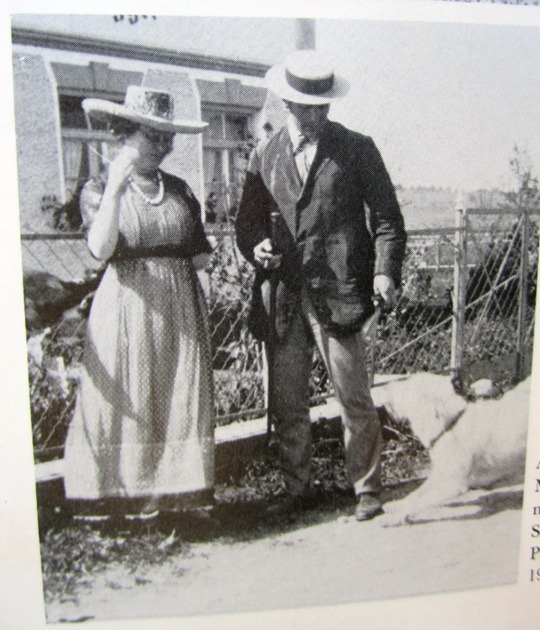
My article related to Franz Marc and his dog, “To Never Know You: Archival Photos of Russi and Franz Marc” has been published in the Fall 2017 issue of Antennae: The Journal of Nature in Visual Culture.
Here is the abstract for the story about Franz Marc and his dog, which also contains some valuable personal insights on vernacular photography from other scholars and benefited from the questions and comments from my Doktormutter Cecilia Novero:
-
This essay examines photographs of the German Expressionist artist, writer, and Tierliebhaber Franz Marc and his dog, Russi, taking the position that one of the most obvious characteristics of Marc’s life his – affectionate and respectful relationship with Russi – has been largely overlooked, though its documentation is clear. I extol the value of what are normally categorised as snapshots in reconstructing animal and human biographies. This raises questions about what photographs are valuable to such research, and why some are used repeatedly and others ignored. Significantly, a previously unknown photograph of Marc taken by his brother Paul in is published for the first time.
Mainly I had wanted to write about discovering this photo of Franz Marc in the DKM/GNM, so here it is again:
Franz Marc, 1914, in Munich. Photo by Paul Marc. Germanisches Nationalmuseum | Des Deutschen Kunstarchivs | Nürnberg
by Jean Marie Carey | 16 Mar 2016 | Animals in Art, Art History, August Macke, Dogs!, Expressionismus, Franz Marc, German Expressionism / Modernism
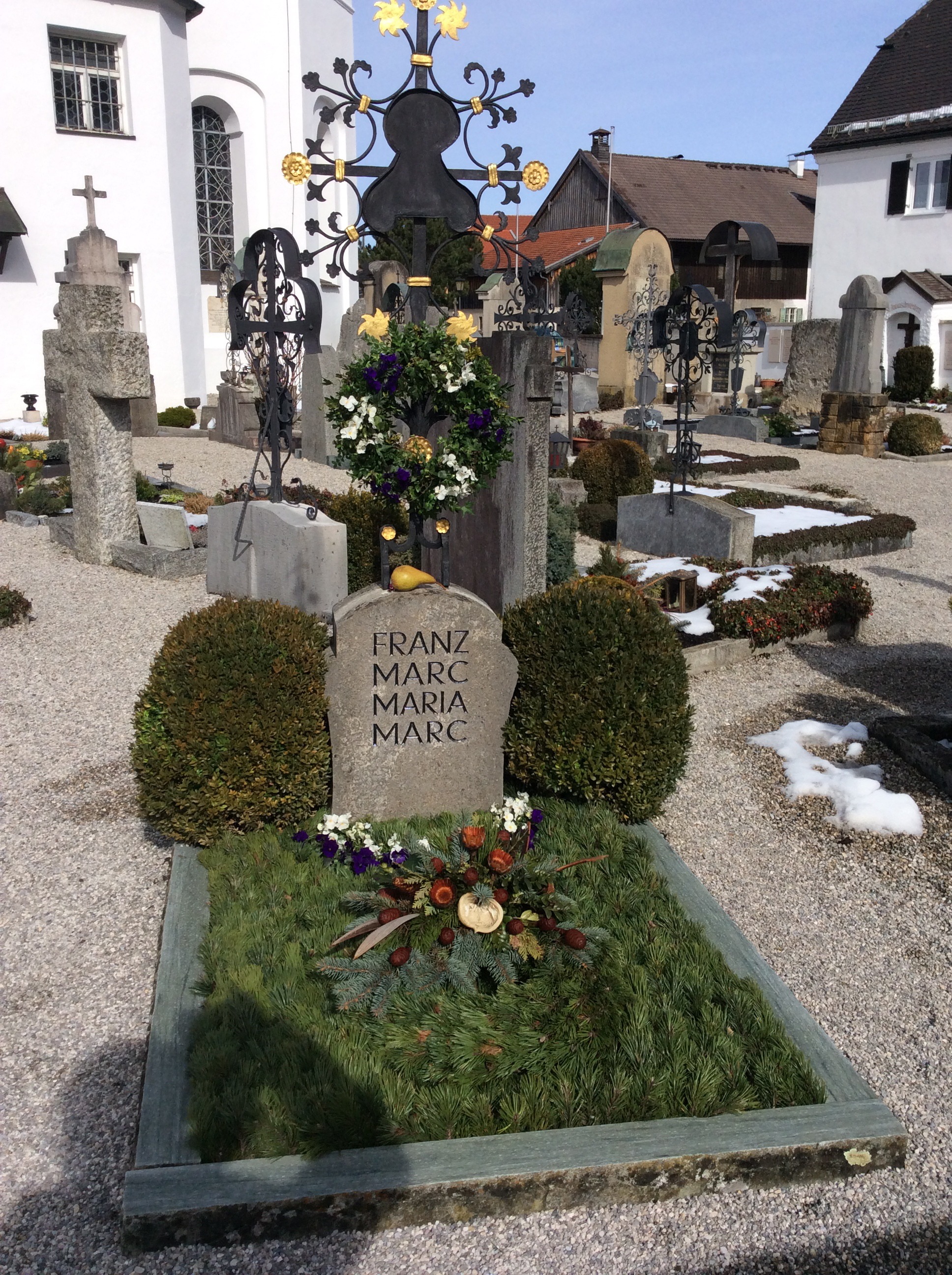
Indexical photo with authorial shadow; graves of Franz and Maria Marc
On 4 March 2016, the 100th anniversary of the death of the painter, animal lover, writer, and ever-elusive person Franz Marc, I visited Marc’s grave in Kochel. Initially I had intended to spend the day between the Lenbachhaus and the Pinakothek der Moderne in München immersed in the paintings I have studied now for many years. But in truth I am devoted to Marc’s life as much as his art, and it seemed more right to take make a pilgrimage and pay respects in the proper sense of the word in the tiny Bavarian town where Marc lived off and on.
This trip was covered on the now-silent Franz Marc Twitter account and received much support and nice wishes from many kind souls.
It was a very emotional experience and had some typical Bavarian humorous adventures as well. I arrived on the regional train at about 11:00 on a dazzling clear, cold day, with most of the snow from the previous week’s blizzard still on the ground. The Ammergau Alps, what Marc called „das blaues Land“, glowed. Inserting itself into this majestic, somber first act was the fact that, in Kochel, Ruhezeit on Fridays apparently begins at 11:00…and this was a very intense Ruhezeit too…everything had abruptly closed, including the flower shop where I had intended to get some violets. I should add that all the flowers and plants were just sitting there outside, and the doors to the shop were open, but the lights were off and the people away being quiet. This was the same at other shops – I have always found it very amusing that in places where Ruhezeit is taken seriously, lunch places also close, even though Ruhezeit is at lunch time, and Kochel takes Ruhezeit quite seriously. In fact it was Friday Ruhezeit the entire time I was there. I stayed until 16:00, the hour of Marc’s death.
(more…)
by Jean Marie Carey | 3 Mar 2016 | Animals, Animals in Art, Art History, Expressionismus, Franz Marc, German Expressionism / Modernism
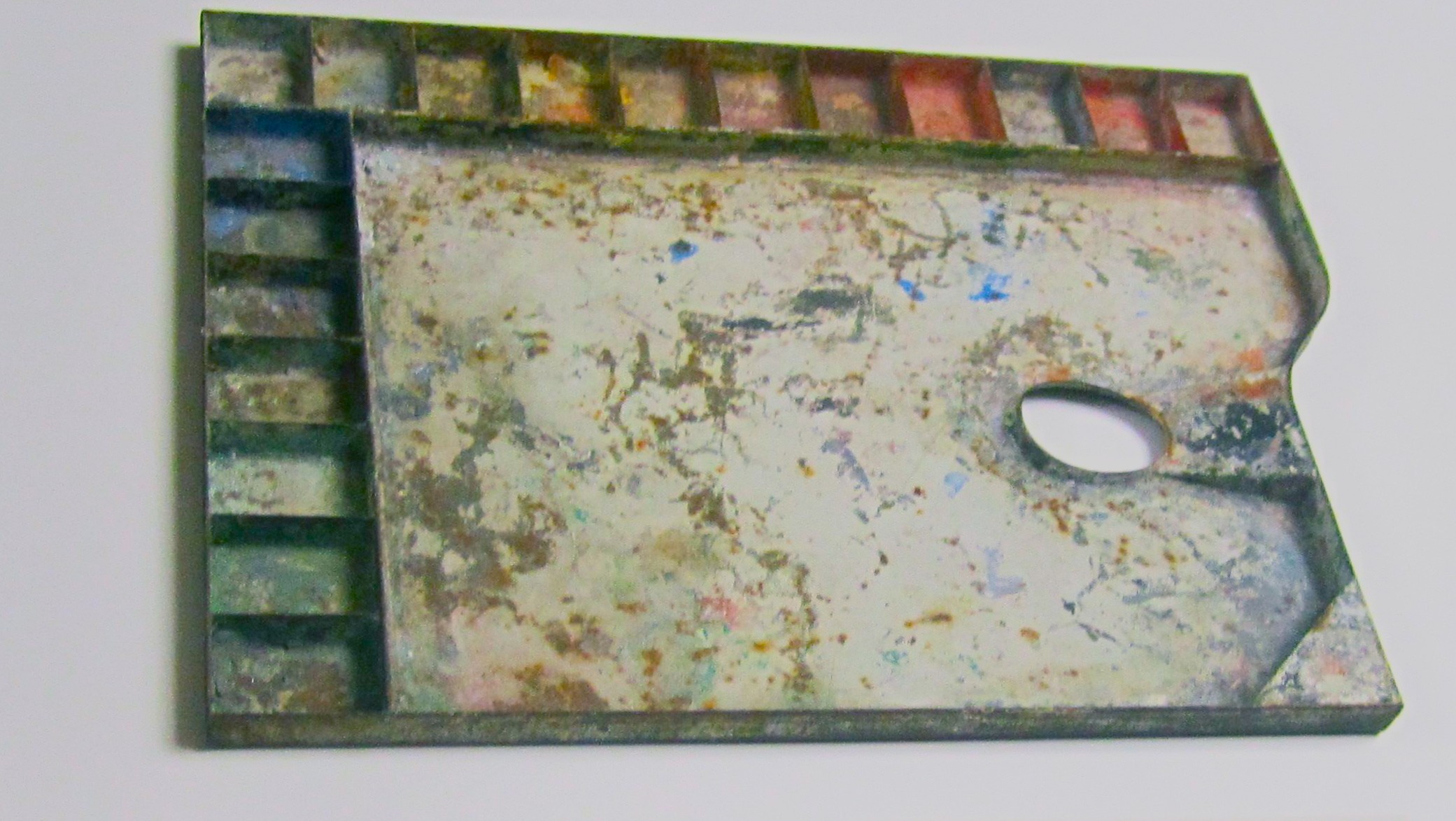
Franz Marc’s palette, from the archives of the Franz Marc Museum, Kochel.
Franz Marc’s “Aphorism 82,” from Die 100 Aphorismen, 1915.
“Ich sah das Bild, das in den Augen des Teichhuhns sich bricht, wenn es untertaucht: die tausend Ringe, die jedes kleine Leben einfassen, das Blau der flüsternden Himmel, das der See trinkt, das verzückte Auftauchen an einem andern Ort, – erkennt, meine Freunde, was Bilder sind: das Auftauchen an einem anderen Ort.”
“I saw what the moorhen sees as it dives: the thousand rings that encircle each little life, the blue of the whispering sky swallowed by the lake, the enraptured moment of surfacing in another place. Know, my friends, what images are: the experience of surfacing in another place.”

by Jean Marie Carey | 28 Jul 2014 | Animals, Animals in Art, Art History, Franz Marc, German Expressionism / Modernism, LÖL
Brigita Hofer cleans, fills, patches, and recolors “Paradies.”
Here is a short article on the ruhr.de website about the restoration of the Paradies mural made by Franz Marc and August Macke in 1912 at the Mackes’ home in Bonn. It’s an interesting little piece and the website also has some photographs of the movement of the mural, in the 1980s, from its original location to the Museum für Kunst ind Kultur/Westfälisches Landesmuseum in Münster, where it lives today (there is a pretty nice replica at the August Macke Haus though). Like a lot of people I am sad that the museums can’t just switch the murals back, but this article sort of explains why that will not happen.
The restorer, Brigita Hofer, has discovered that the mural is pretty structurally unsound, giving it a soundness rating (as happens with earthquake-damaged buildings as I recently learned) of around 25, which means there’s a better than one in four chance it could collapse under any further stress. Hofer has been filling in surface cracks and erosions with non-expanding plaster and emulsifier with the tiniest of syringes. Hofer also restored some of the mural’s damaged or faded paint. In doing so she discovered that Macke and Marc had made a lot of adjustments to the mural as they worked together, repainting Eve’s face and the deer. Hofer also learned from a heretofore covered note that Maria Marc had painted the wasp at the bottom of the mural.
I am fascinated with this mural, as you might guess from how often I write about it, not for the least reason that it seems to be a truly collaborative effort that resulted in a distinct “style” that is identifiably that of both painters but is also a unique meshing of their ideas and talents. Even the animals don’t look exactly like Marc’s other animals, and for both, the palette is a bit subdued. (Except Adam reaching to embrace the monkey on the top left branch though and turning from the other figures – I think that’s a Marc thing. There is a large image of the mural in the post just before this one.)

by Jean Marie Carey | 2 Dec 2011 | Animals in Art, Art History, Dogs!, Franz Marc, German Expressionism / Modernism
Well here it is, the long-awaited sequel to “Franz Marc Holding a Cell Phone.”
One of the things I like so much about Marc is that no matter how much you know about him, there is always something you don’t know, that, when you find out about it, is completely non-disappointing in terms of the fascinating blend of wackiness and gravity expected from Marc.
I especially like this photo because everyone — Maria Marc on the left and Russi Marc on the right — looks happy. Helmuth Macke was staying with the Marcs in 1911 so maybe he was the photographer. One for the road.