by Jean Marie Carey | 9 Feb 2018 | Art History
I have known Mernet Larsen from her role as professor as professor at the University of South Florida’s art studio department, and from her many trenchant and witty remarks on the art situation in Tampa, as well as from her kindness to students and fellow faculty. She made some very telling and compassionate comments at the small memorial for Bradley Nickels some years ago.
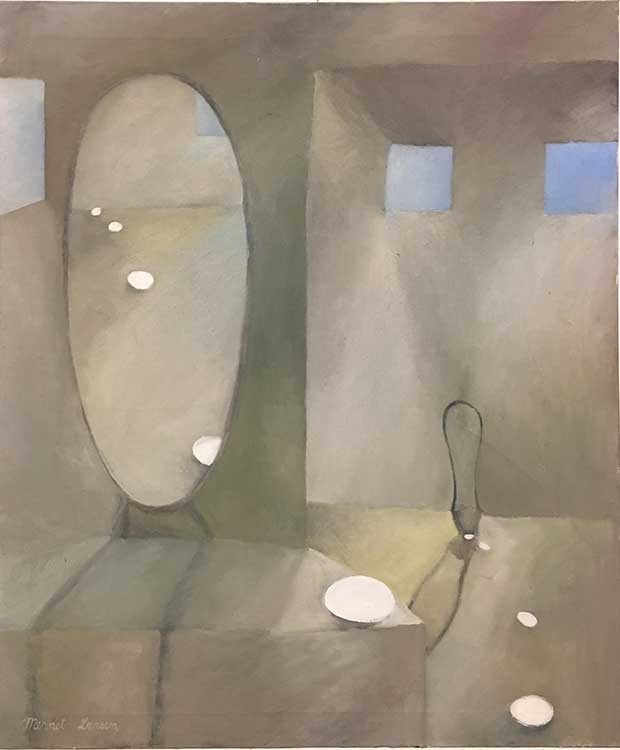
Nonetheless I felt as if I could give this retrospective at the Tampa Museum of Art a fair review and was glad I took the chance to do so for Empty Mirror. Larsen’s painting are intellectually engaging and unclassifiable. Many from Getting Measured, 1957-2017 are reproduced with the article so I will let you look at it on the Empty Mirror website, and it’s also archived as a PDF at the Humanities Commons Core Depository.
Eggs, 1961. Oil on canvas, Courtesy of the artist. © Mernet Larsen
by Jean Marie Carey | 2 Jan 2018 | Art History, Contemporary Art
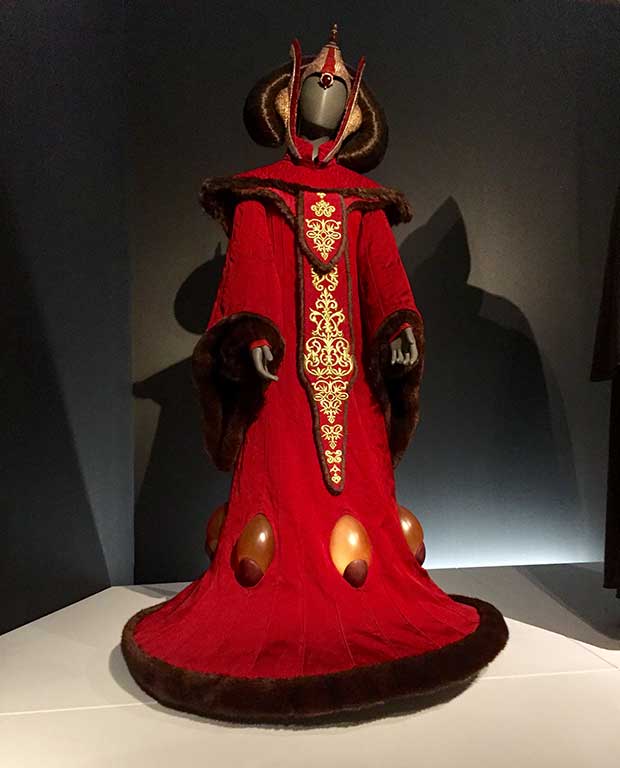
Padmé Amidala’s throne room robes
This is a “locally-coloured” version of this exhibition review. See the “professional” iterations at Humanities Commons or on the Museum Bookstore website.
On view through the spring, this exhibition features 60 costumes representing characters from the Star Wars film saga from A New Hope in 1977 through The Force Awakens in 2015. These outfits are accompanied by selected accessories: props such as light sabers and artists’ sketches of how the costumes, and characters were originally envisioned and evolved. As a group the costumes highlight the intricacy of theatrical and cinematic clothing design. Membership in the cult of Star Wars is not a prerequisite for their appreciation.
These costumes and the drawings giving their background illustrate the evolution from storyboard to screen, and then of the characters who wear these ornaments and attributes. The earlier pieces from the original trilogy – The Empire Strikes Back (1980) and Return of the Jedi (1983) followed A New Hope – are closely allied to the vaguely fascistic, neo-classical iconography favoured by creator George Lucas. These styles – Reich-referencing Imperial officer and Stormtrooper uniforms, the togas and cloaks for Jedi masters Obi-Wan Kenobi and Luke Skywalker – tend to be simplified and literal. As the series progressed with Episodes I, II, and II I – The Phantom Menace (1999), Attack of the Clones (2002), and Revenge of the Sith (2005) – the prequels that appeared fourth, fifth, and sixth in order of release – costumes for both the Republic officials such as Bail Organa and Imperial minion Darth Sidious tend to be highly decorated while more referentially abstract. Particularly the scarlet robe and ornate crown for Princess-Senator Padmé Amidala Naberrie’s Phantom Menace throne room garb, which greets visitors at the exhibit’s entrance, is a marvel. The dazzling effect of the wardrobe of Padmé, portrayed in the films by Natalie Portman, was achieved by the imaginative and subtle use of beads, paillettes, layers of leggings and petticoats, and embedded electronics. Her trains of shimmering brocade and elaborate ceremonial gowns and headdresses show strong influences from feudal Mongolia and Shōgun era Japan. I was astonished to see the level of handicraft and detail given to each garment, having assumed that costumes in a fantasy epic were embellished by computer-generated animations such as those that brought Katniss Everdeen’s “flame” gown to the screen in The Hunger Games: Catching Fire (2013).
(more…)
by Jean Marie Carey | 13 Dec 2017 | Animals in Art, Art History
I was pleased to be asked to write a commemorative post for the Humanities Commons Platypus blog in honour of HC’s first anniversary. You can read the full text here or after the jump. (more…)

by Jean Marie Carey | 20 Oct 2017 | Art History, Re-Enactments© and MashUps
During 2013 when I lived in München Gillian Wearing had a mid-career retrospective at Museum Brandhorst and a poster of the image you see here, “Self Portrait at Seventeen Years Old” (2003) was on placards all over the city as well as a huge replica on the side of the museum.
Gillian Wearing, “Self Portrait at Seventeen Years Old,” 2003; Claude Cahun, Self-Portrait, 1928.
The capstone nature of the show at least intimated that Wearing was moving on to subjects other than herself and I remember thinking that perhaps at last we had reached “peak self portrait.” This proved not to be the case specifically or generally.
I decided to review the catalogue of this exhibition in the hopes of re-examining Wearing and also setting the record correct about one of my favorite photographers, Claude Cahun. I feared when Gillian Wearing and Claude Cahun: Behind the Mask, Another Mask was announced at the National Portrait Gallery in London that is would offer yet another opportunity for female erasure, which is what happened in reviews such as this one from Aindrea Emelife of the BBC shrieking: “Claude Cahun: The Trans Artists Years Ahead of Her Time.”
In fact Cahun was a woman, a lesbian woman, who was perfectly comfortable with her biological sex. She was sentenced to death during her time on Nazi-occupied Jersey for refusing to renounce her lifetime lover, Marcel Moore, so it seems especially egregious to suggest Cahun wavered in her “identity.”
One of the most distinctive aspects of Cahun’s auto-portraits is that her strong features are never obscured, she is always recognisably herself, no matter what the costume or haircut. This is something Wearing, in her response to Cahun’s oeuvre, seems also to diminish, as the series made for this exhibition find Wearing immersed in full disguises as Cahun, Robert Mapplethorpe, Dian Arbus, and others.

Claude Cahun, “Untitled (I Am in Training, Don’t Kiss Me,” 1929; Gillian Wearing, “Self Portrait as Claude Cahun,” 2015.
(more…)

by Jean Marie Carey | 21 Jul 2017 | Art History, Franz Marc, German Expressionism / Modernism, LÖL, Re-Enactments© and MashUps
Much as I enjoy burying the lede, the headline on this story is that I found a heretofore unpublished photo, and this is the Franz Marc photo, taken in the spring of 1914 by the artist’s brother, Paul Marc, in Munich:
Franz Marc, 1914, in Munich. Photo by Paul Marc. Germanisches Nationalmuseum | Des Deutschen Kunstarchivs | Nürnberg
The whole story of finding the Franz Marc photo and a thorough analysis of why it might be that significant images of people and animals are overlooked is forthcoming in the second part of the “Exposing Animals” sequence of Antennae: The Journal of Nature in Visual Culture in September, and this photograph and some others will be reproduced there, but it is also appearing in a different kind of work I did for Empty Mirror Books that comes out this week, so I decided to post it, finally (I first found it in 2015!), here today.
Beyond standing as a strong reminder that there is so much we have not yet learned about the historical avant-garde, this is just a wonderful photograph, “eerie and magnificent,” as Marc would say, so I will just leave it at that for now.
