by Jean Marie Carey | 24 Nov 2015 | Art History, Expressionismus, Franz Marc, German Expressionism / Modernism, Re-Enactments© and MashUps
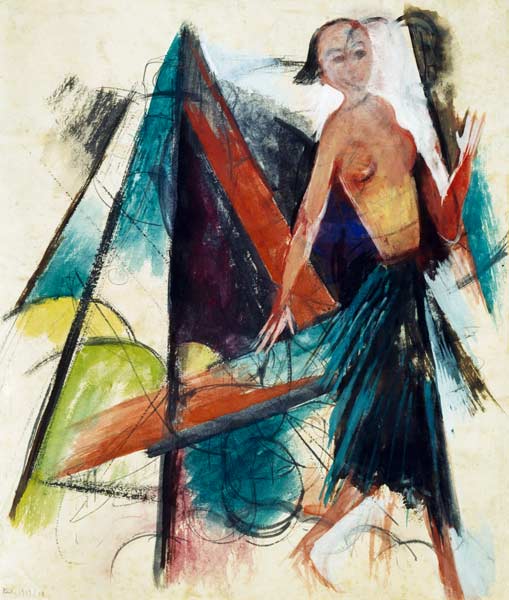
Miranda, 1914
So I am pleased and grateful to report the publication of my first peer-reviewed anthology chapter in the journal Expressionismus in the special issue Der performative Expressionismus. The article is called “‘Der Sturm’ und die Wilden.? Franz Marcs Entscheidungskampf mit der Theatralität,” which translates imperfectly to something like “‘The Tempest’ and the Savages: Franz Marc’s Decisive Encounter with Theatricality.” (Entscheidungskampf can also mean something like Armageddon/scorched earth, which in this case is accurate.)
The article is currently behind the Neofelis Verlag paywall (for a very reasonable €13), but you will soon find it on JSTOR and elsewhere. If you have any questions about how to view article please email me.
This side project to my main research corrects some chronological errors that have consistently been repeated in both Expressionist and Dada literature about the collaboration of Franz Marc and Hugo Ball on a planned production of The Tempest at the Münchner Kammerspiele. Because the story takes place in early 1914, it has been tempting for scholars – some of them quite formidable – to conclude that it was the war that usurped these plans. However, that is not at all the case.
“What really happened” is of course quite interesting on its face and as a reminder that we in fact know very little in the way of actual facts about the historical avant-gardes, who are fast disappearing into hagiography.
More interesting to me, in terms of writing and research, was the analysis of the two small drawings Marc made as character studies of The Tempest’s Miranda and Caliban personalities. This is the first time these drawings, housed in the Kunsthalle Basel, have been subjected to such scholarly scrutiny and each contains many clues and psychological implications.
I was also intrigued to discover that Marc had sent a draft of his June 1914 essay »Das abstrakte Theater,« (also analyzed in the article) about his frustrating foray into the theater to August Macke, and that the two had previously had many exchanges about the performing arts. In fact it is clear that the very precocious Macke – who at only 21 had been the chief set designer for the theater in Düsseldorf – had had a great influence on Marc’s ideas on the subject – ideas being the key word, since Marc had no firsthand dramaturgical knowledge up until this point.
My colleague here at the university, Prof. Dr. August Obermayer, was the very gracious translator but he also provided invaluable editing and advising, and the Neofelis editors were also a pleasure to learn from.
All in all a great experience and I hope readers will find the unraveling of Expressionist mysteries as fascinating as I do.

Caliban, 1914
by Jean Marie Carey | 29 Aug 2015 | Animals, Franz Marc, German Expressionism / Modernism
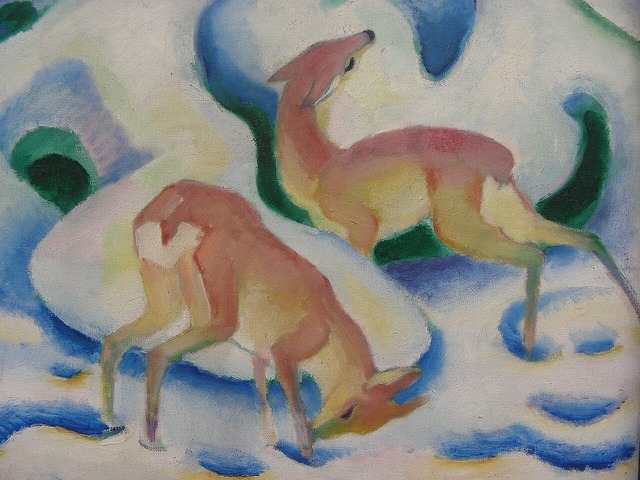
My 2012 M.A. thesis, Franz Marc as an Ethologist, is now part of the online collection of the open-access Social Science Research Network (SSRN). You can download it or look at the abstract here.
UPDATE: I just can’t with Elsevier’s involvement with SSRN. In addition to Elsevier being generally evil, not supporting open access, and ruining the Pergamon imprint, more than a year after acquiring SSRN, there is still no discrete art history rubric, or way for authors to track who is looking at their work. But mainly Elsevier is garbage.
Franz Marc, Rehe im Schnee II, 1911, one of Marc’s paintings discussed in my thesis.
by Jean Marie Carey | 6 Apr 2015 | Animals, Animals in Art, Art History, August Macke, Dogs!, Expressionismus, Franz Marc, German Expressionism / Modernism, LÖL
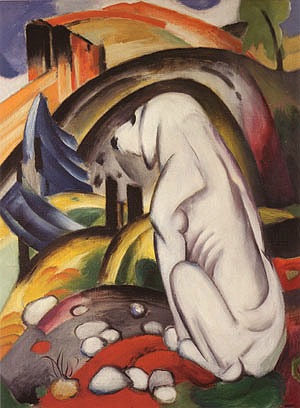
Hund vor der Welt, Franz Marc (1912). Oil on canvas, 118 by 83 centimetres, private collection, Switzerland
I write about this painting a lot – in fact I once, for quite a long time, devoted my academic research solely to this painting – but I realised I don’t often say anything about it in this space. So here is a little excerpt not from my current chapters but from a side project.
§ § §
Franz Marc made an innovative painting – a metaphysical genre portrait of his dog Russi – called Hund vor der Welt in the spring of 1912. The large vertical canvas shows the white hound seated on a hillside, facing the sun and the landscape at an angle across an indeterminate space. We have an account of what Marc had in mind in making this image in particular and Marc’s other thoughts about painting his frequent model.[1] There is also a substantial amount of documentation about Russi, the dog, who, as the artist’s constant companion, was a character who populated the art, photographs, and writing of other people. We even know where Russi was born, how he came as a puppy to live with Marc, and when he died.[2] So despite its slightly whimsical affect, Hund vor der Welt is an image of a real dog about whom much historical information is available. Marc made many paintings in which Russi also appears as a peripheral regular “character;” he leads the way in Im Regen (1912) and leaps after Die gelbe Kuh (1911).
August Macke, who came into frequent contact with Russi and made his own drawings of the dog, prevailed upon Marc to change the name of the painting from the one Marc originally had in mind, So wird mein Hund die Welt sieht.3 We know from Marc that he wanted to show Russi in thought, so the dog’s seated posture suggests that this is what is happening in the stillness. The strange view of the landscape Russi “sees” is nonetheless completely identifiable as a typical one from around Sindelsdorf where Marc lived. By placing buildings in the recognizable, managed farmlands of Bavaria, Marc suggests that people and animals are part of the same ecology, which, for dogs as the primary animal of domestication, is certainly true.
Russi did not have the life of a working dog, instead, with Marc, dividing his time between Munich, Berlin, and the small towns of Sindelsdorf and Ried. Russi lost part of his tail in 1911, an adjustment to his appearance that is reflected in his 1912 portrait. This shows that Marc had a commitment to showing morphologically accurate details even about the animals he painted, even as the paintings themselves broke with academic naturalism.
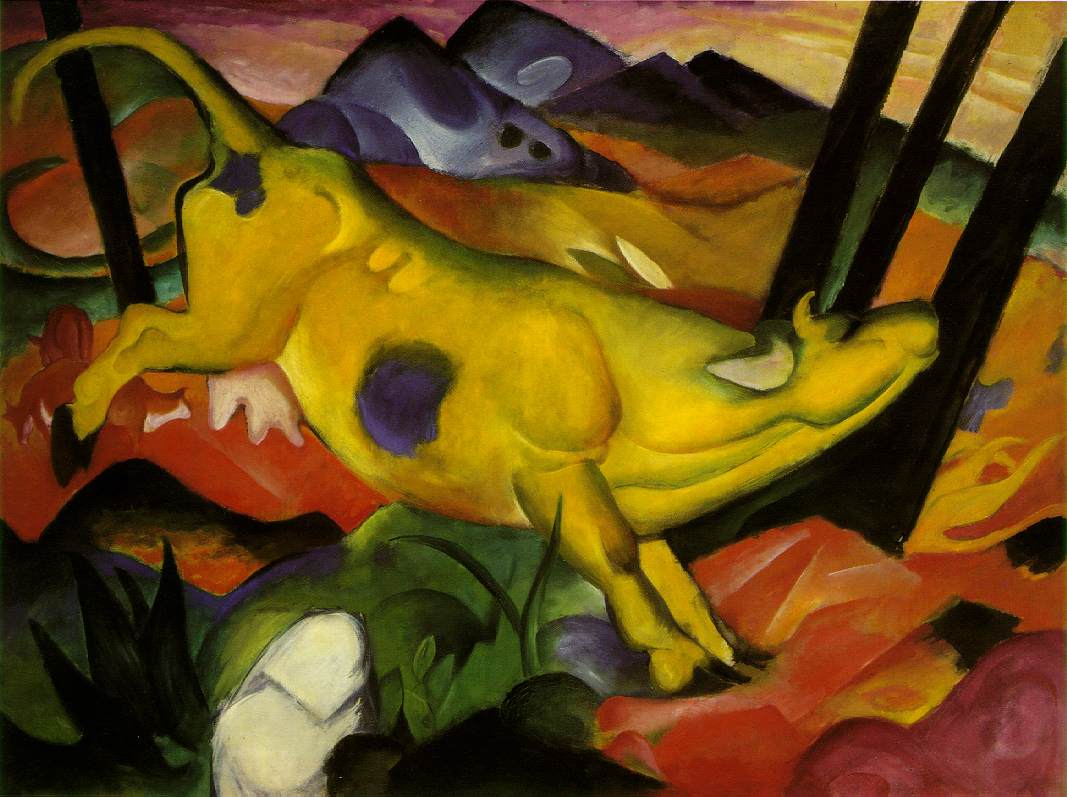
Die gelbe Kuh,
Franz Marc, 1911
189.2 × 140.52 cm
Oil on canvas
Solomon R. Guggenheim Museum, New York. That is Russi Marc in the lower left corner.
[1] Franz Marc, Briefe, Schriften und Aufzeichnungen, (Leipzig: Kiepenheuer, 1989), 11. Observing Russi at this moment, Marc wonders: “Ich möchte mal wissen, was jetzt in dem Hund vorgeht.”
[2] Marc, Briefe, 196-197.
[3] Franz Marc, August Macke, Briefwechsel, (Köln: DuMont, 1964), 124-126.

by Jean Marie Carey | 3 Mar 2015 | Animals in Art, Art History, August Macke, Franz Marc
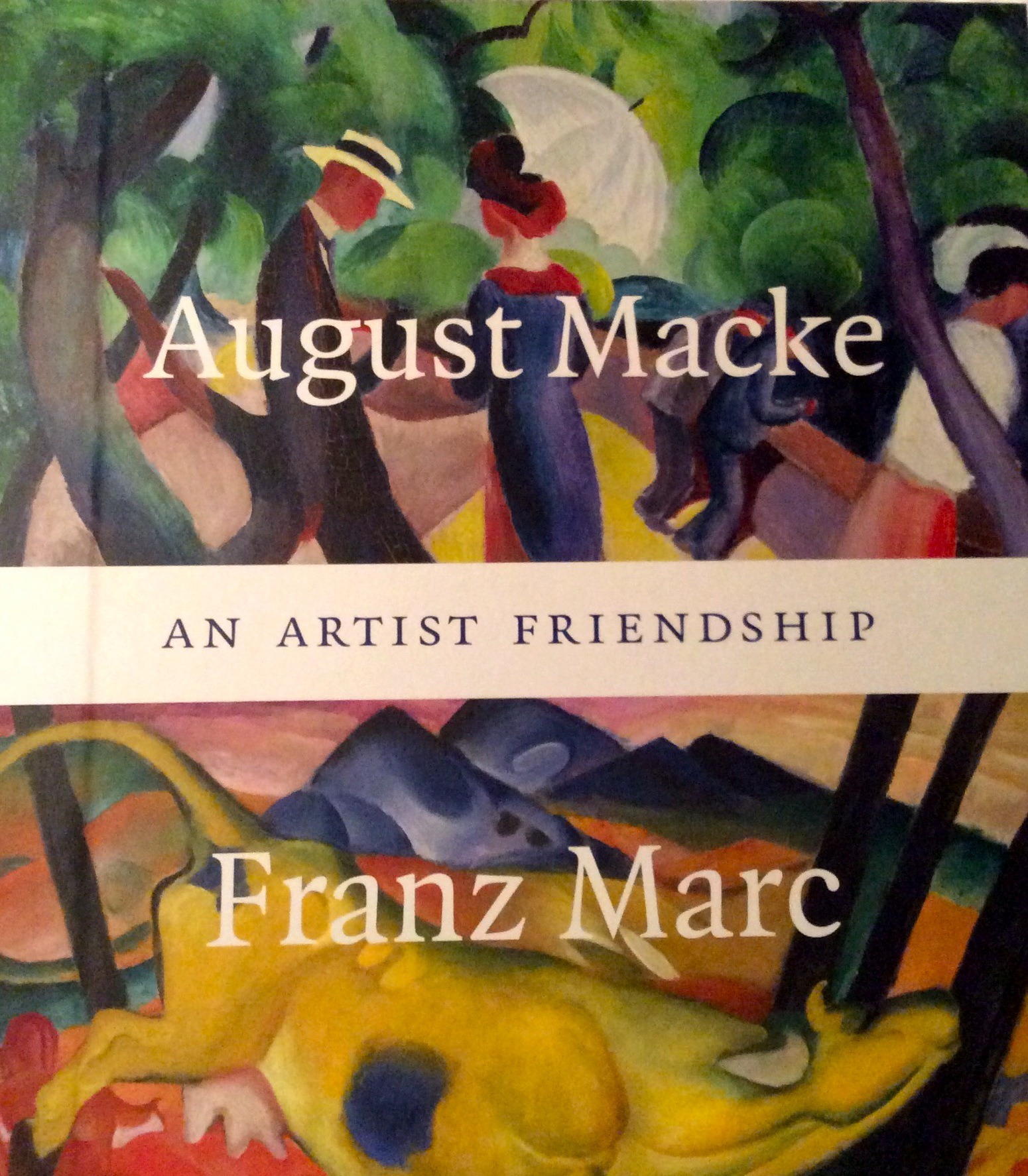
Today is the 99th anniversary of the death of Franz Marc. (Marc would have really liked someone who also died this week, Leonard Nimoy and Nimoy’s Mr. Spock character from Star Trek.) I didn’t write my normal “Franz Marc’s Birthday” post (Marc’s birthday is 8 February) this year because the idea of the grief we feel for Marc and August Macke has been much on my mind. This is partly owing to my own research, but also to do with the publication of the catalogue attendant to the Lenbachhaus’s current exhibition, August Macke und Franz Marc: eine Künstlerfreundschaft (August Macke and Franz Marc: An Artist Friendship in English).
The catalogue is, not surprisingly, a tour-de-force of editing and research by longtime Lenbachhaus Blaue Reiter curator Annegret Hoberg and Volker Adolphs of Kunstmuseum Bonn. What is unexpected is that the editors and included authors bring to bear not just a wealth of knowledge but so much compassion to these essays, confronting directly the loss and sadness we naturally feel over the too-short lives of Marc and Macke.
This is not to say the entries are not impeccably scholarly; Hoberg’s “August Macke and Franz Marc / Ideas for a Renewal of Painting” and Adolphs’ “Seeing the World and Seeing Through the World / Nature in the Work of August Macke and Franz Marc” are classic art historiography based in peerless analysis. Gregor Wedekind’s “The Masks of the Savages / Primitivism and Cultural Critique in the Work of August Macke and Franz Marc” was of particular interest to me as it underscores how the work of the avant-gardes was received in its time as a shocking departure from what the world then considered “civilized” painting. There are a few small errors marring Klara Drenker-Nagels’ otherwise illuminating discussion of the relationship between Maria Marc and Elisabeth Erdmann-Macke that I’m sure will be corrected in subsequent editions.
Of special delight in terms of the arrangement and presentation of the catalogue are some shorter, data-packed chapters on the Paradies (1912) mural and other anecdotes about Marc’s and Macke’s overlapping but very different lives.
Of course the catalogue is rich with the paintings, weavings, sketches, and photos that grace the exhibition itself. As a discrete publication, this is one that must truly be enjoyed as a book – I received it on a Friday afternoon and spent the entire weekend poring over every image, footnote, and phrase, alternately smiling and wiping away tears. Turning the last page, I was filled with admiration for this Lenbachhaus-Kunstmuseum Bonn collaboration, every word written with love.
by Jean Marie Carey | 21 Jan 2015 | Animals, Animals in Art, Art History, August Macke, Expressionismus, Franz Marc, German Expressionism / Modernism, Helmuth Macke, Re-Enactments© and MashUps
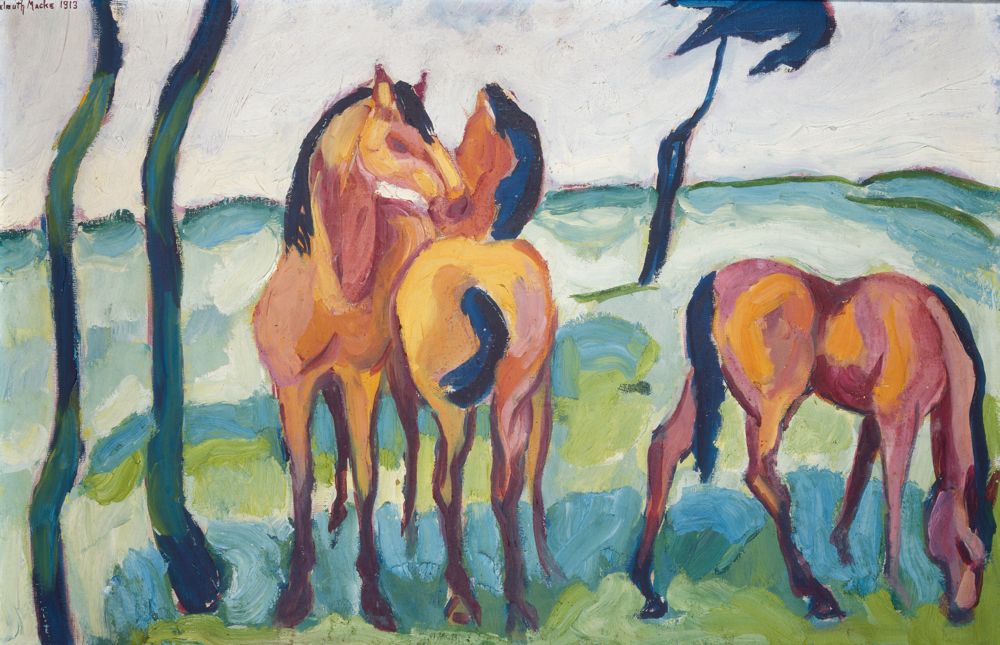
Helmuth Macke,
Drei Pferde,
1913
“The ‘boarding school’ is in session,” Franz Marc wrote nervously to his friend August Macke.[1] Pining for company in the same letter, Marc nonetheless wondered if August should come and get Helmuth Macke, August’s young cousin, whom the Macke family had deposited some weeks earlier at Marc’s small apartment in rural Sindelsdorf. It was late November 1910. Marc would soon turn 31, and Helmuth was 18. Until Helmuth’s arrival, Marc had been working alone for some time. At the insistence of her concerned parents, Maria Marc had returned to Berlin. Marc was just beginning to see the slightest of incomes from his painting, but he was irritable and distracted. And now August, himself adjusting with his wife Elisabeth to the birth of their son, expected Marc to find ways to entertain a teenager.
Yet Helmuth was resourceful and clever. During the weeks in Sindelsdorf, (which become months and longer: “Helmuth’s fine, he’s still growing,” Marc reported the following summer)[2], Helmuth taught himself enough Dutch to communicate with Heinrich Campendonk; chopped wood and built a fence; practiced painting and drawing, befriended Marc’s dog Russi; and demonstrated a talent for cooking and baking. This latter skill commanded Marc’s particular favor. Animated but sympathetic, Helmuth provided stability and encouragement. By Christmas Marc had breezily informed August that Helmuth would be staying on.[3]
As the calendar turned to 1911, the chrysalis of Sindelsdorf opened and released a new Marc to Munich. Seeking a sophisticated way to celebrate New Year’s, Helmuth pointed Marc toward a performance of Arnold Schönberg quartets. The music had a vivid impact on Marc, which he reported with great excitement to Maria, August, and a new friend who had missed the concert – Wassily Kandinsky. At a the soirée given by Marianne von Werefkin at which Marc and Kandinsky met at last in person, Helmuth was at Marc’s side, and witnessed the twinkle in the eye of fate that became Der Blaue Reiter.[4]
After the party, Helmuth and Franz took the late train from Munich to Penzburg, laughing and marveling over their adventure as they walked jauntily through the falling snow back to Sindelsdorf. Neither traveler was concerned for the future at that joyful moment, and mercifully, neither could know what the future held.
Helmuth Macke died in 1936 when his small boat capsized in a sudden storm on Lake Constance, having given his sailing companion the only life preserver.
[1] Franz Marc, August Macke: Briefwechsel. (Köln: DuMont, 1964), 20-21.
[2] Marc and Macke: Briefwechsel, 42.
[3] Marc and Macke: Briefwechsel, 28.
[4] Dominik Bartmann, Helmuth Macke, (Recklinghausen: Verlag Aurel Bongers, 1980), 26.