
by Jean Marie Carey | 12 Jan 2018 | Art History, August Macke, Franz Marc, Re-Enactments© and MashUps
My research about the 1914 Franz Marc essay »Das abstrakte Theater« and Marc’s collaboration with Hugo Ball on an intended production of The Tempest has been published in a special arts issue of Empty Mirror. The fun long title of the article is “The Tempest and the Savages: Franz Marc, Hugo Ball, and a Decisive Moment in Dada-Expressionist Theater With a Special Appearance by August Macke,” and this piece contains important breaking historical avant-garde news.
Fig.01: Franz Marc, Fragmentary First Page of „Das abstrakte Theater,“ 1914. Das Archiv für Bildende Kunst im Germanischen Nationalmuseum, Nürnberg, Germany.
Here is the abstract: This article discusses the 1914 Franz Marc essay “Das abstrakte Theater” and the events surrounding an “Expressionist” production of Shakespeare’s Der Sturm planned by Marc and Hugo Ball the same year. Marc’s position in this detour from painting and writing can be understood in terms of his embrace of “die ‘Wilden’” – “the ‘Savages’” – an idea Marc introduces in 1912’s Blaue Reiter Almanac – as a metaphorical aspiration and as a state of being for both artists and the public as patrons of the arts and citizens of modernity. I also bring recognition to August Macke’s background in theatrical theory and design in terms of how this influenced Marc, particularly in analysis of the artists’ collaboration on Macke’s contribution to the Blaue Reiter Almanac, the essay “Die Masken,” and how this relates to the Der Sturm project. I propose a way of understanding how Marc’s beliefs in the paradoxically beneficial power of destruction dovetailed with Ball’s theology. In the context of this background information I give close reading of paintings Marc made of the Caliban and Miranda characters from Der Sturm. I also correct inaccuracies in the record regarding the chronologies of this encounter between these protagonists of Dada and Expressionism, and in our understanding of Marc’s text itself. Viewing this data in a holistic manner allows new interpretations of influences and collaborations amid the historical avant-garde.
It is great working with Denise Enck at Empty Mirror so it would be nice to look at the article on the Empty Mirror website, but if you would like a PDF of the article there is one here and also at Humanities Commons.

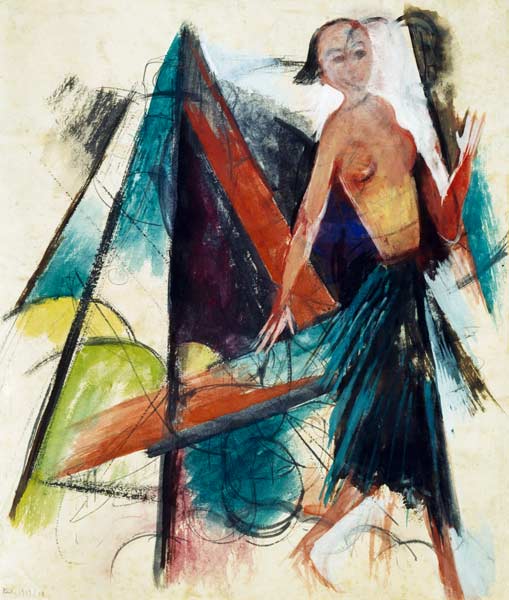
Fig.04: Franz Marc, Miranda, 1914. ( Tempera, 46 x 39.5 cm.) Kunstmuseum Basel, Kupferstichkabinett der öffentlichen Kunstsammlung, Switzerland.
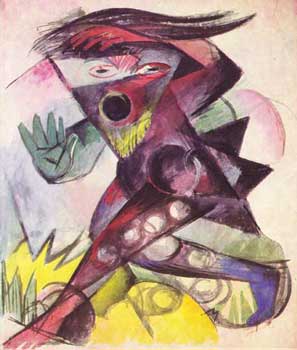
Fig.03: Franz Marc, Caliban, 1914. (Figure for Shakespeare’s „Der Sturm“. Tempera, 46 x 39.5 cm.) Kunstmuseum Basel, Kupferstichkabinett der öffentlichen Kunstsammlung, Switzerland.
by Jean Marie Carey | 24 Nov 2015 | Art History, Expressionismus, Franz Marc, German Expressionism / Modernism, Re-Enactments© and MashUps
Miranda, 1914
So I am pleased and grateful to report the publication of my first peer-reviewed anthology chapter in the journal Expressionismus in the special issue Der performative Expressionismus. The article is called “‘Der Sturm’ und die Wilden.? Franz Marcs Entscheidungskampf mit der Theatralität,” which translates imperfectly to something like “‘The Tempest’ and the Savages: Franz Marc’s Decisive Encounter with Theatricality.” (Entscheidungskampf can also mean something like Armageddon/scorched earth, which in this case is accurate.)
The article is currently behind the Neofelis Verlag paywall (for a very reasonable €13), but you will soon find it on JSTOR and elsewhere. If you have any questions about how to view article please email me.
This side project to my main research corrects some chronological errors that have consistently been repeated in both Expressionist and Dada literature about the collaboration of Franz Marc and Hugo Ball on a planned production of The Tempest at the Münchner Kammerspiele. Because the story takes place in early 1914, it has been tempting for scholars – some of them quite formidable – to conclude that it was the war that usurped these plans. However, that is not at all the case.
“What really happened” is of course quite interesting on its face and as a reminder that we in fact know very little in the way of actual facts about the historical avant-gardes, who are fast disappearing into hagiography.
More interesting to me, in terms of writing and research, was the analysis of the two small drawings Marc made as character studies of The Tempest’s Miranda and Caliban personalities. This is the first time these drawings, housed in the Kunsthalle Basel, have been subjected to such scholarly scrutiny and each contains many clues and psychological implications.
I was also intrigued to discover that Marc had sent a draft of his June 1914 essay »Das abstrakte Theater,« (also analyzed in the article) about his frustrating foray into the theater to August Macke, and that the two had previously had many exchanges about the performing arts. In fact it is clear that the very precocious Macke – who at only 21 had been the chief set designer for the theater in Düsseldorf – had had a great influence on Marc’s ideas on the subject – ideas being the key word, since Marc had no firsthand dramaturgical knowledge up until this point.
My colleague here at the university, Prof. Dr. August Obermayer, was the very gracious translator but he also provided invaluable editing and advising, and the Neofelis editors were also a pleasure to learn from.
All in all a great experience and I hope readers will find the unraveling of Expressionist mysteries as fascinating as I do.

Caliban, 1914
by Jean Marie Carey | 8 Dec 2013 | Animals, Animals in Art, Art History, Franz Marc, German Expressionism / Modernism
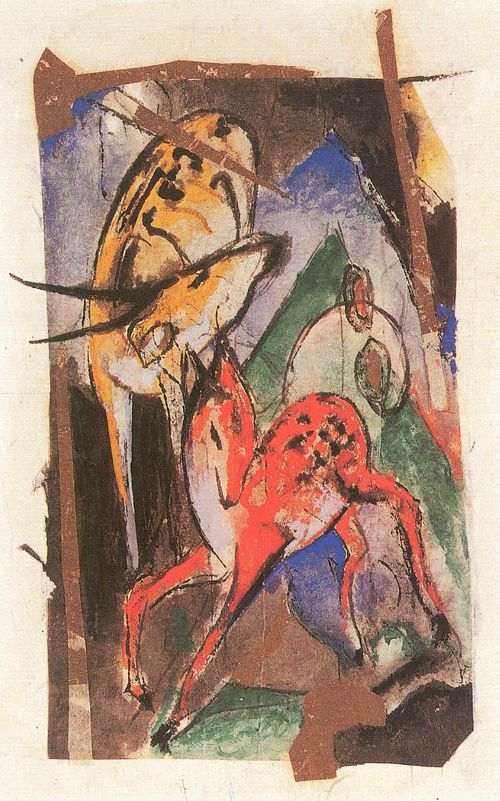
Franz Marc, Rotes Reh und gelbe Antilope, 1913, Mischtechnik und Collage (Silberpapier)
So, Franz Marc always said he was from the future…he amended the amount of how far in the future to 50, then 150, then “about 150 to 500 years” as his own time ran out, and often when saying this was expressing a complaint about his contemporaries that in 2013 we could characterize as: Haters gonna hate.
The recent (and continuing unabated in München) interest over the paintings stolen and hoarded by Hildebrand Gurlitt and his son, Cornelius Gurlitt, has turned to a conversation about the meaning of ‘ownership’ of priceless artworks probably at the very, very, very least obtained via coercive means, and the role of art dealers in the procuring of art and broker of deals for artists.
I began to think about this discussion, in an earlier version though informed by perspicacity, in terms of Marc, who always had a lot to say about art dealers, ranging from the fatalistic to a kind of grudging respect to affection and back, in the case of Hans Goltz, to sputtering but somewhat amused indignation. It seemed beyond the realm of possibility that Marc had encountered the Gurlitts, as Hildebrand Gurlitt was not born until 1895. However I should learn never to ‘bet’ against Marc’s knack for knowing somehow what someday would be meaningful. So, of course he knew the Gurlitts, in the form of the Fritz Gurlitt Gallery, through the eponymous owner and Fritz Gurlitt’s son, Wolfgang (the first cousin of Hildebrand), who had taken over the Berlin gallery and brokerage in 1907.
I was very excited to discover in revisiting Marc’s correspondence with August Macke the followng passage, in which Marc describes his interaction, with Wolfgang Gurlitt (the entire letter follows the break):
Sindelsdorf bei Penzberg, den 12. III. 13 Oberbayern
Lieber August,
… Das Beispiel Pechstein ist für mich typisch. Ich habe kein reines Gefühl mehr vor seiner Persönlichkeit. Mir ist höllisch Angst vor einer Popularität wie der seinen. Nolde tut auch keinesfalls mit, die ›Brücke‹ hat sich bis jetzt auch gesträubt. Aber was die tun, ist mir schliesslich auch nicht ausschlaggebend; wenn sie mittun, ist es ›der Not gehorchend, nicht dem eignen Triebe‹. Meier-Graefe hielt letzthin in München einen Vortrag, in dem er uns alle als Geschäftsmacher bezeichnete und das Publikum aufforderte, es solle sich gegen uns verbinden etc.!! Und Cassirer denkt im Grunde genau so. Mit diesem Kreis will ich nichts zu tun haben. Ich habe die Erfahrung gemacht, dass, wer was von mir haben will, zu mir selber kommt. Wer sich für mich und uns alle interessiert, geht sehr wohl in den ›Sturm‹ und kauft auch dort; der ›Sturm‹ ist als Ausstellungsraum glänzend, riesengross, gutes Licht, dunkle Wände; Ich hab recht gut dort verkauft; tout Berlin braucht gar nicht hinzugehen, ist mir viel lieber so. Gurlitt bedrängt mich seit Monaten, ich soll doch nur bei ihm ausstellen; ich habe ihm jetzt durch Niestlé sagen lassen, wenn er mich durchaus für seinen Salon braucht, soll er mit kaufen anfangen. Auf dem Ohr scheint er aber taub zu sein; wozu soll ich dann bei ihm statt im ›Sturm‹ ausstellen? Ich war dreimal in Berlin (wegen Niestlé) dort und habe, glaube ich, einen einzigen Besucher dort getroffen. Legros war ebenfalls öfters in der Niestlé – und gleichzeitig Pechstein-Ausstellung und traf nie einen Menschen dort. Wenn was Interessantes dort ist, geht man hin, so gut wie in den ›Sturm‹. Tu Du, wie es Dir am besten scheint; ich will mich zurückhalten; ich fühle es als Pflicht gegen meine Ideen über das Ziel unserer Arbeit, das nicht über den Weg der Berliner ›Sommerausstellungen‹ zu erreichen sein wird. Du schimpfst oder lachst, – ich bin nun einmal so. Dass Du Kandinskys Vier Klänge ›schlecht‹ findest, ist mir vollkommen unverständlich; ich denke das Gegenteil: sehr gut. …
One of the things I always like about Marc is that although he is (vaguely) aware of the practical importance of money and often worries about not having any, neither can he be easily enticed or motivated by it (no one seems ever to tried the ‘immediate gratification’ tactic of food, alcohol, cigarettes ‘oder sonst was.’). Also, for a mostly guileless and impetuous person, Marc could sometimes machinate fairly well…
Here Marc tells August of Gurlitt’s persistence in trying to have some dealings with him. On the one hand, Marc doesn’t really have any intention of bailing on the Der Sturm enterprise, but on the other, he wants to keep a line into Gurlitt on behalf of his longtime friend, neighbor, and fellow animal lover and animal painter, Jean-Bloé Niestlé, whose drawings of birds, while very skillful, fell somewhat outside the concern of the avant-gardes. He says Gurlitt actually seems a bit out of it in terms of critical culture, and that, further, no one ever seemed to be at the gallery anyway. It’s interesting that Marc expends a lot of effort trolling Gurlitt for Niestlé, and also that (this is a long and very affctionate letter) that he takes the opportunity to inject a comment preemptively defending Wassily Kandinsky to August, who was not a fan: ‘I think the opposite: very good.’
Actually, in the next few months, the Gurlitt gallery, which had already seen the first and only Brücke group show in 1912, will have a very successful Henri Matisse solo show, followed in 1914 by consecutive spaces devoted to Ernst Ludwig Kirchner, Erich Heckel, and Karl Schmidt-Rottluff, and the handling of all of Lovis Corinth’s prints, and printing portfolios and catalogues of work by Pechstein and Oskar Kokoschka. This probably goes to show that Marc was right to trust his instincts…
In any case it is quite amazing that Marc was very aware of the family who would one day sell Tierschicksale to Kunstmuseum Basel (still waiting to hear the explanation for that) and keep a Blauen Pferde hidden for seven decades. I picked this multimedia print work by Marc because it was made almost exactly 100 years ago, when Marc wrote this letter to August. It’s also very unusual for Marc in that it is truly a collage – the animals are cutouts from another print, and the brown spots are pieces of colored paper.
(more…)
