
by Jean Marie Carey | 3 Mar 2015 | Animals in Art, Art History, August Macke, Franz Marc
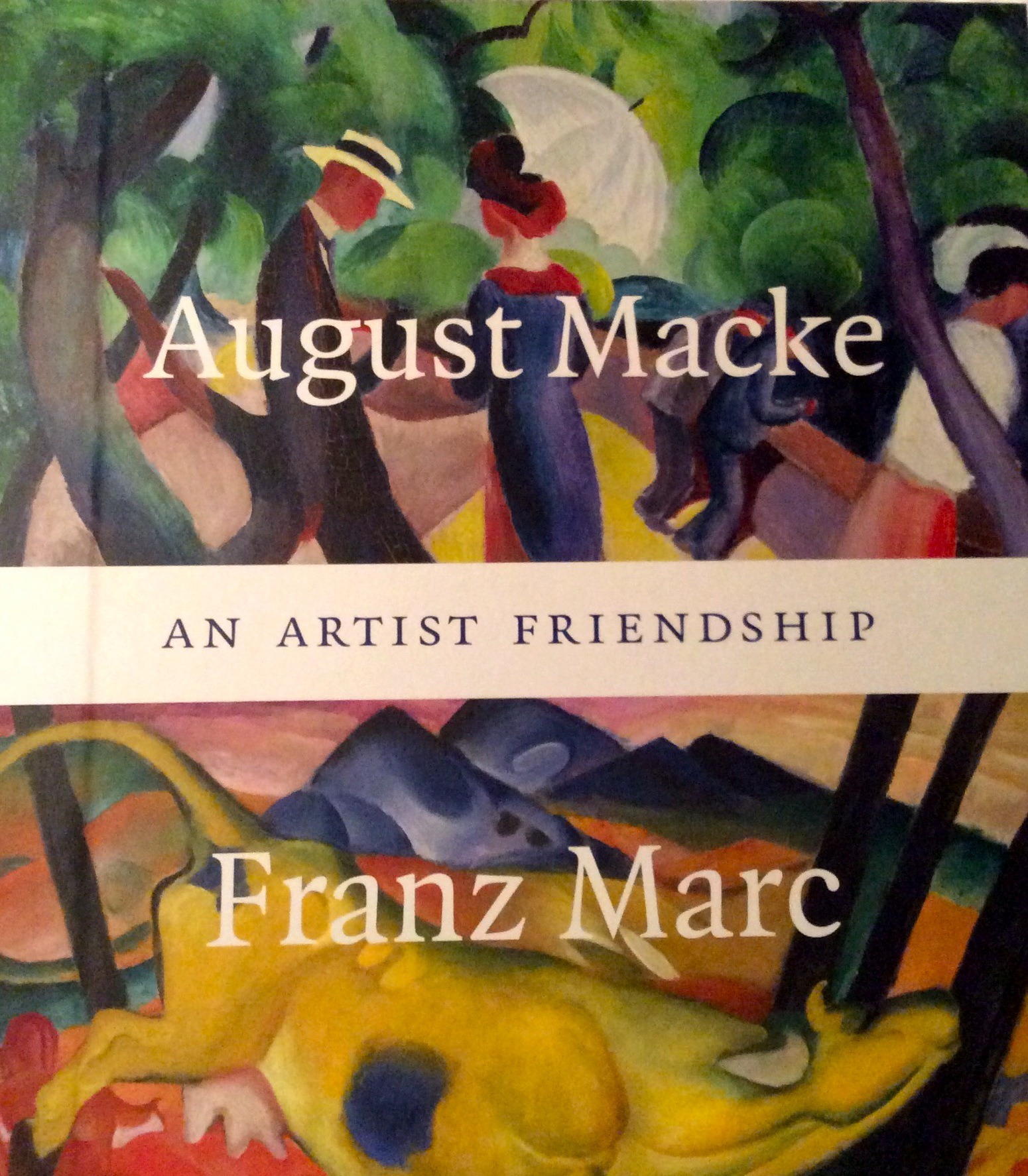
Today is the 99th anniversary of the death of Franz Marc. (Marc would have really liked someone who also died this week, Leonard Nimoy and Nimoy’s Mr. Spock character from Star Trek.) I didn’t write my normal “Franz Marc’s Birthday” post (Marc’s birthday is 8 February) this year because the idea of the grief we feel for Marc and August Macke has been much on my mind. This is partly owing to my own research, but also to do with the publication of the catalogue attendant to the Lenbachhaus’s current exhibition, August Macke und Franz Marc: eine Künstlerfreundschaft (August Macke and Franz Marc: An Artist Friendship in English).
The catalogue is, not surprisingly, a tour-de-force of editing and research by longtime Lenbachhaus Blaue Reiter curator Annegret Hoberg and Volker Adolphs of Kunstmuseum Bonn. What is unexpected is that the editors and included authors bring to bear not just a wealth of knowledge but so much compassion to these essays, confronting directly the loss and sadness we naturally feel over the too-short lives of Marc and Macke.
This is not to say the entries are not impeccably scholarly; Hoberg’s “August Macke and Franz Marc / Ideas for a Renewal of Painting” and Adolphs’ “Seeing the World and Seeing Through the World / Nature in the Work of August Macke and Franz Marc” are classic art historiography based in peerless analysis. Gregor Wedekind’s “The Masks of the Savages / Primitivism and Cultural Critique in the Work of August Macke and Franz Marc” was of particular interest to me as it underscores how the work of the avant-gardes was received in its time as a shocking departure from what the world then considered “civilized” painting. There are a few small errors marring Klara Drenker-Nagels’ otherwise illuminating discussion of the relationship between Maria Marc and Elisabeth Erdmann-Macke that I’m sure will be corrected in subsequent editions.
Of special delight in terms of the arrangement and presentation of the catalogue are some shorter, data-packed chapters on the Paradies (1912) mural and other anecdotes about Marc’s and Macke’s overlapping but very different lives.
Of course the catalogue is rich with the paintings, weavings, sketches, and photos that grace the exhibition itself. As a discrete publication, this is one that must truly be enjoyed as a book – I received it on a Friday afternoon and spent the entire weekend poring over every image, footnote, and phrase, alternately smiling and wiping away tears. Turning the last page, I was filled with admiration for this Lenbachhaus-Kunstmuseum Bonn collaboration, every word written with love.
by Jean Marie Carey | 15 Dec 2014 | Franz Marc, German Expressionism / Modernism
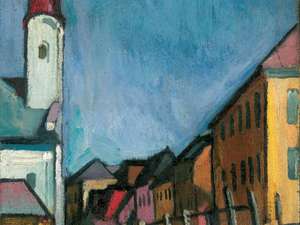
Is this colorful village scene painted by August Macke?
I have been working on a project about authenticating a painting maybe misattributed to one of my Expressionist painters (yet maybe made by another), so I was very interested to see a story crop up over the weekend in the Münchner Merkur online edition (pretty sure Süddeutsche Zeitung, usually so on top of all news Bayern, must be spitting nails!) about a man who thinks he owns a painting by August Macke.
Even more intriguingly, the painting would have been made in 1910, the year Macke spent in Tegernsee during which time Franz Marc often came to visit the Macke family, sometimes walking there through Oberbayern from Sindelsdorf to Tegernsee with Russi Marc. This period of time is recounted with warmth and in detail by Margarethe Jochimsen and Peter Dering in the book August Macke in Tegernsee.
The man who owns the painting, Herbert Spiess, claims to have purchased it from an art dealer in Vienna in 1984. Spiess told the Merkur he became convinced the painting, a small streetscape, was a Macke simply through visual association. (The Westfälische Landesmuseum für Kunst und Kulturgeschichte in Münster says “no” in the Merkur’s story; no comment from the Lenbachhaus or the August Macke Haus in Bonn).
Macke enjoyed his time in Tegernsee. This was a happy year for Macke and his wife, Elizabeth and their first son, Walter, was born in the quiet lakeside village. Macke was more or less amused by his botany-obsessed landlords, whose Bayerische dialect he was able to penetrate with Marc’s help. Stubbornly autodidactic and much more fanciful and imaginative than he appeared at a glance, Macke spent hours doing “copying exercises” with Marc (and doing some other fun stuff too), and experimented with many styles of painting and drawing in 1910.
During this time, despite being in a very attractive location, Macke concentrated on portraiture, making many sketches and paintings of Walter, Elizabeth, and the famous portrait of Marc.
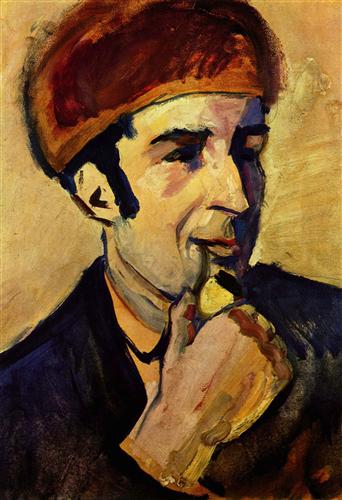
Bildnis Franz Marc, August Macke, 1910
But Macke also was always making all sorts of things, from tapestries to fabric designs to theater decorations. So it’s certainly possible this single painting is something he just knocked out during this period of great productivity – Macke was exceedingly prolific and made more than 200 paintings between 1909 and late 1910, when the young family returned to Bonn, leaving cousin Helmuth Macke to stay with Marc.
So it’s hard to say, from looking alone, if this painting could be Macke’s. I hope it is but (and this is really just a very strong intuition as much as empirical assessment) my feeling is that it might not be. To my eye the painting lacks that little flourish of passion and verve, and of capturing the “inner realities” of the beauty he was in the physical world, that is the beautiful Expressionist hallmark of Macke’s oeuvre. With any luck I’m wrong though, and the world will have a new August Macke painting to admire.
Anyway, the reporter, Vera Markert, asks that if you have any information or ideas about the painting to get in touch with the Merkur via email at kultur@miesbacher-merkur.de wenden.

by Jean Marie Carey | 27 Oct 2014 | Animals, Animals in Art, German Expressionism / Modernism
The Cry of Nature: Art and the Making of Animal Rights
I got a note from the nice people at Sehepunkte about the review of Stephen Eisenman’s The Cry of Nature I wrote (which is posted on Sehepunkte’s website):
“Sofern Sie über eine eigene Präsentation im Internet verfügen, würden wir uns freuen, wenn Sie dort Ihre Rezension und unser Journal verlinken würden. Hierfür können Sie gerne auch eines unserer Logos … verwenden…”
…so of course, OK! I really like Sehepunkte and am working on some more stuff for them too.
So here the logo: 🙂

Now a few months after reading it, I should report that this book has had a nice slow burn and even though this is a very positive review I think I would rate it even more highly now, particularly as a teaching text as it covers a broad subject area still with clarity and depth in each chapter. I was able to use Eisenman’s section on the hunting practice of indigenous peoples, for example, as a point of reference in a recent seminar I gave for the Bioethics Centre at the university and in reference to a discussion about the dolphin massacre in Taiji, Japan. (To support my argument against hunting and hunters I mean: Don’t get me wrong; there’s no place for humans who hunt in any universe, and people trying to be “open minded” about hunting are without fail patronizing, paternalistic, and dead inside.)
Anyway, this is an excellent book and here is the review:
(Stephen F. Eisenman: The Cry of Nature. Art and the Making of Animal Rights, London: Reaktion Books 2013, ISBN 978-1-78023-195-2).
Art historical texts, and especially single-authored volumes, should be judged in great measure by how well they fulfill their expressed ambitions. By this rule The Cry of Nature. Art and the Making of Animal Rights, whose central objective is to provide an intellectual and informational resource for readers interested in the intersection of the animal studies and the making of art, and a platform for scholars to reflect on provocative subjects suggested by the twining of these two themes, must be deemed a success.
Each of its chapters contributes to author Stephen F. Eisenman’s goal of addressing and evaluating important issues pertaining to the contemporary discussion of animal rights and the movement’s connection to art and ideas originating in the 18th century as well as, to some extent, before. Organized into five chapters and a strong introduction and conclusion, plus a recommended reading list of some of the foundational volumes of the relatively new discipline of animal studies, the book surveys not only images but historicizing texts and makes a strong claim that something like an animal rights movement has existed since antiquity, springing into cohesion in the 1700s, with artists making and using images as persuasion and propaganda.
The pleasure derived from reading this book lies partially in the richness of Eisenman’s detailed, personal, and confident descriptions of the lives and emotions of real animals, making his prose eminently accessible. Readers will be compelled by the forcefulness of local histories about, for example, a majestic African elephant photographed in a moment of perfect stillness at a watering hole in 2007 who is killed by poachers in 2009, and delighted by anecdotes about Echo, the author’s dog, who learns to stage pratfalls and tumbles in order to make Eisenman laugh. These stories are integrated meticulously within more formal discussions of images – some well-studied, including Rosa Bonheur’s The Horse Fair (1853) and Jean-Baptiste Oudry’s A Hare and a Leg of Lamb (1742), some less famous – such as Clifford Possum Tjapaltjarri’s 1975 painting Eagle Dreaming – which are produced about, and in mindfulness of, the animal.
The book begins with a background chapter defining “What is an Animal?” in terms of societal mores and biological evidence about the commonalities and differences amid living creatures, centering on the ability of animals to communicate, to experience emotions, and to feel pain. This chapter includes pleasantly unexpected exemplars, such as Simon Tookoome’s 1979 linocut I Am Always Thinking of Animals, as it stakes out the moral and practical discussions around how we define language and consciousness.
The chapters “Animals into Meat” and “Counter Revolution” dwell on images of the corpses of animals, shown as food, prey, and sacrificial stand-in for the human figure and body. While the recurring motif of the flayed ox in paintings by Gustave Caillebotte and Rembrandt may arouse as much distancing disgust as identification, Eisenman’s delicate examination of Jean-Baptiste-Siméon Chardin’s The Ray (1728) makes persuasive on the page that these artists intended to convey their beliefs in the existence of the souls and consciousness of animals, and commensurately, the dismal mortality of humans, on their canvases. (more…)

by Jean Marie Carey | 28 Jul 2014 | Animals, Animals in Art, Art History, Franz Marc, German Expressionism / Modernism, LÖL
Brigita Hofer cleans, fills, patches, and recolors “Paradies.”
Here is a short article on the ruhr.de website about the restoration of the Paradies mural made by Franz Marc and August Macke in 1912 at the Mackes’ home in Bonn. It’s an interesting little piece and the website also has some photographs of the movement of the mural, in the 1980s, from its original location to the Museum für Kunst ind Kultur/Westfälisches Landesmuseum in Münster, where it lives today (there is a pretty nice replica at the August Macke Haus though). Like a lot of people I am sad that the museums can’t just switch the murals back, but this article sort of explains why that will not happen.
The restorer, Brigita Hofer, has discovered that the mural is pretty structurally unsound, giving it a soundness rating (as happens with earthquake-damaged buildings as I recently learned) of around 25, which means there’s a better than one in four chance it could collapse under any further stress. Hofer has been filling in surface cracks and erosions with non-expanding plaster and emulsifier with the tiniest of syringes. Hofer also restored some of the mural’s damaged or faded paint. In doing so she discovered that Macke and Marc had made a lot of adjustments to the mural as they worked together, repainting Eve’s face and the deer. Hofer also learned from a heretofore covered note that Maria Marc had painted the wasp at the bottom of the mural.
I am fascinated with this mural, as you might guess from how often I write about it, not for the least reason that it seems to be a truly collaborative effort that resulted in a distinct “style” that is identifiably that of both painters but is also a unique meshing of their ideas and talents. Even the animals don’t look exactly like Marc’s other animals, and for both, the palette is a bit subdued. (Except Adam reaching to embrace the monkey on the top left branch though and turning from the other figures – I think that’s a Marc thing. There is a large image of the mural in the post just before this one.)

by Jean Marie Carey | 15 Jun 2014 | Animals, Animals in Art, Art History, Franz Marc, German Expressionism / Modernism, LÖL, Re-Enactments© and MashUps
August Macke and Franz Marc packed the friendship of a lifetime into the few short years they had together from early 1910 to the summer of 1914, even with a few breaks for pouting and sulking. Some of their correspondence is recorded in a dedicated volume, and other letters, notes, stories, and recollections of their doings from other people are hidden in unpublished works and Expressionist apocrypha.
Macke and Marc enjoyed working on their art as a pair and in fact they both considered the drawings and sketches they made while just being together to fall into the class of “things we made together” on the same level as the few categorical objects to which we ascribe to their dual provenance, of which the mural Paradies, from 1912, is one. The mural lives now at the Westfalisches Landesmuseum für Kunst und Kultur in Münster, but it was made in the upstairs atelier of the Macke house (now the August Macke Haus ) in Bonn.
Given Macke’s constant scheming and hustling, and the sort of declarations of superficiality he seems to make about all that is admirable in painting, it is easy to think of him as being a sort of light shadow to Marc’s heavy element, but this is not at all true. And Marc often seems supremely naïve and dopey in his out-of-itness, which was also more of an occasional condition. However, the story attendant to the making of this mural finds them both in exactly these roles.
In fact as soon as I learned more about how Paradies was made, I immediately thought of the famous story in Mark Twain’s The Adventures of Tom Sawyer printed below. In fact there is not much I can say about it, or as well.
Paradies, August Macke and Franz Marc, 1912
Excerpt from Tom Sawyer: Chapter 2
“Hi- yi ! You’re up a stump, ain’t you!”
No answer.
Tom surveyed his last touch with the eye of an artist, then he gave his brush another gentle sweep and surveyed the result, as before. Ben ranged up alongside of him. Tom’s mouth watered for the apple, but he stuck to his work. Ben said:
“Hello, old chap, you got to work, hey?”
Tom wheeled suddenly and said:
“Why, it’s you, Ben! I warn’t noticing.”
“Say — I’m going in a-swimming, I am. Don’t you wish you could? But of course you’d druther work — wouldn’t you? Course you would!”
Tom contemplated the boy a bit, and said:
“What do you call work?”
“Why, ain’t that work?”
Tom resumed his whitewashing, and answered carelessly:
“Well, maybe it is, and maybe it ain’t. All I know, is, it suits Tom Sawyer.”
“Oh come, now, you don’t mean to let on that you like it?”
The brush continued to move.
“Like it? Well, I don’t see why I oughtn’t to like it. Does a boy get a chance to whitewash a fence every day?”
That put the thing in a new light. Ben stopped nibbling his apple. Tom swept his brush daintily back and forth — stepped back to note the effect — added a touch here and there — criticised the effect again — Ben watching every move and getting more and more interested, more and more absorbed. Presently he said:
“Say, Tom, let me whitewash a little.”
Tom considered, was about to consent; but he altered his mind:
“No — no — I reckon it wouldn’t hardly do, Ben. You see, Aunt Polly’s awful particular about this fence — right here on the street, you know — but if it was the back fence I wouldn’t mind and she wouldn’t. Yes, she’s awful particular about this fence; it’s got to be done very careful; I reckon there ain’t one boy in a thousand, maybe two thousand, that can do it the way it’s got to be done.”
“No — is that so? Oh come, now — lemme just try. Only just a little — I’d let you , if you was me, Tom.”
“Ben, I’d like to, honest injun; but Aunt Polly — well, Jim wanted to do it, but she wouldn’t let him; Sid wanted to do it, and she wouldn’t let Sid. Now don’t you see how I’m fixed? If you was to tackle this fence and anything was to happen to it — ”
“Oh, shucks, I’ll be just as careful. Now lemme try. Say — I’ll give you the core of my apple.”
“Well, here — No, Ben, now don’t. I’m afeard — ”
“I’ll give you all of it!”
Tom gave up the brush with reluctance in his face, but alacrity in his heart. And while the late steamer Big Missouri worked and sweated in the sun, the retired artist sat on a barrel in the shade close by, dangled his legs, munched his apple, and planned the slaughter of more innocents.

 Today is the 99th anniversary of the death of Franz Marc. (Marc would have really liked someone who also died this week, Leonard Nimoy and Nimoy’s Mr. Spock character from Star Trek.) I didn’t write my normal “Franz Marc’s Birthday” post (Marc’s birthday is 8 February) this year because the idea of the grief we feel for Marc and August Macke has been much on my mind. This is partly owing to my own research, but also to do with the publication of the catalogue attendant to the Lenbachhaus’s current exhibition, August Macke und Franz Marc: eine Künstlerfreundschaft (August Macke and Franz Marc: An Artist Friendship in English).