
by Jean Marie Carey | 18 Feb 2016 | Animals, Animals in Art, Dogs!, Franz Marc, German Expressionism / Modernism, LÖL
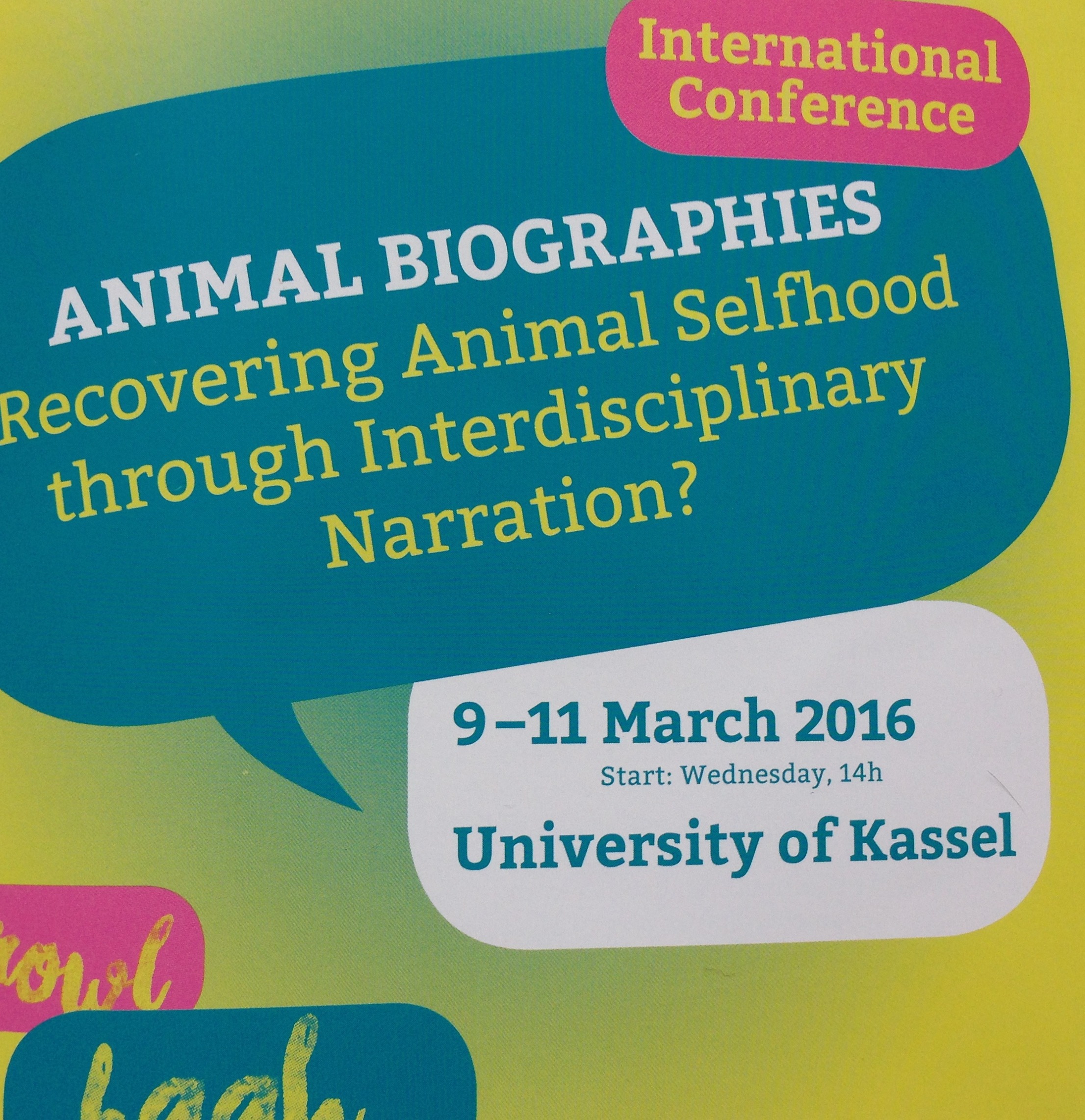
During February and March I am a Wissenschaftliche Gäste of sorts at the Universität Kassel’s Tier-Mensch Gesellschaft. I’m doing some research in the dOCUMENTA Archiv, finishing up a chapter in my dissertation, and giving a talk at this first-of-its-kind conference, “Animal Biographies: Recovering Animal Selfhood through Interdisciplinary Narration?”.
The program is incredible and the speakers amazing, each talk as fascinating as the next. There are also several installations and exhibits by Mathias Antlfinger and Ute Hörner and the interspecies collective from CMUK Köln. The program is free and you can register through 25 February through the link above.
I don’t know if I can quite live up to the talents of the other panelists, but I am confident of the attraction, pathos, and intrigue of my animal biographic subject, Russi Marc, whose death exactly 100 years ago this week was noted by his lifelong human companion, Franz Marc, who made many drawings and paintings of Russi through their lives together. Franz Marc himself died just a few weeks later. Studying Russi has taken on a life of its own in my research, and as this was a very well-documented dog and one who had many humorous and thrilling adventures I am very excited to be able to share his story with other animal lovers.
One thing I like so much about animal studies (in discussing the title of our nascent discipline, which is now beginning something like its second wave most of us are happy to jettison the “human-” prefix) is that its adherents are for the most part partisan activists. This challenge to the academy as we fight the losing battle of the Anthropocene and the Sixth Mass Extinction has not gone unnoticed; this week, a sort of prank article was exposed (and one could extrapolate perhaps planted by the same people or person), in the December 2015 issue of the academic journal Totalitarismus und Demokratie. In retrospect, perhaps a “discovery” about the inherited aggression of “German” German Shepherds was too good to be true…but I am very curious to see what the fallout will be, since the “research” depended upon “primary sources” about dogs…another reason to be glad for Russi’s well-established canine celebritude, I guess.

by Jean Marie Carey | 12 Feb 2016 | Animals, Animals in Art, Art History, Franz Marc
Franz Marc, Zwei Katzen, blau und gelb, 1912
The College Art Association conference was held 3-6 February in Washington, D.C., which for what I study is not a very interesting art city in the way New York City is…and D.C. is thus also very expensive to visit, since the trip doesn’t include a few precious hours in the Met, MoMA, Guggenheim, Neue Galerie, and so on.
If conferencing, not museum-visiting, is to be CAA’s focus going forward, the organization should do what the German Studies Association does, and move the meeting to some less-costly destinations that still have good mass transit and more of a range of hotel rooms, like Las Vegas or Atlanta.
This conference I had a lot of tasks I actually had to do, and one I wanted to do, or I should say was very curious about doing, attending the Historians of German, Scandinavian and Central European Art, or HGSCEA, [formerly just HGCEA, but, I guess the Munch people or something…] meeting, which this year took the form of a dinner honoring the long-reigning and undisputed chief Kandinsky scholar, Rose Carol Washton Long of the Graduate Center of the City University of New York, and Charles Haxthausen from Williams College.
I took the cryptic “honoring” on the invitation to mean “retiring,” which put me in mind of The King of the Cats. Miss Jessel’s “Haunted Palace” blog gives a nice account of the oral history tradition of this tale and its place in the folklore of the British Isles but, basically, without belaboring the point the outstanding extra-narrative moral for cat lovers and observers is probably that upon learning of the death of “the king of the cats,” all cats think that they are the designated heir to the throne.
So with respect to the fractious group of people who comprise known Kandinsky scholars…without an obvious heir apparent (to my mind there is not one, the once-promising regent having chosen their battles poorly), wouldn’t they all be prepared for anointment? As it turned out RCWL, in her very congenial speech, immediately made clear that while she was retiring from CUNY, she would not be relinquishing the reins to the Kandinsky dynasty anytime soon.
 The “party” itself was quite a mysterious affair in that it did not appear as an “affiliated society” event anywhere on the CAA schedule (or the new Linked-In developer-sponsored) app, and was held in a small restaurant in Adams Morgan which was entirely closed except for the HSGCEA dinner. RSVP, affiliation, and credentials were thoroughly vetted at the door, and there were no nametags. Nametags would not have been much use anyway, since everyone went by a non-apparent nickname, like “Ricki” or “Mark.” And it was very dark inside the restaurant, Lillie’s (actual lighting shown), and you couldn’t see even across the room. So in other words it was pretty much how I expected it to be, except there wasn’t any kind of St. Bartholomew’s day type of fracas, duel, or mass feline exit through the fireplace.
As to my own paper and panel, I was thrown off my presentating game a little – not a lot, or not as much as I had expected or was undoubtedly intended – and got a lot of good questions, including some very specific queries from some more-than-casual idolators about Animalisierung, of all things, about the painting Tierschicksale, and about what I had specifically set out to talk about, affect/effect disturbing/calming animal images have upon human animal/human-animal empathy.
Basically my claim is that disapprobation toward animal abusers – such as generated by the film The Cove and the work of Sue Coe – is not as strong a motivator as true identification with the animal subject. Hence the focus on Franz Marc. This isn’t necessarily as obvious an idea as it seems, and bears more discussion and exploration (which is why I am writing about it).
by Jean Marie Carey | 24 Nov 2015 | Art History, Expressionismus, Franz Marc, German Expressionism / Modernism, Re-Enactments© and MashUps
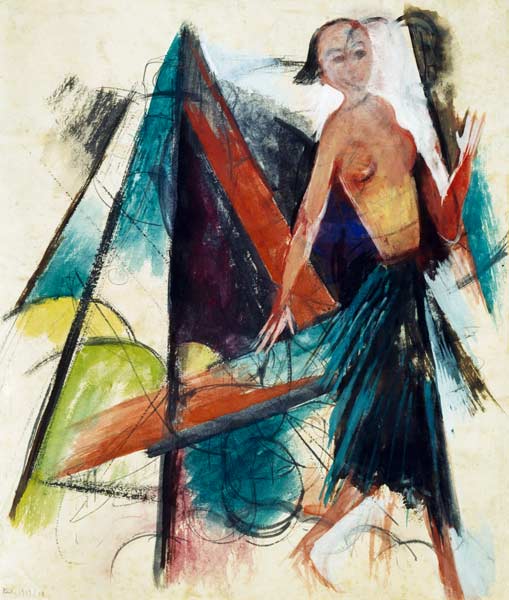
Miranda, 1914
So I am pleased and grateful to report the publication of my first peer-reviewed anthology chapter in the journal Expressionismus in the special issue Der performative Expressionismus. The article is called “‘Der Sturm’ und die Wilden.? Franz Marcs Entscheidungskampf mit der Theatralität,” which translates imperfectly to something like “‘The Tempest’ and the Savages: Franz Marc’s Decisive Encounter with Theatricality.” (Entscheidungskampf can also mean something like Armageddon/scorched earth, which in this case is accurate.)
The article is currently behind the Neofelis Verlag paywall (for a very reasonable €13), but you will soon find it on JSTOR and elsewhere. If you have any questions about how to view article please email me.
This side project to my main research corrects some chronological errors that have consistently been repeated in both Expressionist and Dada literature about the collaboration of Franz Marc and Hugo Ball on a planned production of The Tempest at the Münchner Kammerspiele. Because the story takes place in early 1914, it has been tempting for scholars – some of them quite formidable – to conclude that it was the war that usurped these plans. However, that is not at all the case.
“What really happened” is of course quite interesting on its face and as a reminder that we in fact know very little in the way of actual facts about the historical avant-gardes, who are fast disappearing into hagiography.
More interesting to me, in terms of writing and research, was the analysis of the two small drawings Marc made as character studies of The Tempest’s Miranda and Caliban personalities. This is the first time these drawings, housed in the Kunsthalle Basel, have been subjected to such scholarly scrutiny and each contains many clues and psychological implications.
I was also intrigued to discover that Marc had sent a draft of his June 1914 essay »Das abstrakte Theater,« (also analyzed in the article) about his frustrating foray into the theater to August Macke, and that the two had previously had many exchanges about the performing arts. In fact it is clear that the very precocious Macke – who at only 21 had been the chief set designer for the theater in Düsseldorf – had had a great influence on Marc’s ideas on the subject – ideas being the key word, since Marc had no firsthand dramaturgical knowledge up until this point.
My colleague here at the university, Prof. Dr. August Obermayer, was the very gracious translator but he also provided invaluable editing and advising, and the Neofelis editors were also a pleasure to learn from.
All in all a great experience and I hope readers will find the unraveling of Expressionist mysteries as fascinating as I do.

Caliban, 1914
by Jean Marie Carey | 29 Aug 2015 | Animals, Franz Marc, German Expressionism / Modernism
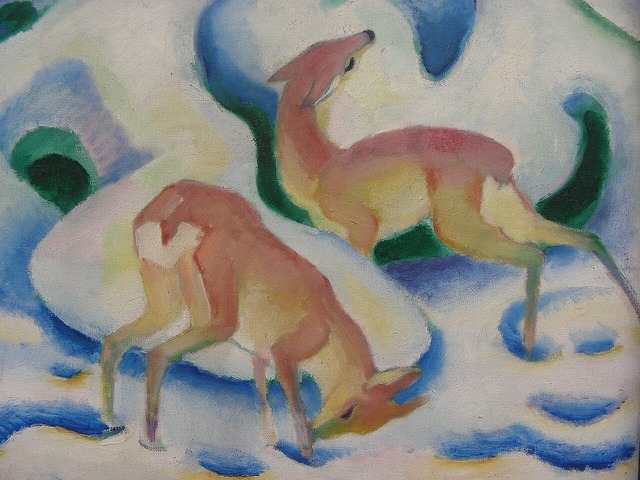
My 2012 M.A. thesis, Franz Marc as an Ethologist, is now part of the online collection of the open-access Social Science Research Network (SSRN). You can download it or look at the abstract here.
UPDATE: I just can’t with Elsevier’s involvement with SSRN. In addition to Elsevier being generally evil, not supporting open access, and ruining the Pergamon imprint, more than a year after acquiring SSRN, there is still no discrete art history rubric, or way for authors to track who is looking at their work. But mainly Elsevier is garbage.
Franz Marc, Rehe im Schnee II, 1911, one of Marc’s paintings discussed in my thesis.
by Jean Marie Carey | 6 Apr 2015 | Animals, Animals in Art, Art History, August Macke, Dogs!, Expressionismus, Franz Marc, German Expressionism / Modernism, LÖL
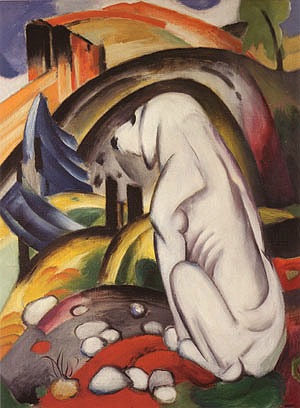
Hund vor der Welt, Franz Marc (1912). Oil on canvas, 118 by 83 centimetres, private collection, Switzerland
I write about this painting a lot – in fact I once, for quite a long time, devoted my academic research solely to this painting – but I realised I don’t often say anything about it in this space. So here is a little excerpt not from my current chapters but from a side project.
§ § §
Franz Marc made an innovative painting – a metaphysical genre portrait of his dog Russi – called Hund vor der Welt in the spring of 1912. The large vertical canvas shows the white hound seated on a hillside, facing the sun and the landscape at an angle across an indeterminate space. We have an account of what Marc had in mind in making this image in particular and Marc’s other thoughts about painting his frequent model.[1] There is also a substantial amount of documentation about Russi, the dog, who, as the artist’s constant companion, was a character who populated the art, photographs, and writing of other people. We even know where Russi was born, how he came as a puppy to live with Marc, and when he died.[2] So despite its slightly whimsical affect, Hund vor der Welt is an image of a real dog about whom much historical information is available. Marc made many paintings in which Russi also appears as a peripheral regular “character;” he leads the way in Im Regen (1912) and leaps after Die gelbe Kuh (1911).
August Macke, who came into frequent contact with Russi and made his own drawings of the dog, prevailed upon Marc to change the name of the painting from the one Marc originally had in mind, So wird mein Hund die Welt sieht.3 We know from Marc that he wanted to show Russi in thought, so the dog’s seated posture suggests that this is what is happening in the stillness. The strange view of the landscape Russi “sees” is nonetheless completely identifiable as a typical one from around Sindelsdorf where Marc lived. By placing buildings in the recognizable, managed farmlands of Bavaria, Marc suggests that people and animals are part of the same ecology, which, for dogs as the primary animal of domestication, is certainly true.
Russi did not have the life of a working dog, instead, with Marc, dividing his time between Munich, Berlin, and the small towns of Sindelsdorf and Ried. Russi lost part of his tail in 1911, an adjustment to his appearance that is reflected in his 1912 portrait. This shows that Marc had a commitment to showing morphologically accurate details even about the animals he painted, even as the paintings themselves broke with academic naturalism.
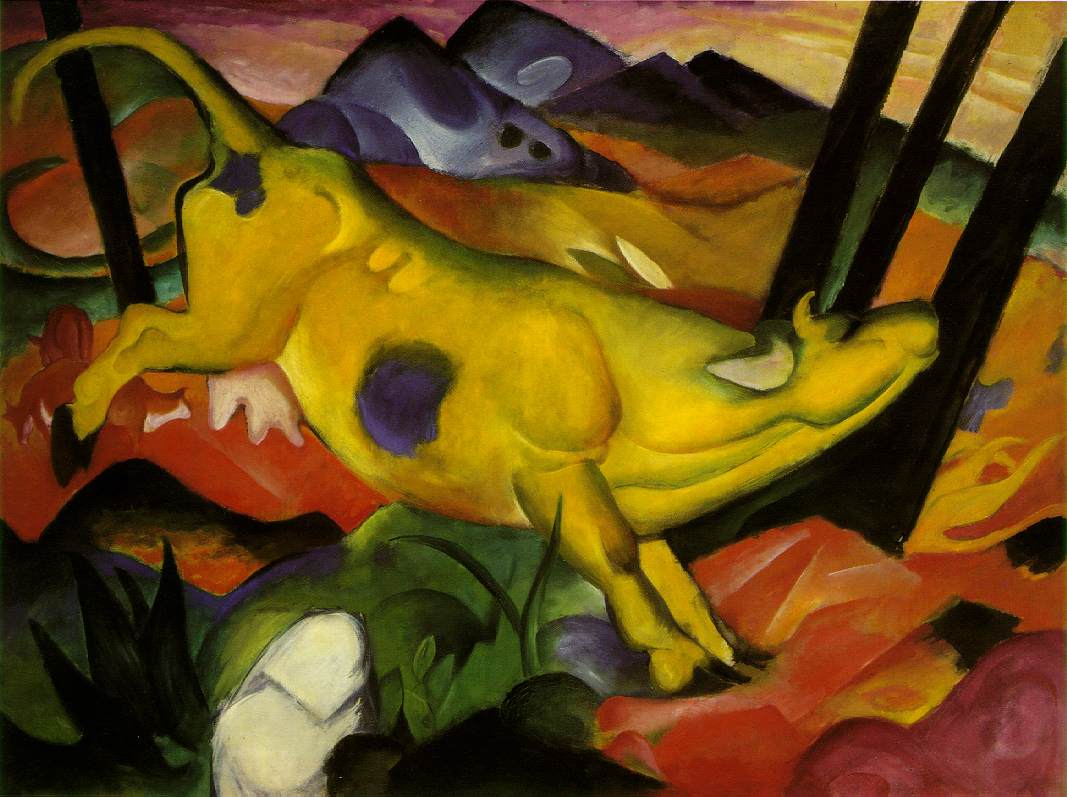
Die gelbe Kuh,
Franz Marc, 1911
189.2 × 140.52 cm
Oil on canvas
Solomon R. Guggenheim Museum, New York. That is Russi Marc in the lower left corner.
[1] Franz Marc, Briefe, Schriften und Aufzeichnungen, (Leipzig: Kiepenheuer, 1989), 11. Observing Russi at this moment, Marc wonders: “Ich möchte mal wissen, was jetzt in dem Hund vorgeht.”
[2] Marc, Briefe, 196-197.
[3] Franz Marc, August Macke, Briefwechsel, (Köln: DuMont, 1964), 124-126.

 During February and March I am a Wissenschaftliche Gäste of sorts at the Universität Kassel’s Tier-Mensch Gesellschaft. I’m doing some research in the dOCUMENTA Archiv, finishing up a chapter in my dissertation, and giving a talk at this first-of-its-kind conference, “Animal Biographies: Recovering Animal Selfhood through Interdisciplinary Narration?”.