
by Jean Marie Carey | 15 Jan 2008 | Art History
Catherine Opie, Papa Bear, Chief, Jake, and Chicken from “Being and Having” series, 1991.
One of my goals this year is to be more intellectually open to works I find aesthetically challenging. Catherine Opie is one photographer whose portraits of others and self-portraits I just cannot appreciate, not because I take exception to her context, agenda, or stated subject matter, but because my eyes just don’t love the juxtaposition of flesh against patterned or fabric backgrounds.
The image “Chicken” (lower right) has entered a larger popular culture forum because it is used prominently in promotional materials and in the opening credits of the cable television series The L Word (one of the characters is a museum curator in California). When I first saw this photo I didn’t realize the person in the photograph was a woman but I did peg it as an Opie because the Chromagenic prints are easily identifiable and the camera available to just a few elite photographers. The intentionally forced and obviously faked identities in this series speak to our recent discussions of photography as an arbiter of “the real.”
The technology, to me, is more interesting than the image itself, and it adds a level of construction, predetermination, and staging that exceeds even Opie’s elaborate theatrics.

by Jean Marie Carey | 1 Jan 2008 | Animals, Dogs!
Astra finds her way to the doorway.
Astra has a New Year’s present, a motion-activated dual 150 watt sensor light that activates when she steps close to the path to the door.
Since her cataract debrasion Astra can apparently detect a general sense of brightness and she has taught herself very quickly to keep the sensor activated by remain in in its sphere and to then to navigate by the flagstones.
by Jean Marie Carey | 22 Dec 2007 | Animals, Art History
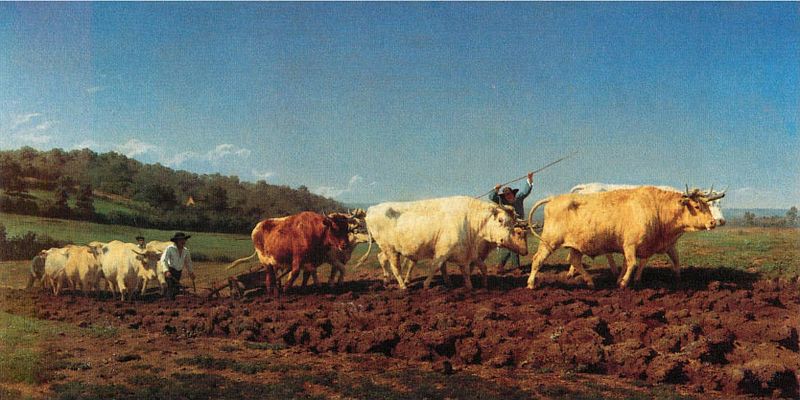
Rosa Bonheur – Labourage nivernais.
If 19th century French painter Rosa Bonheur believed in reincarnation, she would surely have chosen to return to life not as one of the regal lions or leggy gazelles she shared her Bordeaux estate with, but as a sturdy, common barnyard bull. The slyly successful painter had great affection for domestic animals, and enjoyed her greatest artistic success depicting them.
Bonheur was especially adept at imbuing cattle with nobility without giving them airs of humanity.
Though best known for The Horse Fair (1853), a canvas from a few years later in her career, Labourages Nivernais, completed in 1850, is actually a less derivative, more personal, visually individualistic image of Bonheur’s favorite creatures. Nivernais also marks the beginning of a period of commercial and public success for Bonheur, a good fortune enjoyed by few women artists then as now.
At first glance, Nivernais seems a relatively innocuous, though beautifully rendered, ode to agrarian life, and there is nothing “incorrect” with that interpretation. However, Nivernais offers much more to viewers who, like the team of oxen shown, take the time to turn over the well-trodden earth.
Rosa Bonheur, was born in Bordeaux, France on March 16, 1822, the eldest child of Sophie Marquis and Raimond Oscar-Marie Bonheur. The couple called the baby Marie Rosalie, but she almost immediately came to be known as Rosa.
Her father, himself a painter and philosopher, and artists with whom he was friends captured many images of the youthful RB.
Her father shows RB the infant idolized as a cherub in a crib in a painting in 1823. By the time Raimond Bonheur captured Rosa at Four, the child had the set jaw, solemn gaze, erect posture and short tousled hair that would identify her for the rest of her life.
One alleged portrait of RB, showing a square-jawed, serious child in a brimmed hat with feather trim, was painted by Jean Baptiste Camille Corot. After RB’s death, though, her companion Anna Klumpke, came forward to say that she thought the sitter for the portrait was instead a male. Such confusion regarding appearance and gender shadowed RB all her life.
(more…)

by Jean Marie Carey | 8 Dec 2007 | Animals, Art History
The tiny Guennol Lioness was sold at Sotheby’s antiquities auction the first week of December by one private collector to another, with reports referencing but not naming a British archaelogist as the person who paid more than $57 million for this piece found near Baghdad and believed to have been made in Elam, what is now Iran, in about 3000 B.C.
Certainly there will be whines and complaints if the lioness is not displayed in public (she had been on view at a museum in Brooklyn), but it’s hard to imagine who in the world will be sympathetic to these gripes as the Axis Against Evil continues to park its tanks and bombs atop whatever other treasures may reside in the rubble of the library and other sites in the Cradle of Civilzation.
I wouldn’t blame the new owner for keeping the Guennol Lioness in a quiet, private place. She is an amazing creature and it’s enough for her to be safe and protected.
by Jean Marie Carey | 11 Nov 2007 | Art History
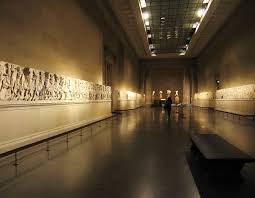
The Parthenon Friezes at the British Museum
At the end of the summer of 2007, the week before fall university classes began, Greece was on fire. The Peloponnese was uniformly scorched, nearly a hundred people were killed, rural economies were displaced, and flora and fauna indigenous only to Greek pine forests and mountainsides were burned, perhaps beyond any eventual recovery. Though the fires were barely held back from the famous antiquities of Olympia and Athens, other archaeologically priceless sites were not so fortunate .
Though some of the fires were attributed at their source to arsonists, Greek Prime Minister, Kostas Karamanlis, whose New Democracy party was returned to office this past September, is partially culpable in this tragedy. Karamanlis and other Greek officials were slow to acknowledge the severity of the fire emergency and have yet to admit the true extent of the damage.
“There are several well known ‘arsonists’ in Greece — garbage dumps (burning spontaneously), farmers burning brush, animal farmers burning land to sprout fresh grass for grazing,” Nikos Charalambides, director of Greenpeace in Greece, told a reporter from Reuters on October 1.
“But the biggest arsonist is the state, which has not clarified the use of land, leaving suburban forests vulnerable to rogue developers,” he added in the same piece.
“The lack of a national land registry and national zoning laws leave room for doubt about the characterization of land, whether it is forest or not,” told Reuters.
It is not a good time for antiquities, and the dire circumstances are of course more attributable to the traditional colonial superpowers than to Grecian malfeasance.
The blame for the theft of treasures from the Baghdad Archaeological Museum, the burning of Baghdad’s National Library, and the looting of more than 10,000 Ur, Sumerian, and Babylonian archaeological sites may be laid, in the name of Operation Iraqi Freedom, on the doorstep of the United States and bullied ally Great Britain.
(more…)
