by Jean Marie Carey | 7 Sep 2007 | Art History
Crack at the Edge of the World
It is clinically and physically possible to inhale a heart-stopping dose of crack cocaine. Yet in the majority of death-by-rock cases in Tampa and other urban centers during the drug’s heyday in the Eighties and the years since, the cocaine dilute has been no more than a contributing factor.
In fact most crack-related fatalities were caused not by toxic rock but by lead poisoning courtesy first of small-caliber handguns and then by increasingly high-powered automatic weapons, often wielded in crimes auxiliary to the actual use of the drug. As convenience store and gas station clerks were gunned down for twenty dollars by desperate rock fiends and hollow-points blasted through children’s bedroom windows, crack’s collateral victims came, almost obsessively, the attention of affluent, white Floridians.
Throughout the Seventies and the early Eighties, Tampa Bay had a fearless if uneasy relationship with cocaine, the party drug of the wealthy and popular. In 1980, suffering hallucinations and insomnia, comedian Richard Pryor set himself on fire while freebasing cocaine — the drug is rendered with ether making it smokable as well as highly flammable — and suddenly it seemed the free ride the suburban white powder had winkingly got in the media was over, becoming the gritty slush of the ghetto.
Juvenile Ibis, August 2007
Freebasing, in which cocaine hydrochloride was chemically converted was clearly too uncontrollable for even the most high-craving fiends. Crack — a mixture of coke, ammonia, baking soda, and other filler ingredients solidified into rough pellets for consumption via a glass pipe — was more stable. Containing only about ten percent pure cocaine, it was also much less expensive than the polar powder inhaled in discos, selling for as little as ten dollars a hit.
The physical effects of smoking crack are instant, extremely pleasurable, — and very brief. Like modern-day scourge meth, crack produces a spurt of intense euphoria, reduced hunger, and trenchant wakefulness .As the rush evaporates after as little as fifteen minutes, these sensations are replaced by an intense depression and the irrational but seemingly irresistible desire for more crack.
The so-called crack epidemic victimized mostly the poor, and inordinately the black, so much so that claims by Jesse Jackson and Al Sharpton that crack was introduced to African American population centers by the CIA were taken quite seriously. Throughout most of the Nineties, gangs dueled for crack-selling corners in housing projects in Tampa and St. Petersburg with frequently fatal results, while police waged a “War on Drugs” in those communities and the justice system executed a no-tolerance-for-possession policy which resulted in insanely long sentences for those caught with just a few rocks.
(more…)
by Jean Marie Carey | 3 Sep 2007 | Art History
It was so encouraging when Lifetime began airing movies having some resonance to the lives of real teens; a particular highlight was Speak, the wonderful adaptation of the teen fiction novel by Laurie Halse Anderson. Less well-executed but at least somewhat credible was Augusta, Gone, but this aught-year Don’t Ask Alice also benefited from the literary skeleton of Martha Tod Dudman’s autobiographical work of the same name.
Normal Adolescent Behavior however is so sordid, so nasty, that even adults will come away from this two-hour skank fest (significantly padded by endless montages of the core group of six teens dressing, undressing, “hanging out,” and in one particularly creepy aside having a Cabaret-motifed karaoke party).
The plot of this movie basically concerns a sextet of polyamorous high school students (though the word polyamorous never is uttered) which is nasty enough. The girls who proclaim that they’re special because they don’t do pole dances and stuff like that are insanely surgically enhanced, particularly the borderline blonde.
A lot of the group sex is pretty much shown, as much as can be on regular cable, but as if that’s not sick-making enough, there’s an even weirder scene (which has no relevance to the plot) of Amber Tamblyn begging an “outsider” boy to spank her as she wiggles her floral-grandma-panties-clad ass).
The moral of the story seems to be that polyamorous relationships aren’t bad, just temporal, and that if your little brother spends all his time cooking for the Desperate Housewives-style neighbor and babbling about frisee, well, that’s about the best the burbs have to offer.
Despite is queasiness-inducement this film is also very boring; the two hours will seem like five. Must to avoid.
by Jean Marie Carey | 27 Aug 2007 | Art History
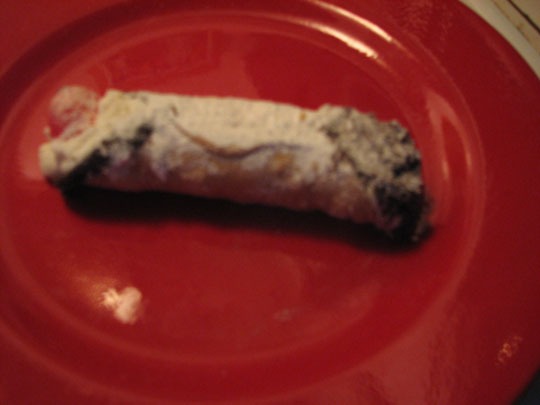
Purchased at Publix on East Lake Road in Palm Harbor. Adorned with cherries, chocolate sprinkles, chocolate icing, and powdered sugar.

by Jean Marie Carey | 18 Jul 2007 | Art History
Still Life With Parrots, Still Life with Parrots Jan Davidz. de Heem 1606-1684
Formal Analysis: Still Life With Parrots
Jan Davidsz. de Heem, who also fixed his signature as Johannes de Heem and J D de Heem ((Ildikó Ember, Delights for the Senses: Dutch and Flemish Still-Life Paintings from Budapest (Seattle, WA.: University of Washington Press, 1989) xiv)) , worked in Antwerp, Utrecht, and Leiden during the middle decades of the 17th Century, distinguishing himself from his mentor Balthasar van der Ast ((Arie Wallert, Still Lifes: Techniques and Styles: The Examination of Paintings from the Rijksmuseum (Zwolle, The Netherlands.: Waanders Publishers, 1999) 61.)) by pushing the form of the still life to include not just a signature patch
of angled lighting but elements and objects in his reflective collections arcane to the point of being obviously grotesque. Though many of de Heem’s canvases are simply beautiful — Communion Cup and Host, Encircled with a Garland of Fruit and Vanitas — Still Life With Parrots though produced during the same approximate period, does not fall into this category. Rather its disharmonious florid colors, strategically chaotic placement of objects, and zoological inaccuracies create tensions and puzzles which are depthlessly fascinating.
Still Life With Parrots is an oil painting measuring approximately five feet high and four feet across — enormous, particularly by the standards of its date of creation sometime in the latter half of the 1640s.
In another break with his habit of observing strict and straight diagonal composition lines, Parrots is filled with jagged, broken planes and difficult, harsh contours, this despite the presence of many objects — oysters, plums, lemons — with rounded, convex surfaces unto themselves. Several objects — a extraordinarily large gold and silver tazza, a conch shell, and a macaw are presented in unrealistic perspectival distance, competing for dominance. The single level surface shown is a horizontal tabletop splitting the canvas in its lower third, but only a single, flat, right-angle of the table is shown at the left of the painting, the rest of the furniture shrouded in a cloth.
(more…)

by Jean Marie Carey | 13 Jun 2007 | Art History
“Mega-Exhibitions and the Antimonies of a Transnational Global Form” by Okwui Enwezor vs. “The Globalization of the False: A Response to Okwui Enwezor” by George Baker
Theorist and curator Okwui Enwezor, who had written and published this paper on the emerging globalization of the art market and its relationship for better and worse to capitalism as the universally dominant system of commerce, repurposed and edited his original piece to accommodate a tandem presentation at Columbia University’s 2002 Sawyer Seminar. Presenting an opposing and decidedly more personal address was art critic George Baker.
Anolis carolinensis, green anole
Anolis carolinensis, the green anole, Florida’s only native anole species, May 2007
Enwezor allows that the so-called globalization of the art market is not seen be a positive by all ((“Mega-Exhibitions and the Antimonies of a Transnational Global Form†by Okwui Enwezor. 4)), but proposes, basically, that the world globalization be associated not just with the economic hegemony of the very wealthy individuals and institutions who collect and purchase art objects and support their creation but with a true internationalization of the art world. In this new and improved postmodernist art world, the old canon of art stars and art history would implode what would now occur would be the “broadening … of international participation across a range of cultural, social, and political spheres. ((ibid., 4))â€
(more…)
