by Jean Marie Carey | 18 May 2008 | Art History
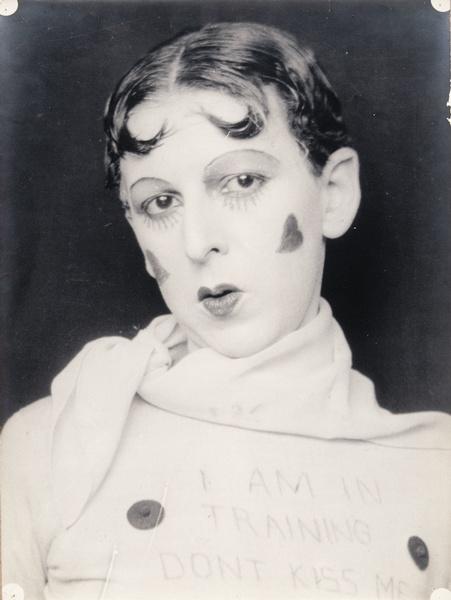
Claude Cahun Self Portrait, 1927. Collection Musée des beaux-arts, Nantes.
In her essay “In Our Glory: Photography and Black Life,” bell hooks uses a story about the relationship she and her two sisters “V.” and “G.” have to a photograph of their father, Veodis Watkins, taken before the girls were born, to set up a general dialogue about the function of snapshot collection displays in African American households and the role these photos play in construction and possession of black identity. Though a very prolific writer who mostly espouses disengagement from the concept of “the enemy,” hooks frequently chooses unusual adversaries (among them rapper Lil’ Kim and filmmaker Wim Wenders). In “In Our Glory” hooks’s rival is her sister “V.”
(more…)

by Jean Marie Carey | 18 Jul 2007 | Art History
Still Life With Parrots, Still Life with Parrots Jan Davidz. de Heem 1606-1684
Formal Analysis: Still Life With Parrots
Jan Davidsz. de Heem, who also fixed his signature as Johannes de Heem and J D de Heem ((Ildikó Ember, Delights for the Senses: Dutch and Flemish Still-Life Paintings from Budapest (Seattle, WA.: University of Washington Press, 1989) xiv)) , worked in Antwerp, Utrecht, and Leiden during the middle decades of the 17th Century, distinguishing himself from his mentor Balthasar van der Ast ((Arie Wallert, Still Lifes: Techniques and Styles: The Examination of Paintings from the Rijksmuseum (Zwolle, The Netherlands.: Waanders Publishers, 1999) 61.)) by pushing the form of the still life to include not just a signature patch
of angled lighting but elements and objects in his reflective collections arcane to the point of being obviously grotesque. Though many of de Heem’s canvases are simply beautiful — Communion Cup and Host, Encircled with a Garland of Fruit and Vanitas — Still Life With Parrots though produced during the same approximate period, does not fall into this category. Rather its disharmonious florid colors, strategically chaotic placement of objects, and zoological inaccuracies create tensions and puzzles which are depthlessly fascinating.
Still Life With Parrots is an oil painting measuring approximately five feet high and four feet across — enormous, particularly by the standards of its date of creation sometime in the latter half of the 1640s.
In another break with his habit of observing strict and straight diagonal composition lines, Parrots is filled with jagged, broken planes and difficult, harsh contours, this despite the presence of many objects — oysters, plums, lemons — with rounded, convex surfaces unto themselves. Several objects — a extraordinarily large gold and silver tazza, a conch shell, and a macaw are presented in unrealistic perspectival distance, competing for dominance. The single level surface shown is a horizontal tabletop splitting the canvas in its lower third, but only a single, flat, right-angle of the table is shown at the left of the painting, the rest of the furniture shrouded in a cloth.
(more…)
