by Jean Marie Carey | 5 Jun 2013 | Art History, German Expressionism / Modernism
Artists in Schwabing.
Some Anglophones were saying recently how there were no artists neighborhoods left in München, specifically how there were no longer any such enclaves in Schwabing. I think what the person actually meant is that George Maciunas isn’t walking up and down Schellingstraße tossing boxes of junk around, leafleting, or setting up a utopian community in a Hofpfisterei storefront, meaning, there are few obvious visual social interruptions of “bohemian-ness” to the reality that it is very expensive to live or have a gallery space in the center of the city there is sometimes a tremendous, pressured sense of homogeneity in the immediate environment. This is both a true and false perception.
(more…)
by Jean Marie Carey | 12 May 2013 | Art History, German Expressionism / Modernism
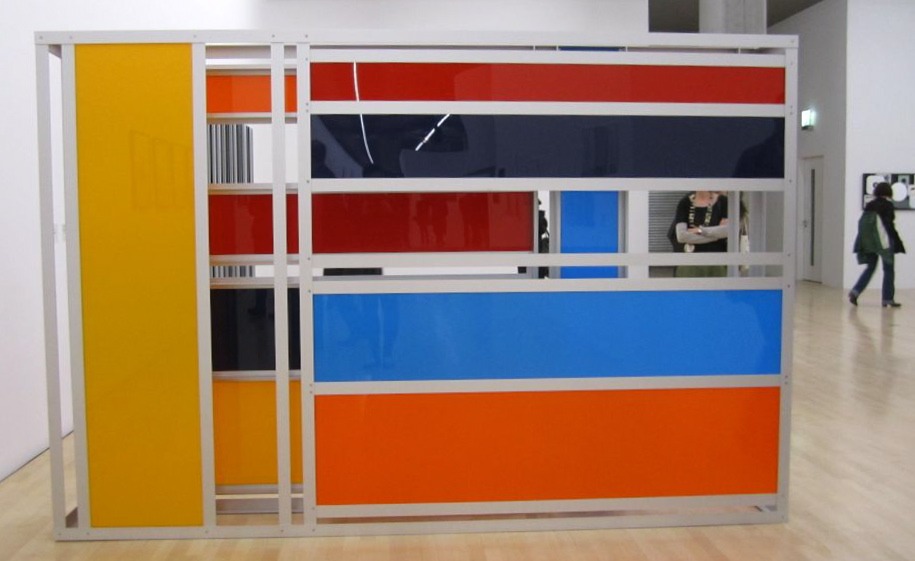
There’s a moment when the super-creative but detached suddenly open up and reveal actually, they do know what’s going on. It’s a brave thing to do because it both raises the stakes for intellectual performance and blows away the dandelion dander of the potentially naive. Maybe partly involuntarily but resolutely nonetheless, Liam Gillick’s two works arranged in careful complement in the subterranean Lenbachhaus annex achieve this emergence, perhaps more substantively than at their dates of creation in the ‘aughts.
Part of the KiCo Stiftung comprising the very deep “Kunst nach 1945” Sammlung, Gillick’s Screened Reduction (2001) and Glanced in the Midst of a Legislative Break (2006) are opaque Plexiglas and aluminum structures, sculptures poised at the edge of painting. In reference to the latter they clearly hearken to Kenneth Noland’s high Straight Edge (think Bridge circa 1964) and are also thematically in sync with an earlier guest in the Kunstbau, Piet Mondrian, and as such more than nod to the historical commitment to abstraction.
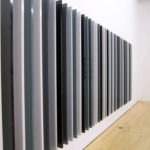
Gillick, who is also a composer and musician (he actually made the sampling loop of the Smiths’ How Soon is Now? you will remember – if you are a former club kid – from Soho’s 1990 nightclub single Hippy Chick!), tends to characterize his work in careful Global Art Fair-speak as being about the questioning of political authority and so on. However taking at visual and bodily encounter value, Screened Reduction and Glanced in the Midst of a Legislative Break are hardly obscurantist, inviting inspection and delectation in simple optics.
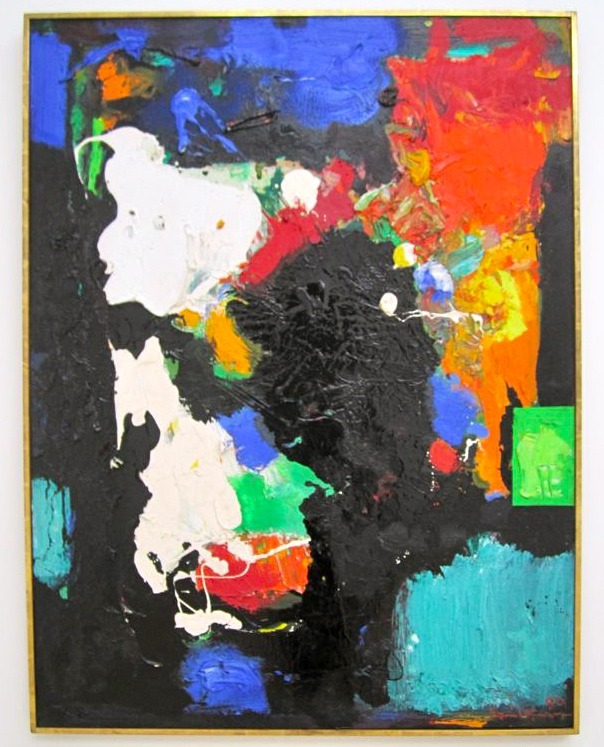
I decided to take this sort of sideways approach to writing about “Das Neue Lenbachhaus” when on a subsequent visit I saw for the first time, for a long time, and up very close, Hans Hoffman’s The Conjurer (1959). Hoffman is very collected but quite under-studied, and this painting is historically significant as well as quite lovely. I hope you can see in the adjacent image the toned translucency and balance of the aqua swatch, which is so carefully balanced on the canvas that the bright color does not preoccupy the eye, and also the charcoal impasto and general texture of the canvas, which is both thick and lustrous.
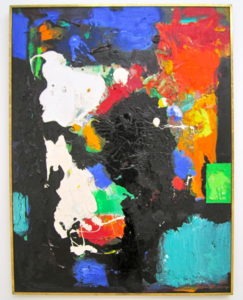
The Bavarian-born Hoffman traveled back and forth between Munich and the United States, and like Kandinsky once opened his own school for artists. Hoffman had many talented students, including Louise Nevelson, Allan Kaprow and Helen Frankenthaler. The Conjurer, made some years after Frankenthaler became well-known for her vertical soak-stain paintings, suggests maybe Hoffman, like Morris Louis, got some ideas from Frankenthaler, too.

by Jean Marie Carey | 17 Feb 2013 | Animals, Animals in Art, Franz Marc, German Expressionism / Modernism, Re-Enactments© and MashUps
It was actually a very solemn week and past few days but in recounting some stories it’s easier to begin with flashes of humor, and there were a few extremely funny episodes to report.
The first was while visiting the Cloisters. After viewing the very disturbing (to me) tapestries of the allegorical (but very graphically woven) hunting of the unicorn we came upon this:
Called a Palmesel; this model dated 1470 is from a church in Mellrichstadt – perhaps I should have guessed that such a fun crazy object would come from Bavaria – and apparently they continued to be quite popular in the beautiful south to the relatively modern times, protected from the Reformation.
We went to the Metropolitan Museum of Art which is another whole story I will get to…but, in trying to dash through the rooms and rooms of Impressionism to come out in the relatively tiny alcove of the good stuff, out of the corner of my eye, I spotted this:

I think he means “peniche.”
M^2 knew what time it was but the group of admirers who were lingering to count the dots or whatever were perplexed by our laughter so as you can see I had to share this important re-enactment with them. It’s kind of hard to explain anyway, but the people seemed amused and we were also very cheerful.
by Jean Marie Carey | 7 Feb 2013 | Animals, Animals in Art, Art History, Franz Marc, German Expressionism / Modernism, Re-Enactments© and MashUps
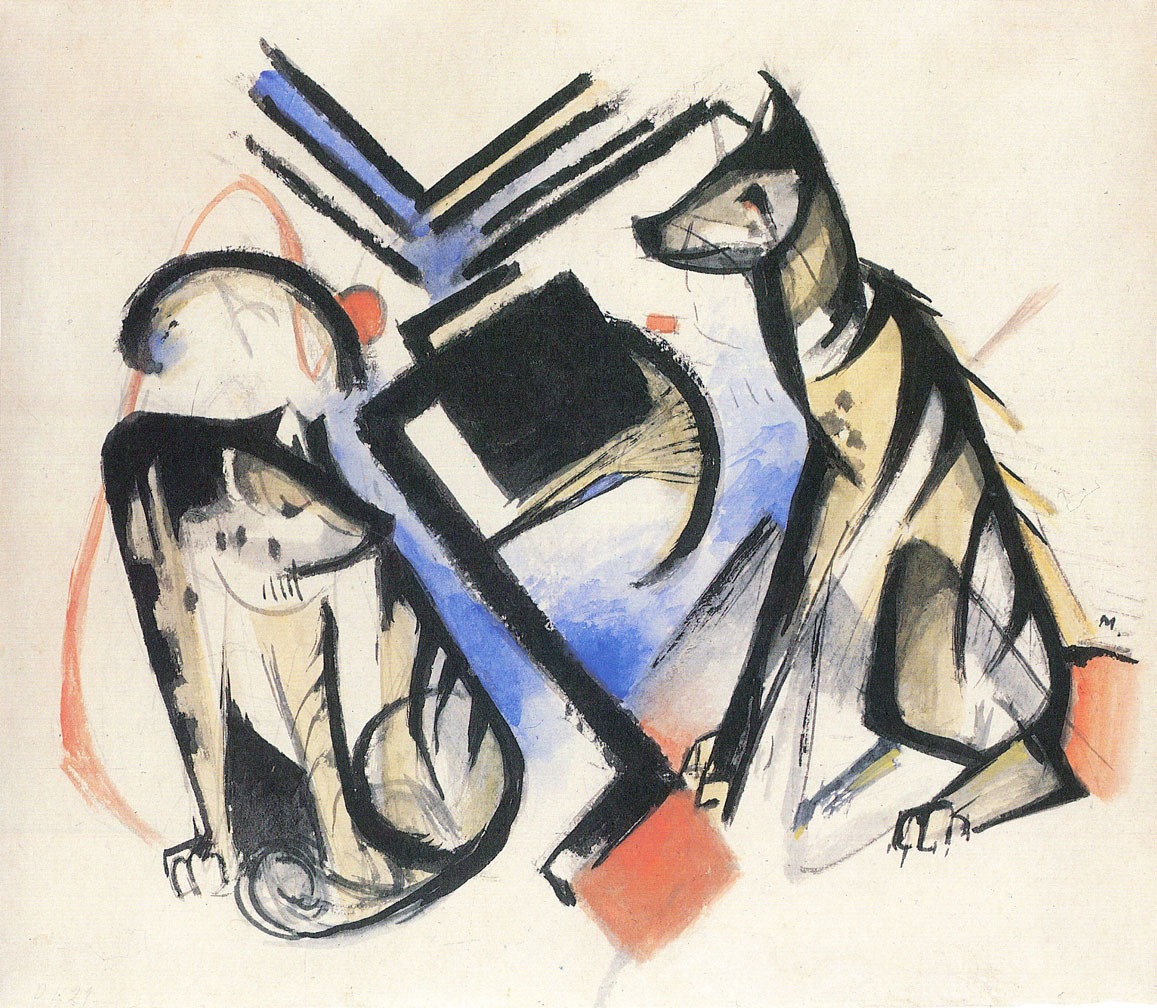
Zwei Wölfe, Franz Marc, 1913
“Furr” – Blitzen Trapper
Yeah, when I was only 17,
I could hear the angels whispering
So I droned into the words and
wandered aimlessly about till
I heard my mother shouting through the fog
It turned out to be the howling of a dog
or a wolf to be exact.
The sound sent shivers down my back
but I was drawn into the pack.
And before long, they allowed me
to join in and sing their song.
So from the cliffs and highest hill, yeah
we would gladly get our fill,
howling endlessly and shrilly at the dawn.
And I lost the taste for judging right from wrong.
For my flesh had turned to fur, yeah
And my thoughts, they surely were turned to
instinct and obedience to God.
You can wear your fur
like the river on fire.
But you better be sure
if you’re makin’ God a liar.
I’m a rattlesnake, babe,
I’m like fuel on fire.
So if you’re gonna’ get made,
don’t be afraid of what you’ve learned.
On the day that I turned 23,
I was curled up underneath a dogwood tree.
When suddenly a girl
with skin the color of a pearl,
wandered aimlessly,
but she didn’t seem to see.
She was listenin’ for the angels just like me.
So I stood and looked about.
I brushed the leaves off of my snout.
And then I heard my mother shouting through the trees.
You should have seen that girl go shaky at the knees.
So I took her by the arm
we settled down upon a farm.
And raised our children up as
gently as you please.
And now my fur has turned to skin.
And I’ve been quickly ushered in
to a world that I confess I do not know.
But I still dream of running careless through the snow.
An’ through the howlin’ winds that blow,
across the ancient distant flow,
it fill our bodies up like water till we know.
§ § §
*(Actually February 8) This year’s anecdote: In the frustration of inertia I went back to as yet untranslated Marc letters, and I found some correspondence that looked interesting about when FM went to visit the Brücke at the beginning of 1912. FM was only supposed to be gone for a few days but actually disappeared for, like, three weeks – this was noted by KBoyV who wrote annoyed notes almost every day commenting on the the situation, i.e. “You left on 2 January and were supposed to return on 5 January and it is now 12 January!”
FM sent some cheerful postcards but made no mention of being in any hurry to return to being, as FM put it, “henpecked.” (FM went to Berlin around the holidays anyway, to visit his perplexed in-laws, camp out on the doorstep of the von Eckhardts, continue investigating the musems, and generally “see what was going on.”)
FM was very intrigued by the crazy goings-on at the Brücke hangout, trying to remain unfazed in the midst of what must have been, even by FM standards, extreme partying situations, nonetheless reporting breathlessly in letters (“OMG these guys are doing DRUGS and stuff!..” and [this is an actual quote, not my interpretation for the modern times] about people “doing goblin-like gymnastics and cartwheels.”
The Brücke had made all their own furniture, wall hangings, murals, even ceramics, lamps, glassware and stuff, and despite the CD cases, pizza boxes and beer bottles strewn around it looked like kind of a cool studio to hang out in. Anyway, a repeated theme in people’s observations and sometimes FM’s own about himself is that he was, sometimes, kind of clumsy or as KBoyV frequently remarks “awkward.” The Brücke dudes finally agree to let FM put some of their stuff in the second Blue Rider show. Meanwhile, FM keeps accidentally busting up their handmade furniture. On 19 January 1912, there was actually the classic sit-down-on-a-chair-and-it-breaks pratfall.
HM was finally dispatched to Berlin to get FM detoxed from opium, teenagers, or whatever, and back on the train home to Bavaria (this lead to a typically digressive and huffy mini-festo on the annoying tendency of trains to go, you know, directly from place to place instead of just cruising around for a while). FM remarked to HM upon departing that even though the place was pretty much already trashed when he got there, it looked like “a couple of giant bears had turned everything over” by the time he left…
From (more or less): Franz Marc: Briefe, Schriften, Aufzeichnungen. Leipzig: Gustav Kiepenheuer, 1989, S. 60-66

by Jean Marie Carey | 8 Feb 2012 | Animals, Animals in Art, Art History, Franz Marc, German Expressionism / Modernism
“I saw what the moorhen sees as it dives: the thousand rings that encircle each little life, the blue of the whispering sky swallowed by the lake, the enraptured moment of surfacing in another place. Know, my friends, what images are: the experience of surfacing in another place.”
{ Ich sah das Bild, das in den Augen des Teichhuhns sich bricht, wenn es untertaucht: die tausend Ringe, die jedes kleine Leben einfassen, das Blau der flüsternden Himmel, das der See trinkt, das verzückte Auftauchen an einem andern Ort, – erkennt, meine Freunde, was Bilder sind: das Auftauchen an einem anderen Ort. }
Franz Marc, Aphorismen 82, 1915.
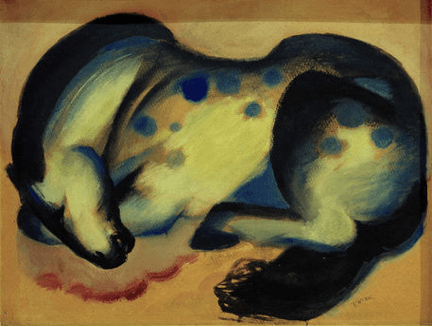
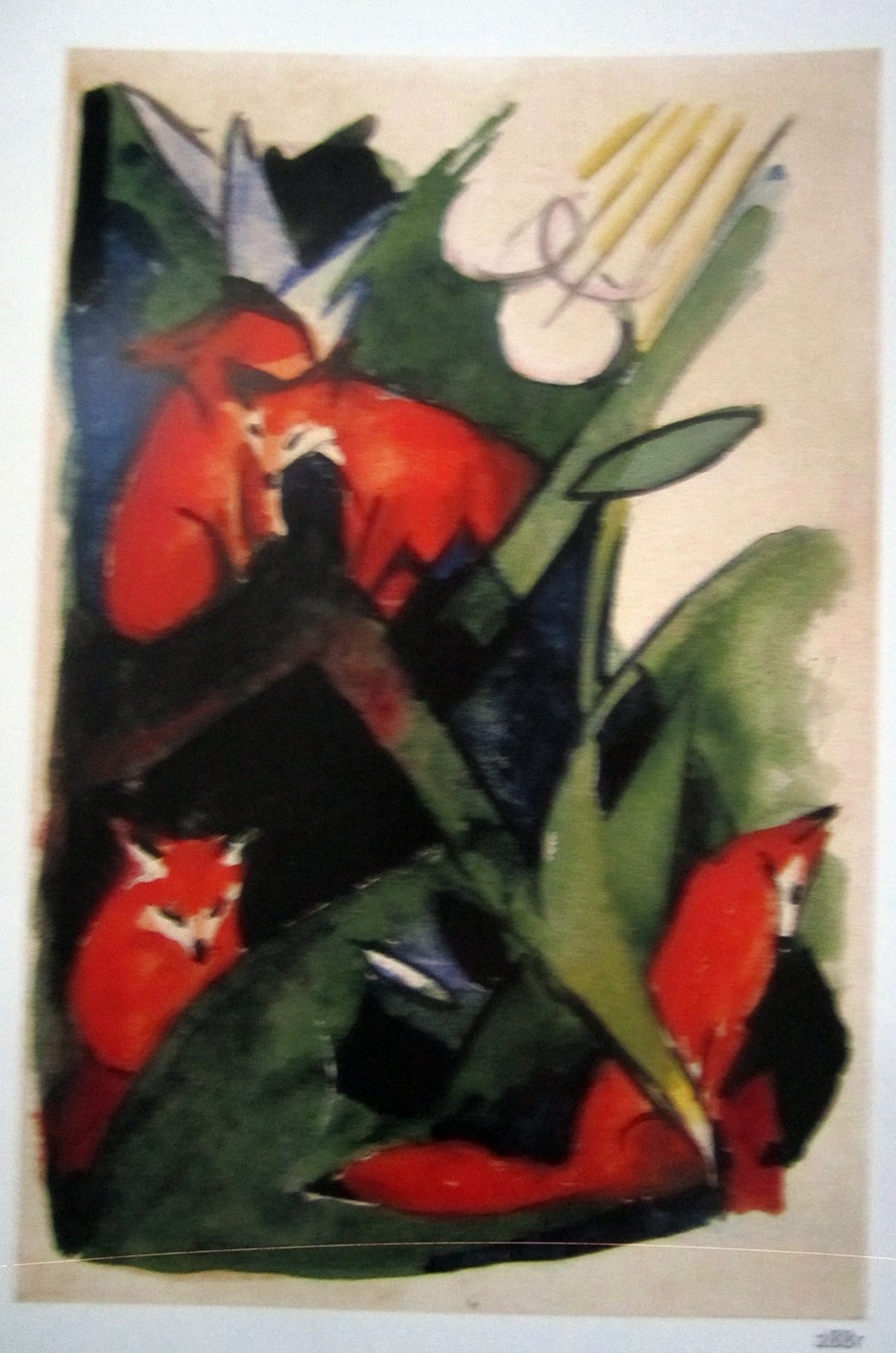
The images are Vier Füchse, a postcard from 1914, and Liegendes Pferd, a water color from 1911.