by Jean Marie Carey | 6 Apr 2015 | Animals, Animals in Art, Art History, August Macke, Dogs!, Expressionismus, Franz Marc, German Expressionism / Modernism, LÖL
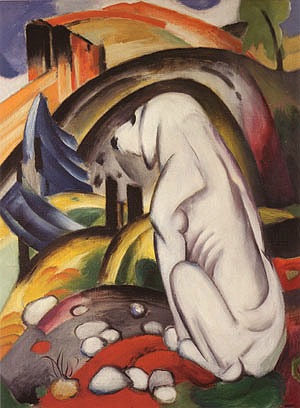
Hund vor der Welt, Franz Marc (1912). Oil on canvas, 118 by 83 centimetres, private collection, Switzerland
I write about this painting a lot – in fact I once, for quite a long time, devoted my academic research solely to this painting – but I realised I don’t often say anything about it in this space. So here is a little excerpt not from my current chapters but from a side project.
§ § §
Franz Marc made an innovative painting – a metaphysical genre portrait of his dog Russi – called Hund vor der Welt in the spring of 1912. The large vertical canvas shows the white hound seated on a hillside, facing the sun and the landscape at an angle across an indeterminate space. We have an account of what Marc had in mind in making this image in particular and Marc’s other thoughts about painting his frequent model.[1] There is also a substantial amount of documentation about Russi, the dog, who, as the artist’s constant companion, was a character who populated the art, photographs, and writing of other people. We even know where Russi was born, how he came as a puppy to live with Marc, and when he died.[2] So despite its slightly whimsical affect, Hund vor der Welt is an image of a real dog about whom much historical information is available. Marc made many paintings in which Russi also appears as a peripheral regular “character;” he leads the way in Im Regen (1912) and leaps after Die gelbe Kuh (1911).
August Macke, who came into frequent contact with Russi and made his own drawings of the dog, prevailed upon Marc to change the name of the painting from the one Marc originally had in mind, So wird mein Hund die Welt sieht.3 We know from Marc that he wanted to show Russi in thought, so the dog’s seated posture suggests that this is what is happening in the stillness. The strange view of the landscape Russi “sees” is nonetheless completely identifiable as a typical one from around Sindelsdorf where Marc lived. By placing buildings in the recognizable, managed farmlands of Bavaria, Marc suggests that people and animals are part of the same ecology, which, for dogs as the primary animal of domestication, is certainly true.
Russi did not have the life of a working dog, instead, with Marc, dividing his time between Munich, Berlin, and the small towns of Sindelsdorf and Ried. Russi lost part of his tail in 1911, an adjustment to his appearance that is reflected in his 1912 portrait. This shows that Marc had a commitment to showing morphologically accurate details even about the animals he painted, even as the paintings themselves broke with academic naturalism.
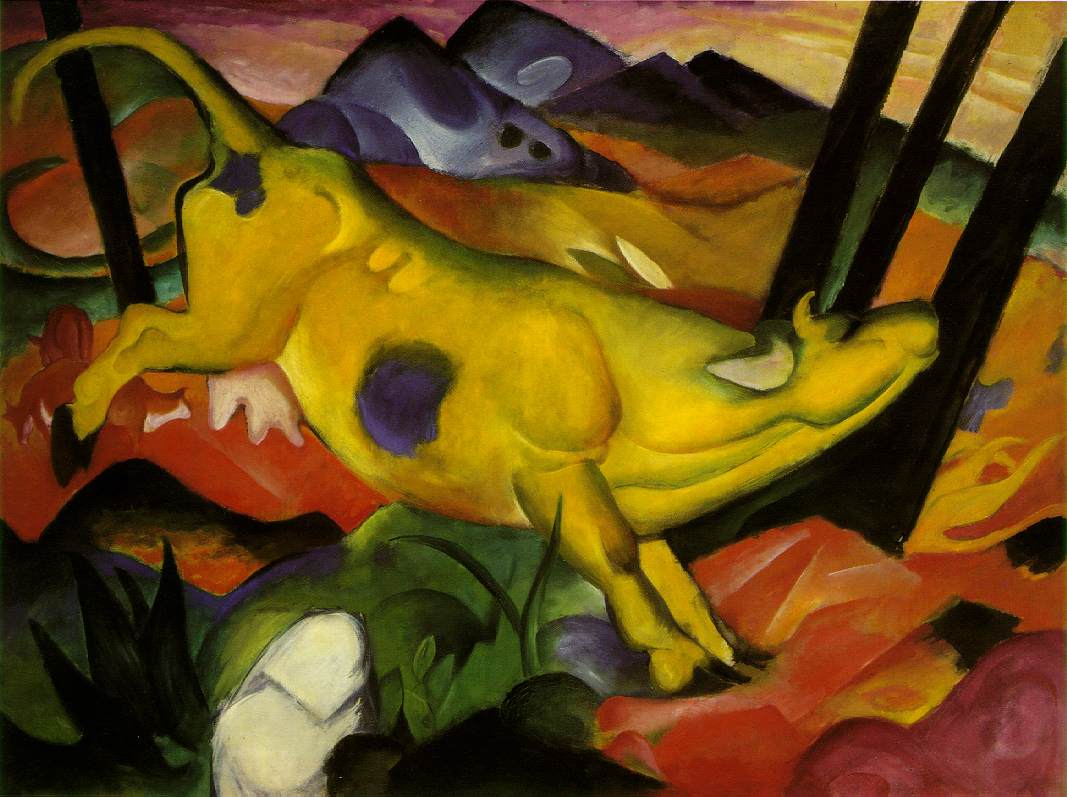
Die gelbe Kuh,
Franz Marc, 1911
189.2 × 140.52 cm
Oil on canvas
Solomon R. Guggenheim Museum, New York. That is Russi Marc in the lower left corner.
[1] Franz Marc, Briefe, Schriften und Aufzeichnungen, (Leipzig: Kiepenheuer, 1989), 11. Observing Russi at this moment, Marc wonders: “Ich möchte mal wissen, was jetzt in dem Hund vorgeht.”
[2] Marc, Briefe, 196-197.
[3] Franz Marc, August Macke, Briefwechsel, (Köln: DuMont, 1964), 124-126.
by Jean Marie Carey | 5 Mar 2015 | August Macke, Expressionismus, Franz Marc, German Expressionism / Modernism, Re-Enactments© and MashUps
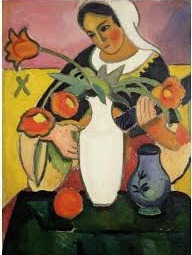
Die Lautenspielerin, August Macke, 1910
“Recent publications” is in quotes because all of the great opportunities to preach the gospel of Marc lately have come to me strictly through the generosity of other people, so I will quickly get to the point of thanking Trang Vu Thuy and the curatorial staff at the Lenbachhaus and Janine Arnold of Notes About Art. (Please click through the links to view the articles themselves.)
My post (which is present entirely owing to the patience of Vu Thuy) “Ein Manifest der Freundschaft” is in honor of the August Macke und Franz Marc: Eine Künstlerfreundschaft exhibition (on through 3 May 2015 in the Lenbachhaus Kunstbau) and concerns one of my favorite subjects, the Paradies mural.
“Von »Köstlichen Figürchen« und »Wunderherlichen Farben«” by assistant curator Monika Bayer-Wermuth is actually the most wonderful post, though, on the gifts sent by the Marcs to the Mackes and is told in the same thoughtful, personal vein as are many of the chapters in the companion catalogue.
Thanks to the generous invitation of Arnold, I have two entries on her Notes About Art website, one called “Confrontations & Reconciliations” about my interpretation of Franz Marc’s gift of the painting Blaues Pferdchen, Kinderbild to August Macke and the other a bit about the history of Marc’s two Turm der blauen Pferde.
I am very happy to see art historians collaborating across distance and language just because we like the art and want for other people to be able to know about and appreciate the work of Der Blaue Reiter. (more…)
by Jean Marie Carey | 21 Jan 2015 | Animals, Animals in Art, Art History, August Macke, Expressionismus, Franz Marc, German Expressionism / Modernism, Helmuth Macke, Re-Enactments© and MashUps
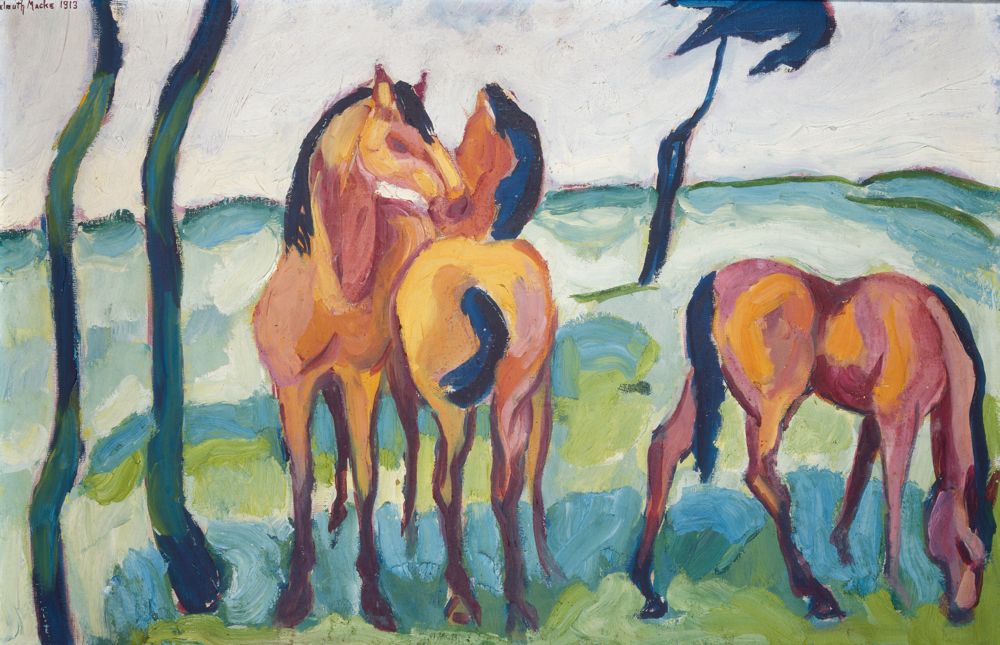
Helmuth Macke,
Drei Pferde,
1913
“The ‘boarding school’ is in session,” Franz Marc wrote nervously to his friend August Macke.[1] Pining for company in the same letter, Marc nonetheless wondered if August should come and get Helmuth Macke, August’s young cousin, whom the Macke family had deposited some weeks earlier at Marc’s small apartment in rural Sindelsdorf. It was late November 1910. Marc would soon turn 31, and Helmuth was 18. Until Helmuth’s arrival, Marc had been working alone for some time. At the insistence of her concerned parents, Maria Marc had returned to Berlin. Marc was just beginning to see the slightest of incomes from his painting, but he was irritable and distracted. And now August, himself adjusting with his wife Elisabeth to the birth of their son, expected Marc to find ways to entertain a teenager.
Yet Helmuth was resourceful and clever. During the weeks in Sindelsdorf, (which become months and longer: “Helmuth’s fine, he’s still growing,” Marc reported the following summer)[2], Helmuth taught himself enough Dutch to communicate with Heinrich Campendonk; chopped wood and built a fence; practiced painting and drawing, befriended Marc’s dog Russi; and demonstrated a talent for cooking and baking. This latter skill commanded Marc’s particular favor. Animated but sympathetic, Helmuth provided stability and encouragement. By Christmas Marc had breezily informed August that Helmuth would be staying on.[3]
As the calendar turned to 1911, the chrysalis of Sindelsdorf opened and released a new Marc to Munich. Seeking a sophisticated way to celebrate New Year’s, Helmuth pointed Marc toward a performance of Arnold Schönberg quartets. The music had a vivid impact on Marc, which he reported with great excitement to Maria, August, and a new friend who had missed the concert – Wassily Kandinsky. At a the soirée given by Marianne von Werefkin at which Marc and Kandinsky met at last in person, Helmuth was at Marc’s side, and witnessed the twinkle in the eye of fate that became Der Blaue Reiter.[4]
After the party, Helmuth and Franz took the late train from Munich to Penzburg, laughing and marveling over their adventure as they walked jauntily through the falling snow back to Sindelsdorf. Neither traveler was concerned for the future at that joyful moment, and mercifully, neither could know what the future held.
Helmuth Macke died in 1936 when his small boat capsized in a sudden storm on Lake Constance, having given his sailing companion the only life preserver.
[1] Franz Marc, August Macke: Briefwechsel. (Köln: DuMont, 1964), 20-21.
[2] Marc and Macke: Briefwechsel, 42.
[3] Marc and Macke: Briefwechsel, 28.
[4] Dominik Bartmann, Helmuth Macke, (Recklinghausen: Verlag Aurel Bongers, 1980), 26.
by Jean Marie Carey | 15 Dec 2014 | Franz Marc, German Expressionism / Modernism
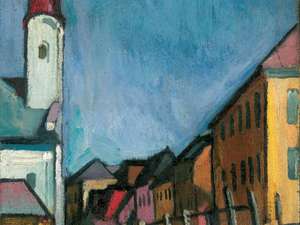
Is this colorful village scene painted by August Macke?
I have been working on a project about authenticating a painting maybe misattributed to one of my Expressionist painters (yet maybe made by another), so I was very interested to see a story crop up over the weekend in the Münchner Merkur online edition (pretty sure Süddeutsche Zeitung, usually so on top of all news Bayern, must be spitting nails!) about a man who thinks he owns a painting by August Macke.
Even more intriguingly, the painting would have been made in 1910, the year Macke spent in Tegernsee during which time Franz Marc often came to visit the Macke family, sometimes walking there through Oberbayern from Sindelsdorf to Tegernsee with Russi Marc. This period of time is recounted with warmth and in detail by Margarethe Jochimsen and Peter Dering in the book August Macke in Tegernsee.
The man who owns the painting, Herbert Spiess, claims to have purchased it from an art dealer in Vienna in 1984. Spiess told the Merkur he became convinced the painting, a small streetscape, was a Macke simply through visual association. (The Westfälische Landesmuseum für Kunst und Kulturgeschichte in Münster says “no” in the Merkur’s story; no comment from the Lenbachhaus or the August Macke Haus in Bonn).
Macke enjoyed his time in Tegernsee. This was a happy year for Macke and his wife, Elizabeth and their first son, Walter, was born in the quiet lakeside village. Macke was more or less amused by his botany-obsessed landlords, whose Bayerische dialect he was able to penetrate with Marc’s help. Stubbornly autodidactic and much more fanciful and imaginative than he appeared at a glance, Macke spent hours doing “copying exercises” with Marc (and doing some other fun stuff too), and experimented with many styles of painting and drawing in 1910.
During this time, despite being in a very attractive location, Macke concentrated on portraiture, making many sketches and paintings of Walter, Elizabeth, and the famous portrait of Marc.
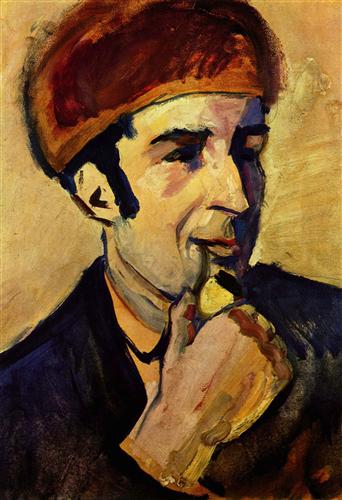
Bildnis Franz Marc, August Macke, 1910
But Macke also was always making all sorts of things, from tapestries to fabric designs to theater decorations. So it’s certainly possible this single painting is something he just knocked out during this period of great productivity – Macke was exceedingly prolific and made more than 200 paintings between 1909 and late 1910, when the young family returned to Bonn, leaving cousin Helmuth Macke to stay with Marc.
So it’s hard to say, from looking alone, if this painting could be Macke’s. I hope it is but (and this is really just a very strong intuition as much as empirical assessment) my feeling is that it might not be. To my eye the painting lacks that little flourish of passion and verve, and of capturing the “inner realities” of the beauty he was in the physical world, that is the beautiful Expressionist hallmark of Macke’s oeuvre. With any luck I’m wrong though, and the world will have a new August Macke painting to admire.
Anyway, the reporter, Vera Markert, asks that if you have any information or ideas about the painting to get in touch with the Merkur via email at kultur@miesbacher-merkur.de wenden.

by Jean Marie Carey | 28 Jul 2014 | Animals, Animals in Art, Art History, Franz Marc, German Expressionism / Modernism, LÖL
Brigita Hofer cleans, fills, patches, and recolors “Paradies.”
Here is a short article on the ruhr.de website about the restoration of the Paradies mural made by Franz Marc and August Macke in 1912 at the Mackes’ home in Bonn. It’s an interesting little piece and the website also has some photographs of the movement of the mural, in the 1980s, from its original location to the Museum für Kunst ind Kultur/Westfälisches Landesmuseum in Münster, where it lives today (there is a pretty nice replica at the August Macke Haus though). Like a lot of people I am sad that the museums can’t just switch the murals back, but this article sort of explains why that will not happen.
The restorer, Brigita Hofer, has discovered that the mural is pretty structurally unsound, giving it a soundness rating (as happens with earthquake-damaged buildings as I recently learned) of around 25, which means there’s a better than one in four chance it could collapse under any further stress. Hofer has been filling in surface cracks and erosions with non-expanding plaster and emulsifier with the tiniest of syringes. Hofer also restored some of the mural’s damaged or faded paint. In doing so she discovered that Macke and Marc had made a lot of adjustments to the mural as they worked together, repainting Eve’s face and the deer. Hofer also learned from a heretofore covered note that Maria Marc had painted the wasp at the bottom of the mural.
I am fascinated with this mural, as you might guess from how often I write about it, not for the least reason that it seems to be a truly collaborative effort that resulted in a distinct “style” that is identifiably that of both painters but is also a unique meshing of their ideas and talents. Even the animals don’t look exactly like Marc’s other animals, and for both, the palette is a bit subdued. (Except Adam reaching to embrace the monkey on the top left branch though and turning from the other figures – I think that’s a Marc thing. There is a large image of the mural in the post just before this one.)
