Eden and Everything After

From: 21 January 2023-21 December 2023

Opening: 21 January 2023, 14:00

University of Stavanger Archaeological Museum

Peder Klows gate 30A 4010 Stavanger Norway

Hours:

Tuesday 11 – 20

Wednesday – Sunday 11 – 16

Monday closed.

Information: post-am@uis.no

Online: Twitter |Facebook | uis.no/nb/arkeologisk-museum

Catalogue: Eden and Everything After, Jean Marie Carey and Kristin Armstrong-Oma, eds. University of Stavanger (2023), ISBN 978-82-7760-196-0.

Eden and Everything After explores Eden as utopia in the past, present, and as futuristic visions. It is a meeting point between prehistoric objects, German Modernist art of the Blaue Reiter, and Norwegian contemporary artist Tanja Thorjussen. Animals and their poignant presences weave together these divergent strands as beings imbued with a spirituality and mysticism that inspired past and present artists.  

This historic exhibition places prehistoric objects, found materials, and visual arts side by side, combined, or adjacent. These artworks share some special visual or symbolic relationship. Juxtapositions of pieces are seen differently than as by single displays.

The eponymous catalogue is conceived as a tribute to “modernism’s integrative personality,”[1] Franz Marc, and his reimagining of paradise. Contributors to the catalogue include Dolly Jørgensen, Olaya Sanfuentes, Mira Shah, Kristin Armstrong-Oma, Stephanie Lebas Huber, Siv Kristoffersen, Håkon Reiersen, Tanja Müller-Jonak, Laura Hohlwein, Siddarth Sareen, and Ellen Hagen, plus features prose and artwork by Thorjussen. The article “Traumatic Imagination in Franz Marc’s Animalisation of Art” by Julie Kim Rossiter and Jean Marie Carey presents new research on the artist’s last painting, Abstrakte Landschaft mit fabelhaftem Tier (Rotwild) (1915) and analysis of his Skizzenbuch aus dem Felde.

Eden and Everything After opens on 21 January 2023 and will be open through the year at the University of Stavanger Archaeology Museum, 30A Peder Klows gate, 4010 Stavanger, Norway. Please send questions to curator Jean Marie Carey, whose work on the project is funded by the U.S.-Norway Fulbright Foundation and the European Union’s Marie Sklodowska Curie Actions.

Tupilaq Relic Slange. Animal figurine, snake, gold, Bronze Age or Iron Age (1800 BCE–CE 1050), from Hesby, Finnøy. Tanja Thorjussen, 2022. Photo: Annette Græsli Øvrelid
Detail of the atelier and the replica of the Paradies mural made in situ by August Macke and Franz Marc in 1912. Photo: Jean Marie Carey

[1] Robin Lenman, “The Internationalization of the Berlin Art Market 1910-1920 and the Role of Herwarth Walden,” in Künstlerischer Austausch – Artistic Exchange, vol. 3, ed. Thomas W. Gaehtgens (1993), pp. 535-542 (537).

bauhaus imaginista

bauhaus imaginista


 Luca Frei, Model for a Pedagogical Vehicle, 2017. Photo: Karl Isakson. 


 bauhaus imaginista is, or was since it’s taken a while to get this post together, an international exhibition project examining the global influence of the Bauhaus on the centennial of the founding of the school in Weimar, Germany. bauhaus imaginista’s main event, Bauhaus Week Berlin, ran 30 August through 8 September 2019, but other showcases and one-off events go through the end of the year. Headquartered at the Festival Center at Ernst-Reuter-Platz (Mittelinsel) in Berlin-Charlottenburg, the art festival includes tours of the Mies van der Rohe Haus, demonstrations of Josef Albers’ glassworks techniques, exhibits of Bauhaus printing and typography, weaving and ceramics workshops, tours of Bauhaus architecture, and re-created shop windows. Here I am condensing a review of the very comprehensive catalogue of the global exhibition, which ran in full at Museum Books, and of the exhibition, featured in ArteFuse. For a complete schedule of events, see https://www.bauhaus100.berlin/

Coming soon some very interesting provenance news – a triple header! 


 Kurt Schwerdtfeger, Reflektorische Farblichtspiele, 1922. Courtesy of Microscope Gallery and Kurt Schwerdtfeger Estate © 2016. 


Satellites of bahaus imaginistaare ongoing around Germany. In Leipzig an exhibition showcasing the academy’s material culture focus is open through 29 September 2019 at the GRASSI Museum für Angewandte Kunst, with well-known manufactured items made in Saxony’s factories face contemporary examples of applied design and craft. The exhibition History, Present and Future of a City presented by the Staatsgalerie Stuttgart through 20 October 2019 and is a collection of reflections by contemporary artists on the interaction of the Bauhaus with international influences.


The series of Bauhaus centennial symposiums, classes, performances, and exhibits began in March 2018 with an academic conference at the China Academy of Art in Hangzhou and will conclude at Nottingham Contemporary in England with the show Still Undead: Pop Culture in Britain Beyond the Bauhaus, opening 21 September 2019 and running until 5 January 2020; bauhaus-imaginista.org is the online journal of the project.
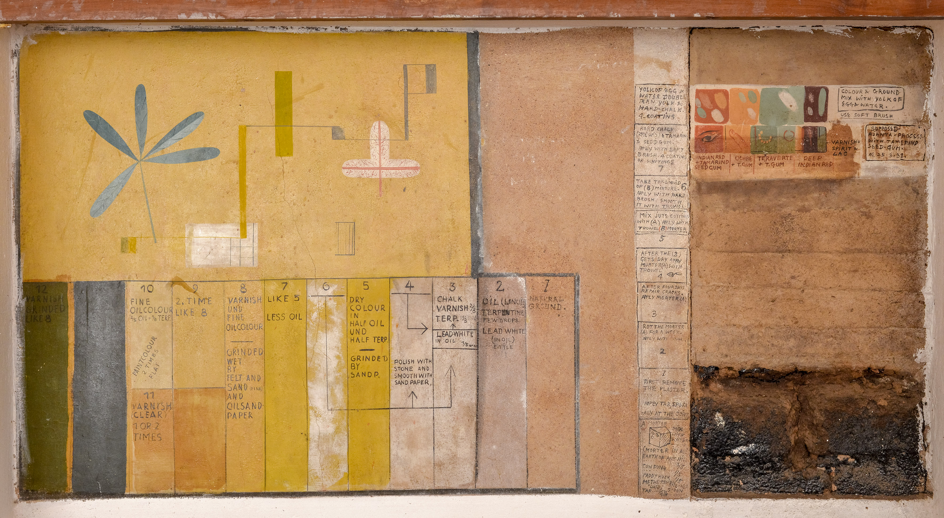


  Nandalal Bose, Anleitung zur Wandmalerei, 1929/30. Fresco on cement wall, 80 x 100 cm.Kala Bhavana, India.


 On the centennial of the founding of the Bauhaus school in Weimar, an ambitious exhibition project, touring 11 countries, is revisiting – and in some cases challenging and sideswiping – the pervasive influence of the academy. Curated and directed by Marion von Osten of Berlin and London-based Grant Watson, the individual parcels of the bauhaus imaginistaare complemented by a program of cross-hemispheric satellite events, workshops, and panels. The confluence with the current critique-of-Modernism zeitgeistis fortuitous for the project, because otherwise I am not sure that bauhaus imaginistaposes a provocative question that requires a jusqu’au bout du monde-style breakneck global investigation to answer: The existence of the Nike Air Max 270 React ‘Bauhaus’ trainer seems substantive proof that the Bauhaus is both certifiably reify-able and has a broad popular influence. Notably, with most German-side events taking place in Berlin, Weimar’s present-day incarnation as an out-of-the way village with only one coffee shop to greet disappointed architecture students making the pilgrimage is glossed over.


Paulo Tavares, DES-HABITAT, 2018.


 However, 15 years after the dueling canonical polemics of Okwui Enwezor’s “Mega-Exhibitions and the Antinomies of a Transnational Global Form” and George Baker’s “The Globalization of the False: A Response to Okwui Enwezor” appeared in The Biennial Reader(Berlin: Hatje-Cantz, 2004) the sprawling exhibition does provide evidence of an interesting art world mutation. While Enwezor was cautiously optimistic that the global art fair phenomenon would open a cultural sphere for the inclusion of artistic practices beyond the West, Baker argued that such festivals were no more than a consolidation of hegemonic bourgeois culture, and thus by definition Eurocentric and nationalistic.


 Paul Klee, Teppich, 1927. Pencil on paper and cardboard, 23 x 30 cm. Hans Snoeck Collection, New York.Photo: Edward Watkins 


What has happened in the intervening years has been both predictable, as in the rise of the value and popularity of contemporary Chinese art, and surprising. Despite its widespread panning and numerous financial peccadilloes, Kassel’s 2017 Documenta 14 didhave some startling entries, from the breakout durational performance of the women of iQhiya, a collective of University of Cape Town alumnae, to the seemingly incontrovertible solution of the 2006 murder of Halit Yozgat in the installation by The Society of Friends of Halit. The cheekily named Oslo “Biennial” began this summer and runs through 2024…to be followed by the next Oslo Biennial in 2025.
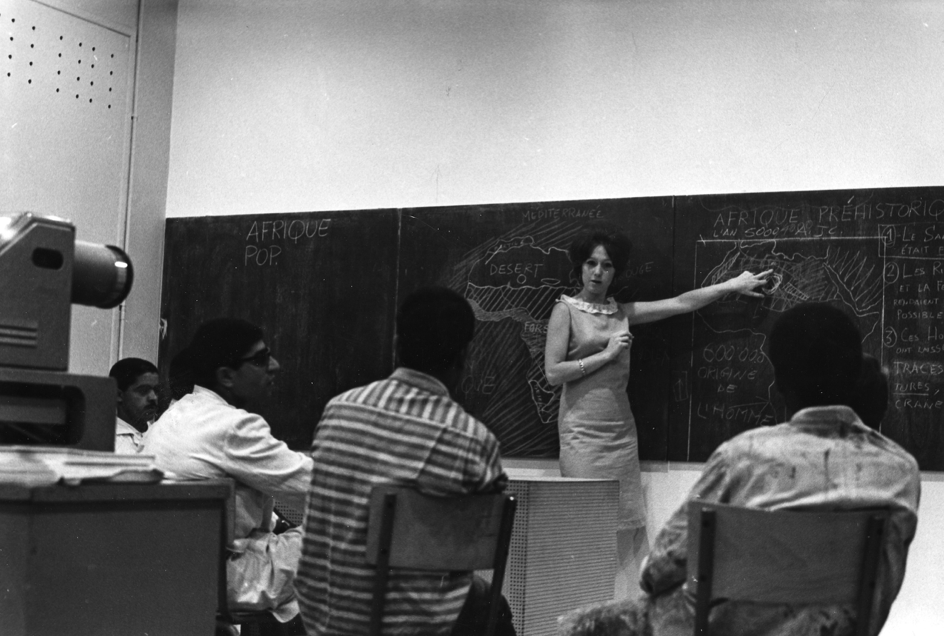


Toni Maraini teaches an art history class at the Ecole des Beaux-Arts in Casablanca, 1965.Photo by Mohammed Melehi,courtesy of Toni Maraini. 
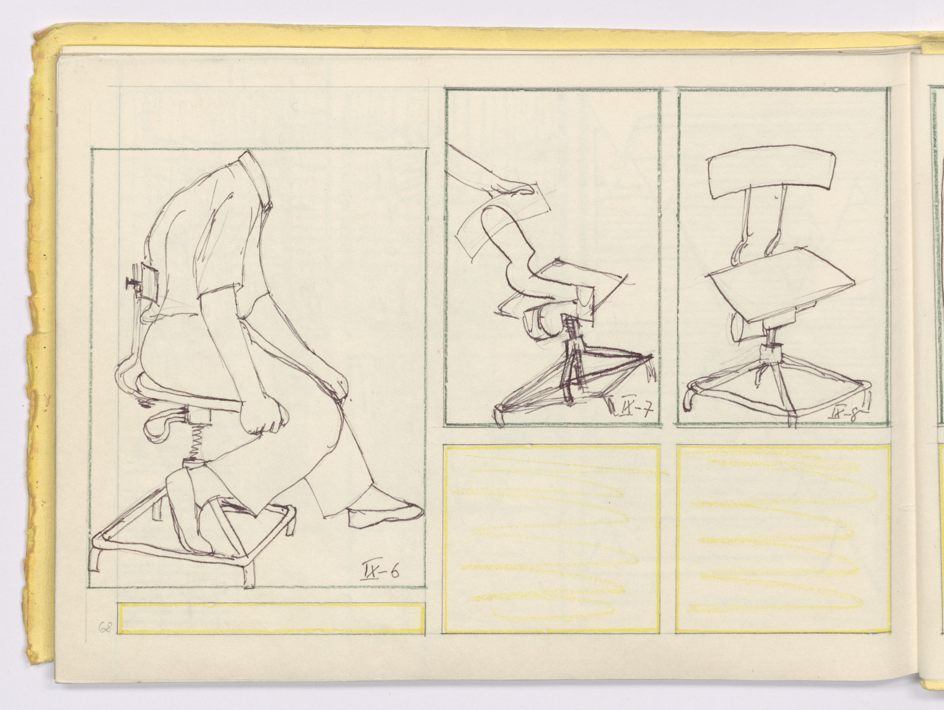


Hannes Meyer, Skizze in einem Dummy für ein Bauhausbuch, c. 1950.GTA Archiv / ETH Zürich, © Hannes Meyer.


bauhaus imaginista’s distinction is that it is likely that not one single person has seen every instantiation of the concept show. Thus a catalogue for the project edited by von Osten and Watson is valuable as an artefact for the curious and as an interesting volume in its own right (London: Thames & Hudson, 2019). The four thematic movements of the project correspond with the four sections of the catalogue, each based upon one specific Bauhaus object: The Bauhaus Manifesto of 1919; a collage by Marcel Breuer; a drawing of a patterned carpet by Paul Klee; and a light game by Kurt Schwerdtfeger. Theoretically these form the framework for bauhaus imaginista, within which specific themes, historical genealogies, and contemporary debates were to be developed. Fortunately, the catalogue content itself is rich in images of concurrent and archival works, and the individual essays are relatively short and didactic.
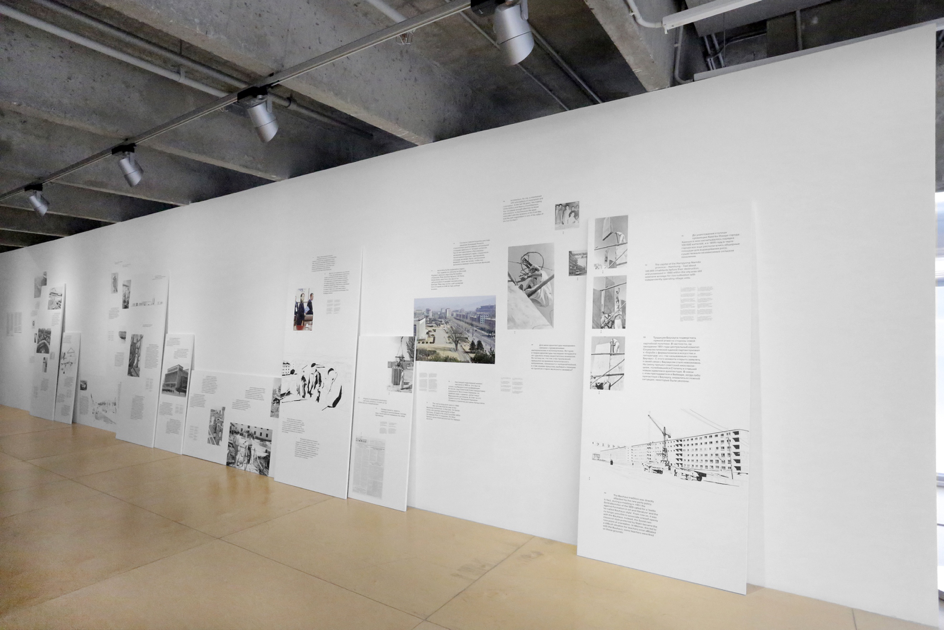


Doreen Mende, Hamhung’s two Orphans, 2018. Photo: Silke Briel; © Doreen Mende, Silke Briel.  


Marcel Breuer, ein bauhaus-film. fünf jahre lang, 1926. From: Bauhaus, vol. 1, 1926, Offset print, 42 x 29.7 cm. Bauhaus-Archiv Berlin.


 The Bauhaus was in contact with institutions in many countries, where it encountered similar movements that had arisen independently of it, and that lent the Bauhaus itself strong stimuli. The bauhaus imaginistacuratorial mission of commenting on this simultaneity was expressed in newly commissioned works by Kader Attia, Luca Frei, Wendelien van Oldenborgh, the Otolith Group, Alice Creischer, Doreen Mende, Adrian Rifkin, and Zvi Efrat.During the remainder of the exhibition, taking place in Germany with one more satellite show Nottingham, local art and design movements will be paired with artefacts of the historical avant-garde to memorialize the Bauhaus as well as with processes of decolonization 


Takehiko Mizutani, Studie zum Simultankontrast (Unterricht Josef Albers), 1927.Gouache on cardboard; 80.4 x 55 cm. Bauhaus-Archiv Berlin.


  Ceramics by Marguerite Wildenhain at Luther College, Decorah, Iowa, USA, 2016.Photo: Grant Watso 



Raubkunst at the Ringling…

Raubkunst at the Ringling…

The Story Continues

 Its genesis in 2016 was the glimpse of a fin becoming a feather that ignited a strong intuition at ”Raubkunst als Erinnerungsort,” a research fellowship sponsored by the Zentrum für Historische Forschung der Polnischen Akademie der Wissenschaften in Berlin that same December. Eventually, and with the help of many people, “Raubkunst at the Ringling” ran in the Modernism journal Lapsus Lima on 9 January 2019 and was picked up in the news all the way to the Antipodes that week with, for example, the story “Otago Link to Identifying Art Looted by Nazis.”

On 13 February 2019 I presented this research about Franz Marc’s woodcuts Schöpfungsgeschicte II (1914) and Geburt der Pferde (1913) amid colleagues at the College Art Association conference in New York City. The very next day I learned “Raubkunst at the Ringling” had been formally recognised as a “solved” case of Nazi looted art with the recognition of my findings by the Commission for Looted Art in Europe in the annals of The Central Registry of Information on Looted Cultural Property 1933-1945.

 My hope all along has been that the John and Mable Ringling Museum of Art, the State Art Museum of Florida operated by Florida State University, would acknowledge the illicit acquisition of the prints by the American UPI reporter Robert Beattie from the notorious “Kunsthändler to the Third Reich” Bernhard A. Böhmer in 1940, prior to Beattie’s donation of them to the Ringling in 1956, where they have been hidden since, and allow these works to be shared with the public.

But wait: I have subsequently learned that there is potentially even more Raubkunst at the Ringling: Paintings by Christian Rohlfs and George Grosz and bronzes by Ernst Barlach with provenance gaps from 1933-1945 are also locked away at the museum as well as some oils and terracottas from the 16thand 17thcenturies that, while not entartete, were simply stolen or subject to forced “sales” from museums or private owners under the Reich.

To more fully bring this story to light, I would like to compile a volume – half catalogue, half detective story – about these works. Please do contact me if you are interested in working together on this project.

RECENTLY ON MICHELANGELOST™...

Email

2 + 12 =

Unfollow Me on Twitter

The only social media I participate in; this feed is mostly about art history and animals.

Art History at the Library

Art History at the Library

Art History at the Library

I was very happy to have the grant renewed and be invited back to the SouthShore Regional Public Library for another series of “Art History at the Library” discussions.

The library had in mind a series that was a little more intensive than “art appreciation”-cruise ship type talks. I did try out some kind of conceptual themes last time, but I also was able to implement my tech whirligigs and to do something I had wanted to do for a long time, have the audience be able to drive a lot of the content. I experimented with this just by stopping often to ask if people had questions or comments, and to my delight they did.

I try to memorise what I’m going to talk about so it’s possible to both extemporise as desired by the patrons’ concerns and also not get thrown off track.

Anyway the schedule for the fall is below. Thank you again to the Hillsborough Public Library Cooperative for supporting this project.

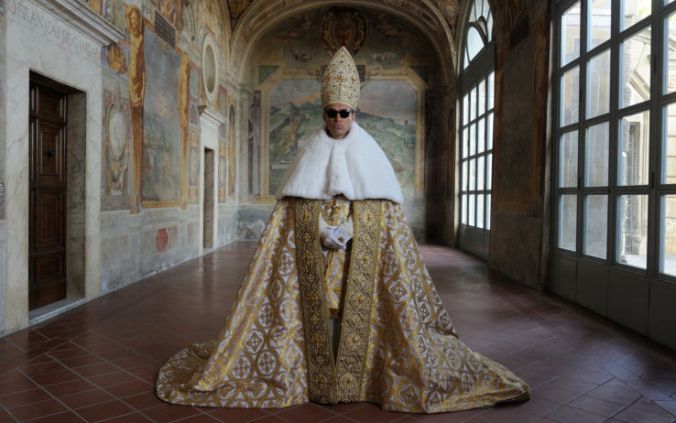
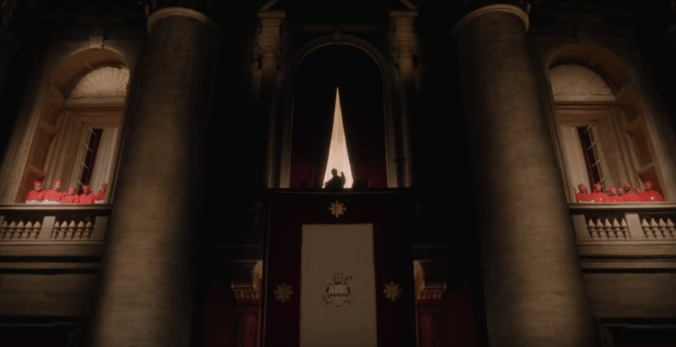
15 September: Special Guest Appearances: Art in Movies and on Television.” Participants are invited to think of their own favorite examples to discuss and share. This talk will examine the appearance of artworks and references to famous works of art in popular movies and television programs, including Vikings, Bojack Horseman, The Young Pope, Skyfall,  and more. We’ll also discuss films that are about artists and art. I am especially excited to be able to talk about some of the painterly images from The Young Pope, which so centre the body. I know a lot of people hated this show, but I liked how it looked, and found director Paolo Sorrentino and cinematographer Luca Bigazzi neomodernist visual world were stunning but also very ambiguous about the questions of faith and the supernatural raised by the narrative.

20 October: “The Body in the Book: Beauty and Suffering in Illuminated Manuscripts.”The session will be about the process of making illuminated manuscripts and scrolls including well-known examples such as the Book of Kells and the Grimani Breviary as well as less-familiar secular texts.

17 November: “What’s the Difference Between Arts and Crafts? Fashion, Textiles, and Design.” Rather than trying to come up with a definitive answer to this question, we will discuss how aesthetic hierarchies come to be. Which tdo we prize more, purely aesthetic innovation, of the form of utilitarian objects, and why? Participants are invited to share examples of their own works and of course their opinions!

15 December: “A Celebration of Animals in Art.” This discussion will cover artwork that recognizes the power of animal life, from the cave paintings of Chauvet and Alta to Tanja Thorjussen’s endangered Arctic wildlife and everything in between.

Franz Marc’s Blaues Pferd I (1911) in Bojack Horseman, above, and shots from The Young Pope (2016) below.

RECENTLY ON MICHELANGELOST™...

Email

8 + 9 =

Unfollow Me on Twitter

The only social media I participate in; this feed is mostly about art history and animals.

Introducing Michelangelost™

Introducing Michelangelost™

Michelangelost is the newest name for the blog I have been writing since 2006, which began as mostly about dogs and animals. It has since had several titles, including Errata and German Modernism, and expanded to include numerous topics. Even though this website is becoming more of an official enterprise, I have kept my experimental and sometimes idiotic posts in the archive. The name Michelangelost™ came to me in Berlin, where Michelangelostraße is one of the stops on the Tiergarten Buslinie 200. Because the name of the stop is so long it was (funnily to me) abbreviated as “Michelangelost” on the scrolling Haltestelle legend. A remarkable photo was taken to document this occasion. I love obscurantist plays on words plus it seems descriptive of where we are in the art world right now. I had intended the Michelangelost™ project to be devoted to art criticism in the broadest sense, extended beyond galleries and museums to organisations, scenes, and academic affiliates, but I like the word and this photo in a more general way. So you will have to stay tuned for that secondary project, which now tentatively has the name “Intersectional Criminal Tribunal.”  Meanwhile I am experimenting with this new design and how to retroactively typeset the older posts. – Until soon.

RECENTLY ON MICHELANGELOST™...