Serials

Serials

The Popular Artist Jeremy Deller...

The Popular Artist Jeremy Deller…

Felix Burrichter, the editor and creative director of PIN–UP (“the only biannual magazine for architectural entertainment”) and the curator of the current “Paper Weight — Genre-defining Magazines 2000 to Now” at Haus der Kunst explained his work process for the exhibit quite simply. The present-day print artifacts were chosen to reflect a range of well-known and unknown individuals showcased in magazines defiantly having a post-print life “off the reading table.”

More slickly produced and (seemingly) precisely targeted than Nick Logan’s The Face, which arguably is the forerunner, at least in typographic/photographic style of many of these volumes, the periodicals examined in Paper Weight are densely specific.

Visually, the exhibit at Haus der Kunst depends barely at all on a background knowledge of what are essentially very glossy ‘zines.  Architect Andreas Angelidakis was clever to blow up the magazine covers to slightly-smaller-than-billboard sizes but particularly to make the finishes completely matte and impermeably saturated; they recall story boards but make visitors feel as if they are moving about the set of Lars von Trier film. (There are a few unfortunate Tracey Emin-recalling pieces of furniture here and there but nothing too invasive.

My favorite scene was the proximal juxtaposition of what happens to be the cover of the current edition of Fantastic Man featuring a stunning portrait of conceptual artist Jeremy Deller in a pink hoodie angled near a 2012 issue of The Gentlewoman featuring Angela Lansbury against a complementary tarama salada background. Fantastic Man of course is obviously trenchant and droll somewhat in the manner of the late Quentin Crisp while The Gentlewoman takes itself quite seriously (the Lansbury cover is somewhat of an anomaly with the usual sitters ranging within Beyonce and Christy Turlington to the same equestrienne-socialites you also don’t know from W and Town & Country.
(more…)
Time’s Arrows

Time’s Arrows

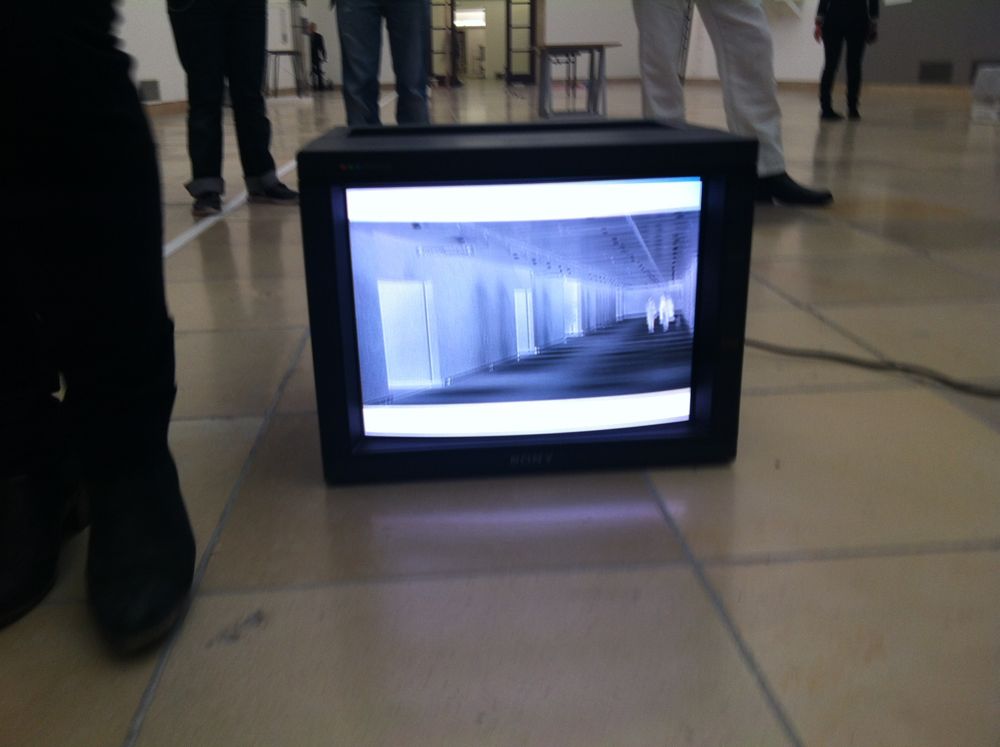
Video is a small but strong component of Joëlle Tuerlinckx's exhibition at Haus der Kunst.

Video is a small but strong component of Joëlle Tuerlinckx’s exhibition at Haus der Kunst.

The legendary documentary Degenerate Art: The Nazis vs. Expressionism is available now (and probably not for long, so, Greasemonkey extension for Firefox, if you know what I mean) on youtube. Part of the mythical status of this program that originally aired in 1993 on the BBC is that it was never converted from VHS to DVD or digital download and has thus been difficult to locate and view.

As you might guess from the title this documentary by David Grubin is about the famous 1937 art exhibit held in Munich called Entartete Kunst, intended by the Nazis to show, collected, the most non-enobling effects of “degenerate art.” (Der Turm der blauen Pferde was part of this exhibit in Munich, and then removed when the show traveled to Berlin, beginning its period of being missing and presumed destroyed. I wonder sometimes if it would make Franz Marc scholars more happy or more sad if it is ever recovered…).
(more…)

Ideological Objects

Ideological Objects

Cafeful: Capitalism Can Hear You
There were opportunities during Isabelle Graw’s presentation this past week at the Lenbachhaus to make some some site-specific comments about the collections at hand, and Graw did make tangential connections to work by Joseph Beuys and Wolfgang Tillmans, thought not those which belongs to the museum’s Kunst Nach 1945 collection.

Intensely and yet breezily theoretical (I have heard Graw speak several times, on one of those occasions dismissing the Adorno-Horkheimer ‘culture industry’ works most art historians spend their lives trying to understand as insufficiently complex for her needs in explaining the reification of art) Graw is an engaging speaker, readily admitting that many of her contentions create oppositional paradoxes which thus cannot be argued against. Graw herself occupies dual roles, as professor for Art Theory and Art History at Staatliche Hochschule für Bildende Künste in Frankfurt am Main and as an art critic and co-founder of Texte zur Kunst, the respectable but for-profit Berlin art journal. Graw also has a heavy amount of street cred coming from a lengthy association with Martin Kippenberger during Kippenberger’s time in Cologne.

objecitons3Her talk at the Lenbachhaus, Malerei als indexikalisches Medium in der neuen Ökonomie recasts the idea that paintings are “alive” somehow in the sense that they emanate an autonomous value in terms of the role of Painting with a “P” as both commodity and part of the larger “organism” of the process and documentation of the making of art.

Indexical is a word mostly associated in art history  with photography, and photography is important to Graw’s current interest, which expands upon many of the ideas she raised in her recent book High Price: Art Between the Market and Celebrity Culture in the sense that “documentary indexicality” is all but a de-facto given the ubiquity of record-making technology. Additionally, in the trinity of “icon/index/symbol,” “index” marks a definite place and time by compelling a reaction in the beholder. But I think it is the more abstruse “referential indexicality” that most interests Graw in this sense, as she used Diedrich Diedrichsen’s term “Selbstdarsteller” to describe Kippenberger’s performances of himself as himself (as opposed to performing “the other” or just “being” himself).objections2

(more…)

Pushers

Pushers


Should We Go In?

Should We Go In?

I have followed Kunstraum München for some time and now that I’m here have been eager to investigate, a plan somewhat impeded by the Verein’s tendency to announce events through the city (which supports the venue/group for contemporary art and criticism – its 40th anniversary is this year) i.e. a bit slowly, and sporadically through a social media platform owned by someone with the initials MZ  I do not often participate in (more on social media at the end), and also since I am often busy on the Wednesdays when meetings and lectures take place.

In any case being free on Pfingstenmontag allowed a friend visiting from Brussels and I to haunt tonight’s talk „Warum im Kollektiv?“ by members of Hamburg’s 8. Salon. Visually this also served as a near-to-closing reception for the Mahlergruppe Austellung Of Two Minds (the actual end date is 26 May).  You can see some Mahlergruppe work on its low-key Website. The emphasis on group (founded in 2008 at Munich’s Akademie der Bildenden Künste) and the lack of artists’ statements and biographies is very refreshing, and the powerful graphite-and-acrylic bilder – somewhere between drawings and paintings, are, to me distinctively Munchneresque.

Of Two Minds also includes a sculpture, Bellestar, a craft of formed and draped corrugated framing, and a few photographs of Zurich’s “Needle Park,” circa the 1980s and 1990s at the beginning and then height of needle-borne infection. Of Two Minds isn’t a conceptually straightforward rumination on dystopia, though. Perhaps as the name implies it asks about how we remember these types of weirdly hermetic thought/images that may or may not be indexical. (Of course for Americans the first thing that comes to mind is Al Pacino’s laconic junkie in Panic in Needle Park, the film school staple from 1971.) Thinking about how much Zurich has changed in the past decades doesn’t diminish these images which aren’t exactly memories, though they do form the strong impression of something personally experienced (another film analogy would be the impression of Marseille and Brest from The French Connection and Querelle, though the French coastal cities haven’t been like that in … forever, and were already “not like that” when Genet was writing and Fassbinder and Friedkin were filming).

(more…)

Synonyms for Sharp at the Neue Lenbachhaus

Synonyms for Sharp at the Neue Lenbachhaus

There’s a moment when the super-creative but detached suddenly open up and reveal actually, they do know what’s going on. It’s a brave thing to do because it both raises the stakes for intellectual performance and blows away the dandelion dander of the potentially naive. Maybe partly involuntarily but resolutely nonetheless, Liam Gillick’s two works arranged in careful complement in the subterranean Lenbachhaus annex achieve this emergence, perhaps more substantively than at their dates of creation in the ‘aughts.

LG1

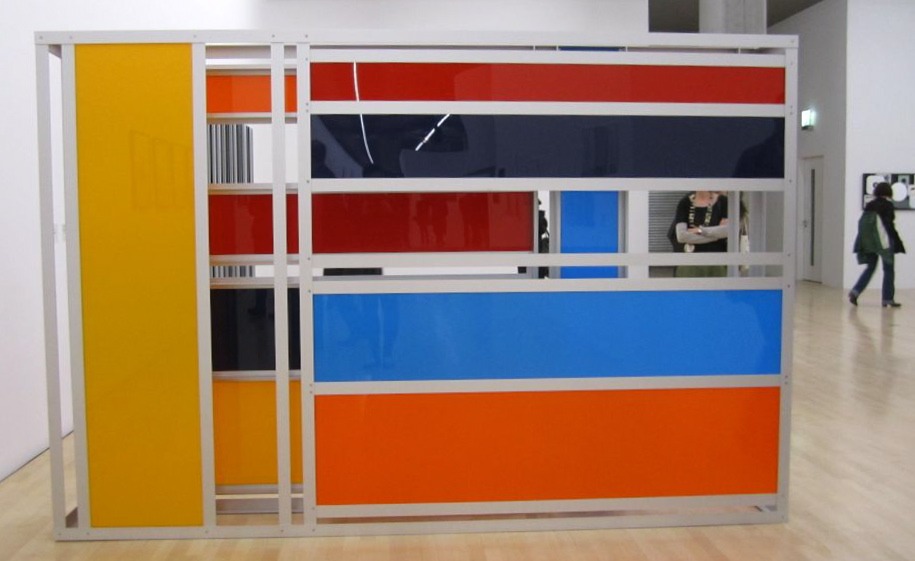
Part of the KiCo Stiftung comprising the very deep “Kunst nach 1945” Sammlung, Gillick’s Screened Reduction (2001) and Glanced in the Midst of a Legislative Break (2006) are opaque Plexiglas and aluminum structures, sculptures poised at the edge of painting. In reference to the latter they clearly hearken to Kenneth Noland’s high Straight Edge (think Bridge circa 1964) and are also thematically in sync with an earlier guest in the Kunstbau, Piet Mondrian, and as such more than nod to the historical commitment to abstraction.

LG2

Gillick, who is also a composer and musician (he actually made the sampling loop of the Smiths’ How Soon is Now? you will remember – if you are a former club kid – from Soho’s 1990 nightclub single Hippy Chick!), tends to characterize his work in careful Global Art Fair-speak as being about the questioning of political authority and so on. However taking at visual and bodily encounter value, Screened Reduction and Glanced in the Midst of a Legislative Break are hardly obscurantist, inviting inspection and delectation in simple optics.

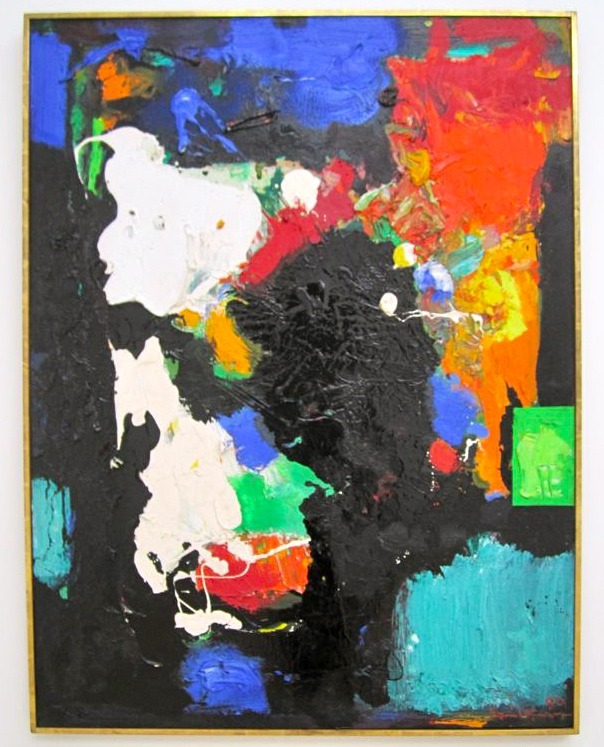
I decided to take this sort of sideways approach to writing about “Das Neue Lenbachhaus” when on a subsequent visit I saw for the first time, for a long time, and up very close, Hans Hoffman’s The Conjurer (1959). Hoffman is very collected but quite under-studied, and this painting is historically significant as well as quite lovely. I hope you can see in the adjacent image the toned translucency and balance of the aqua swatch, which is so carefully balanced on the canvas that the bright color does not preoccupy the eye, and also the charcoal impasto and general texture of the canvas, which is both thick and lustrous.

Hoffman

The Bavarian-born Hoffman traveled back and forth between Munich and the United States, and like Kandinsky once opened his own school for artists. Hoffman had many talented students, including Louise Nevelson, Allan Kaprow and Helen Frankenthaler. The Conjurer, made some years after Frankenthaler became well-known for her vertical soak-stain paintings, suggests maybe Hoffman, like Morris Louis, got some ideas from Frankenthaler, too.