Today is the 99th anniversary of the death of Franz Marc. (Marc would have really liked someone who also died this week, Leonard Nimoy and Nimoy’s Mr. Spock character from Star Trek.) I didn’t write my normal “Franz Marc’s Birthday” post (Marc’s birthday is 8 February) this year because the idea of the grief we feel for Marc and August Macke has been much on my mind. This is partly owing to my own research, but also to do with the publication of the catalogue attendant to the Lenbachhaus’s current exhibition, August Macke und Franz Marc: eine Künstlerfreundschaft (August Macke and Franz Marc: An Artist Friendshipin English).
The catalogue is, not surprisingly, a tour-de-force of editing and research by longtime Lenbachhaus Blaue Reiter curator Annegret Hoberg and Volker Adolphs of Kunstmuseum Bonn. What is unexpected is that the editors and included authors bring to bear not just a wealth of knowledge but so much compassion to these essays, confronting directly the loss and sadness we naturally feel over the too-short lives of Marc and Macke.
This is not to say the entries are not impeccably scholarly; Hoberg’s “August Macke and Franz Marc / Ideas for a Renewal of Painting” and Adolphs’ “Seeing the World and Seeing Through the World / Nature in the Work of August Macke and Franz Marc” are classic art historiography based in peerless analysis. Gregor Wedekind’s “The Masks of the Savages / Primitivism and Cultural Critique in the Work of August Macke and Franz Marc” was of particular interest to me as it underscores how the work of the avant-gardes was received in its time as a shocking departure from what the world then considered “civilized” painting. There are a few small errors marring Klara Drenker-Nagels’ otherwise illuminating discussion of the relationship between Maria Marc and Elisabeth Erdmann-Macke that I’m sure will be corrected in subsequent editions.
Of special delight in terms of the arrangement and presentation of the catalogue are some shorter, data-packed chapters on the Paradies (1912) mural and other anecdotes about Marc’s and Macke’s overlapping but very different lives.
Of course the catalogue is rich with the paintings, weavings, sketches, and photos that grace the exhibition itself. As a discrete publication, this is one that must truly be enjoyed as a book – I received it on a Friday afternoon and spent the entire weekend poring over every image, footnote, and phrase, alternately smiling and wiping away tears. Turning the last page, I was filled with admiration for this Lenbachhaus-Kunstmuseum Bonn collaboration, every word written with love.
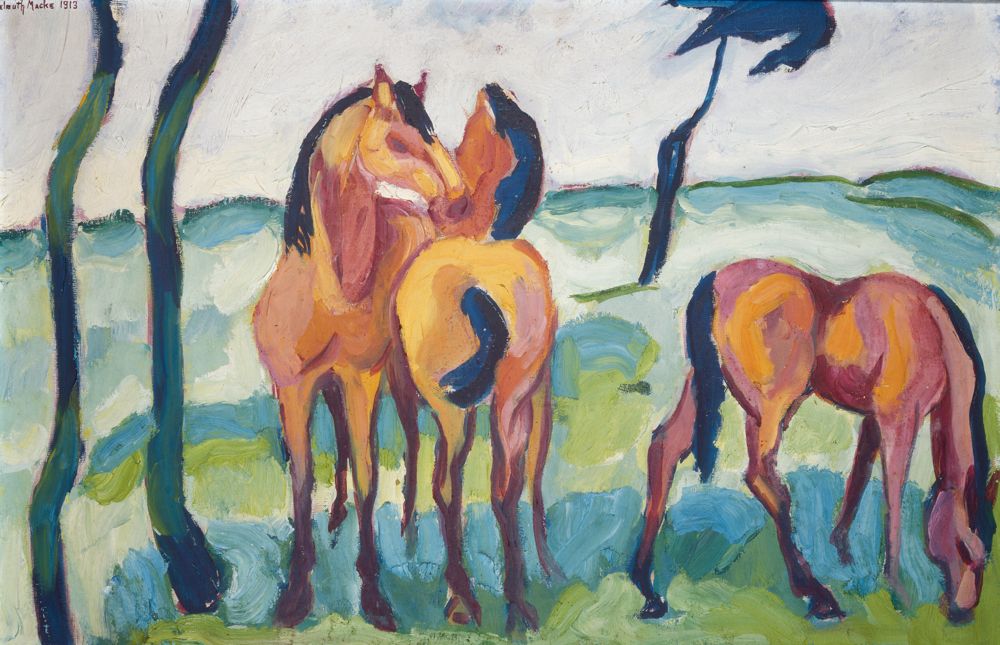
“The ‘boarding school’ is in session,” Franz Marc wrote nervously to his friend August Macke.[1] Pining for company in the same letter, Marc nonetheless wondered if August should come and get Helmuth Macke, August’s young cousin, whom the Macke family had deposited some weeks earlier at Marc’s small apartment in rural Sindelsdorf. It was late November 1910. Marc would soon turn 31, and Helmuth was 18. Until Helmuth’s arrival, Marc had been working alone for some time. At the insistence of her concerned parents, Maria Marc had returned to Berlin. Marc was just beginning to see the slightest of incomes from his painting, but he was irritable and distracted. And now August, himself adjusting with his wife Elisabeth to the birth of their son, expected Marc to find ways to entertain a teenager.
Yet Helmuth was resourceful and clever. During the weeks in Sindelsdorf, (which become months and longer: “Helmuth’s fine, he’s still growing,” Marc reported the following summer)[2], Helmuth taught himself enough Dutch to communicate with Heinrich Campendonk; chopped wood and built a fence; practiced painting and drawing, befriended Marc’s dog Russi; and demonstrated a talent for cooking and baking. This latter skill commanded Marc’s particular favor. Animated but sympathetic, Helmuth provided stability and encouragement. By Christmas Marc had breezily informed August that Helmuth would be staying on.[3]
As the calendar turned to 1911, the chrysalis of Sindelsdorf opened and released a new Marc to Munich. Seeking a sophisticated way to celebrate New Year’s, Helmuth pointed Marc toward a performance of Arnold Schönberg quartets. The music had a vivid impact on Marc, which he reported with great excitement to Maria, August, and a new friend who had missed the concert – Wassily Kandinsky. At a the soirée given by Marianne von Werefkin at which Marc and Kandinsky met at last in person, Helmuth was at Marc’s side, and witnessed the twinkle in the eye of fate that became Der Blaue Reiter.[4]
After the party, Helmuth and Franz took the late train from Munich to Penzburg, laughing and marveling over their adventure as they walked jauntily through the falling snow back to Sindelsdorf. Neither traveler was concerned for the future at that joyful moment, and mercifully, neither could know what the future held.
Helmuth Macke died in 1936 when his small boat capsized in a sudden storm on Lake Constance, having given his sailing companion the only life preserver.
[1] Franz Marc, August Macke: Briefwechsel. (Köln: DuMont, 1964), 20-21.
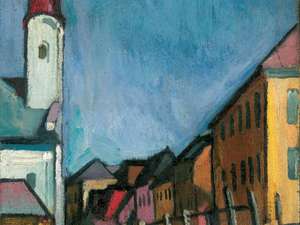
Is this colorful village scene painted by August Macke?
I have been working on a project about authenticating a painting maybe misattributed to one of my Expressionist painters (yet maybe made by another), so I was very interested to see a story crop up over the weekend in the Münchner Merkuronline edition (pretty sure Süddeutsche Zeitung, usually so on top of all news Bayern, must be spitting nails!) about a man who thinks he owns a painting by August Macke.
Even more intriguingly, the painting would have been made in 1910, the year Macke spent in Tegernsee during which time Franz Marc often came to visit the Macke family, sometimes walking there through Oberbayern from Sindelsdorf to Tegernsee with Russi Marc. This period of time is recounted with warmth and in detail by Margarethe Jochimsen and Peter Dering in the book August Macke in Tegernsee.
The man who owns the painting, Herbert Spiess, claims to have purchased it from an art dealer in Vienna in 1984. Spiess told the Merkur he became convinced the painting, a small streetscape, was a Macke simply through visual association. (The Westfälische Landesmuseum für Kunst und Kulturgeschichte in Münster says “no” in the Merkur’s story; no comment from the Lenbachhaus or the August Macke Haus in Bonn).
Macke enjoyed his time in Tegernsee. This was a happy year for Macke and his wife, Elizabeth and their first son, Walter, was born in the quiet lakeside village. Macke was more or less amused by his botany-obsessed landlords, whose Bayerische dialect he was able to penetrate with Marc’s help. Stubbornly autodidactic and much more fanciful and imaginative than he appeared at a glance, Macke spent hours doing “copying exercises” with Marc (and doing some other fun stuff too), and experimented with many styles of painting and drawing in 1910.
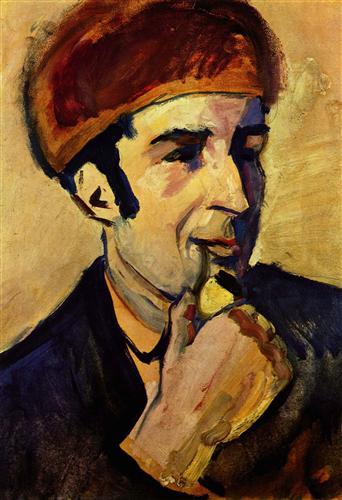
During this time, despite being in a very attractive location, Macke concentrated on portraiture, making many sketches and paintings of Walter, Elizabeth, and the famous portrait of Marc.
Bildnis Franz Marc, August Macke, 1910
But Macke also was always making all sorts of things, from tapestries to fabric designs to theater decorations. So it’s certainly possible this single painting is something he just knocked out during this period of great productivity – Macke was exceedingly prolific and made more than 200 paintings between 1909 and late 1910, when the young family returned to Bonn, leaving cousin Helmuth Macke to stay with Marc.
So it’s hard to say, from looking alone, if this painting could be Macke’s. I hope it is but (and this is really just a very strong intuition as much as empirical assessment) my feeling is that it might not be. To my eye the painting lacks that little flourish of passion and verve, and of capturing the “inner realities” of the beauty he was in the physical world, that is the beautiful Expressionist hallmark of Macke’s oeuvre. With any luck I’m wrong though, and the world will have a new August Macke painting to admire.
Anyway, the reporter, Vera Markert, asks that if you have any information or ideas about the painting to get in touch with the Merkur via email at kultur@miesbacher-merkur.de wenden.
August Macke and Franz Marc packed the friendship of a lifetime into the few short years they had together from early 1910 to the summer of 1914, even with a few breaks for pouting and sulking. Some of their correspondence is recorded in a dedicated volume, and other letters, notes, stories, and recollections of their doings from other people are hidden in unpublished works and Expressionist apocrypha.
Macke and Marc enjoyed working on their art as a pair and in fact they both considered the drawings and sketches they made while just beingtogether to fall into the class of “things we made together” on the same level as the few categorical objects to which we ascribe to their dual provenance, of which the mural Paradies, from 1912, is one. The mural lives now at the Westfalisches Landesmuseum für Kunst und Kultur in Münster, but it was made in the upstairs atelier of the Macke house (now the August Macke Haus ) in Bonn.
Given Macke’s constant scheming and hustling, and the sort of declarations of superficiality he seems to make about all that is admirable in painting, it is easy to think of him as being a sort of light shadow to Marc’s heavy element, but this is not at all true. And Marc often seems supremely naïve and dopey in his out-of-itness, which was also more of an occasional condition. However, the story attendant to the making of this mural finds them both in exactly these roles.
In fact as soon as I learned more about how Paradies was made, I immediately thought of the famous story in Mark Twain’s The Adventures of Tom Sawyer printed below. In fact there is not much I can say about it, or as well.
Paradies, August Macke and Franz Marc, 1912
Excerpt from Tom Sawyer: Chapter 2
“Hi- yi ! You’re up a stump, ain’t you!”
No answer.
Tom surveyed his last touch with the eye of an artist, then he gave his brush another gentle sweep and surveyed the result, as before. Ben ranged up alongside of him. Tom’s mouth watered for the apple, but he stuck to his work. Ben said:
“Hello, old chap, you got to work, hey?”
Tom wheeled suddenly and said:
“Why, it’s you, Ben! I warn’t noticing.”
“Say — I’m going in a-swimming, I am. Don’t you wish you could? But of course you’d druther work — wouldn’t you? Course you would!”
Tom contemplated the boy a bit, and said:
“What do you call work?”
“Why, ain’t that work?”
Tom resumed his whitewashing, and answered carelessly:
“Well, maybe it is, and maybe it ain’t. All I know, is, it suits Tom Sawyer.”
“Oh come, now, you don’t mean to let on that you like it?”
The brush continued to move.
“Like it? Well, I don’t see why I oughtn’t to like it. Does a boy get a chance to whitewash a fence every day?”
That put the thing in a new light. Ben stopped nibbling his apple. Tom swept his brush daintily back and forth — stepped back to note the effect — added a touch here and there — criticised the effect again — Ben watching every move and getting more and more interested, more and more absorbed. Presently he said:
“Say, Tom, let me whitewash a little.”
Tom considered, was about to consent; but he altered his mind:
“No — no — I reckon it wouldn’t hardly do, Ben. You see, Aunt Polly’s awful particular about this fence — right here on the street, you know — but if it was the back fence I wouldn’t mind and she wouldn’t. Yes, she’s awful particular about this fence; it’s got to be done very careful; I reckon there ain’t one boy in a thousand, maybe two thousand, that can do it the way it’s got to be done.”
“No — is that so? Oh come, now — lemme just try. Only just a little — I’d let you , if you was me, Tom.”
“Ben, I’d like to, honest injun; but Aunt Polly — well, Jim wanted to do it, but she wouldn’t let him; Sid wanted to do it, and she wouldn’t let Sid. Now don’t you see how I’m fixed? If you was to tackle this fence and anything was to happen to it — ”
“Oh, shucks, I’ll be just as careful. Now lemme try. Say — I’ll give you the core of my apple.”
“Well, here — No, Ben, now don’t. I’m afeard — ”
“I’ll give you all of it!”
Tom gave up the brush with reluctance in his face, but alacrity in his heart. And while the late steamer Big Missouri worked and sweated in the sun, the retired artist sat on a barrel in the shade close by, dangled his legs, munched his apple, and planned the slaughter of more innocents.
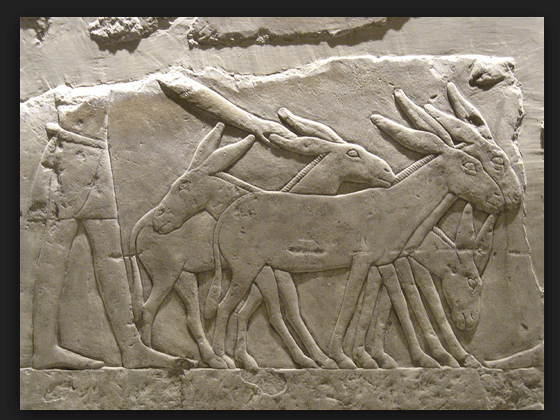
A couple pending matters before getting along to new business; thus, before too much more time goes by, my adventures in Hull, England, in which it turned out that donkeys were very important. Incredibly before last fall, I had never been to England, let alone Yorkshire…*
When I first became aware of Botschaften an den Prinzen Jussuf, the story around which I originally intended to discuss at the University of Hull’s Visions of Egypt: History and Culture from the 19th Century to the Present conference, my immediate reactions was, “Wow…So Sylvester!” I’m sure you are aware of who Sylvester is but, as a reminder, before Boy George, before Lady Gaga, there was Sylvester.
In addition to being an amazing soul and HiNRG dance music recording artist, Sylvester was known for hanging out in San Francisco dressed in amazing costumes, including his trademark pharaoh outfit. One of the only two times I snuck underagedly into a nightclub with a fake ID (the other time was to see the Thompson Twins) was to see Sylvester at El Goya.
So. Visions of Egypt was a conference mostly attended by actual Egyptologists, not art historians, and thus there was a lot of humor and pop-culture-referencing in many of the presentations so I think Sylvester would have been well-received. However owing to the great enthusiasm for donkeys expressed by insurgent quadruped fans, I did not get to work in any sort of reference to Sylvester in my presentation. (more…)


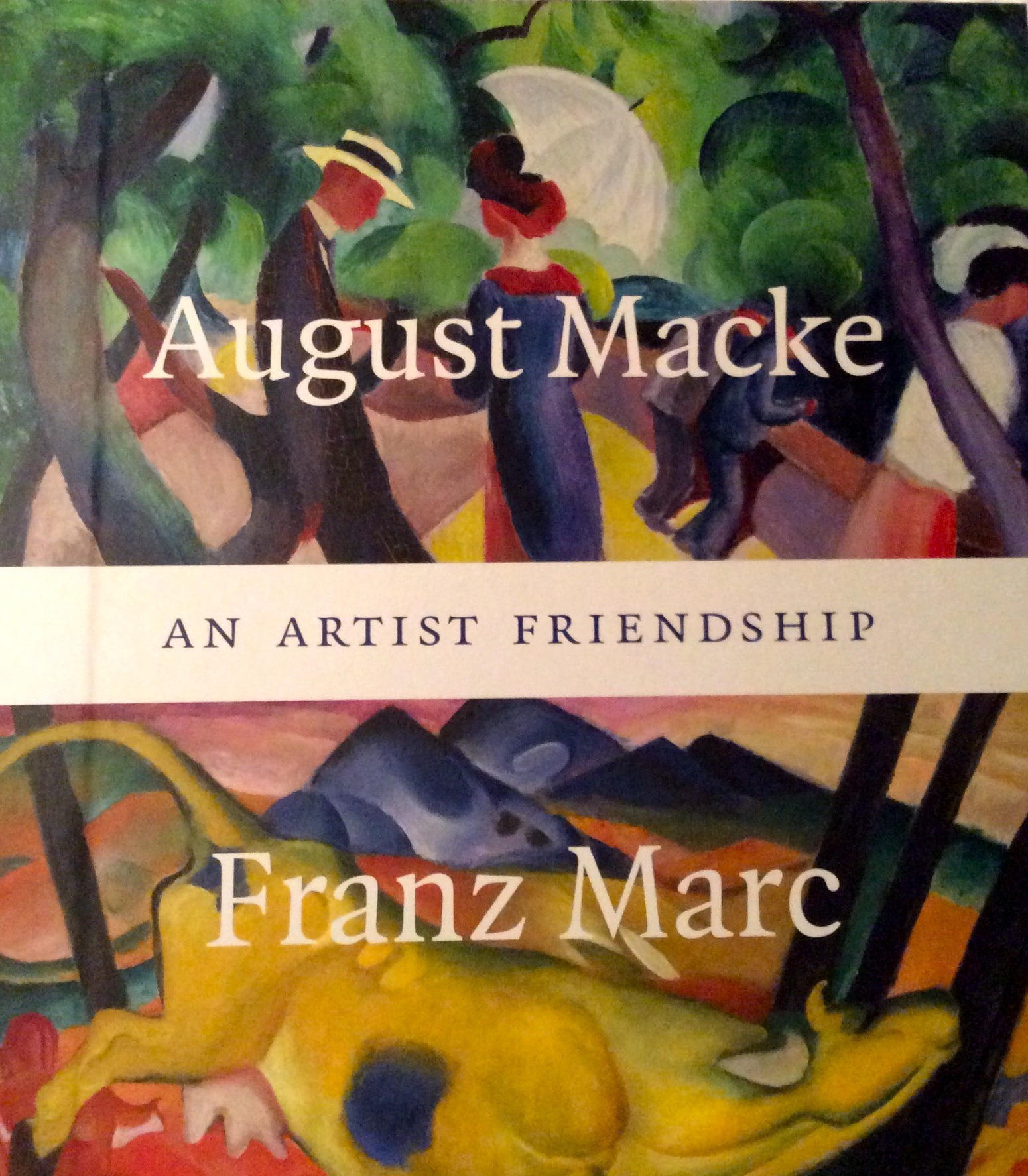 Today is the 99th anniversary of the death of Franz Marc. (Marc would have really liked someone who also died this week, Leonard Nimoy and Nimoy’s Mr. Spock character from Star Trek.) I didn’t write my normal “Franz Marc’s Birthday” post (Marc’s birthday is 8 February) this year because the idea of the grief we feel for Marc and August Macke has been much on my mind. This is partly owing to my own research, but also to do with the publication of the catalogue attendant to the Lenbachhaus’s current exhibition, August Macke und Franz Marc: eine Künstlerfreundschaft (August Macke and Franz Marc: An Artist Friendship in English).