On “Situationism: A Primer” by Marina LaPalma (Grim)
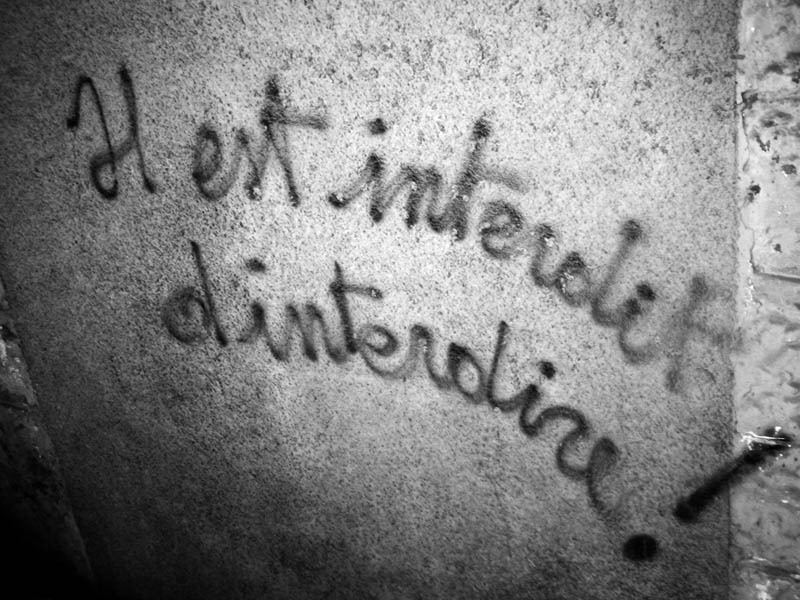
Situationist grafitti, Menton, Occitania, 2006 (the 1968 slogan “It is forbidden to forbid”, with missing apostrophe). Wikipedia Commons
“Rather — just as certain biologists argue for the maintenance of species diversity among plants in order to preseve them for potential use by future generations — we should battle on the side of the obscure, the small, the powerless, the marginalized in order to maintain bio-diversity of memes, of ideas and aesthetic and imaginary realms.”
Marina LaPalma’s “Situationism: A Primer” is one of the best readings in existence for art history students because it is very easy to digest, in terms of distilling the much more difficult prose of situationists from the 1960s, particularly Guy Debord, but also because it is a call to action that clearly illuminates some of the social conditions to be acted against.
Written in 1988 in honor of the approximate twentieth anniversary of the publication of The Society of the Spectacle, “Primer” notes that the intervening decades have made DeBord’s observations seem even more absolutely correct. (Time has done the same for “Primer.”) LaPalma describes a completely dystopic society, yet in the last quarter of the article makes clear that her intent overall mood is hopeful.
Like the original SI group, LaPalma makes a few incorrect assessments, identifying simple sociopathy (“Can any pleasure we are allowed to taste compare with the indescribable joy of casting aside every form of restraint and breaking every conceivable law?”) and the Los Angeles riots as appropriations of situationism.
Yet many – most – of LaPalma’s statements about the Spectacle, like DeBord’s, seem even more valid today than when written: “The world we see is not the real world, it is the world we have been conditioned to see; a world constructed from the black and white of tabloids, a world framed by the mahogany veneer of the television set, a world of carefully constructed illusions – about ourselves, about each other, about power, authority, justice and daily life. A view of life from the perspective of power.”
LaPalma uses the commodification of superficially “rebellious” music (punk and techno) to illustrate the idea of recuperation, and is also, mercifully, extremely critical of hippie-collectivist modes of dropping out. “Revolution is a process, a process that can be started now,” says LaPalma.
The problems – isolation through the work/home/consumer system, totally immersive media that purports to broadcast reality, the replacement of the citizen by the consumer – are clear. The extremity of the endless war, continuous states of celebrity meltdown, and now, recession, makes action seem like the only choice. LaPalma does not provide any guidance for resisting the Spectacle within society without perpetuating it.