
by Jean Marie Carey | 29 May 2008 | Art History
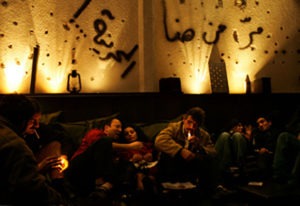 Nightclub in Beirut, Lebanon (Stephanie Sinclair, 2005)
In July of 2006, during a bout of intense border battles between Israeli armed forces and members of Lebanon’s Hezbollah militia, a photograph made by Stephanie Sinclair achieved a broad second life on the Internet when it accompanied a post on food writer and Travel Channel star Anthony Bourdain’s blog; Bourdain and crew had been filming an episode of No Reservations in Beirut and were “trapped” in the city owing to the destruction of the airport and an naval blockade effectively halting departures by Americans from the Gulf states. The photograph had originally appeared on March 12, 2005, in the Travel section of the New York Times with a story by Scott Spencer about the nonchalant nightlife scene in Beirut following the assassination of Lebanese prime minister Rafik Hariri. The image was described in the Times as “Love among the ruins at the war-themed Beirut club known as 1975,” and on Bourdain’s blog with the following caption: “Prewar partygoers enjoy the music and atmosphere at 1975, a bar whose theme is the country’s civil war.”
The odd syntax of the cutlines suggests that “the war” was an omnipresent future, past, and present entity. Regardless of the date the image was made, though, its placement in the context of stories about a “live,” ongoing military flare-up, even amid the larger ceaseless tragedy in the Middle East, makes the powerful suggestion that Beirutis party even as rockets and air strikes devastate the buildings around them.
(more…)
by Jean Marie Carey | 16 Mar 2008 | Art History
“…One of the defining features of Orientalist painting is its dependence for its very existence on a presence that is always an absence: the Western colonial or touristic presence.”
In her essay “The Imaginary Orient,” Linda Nochlin certainly discusses the omnipresent absence of Westerners in the works of two painters in particular, Eugène Delacroix and Jean-Léon Gérôme. Nochlin seems to focus on how Delacroix, the unapologetic romantic, and Gérôme, known as a “realist” painter, created a vision of “the Orient” (actually the near Middle East) that elevated the omniscient Western observer to superior connoisseur while relegating Turks and Arabs to the roles of sexual and social degenerates dwelling in decrepitude who can only benefit from colonial oversight. However the feminist art scholar who asked “Why Have There Been No Great Women Artists?” eventually reveals her true interest in Orientalism, that of revealing these French painters as renderers of women as possessions and completely powerless victims.
(more…)
by Jean Marie Carey | 22 Dec 2007 | Animals, Art History
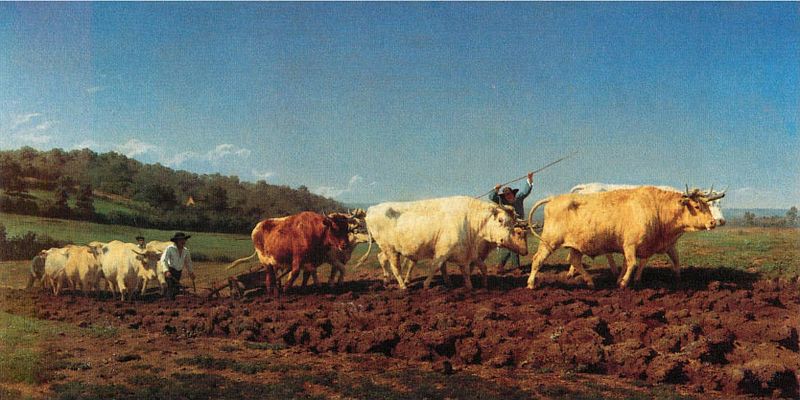
Rosa Bonheur – Labourage nivernais.
If 19th century French painter Rosa Bonheur believed in reincarnation, she would surely have chosen to return to life not as one of the regal lions or leggy gazelles she shared her Bordeaux estate with, but as a sturdy, common barnyard bull. The slyly successful painter had great affection for domestic animals, and enjoyed her greatest artistic success depicting them.
Bonheur was especially adept at imbuing cattle with nobility without giving them airs of humanity.
Though best known for The Horse Fair (1853), a canvas from a few years later in her career, Labourages Nivernais, completed in 1850, is actually a less derivative, more personal, visually individualistic image of Bonheur’s favorite creatures. Nivernais also marks the beginning of a period of commercial and public success for Bonheur, a good fortune enjoyed by few women artists then as now.
At first glance, Nivernais seems a relatively innocuous, though beautifully rendered, ode to agrarian life, and there is nothing “incorrect” with that interpretation. However, Nivernais offers much more to viewers who, like the team of oxen shown, take the time to turn over the well-trodden earth.
Rosa Bonheur, was born in Bordeaux, France on March 16, 1822, the eldest child of Sophie Marquis and Raimond Oscar-Marie Bonheur. The couple called the baby Marie Rosalie, but she almost immediately came to be known as Rosa.
Her father, himself a painter and philosopher, and artists with whom he was friends captured many images of the youthful RB.
Her father shows RB the infant idolized as a cherub in a crib in a painting in 1823. By the time Raimond Bonheur captured Rosa at Four, the child had the set jaw, solemn gaze, erect posture and short tousled hair that would identify her for the rest of her life.
One alleged portrait of RB, showing a square-jawed, serious child in a brimmed hat with feather trim, was painted by Jean Baptiste Camille Corot. After RB’s death, though, her companion Anna Klumpke, came forward to say that she thought the sitter for the portrait was instead a male. Such confusion regarding appearance and gender shadowed RB all her life.
(more…)

 Nightclub in Beirut, Lebanon (Stephanie Sinclair, 2005)