by Jean Marie Carey | 25 Feb 2019 | Animals in Art, Art History, Expressionismus, Franz Marc, German Expressionism / Modernism, Michelangelost©, Re-Enactments© and MashUps
Raubkunst at the Ringling…
…The Story Continues
Its genesis in 2016 was the glimpse of a fin becoming a feather that ignited a strong intuition at ”Raubkunst als Erinnerungsort,” a research fellowship sponsored by the Zentrum für Historische Forschung der Polnischen Akademie der Wissenschaften in Berlin that same December. Eventually, and with the help of many people, “Raubkunst at the Ringling” ran in the Modernism journal Lapsus Lima on 9 January 2019 and was picked up in the news all the way to the Antipodes that week with, for example, the story “Otago Link to Identifying Art Looted by Nazis.”
On 13 February 2019 I presented this research about Franz Marc’s woodcuts Schöpfungsgeschicte II (1914) and Geburt der Pferde (1913) amid colleagues at the College Art Association conference in New York City. The very next day I learned “Raubkunst at the Ringling” had been formally recognised as a “solved” case of Nazi looted art with the recognition of my findings by the Commission for Looted Art in Europe in the annals of The Central Registry of Information on Looted Cultural Property 1933-1945.
My hope all along has been that the John and Mable Ringling Museum of Art, the State Art Museum of Florida operated by Florida State University, would acknowledge the illicit acquisition of the prints by the American UPI reporter Robert Beattie from the notorious “Kunsthändler to the Third Reich” Bernhard A. Böhmer in 1940, prior to Beattie’s donation of them to the Ringling in 1956, where they have been hidden since, and allow these works to be shared with the public.
But wait: I have subsequently learned that there is potentially even more Raubkunst at the Ringling: Paintings by Christian Rohlfs and George Grosz and bronzes by Ernst Barlach with provenance gaps from 1933-1945 are also locked away at the museum as well as some oils and terracottas from the 16thand 17thcenturies that, while not entartete, were simply stolen or subject to forced “sales” from museums or private owners under the Reich.
To more fully bring this story to light, I would like to compile a volume – half catalogue, half detective story – about these works. Please do contact me if you are interested in working together on this project.
The only social media I participate in; this feed is mostly about art history and animals.
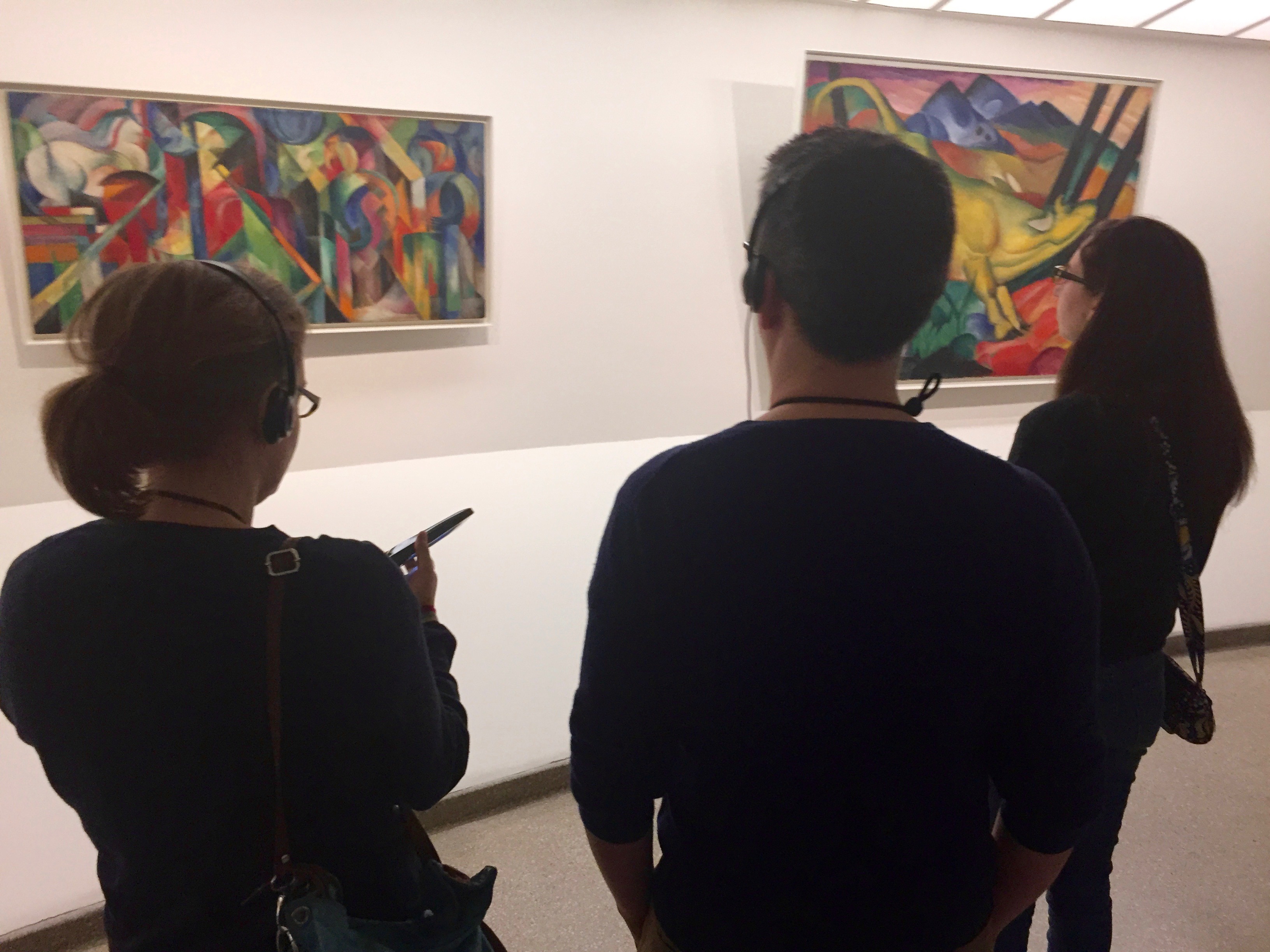
by Jean Marie Carey | 16 May 2017 | Animals, Animals in Art, Art History, Franz Marc, German Expressionism / Modernism, Re-Enactments© and MashUps
This post goes with a book review of the exhibition catalogue Visionaries: Creating a Modern Guggenheim (2017) for Museum Bookstore which is posted here and also follows in a slightly different form below.
It has been one of life’s great pleasures to see Franz Marc’s Die gelbe Kuh many times over the years at the Solomon R. Guggenheim Museum. Every time I get the same huge surge of joy as the first, and I think other people feel the same way. When the painting is where it lives normally, in the Thannhauser wing, you can sit on a bench in the gallery and watch people come in, weaving their way through some much smaller woodcuts and decorated books, and then turn the corner to be met by this enormous colourful and cheerful painting. Always a lot of oohs and ahhs and delighted small children.
§ § §
People admiring Franz Marc’s Stallungen (1913, l) and Die gelbe Kuh (1911) at the Guggenheim.
Visionaries: Creating a Modern Guggenheim
Edited and introduced by Megan Fontanella with chapters by Vivien Greene, Jeffrey Weiss, Susan Thompson, Tracey Bashkoff, Lauren Hinkson, and Susan Davidson and published by Guggenheim Museum Publications, this catalogue accompanies the eponymous exhibition held at the Solomon R. Guggenheim Museum in New York City, 10 February-6 September 2017; 312 pages with color reproductions of all the paintings and sculptures from the exhibition plus archival photographs, illustrations, letters, and newspaper and magazine notices.
The “modernization” of European art around 1900 is usually associated with the evolution of line, color, and figuration toward abstraction, as manifested by Expressionism and Futurism. The fact that art collectors and dealers played an important role in codifying what we think of now as Modernism is brought to full light in the catalogue Visionaries: Creating a Modern Guggenheim, produced to coincide with the exhibition of the same name.
In fact the catalogue seems, at least at first glance, intent upon driving home the idea that art is a business, opening with the normally blank flyleaf emblazoned with corporate logos and an unprecedented “Sponsor Statement” by Francesca Lavazza, heir to the Lavazza coffee brand, the underwriter of the exhibition. However the scholarly contents are innovatively presented and well-researched, with five sections devoted to each of the “visionaries” (in this case being the collectors, not the artists), paired with a focus on one of the museum’s key acquisitions. An opening essay by the Guggenheim’s curator of collections and provenance, Megan Fontanella, introduces the scope of the exhibition and the historical circumstances that allowed American entrepreneur Solomon Robert Guggenheim to decide in the 1920s, after five decades dominating the U.S. mining industry, to become the world’s foremost collector and exhibitor of what became dubbed “non-objective” art. (42) As in the rest of the book, the introduction offers wisely-selected and superbly reproduced works from both the immediate exhibition and from other sources.
Of great interest are photos of the assorted collectors and dealers in domestic settings, surrounded by their objets, which are very revealing, perhaps beyond what is intended by their inclusion in a book that is an official history of the Guggenheim. It is impossible, for example, not to be vexed by the careless profligacy of Peggy Guggenheim, niece of Solomon and founder of the Guggenheim Collection Venice. She is shown on the terrace of an Île Saint-Louis flat, wearing pearls and sipping an espresso as the Nazi-occupied Paris of the 1940s falls away across the river, Constantin Brancusi’s Maiastra (1912) set perilously on the parapet beside her. (254)
In fact the catalogue is an outstanding exercise for those willing to read between its restrained lines. Taken this way, an excellent contemporized portrait of the Guggenheim’s co-founder and first director, Hilla Rebay, emerges. Fontanella and Susan Thompson dispense with the “female hysteria” characterization of Rebay as the occult-obsessed lover of painter Rudolf Bauer to focus on her acumen as a businesswoman and strategic positioning as a collage artist. Thompson shows Rebay’s collages – figurative portraits for the most part, more like mosaics made with bits of paper than Hanna Höch’s more associative and confrontational critiques of Weimar culture – as a distinct oeuvre outside the canonical avant-garde’s concentration on sculpture and painting.
Equally calculating and less sympathetic is Rebay’s outsize ambition as Guggenheim’s chief advisor and deal-maker. Fontanella reports:
Rebay […] did attend the notorious Entartete Kunst show in Munich in August 1937, fresh from the June establishment of the Solomon R. Guggenheim Foundation. The foundation would make important purchases from the ensuing German-government-sponsored degenerate art sales: [Wassily] Kandinsky’s Der blaue Berg (1908-09) and Einige Kreise (1926), and [Paul] Klee’s Tanze Du Ungeheuer zu meinem sanften Lied (1922) were among the works that entered its holdings this way in 1939 – works that might have been destroyed. (30)
…Or works that might have been returned to their rightful owners.
(more…)



