by Jean Marie Carey | 12 Jul 2018 | Animals, Animals in Art, Art History, Michelangelost©, Stuff Found in Library Books
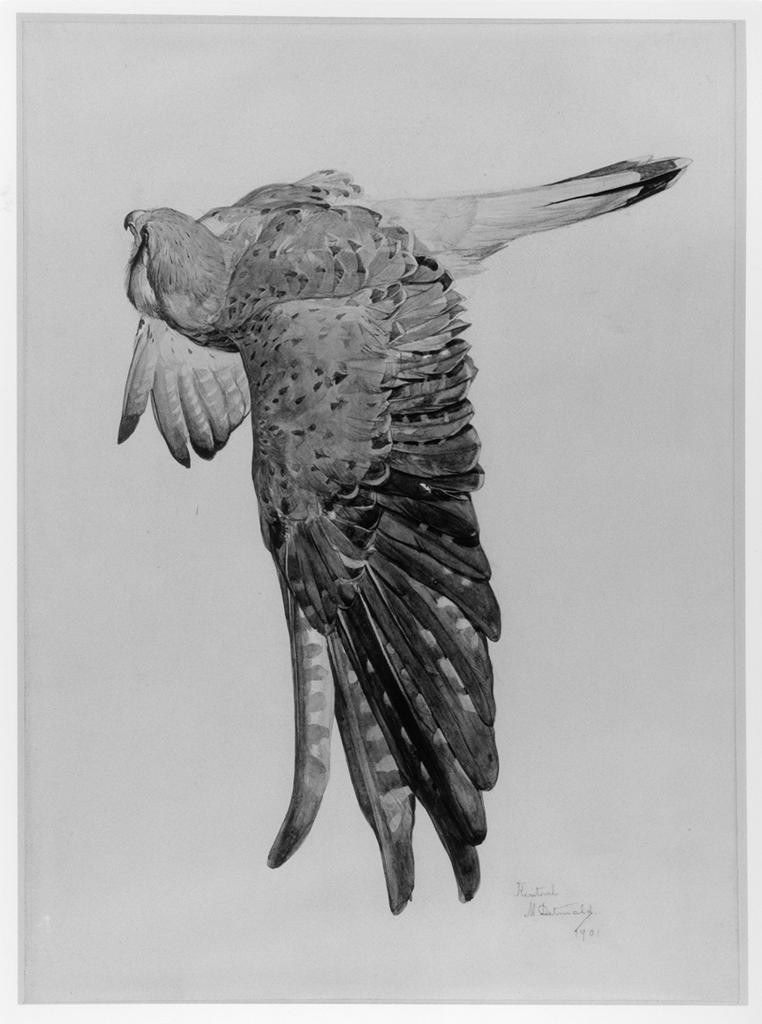
Charles Maurice Detmold (1883-1908), Kestrel in flight, 1901. Watercolour. British Museum. Dept. of Prints and Drawings.
We, as mere humans, cannot see and feel as birds do as they navigate their habitats. Birds have immediate needs that relate directly to food availability, energy, water, and temperature, social contact, reproduction, predator detection, and shelter that are more complex than the features we perceive on their behalf as “nature.” Nevertheless, it is urgent for us to understand what bird species need from their surroundings as human intrusion, habitat loss, and climate change conspire to accelerate our need to make the best use of those habitats we can manage for the remaining populations of birds who survive. This is part of what makes Birds: The Art of Ornithology by Jonathan Elphick such a vital contribution to our historical knowledge.
A recent zoological conference in London featured a game of “Animal Studies Tic-Tac-Toe,” in which “David Attenborough” occupied a central square. Though the game was in jest, it is certainly true – and tellingly so that this is often the case even for those whose profession ostensibly involves the fauna of the wilderness – that for most people, the experience of nature is mediated by films such as those in the Life and Planet Earth series, augmented by precision editing, emotional cue music, and witty commentary.
Though not the overt intention of Birds: The Art of Ornithology, this book is a powerful reminder that connecting meaningfully with nature requires leaving the house, and that this experience is both transcendent and daunting. Birdwatching especially demands patience, silence, and solitude. Elphick conveys this foregrounding with subtlety, and describes the conditions faced by naturalists in the time before photography and video, who, tasked often only by their own passion – what John James Audubon characterized as “…nothing was left to me but my humble talents” – set out not only to observe birds but to record their activities and document their environments.
(more…)

by Jean Marie Carey | 3 Mar 2015 | Animals in Art, Art History, August Macke, Franz Marc
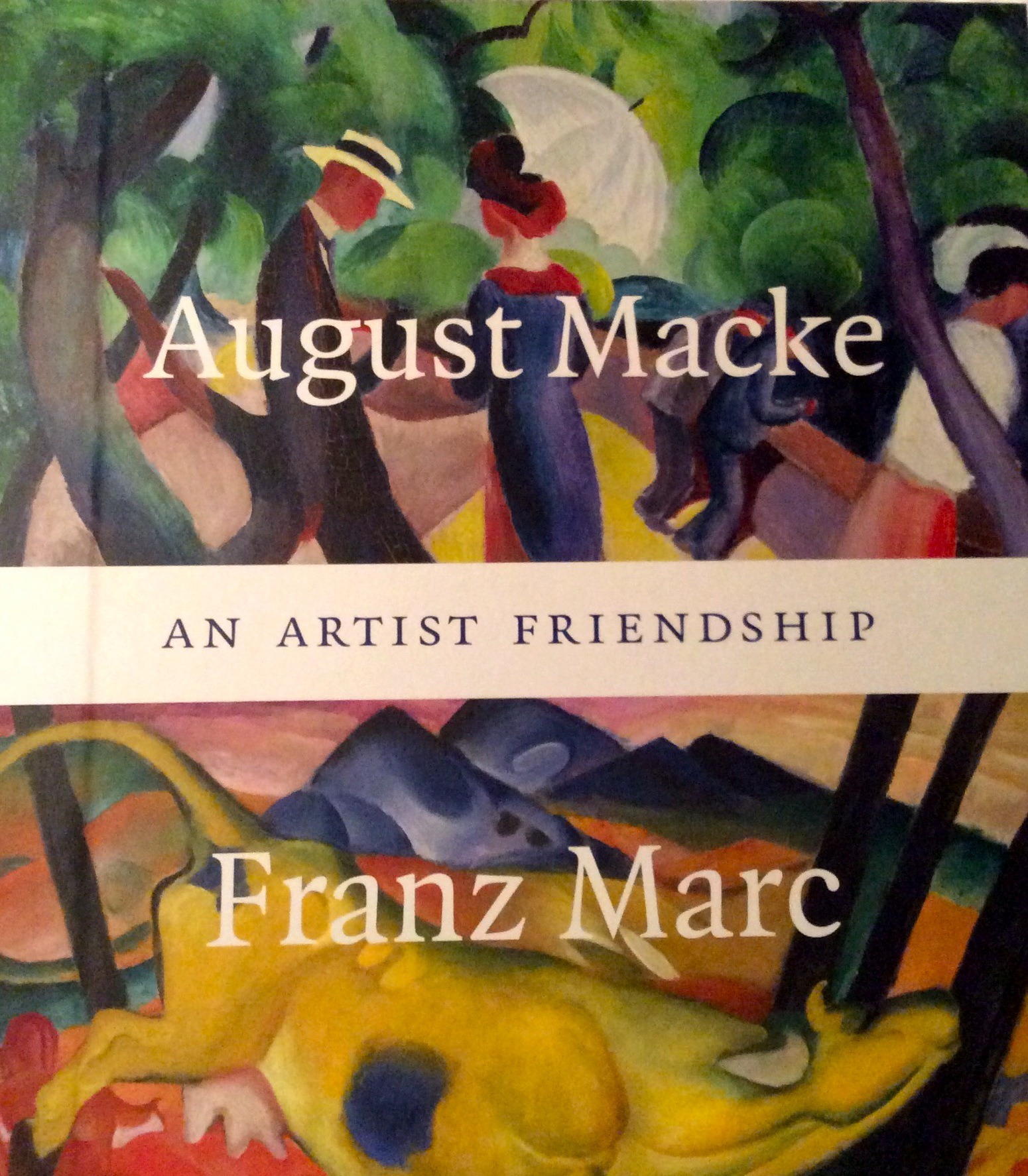
Today is the 99th anniversary of the death of Franz Marc. (Marc would have really liked someone who also died this week, Leonard Nimoy and Nimoy’s Mr. Spock character from Star Trek.) I didn’t write my normal “Franz Marc’s Birthday” post (Marc’s birthday is 8 February) this year because the idea of the grief we feel for Marc and August Macke has been much on my mind. This is partly owing to my own research, but also to do with the publication of the catalogue attendant to the Lenbachhaus’s current exhibition, August Macke und Franz Marc: eine Künstlerfreundschaft (August Macke and Franz Marc: An Artist Friendship in English).
The catalogue is, not surprisingly, a tour-de-force of editing and research by longtime Lenbachhaus Blaue Reiter curator Annegret Hoberg and Volker Adolphs of Kunstmuseum Bonn. What is unexpected is that the editors and included authors bring to bear not just a wealth of knowledge but so much compassion to these essays, confronting directly the loss and sadness we naturally feel over the too-short lives of Marc and Macke.
This is not to say the entries are not impeccably scholarly; Hoberg’s “August Macke and Franz Marc / Ideas for a Renewal of Painting” and Adolphs’ “Seeing the World and Seeing Through the World / Nature in the Work of August Macke and Franz Marc” are classic art historiography based in peerless analysis. Gregor Wedekind’s “The Masks of the Savages / Primitivism and Cultural Critique in the Work of August Macke and Franz Marc” was of particular interest to me as it underscores how the work of the avant-gardes was received in its time as a shocking departure from what the world then considered “civilized” painting. There are a few small errors marring Klara Drenker-Nagels’ otherwise illuminating discussion of the relationship between Maria Marc and Elisabeth Erdmann-Macke that I’m sure will be corrected in subsequent editions.
Of special delight in terms of the arrangement and presentation of the catalogue are some shorter, data-packed chapters on the Paradies (1912) mural and other anecdotes about Marc’s and Macke’s overlapping but very different lives.
Of course the catalogue is rich with the paintings, weavings, sketches, and photos that grace the exhibition itself. As a discrete publication, this is one that must truly be enjoyed as a book – I received it on a Friday afternoon and spent the entire weekend poring over every image, footnote, and phrase, alternately smiling and wiping away tears. Turning the last page, I was filled with admiration for this Lenbachhaus-Kunstmuseum Bonn collaboration, every word written with love.

by Jean Marie Carey | 27 Oct 2014 | Animals, Animals in Art, German Expressionism / Modernism
The Cry of Nature: Art and the Making of Animal Rights
I got a note from the nice people at Sehepunkte about the review of Stephen Eisenman’s The Cry of Nature I wrote (which is posted on Sehepunkte’s website):
“Sofern Sie über eine eigene Präsentation im Internet verfügen, würden wir uns freuen, wenn Sie dort Ihre Rezension und unser Journal verlinken würden. Hierfür können Sie gerne auch eines unserer Logos … verwenden…”
…so of course, OK! I really like Sehepunkte and am working on some more stuff for them too.
So here the logo: 🙂

Now a few months after reading it, I should report that this book has had a nice slow burn and even though this is a very positive review I think I would rate it even more highly now, particularly as a teaching text as it covers a broad subject area still with clarity and depth in each chapter. I was able to use Eisenman’s section on the hunting practice of indigenous peoples, for example, as a point of reference in a recent seminar I gave for the Bioethics Centre at the university and in reference to a discussion about the dolphin massacre in Taiji, Japan. (To support my argument against hunting and hunters I mean: Don’t get me wrong; there’s no place for humans who hunt in any universe, and people trying to be “open minded” about hunting are without fail patronizing, paternalistic, and dead inside.)
Anyway, this is an excellent book and here is the review:
(Stephen F. Eisenman: The Cry of Nature. Art and the Making of Animal Rights, London: Reaktion Books 2013, ISBN 978-1-78023-195-2).
Art historical texts, and especially single-authored volumes, should be judged in great measure by how well they fulfill their expressed ambitions. By this rule The Cry of Nature. Art and the Making of Animal Rights, whose central objective is to provide an intellectual and informational resource for readers interested in the intersection of the animal studies and the making of art, and a platform for scholars to reflect on provocative subjects suggested by the twining of these two themes, must be deemed a success.
Each of its chapters contributes to author Stephen F. Eisenman’s goal of addressing and evaluating important issues pertaining to the contemporary discussion of animal rights and the movement’s connection to art and ideas originating in the 18th century as well as, to some extent, before. Organized into five chapters and a strong introduction and conclusion, plus a recommended reading list of some of the foundational volumes of the relatively new discipline of animal studies, the book surveys not only images but historicizing texts and makes a strong claim that something like an animal rights movement has existed since antiquity, springing into cohesion in the 1700s, with artists making and using images as persuasion and propaganda.
The pleasure derived from reading this book lies partially in the richness of Eisenman’s detailed, personal, and confident descriptions of the lives and emotions of real animals, making his prose eminently accessible. Readers will be compelled by the forcefulness of local histories about, for example, a majestic African elephant photographed in a moment of perfect stillness at a watering hole in 2007 who is killed by poachers in 2009, and delighted by anecdotes about Echo, the author’s dog, who learns to stage pratfalls and tumbles in order to make Eisenman laugh. These stories are integrated meticulously within more formal discussions of images – some well-studied, including Rosa Bonheur’s The Horse Fair (1853) and Jean-Baptiste Oudry’s A Hare and a Leg of Lamb (1742), some less famous – such as Clifford Possum Tjapaltjarri’s 1975 painting Eagle Dreaming – which are produced about, and in mindfulness of, the animal.
The book begins with a background chapter defining “What is an Animal?” in terms of societal mores and biological evidence about the commonalities and differences amid living creatures, centering on the ability of animals to communicate, to experience emotions, and to feel pain. This chapter includes pleasantly unexpected exemplars, such as Simon Tookoome’s 1979 linocut I Am Always Thinking of Animals, as it stakes out the moral and practical discussions around how we define language and consciousness.
The chapters “Animals into Meat” and “Counter Revolution” dwell on images of the corpses of animals, shown as food, prey, and sacrificial stand-in for the human figure and body. While the recurring motif of the flayed ox in paintings by Gustave Caillebotte and Rembrandt may arouse as much distancing disgust as identification, Eisenman’s delicate examination of Jean-Baptiste-Siméon Chardin’s The Ray (1728) makes persuasive on the page that these artists intended to convey their beliefs in the existence of the souls and consciousness of animals, and commensurately, the dismal mortality of humans, on their canvases. (more…)