by Jean Marie Carey | 20 Aug 2013 | Art History, Franz Marc, German Expressionism / Modernism, LÖL
Postkarte am Bubi, Franz Marc and Auguste Macke, 1911. This looks like mostly AM really. I love the way the feathers become the fish…
“We actually had many more exciting exchanges back-and-forth, most of which were very unproductive and very unbecoming of two grown men.” LÖL.
by Jean Marie Carey | 6 Dec 2012 | Animals in Art, Art History, Franz Marc, German Expressionism / Modernism, Italian Greyhounds, Stuff Found in Library Books
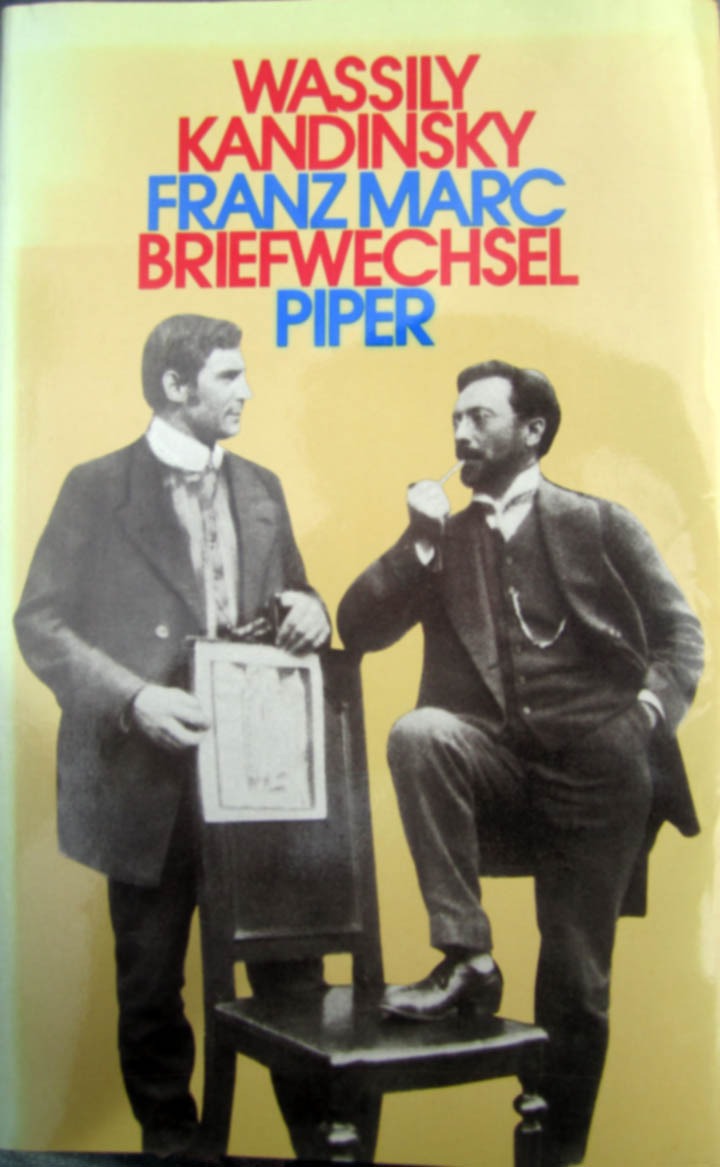
 Wassily Kandinsky, Franz Marc, Briefwechsel : mit Briefen von und an Gabriele Münter und Maria Marc
…After several years of seeking this book and not being able to find it, or finding it and having it be a million Euros or something, I was surprised to locate it in a German used bookstore’s inventory and not too crazily dear. It came in a package from Frankfurt am Main with probably the most Luftpost and other sticker adornments ever in the history of mail. I liked the wrapping so much that I just left the book in it for like a month and kept admiring it. Finally I actually needed to look something up and I had this week to open it. I was beyond thrilled to see that it had a dust jacket with fantastic 1980s typography and an X-acto bladed cutout of the “Show Him the Picture!” photo. The pages aren’t highlighted or written in, but they are pretty beat up and smell like bourbon and tobacco; I am always happy to find someone has really been reading a book hard.
I have been reading, listening to Bayern 2, and conversing with my two patient friends auf Deutsch a bit more diligently and was very pleased to be able to just sit down and read the book without too much difficulty, a far different experience from when first I met it. There are a lot more references to August Macke than I remember, and to AM’s influence…FM was always agitating on AM’s behalf.
I see from looking in Worldcat that this is something of a rare book (rarer now that the Little Mermaid dragged the USF copy to the bottom of the ocean or something – way to stay classy). I wonder why Piper never issued another edition, because in addition to the text of the letters there are extensive notations about the context of the references in the letters, and, very helpfully, descriptions of what was on the obverses of the postcards FM sent that he didn’t make himself. Between the paint, the content, and the terrible writing and incomplete addresses, FM was a real terror to the kingdom’s postal service – they regularly sent his stuff back or just handed it back and refused to deal with it – and they must have been relieved to see just normal “art” postcards such as people send today.


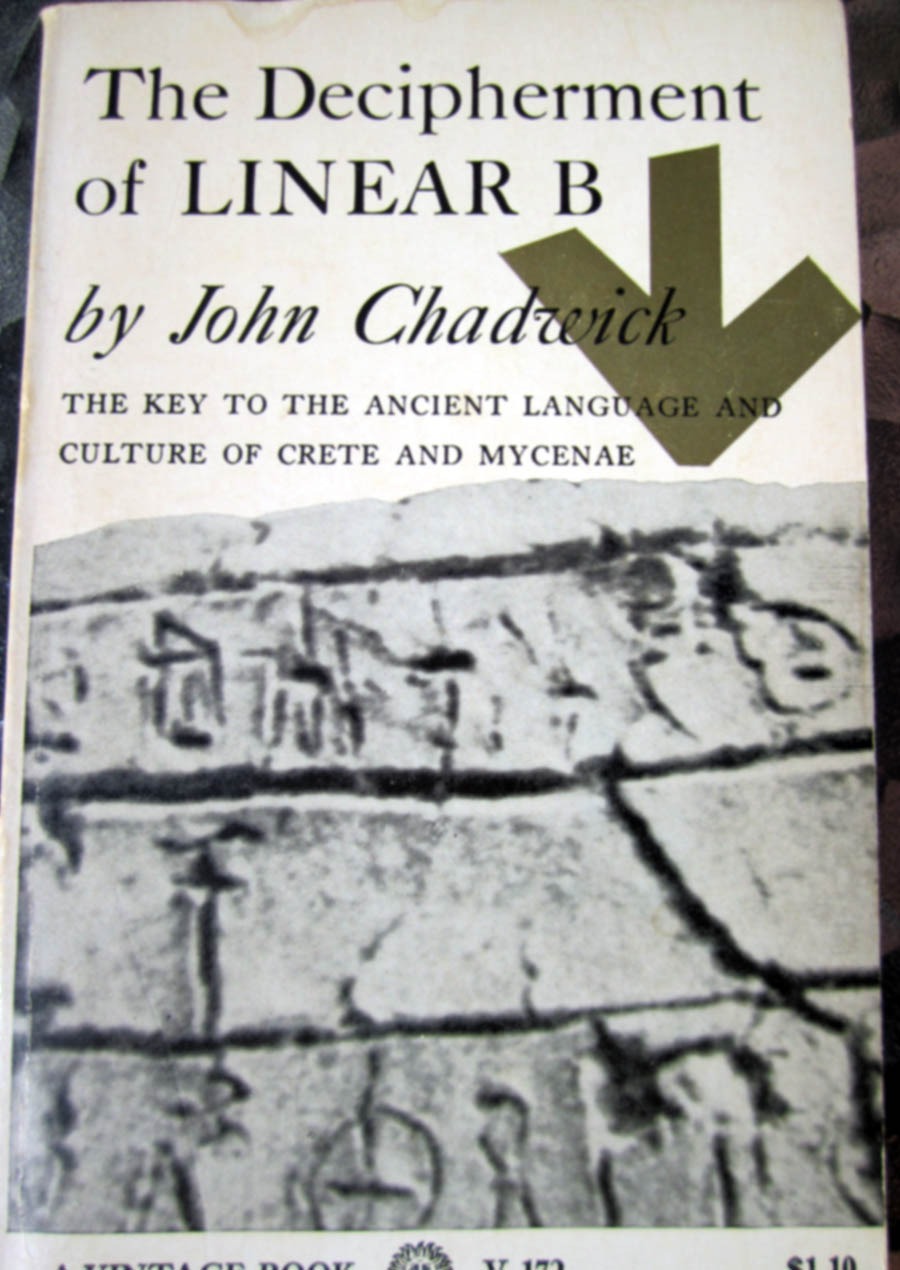
The other text I came across when I was organizing some shelves of books was this: The Decipherment of Linear B. I have always been very fascinated with cuneiform and with the work of Michael Ventris. The author, John Chadwick, was a friend and colleague of Ventris and though this is a very staid account of the process of identification and transcription of the cuneiform characters as both compared with Phoenician and Egyptian and deductively derived, Chadwick mentions Ventris’ untimely death in the introduction. I snatched this book from the trash and am very glad to have it now.
by Jean Marie Carey | 26 Aug 2012 | Animals in Art, Art History, Franz Marc, German Expressionism / Modernism, Music, Re-Enactments© and MashUps
Apollinaire was very popular in Bonn and in Berlin, where he befriended Herwarth Walden, who, among other things, occupied a societal role similar to that of Apollinaire. Apollinaire also wrote and drew quite prolifically, of course, in addition to being a tastemaker around whom a circle of other artists and authors coalesced.
In early 1913, August Macke was very excited when not only Apollinaire but Robert Delaunay (and later Max Ernst) came to hang out at his place. Apollinaire spoke German very well, also. Anyway, AM just loved these guys, and generally began trailing them around and writing to them all the time and so on.
There is much more to this story, some of it very exciting, and be assured I will get to it all shortly…
However not everyone was enchanted by Apollinaire. That “not everyone” included, well… for the immediate subject at hand, Franz Marc. FM actually had little use for Delaunay, after a (short) while, either. During 1913, FM pesters Delaunay with tons of perplexing, unsolicited criticism, finally in one outburst declaring that RD wasn’t a very good writer, either.
Apollinaire did like FM’s work, but FM kept a distance. Today upon discovering that it is Apollinaire’s birthday, well, what can I say? It explains a lot. Here is a very comprehensive if somewhat outdatedly designed Website about Apollinaire.
AM finally told FM, basically, to stop embarrassing him in front of his cool new friends. FM pointed out that it was he who had introduced these three to one another, and, that also, RD was kind of a jerk, refusing to give AM anything but a scrap of used drawing paper (like literally AM was begging for any type of memento and that was what RD let him have!). Anyway, RM and AM fought all the time as it was, so this altercation of course could not be resolved swiftly or in a few words and continued over the course of some petulant correspondence and huffy silences…full citations to come. FM was jealous, of course, but also he hated to see AM fall in with people he thought embodied the worst characteristic of all, that of being fake.
Fortunately, since everything that has happened before will happen again, this throwdown has been re-enacted by two parallel characters in one of the most important documentaries of our time (it had to be peddled as fiction because of the potency of its truth), Mean Girls (2004).
Above is the epic scene in which Janis Ian (as FM) confronts Cady Heron (as AM) [we won’t even get into the whole LiLo thing here, or about… nevermind) about being plastic…
With a special guest appearance by Damian as Helmuth Macke.

by Jean Marie Carey | 3 Apr 2011 | Animals, Animals in Art, Art History
Postcard to August Macke, 29 December 1910:
“Greetings to all, please give my best to your brother, and I respectfully commend your mother.”