by Jean Marie Carey | 12 Jan 2018 | Art History, August Macke, Franz Marc, Re-Enactments© and MashUps
My research about the 1914 Franz Marc essay »Das abstrakte Theater« and Marc’s collaboration with Hugo Ball on an intended production of The Tempest has been published in a special arts issue of Empty Mirror. The fun long title of the article is “The Tempest and the Savages: Franz Marc, Hugo Ball, and a Decisive Moment in Dada-Expressionist Theater With a Special Appearance by August Macke,” and this piece contains important breaking historical avant-garde news.
Fig.01: Franz Marc, Fragmentary First Page of „Das abstrakte Theater,“ 1914. Das Archiv für Bildende Kunst im Germanischen Nationalmuseum, Nürnberg, Germany.
Here is the abstract: This article discusses the 1914 Franz Marc essay “Das abstrakte Theater” and the events surrounding an “Expressionist” production of Shakespeare’s Der Sturm planned by Marc and Hugo Ball the same year. Marc’s position in this detour from painting and writing can be understood in terms of his embrace of “die ‘Wilden’” – “the ‘Savages’” – an idea Marc introduces in 1912’s Blaue Reiter Almanac – as a metaphorical aspiration and as a state of being for both artists and the public as patrons of the arts and citizens of modernity. I also bring recognition to August Macke’s background in theatrical theory and design in terms of how this influenced Marc, particularly in analysis of the artists’ collaboration on Macke’s contribution to the Blaue Reiter Almanac, the essay “Die Masken,” and how this relates to the Der Sturm project. I propose a way of understanding how Marc’s beliefs in the paradoxically beneficial power of destruction dovetailed with Ball’s theology. In the context of this background information I give close reading of paintings Marc made of the Caliban and Miranda characters from Der Sturm. I also correct inaccuracies in the record regarding the chronologies of this encounter between these protagonists of Dada and Expressionism, and in our understanding of Marc’s text itself. Viewing this data in a holistic manner allows new interpretations of influences and collaborations amid the historical avant-garde.
It is great working with Denise Enck at Empty Mirror so it would be nice to look at the article on the Empty Mirror website, but if you would like a PDF of the article there is one here and also at Humanities Commons.

Fig.04: Franz Marc, Miranda, 1914. ( Tempera, 46 x 39.5 cm.) Kunstmuseum Basel, Kupferstichkabinett der öffentlichen Kunstsammlung, Switzerland.
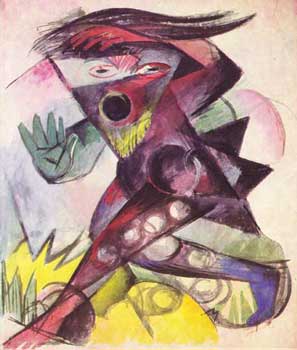
Fig.03: Franz Marc, Caliban, 1914. (Figure for Shakespeare’s „Der Sturm“. Tempera, 46 x 39.5 cm.) Kunstmuseum Basel, Kupferstichkabinett der öffentlichen Kunstsammlung, Switzerland.
by Jean Marie Carey | 3 Mar 2016 | Animals, Animals in Art, Art History, Expressionismus, Franz Marc, German Expressionism / Modernism
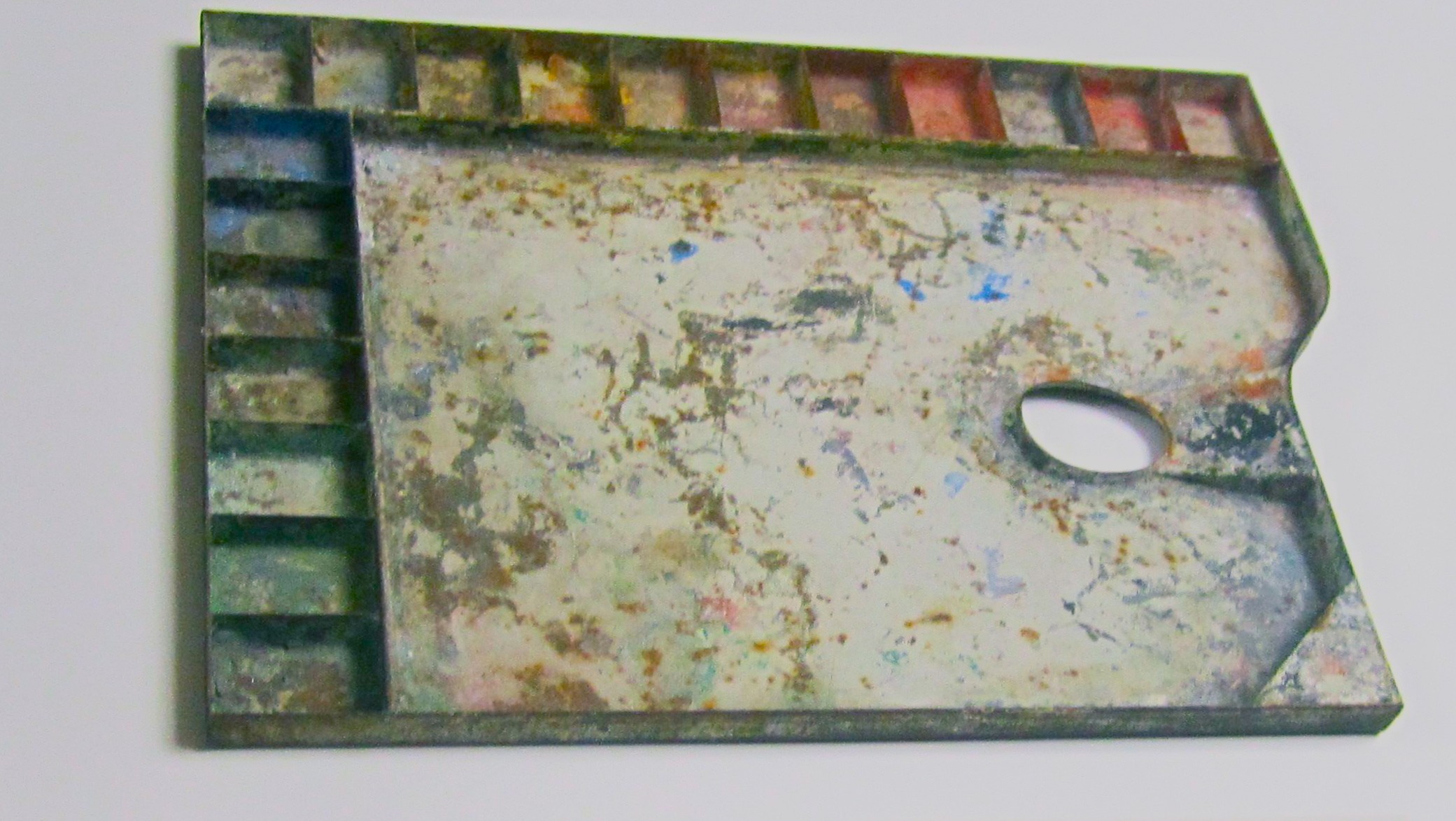
Franz Marc’s palette, from the archives of the Franz Marc Museum, Kochel.
Franz Marc’s “Aphorism 82,” from Die 100 Aphorismen, 1915.
“Ich sah das Bild, das in den Augen des Teichhuhns sich bricht, wenn es untertaucht: die tausend Ringe, die jedes kleine Leben einfassen, das Blau der flüsternden Himmel, das der See trinkt, das verzückte Auftauchen an einem andern Ort, – erkennt, meine Freunde, was Bilder sind: das Auftauchen an einem anderen Ort.”
“I saw what the moorhen sees as it dives: the thousand rings that encircle each little life, the blue of the whispering sky swallowed by the lake, the enraptured moment of surfacing in another place. Know, my friends, what images are: the experience of surfacing in another place.”

by Jean Marie Carey | 23 Mar 2014 | Animals, Animals in Art, Art History, Dogs!, Franz Marc, German Expressionism / Modernism, LÖL, Re-Enactments© and MashUps
Franz Marc’s family home in the München suburb of Pasing.
I’ve written a little bit about (we’re saving our full repertoire for our even-bigger-screen reveal) the accidental hobby of my creative partner and myself, a sort of reverse geocaching + film. Basically we found out we like to research the addresses of art-historical places and find the spot on the earth where they once stood. In most of these cases, such as the pop-up gallery in Berlin search which ended up being recorded during a blizzard, or the colorful studio here in München destroyed in the war, we had city records and things like invitations to or posters for exhibits to go on, and it was possible to figure out, even where addresses had changed or buildings had been demolished, where they once stood. Sometimes we were able to use GPS coordinates, tagging our own maps as we went along, and sometimes we just used a compass, building keystones, and asking questions. Most of these excursions took a couple days of research and a one-shot hike.
Franz Marc’s family house in the München suburb of Pasing turned out to be our biggest challenge, though, and somewhat unexpectedly since Pasing was never destroyed and a lot of the old buildings have been preserved. However, perhaps not surprisingly, neither were Sophie and Wilhelm Marc, the parents of Franz, nor Paul, Franz’s brother, either very good with managing money nor with keeping records. Thus as it turns out the Marcs owned the house through a chain of convoluted machinations, so the normally very useful city and state records were not helpful. We assembled our clues – fragments of notes and letters mostly, and importantly, photographs showing the house and the yard – and set off to Pasing with only a couple of bottles of water because “how big can Pasing be?”.
Well, Pasing is not that big, but, never underestimate the amount of confusion Franz Marc can cause. On our first journey (like, on the Straßenbahn Linie 19 so not that far) we walked around the neighborhood with the most Altbauten – nothing. The second day we knew to bring some snacks, but, still, after many hours – nothing. We were getting a bit anxious time-wise, and looked over all our notes again. I kept going back to the photographs, which showed very clear views of the property including which way the shadows were falling, and, since they photos were clearly taken in summer, and then in winter, you could see which way the house itself faced. We decided on the third trip to just be more playful and counterintuitively left everything at home but the camera, and getting off the tram just walked in a direction that seemed, for lack of a better way to describe, enticing and pleasant.
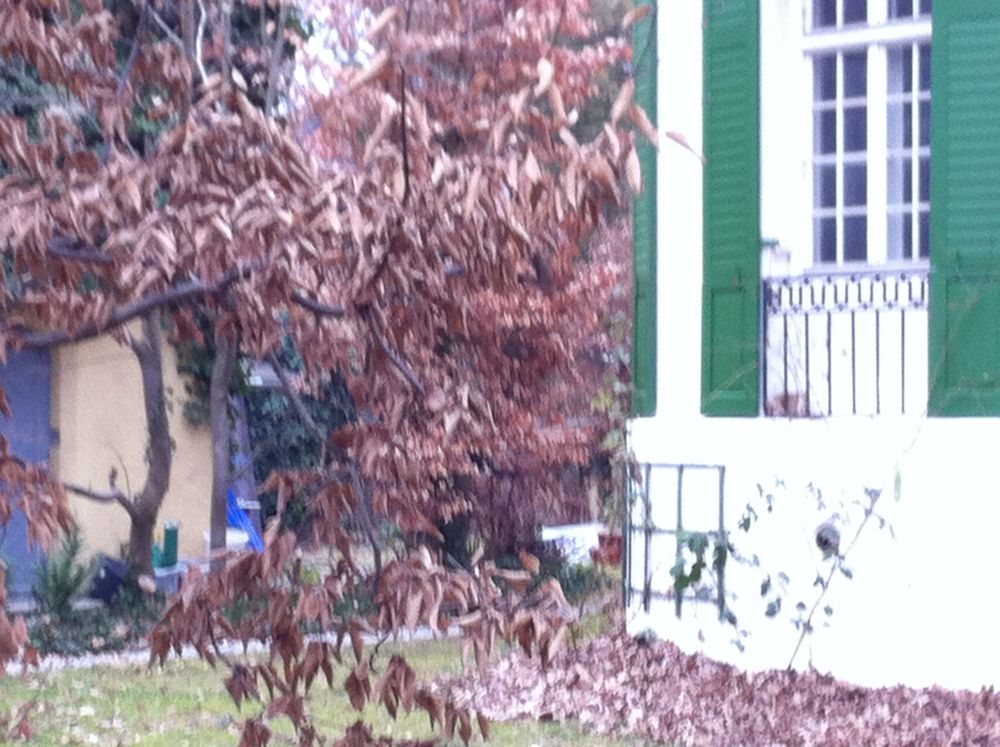
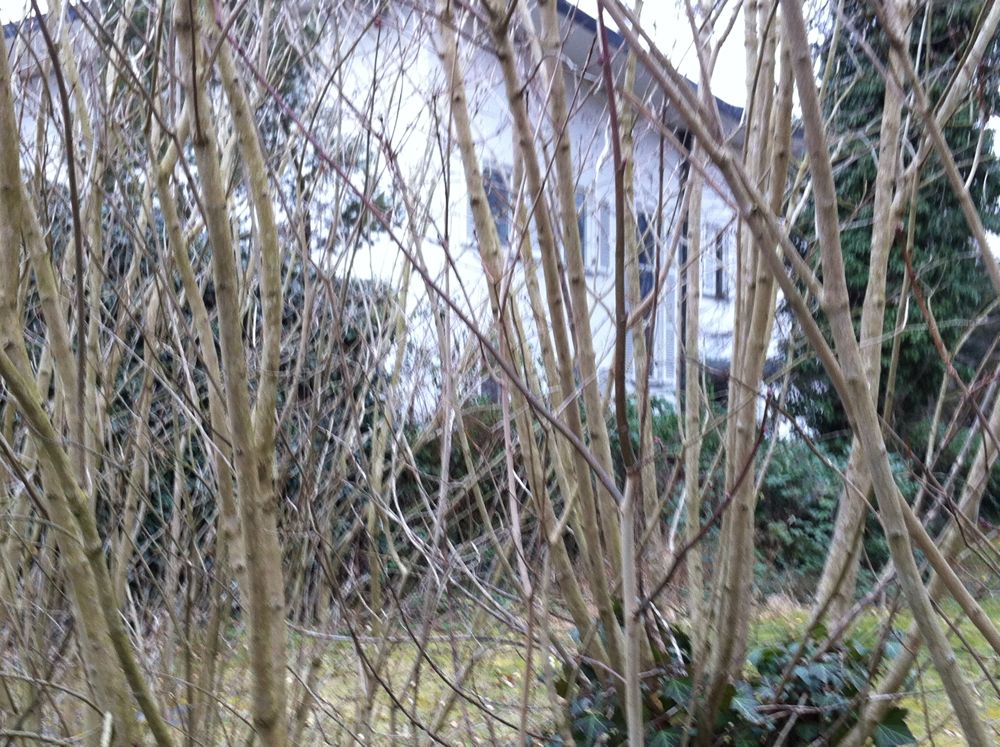
Not even half an hour into the walk, we turned a corner, and there it was. The other times we had been going completely in the wrong directions, by the way. Even if I didn’t know from the photographs, I would have just known, I think, that this was a place the Marc family would have lived. It’s a comfortably large enough home, but kind of secluded, even though it’s on city block, with many trees that were saplings in the photographs, a sort of open gazebo, and many eaves and places for birds to live. It definitely had an aura and I was very happy to have found the place – it made me feel very light at heart – and happy that the Marcs had lived there. Sophie Marc stayed on at the house after Wilhelm Marc died in 1907 until she went to stay with Maria Marc later in 1914 (yes, Sophie Marc outlived Franz by just a few months).
Unfortunately, as you can see from the photos, the home is abandoned and in desperate need of some repairs. It’s probably not habitable the way it is now. I dearly hope someone will lovingly restore this historic treasure. If that person is you, please write to me and I will send you the address!
Once my heart had turned to being interested in “recovered biography” I realized how important it is to actually physically experience places and things important in the life of Franz Marc. It’s incredible to me that in a place as self-consciously “historic” as Bayern so many things are falling away. In 2013, the Goltz book store closed its physical location on the Türkenstraße, which should really have been outlawed or something. We did make some documentation of that location, too, though. But that is another story.
UPDATE: May 2015
In some recent research I was doing about some other property records and dates of births and things, I ran across an interesting fact: Around 1885-1900, Annette von Eckardt and her family, which then would have included her baby daughter Helene and husband Richard Simon, a professor at Ludwig-Maximilians Universität, lived in Pasing. By this time Richard Simon would’ve known Paul Marc, Franz Marc’s brother who also taught at the university, and who still lived with the family in Pasing, too. I’m writing something for publication about these interconnected relationships for soon, so…watch this space. The implications are interesting, and a little disturbing, too, but my intuition has been givine me this message for a long time…

by Jean Marie Carey | 8 Feb 2014 | Animals, Animals in Art, Art History, Franz Marc, German Expressionism / Modernism, LÖL, Re-Enactments© and MashUps
Tierschicksale, 1914, Franz Marc
Was kann man thun zur Seligkeit als alles aufgeben und fliehen? als einen Strich ziehen zwischen dem Gestern und dem Heute? – Franz Marc, February 1914, from the intended introduction to the second edition of the Blaue Reiter Almanac. First printed in Der Blaue Reiter. Dokumentarische Neuausgabe by Klaus Lankheit. München, 1965, p. 325.
One of the most frequently cited articles about Franz Marc in popular literature is Frederick S. Levine’s “The Iconography of Franz Marc’s Fate of the Animals” from a 1976 issue of The Art Bulletin, and, subsequently, a short book on the same subject. Apparently there are some issues with the accuracy of the translations presented in both. What’s interesting to me is the creative idea Levine had to analyze Marc’s enormous 1913 painting Tierschicksale (mysteriously residing in the Kunstmuseum Basel) as an expression of Ragnarök, the apocalypse of Norse mythology. My opinion is that despite being generally familiar with the Eddas and with Der Ring des Nibelungen Marc wasn’t that interested in these sagas and didn’t consider them as particularly German.
A few years ago Andreas Hüneke, researching at the Lenbachhaus, discovered that the inscription on the back of the painting, „Und alles Sein ist flammend Leid“ is from a volume of the Buddhist Dhammapada of the Pali Canon of Buddha Siddhartha Gautama given to Marc by Annette von Eckardt. So it doesn’t seem to refer to Ragnarök directly as Levine (not having the benefit of Hüneke’s recent work) asserts. It seems more likely that Marc was very distressed, in the summer of 1913 when he made Tierschicksale, about von Eckardt’s move away from Munich to Sarajevo. It explains a little bit about why, upon seeing the painting again a few years later, Marc says he doesn’t even remember creating it and ascribes its meaning to the more external conflagration at hand.
In any case, Levine was not discouraged by his translating experience and went on to the faculty at Palomar College in California and also spent a lot of time studying and teaching at the University of Tasmania in Hobart.
Today, on Marc’s birthday, with so many animals imperiled, Tierschicksale doesn’t really need any overdetermining; it would be very tempting to just turn and flee, if only there was somewhere to go.