by Jean Marie Carey | 7 Oct 2010 | Animals, Animals in Art, Dogs!
Landscape with Snow
Vincent Van Gogh’s Landscape With Snow (1888) is a bit of an oddity amid the nearly 200 paintings Van Gogh made during his relatively brief (fifteen months) but exceedingly productive sojourn to the outskirts of Arles, France, following his immersion in Parisian café culture. As with the canvas depicting the storm on the shore at Scheveningen, Landscape With Snow seems to have recorded a real weather event, a heavy and rare blizzard that happened just as Van Gogh arrived in what he must have been surprised to find was not a sunny early spring day in the south of France. Of greater interest for my research, however, is the rare appearance of an animal – a dog – in this painting.
The dog and his man are walking away from the viewer, and the painter, on the left side of the raised rut between a slushy dirt road and an adjacent fallow field, also patched with snow and maybe ice, though the cold and precipitation seems not to have discouraged the emergence of a few early bursts of foliage. The sky overhead is the cold grey of a European late afternoon, but the village, not too far distant, offers the shelter of steadfast trees and some inviting-looking structures. Still it is the presence of the dog that lends this canvas a sense of comfort – the man and the dog are just out walking and will soon reach the village – rather than the foreboding and isolation a solitary figure would indicate.
Vojtech Jirat-Wasiutynski describes Van Gogh’s fascination with Arlesian agrarian labor practices (and the impingement upon those practices as evidence by the occasional appearance of modern machinery) in a way that echoes Griselda Pollock’s pieces (supported by an even greater amount of first-source historical data) about Van Gogh and the peasant population around Nuenen. Both scholars more than suggest that Van Gogh was a bit clueless as to the actual monotonous particularities of the type of manual labor required by life on a farm, with or without the assistance of efficiency-making devices. However, while Pollock’s interest in Van Gogh is more or less in envisioning the social practices of capitalism realized in painting with the painter as the generalized fulcrum, Jirat-Wasiutnski concentrates on a favorable understanding of Van Gogh’s intentions. I say intentions because while Jirat-Wasiutnski intuits a good bit of bonhomie from Van Gogh’s visions of companionship with like-minded artists as he imagined existence in Japan and an almost Futurist-like faith in the benefits of embracing modernity, the landscape paintings do not precisely, in many cases, reflect this sense of community and optimism. In fact despite its chilly setting, Landscape With Snow (because of the dog) is much more emotionally vibrant than, for example, the invitingly titled but simultaneously cluttered and barren Orchard With Blossoming Apricot Trees (1988) from just one month later.
Flying Fox
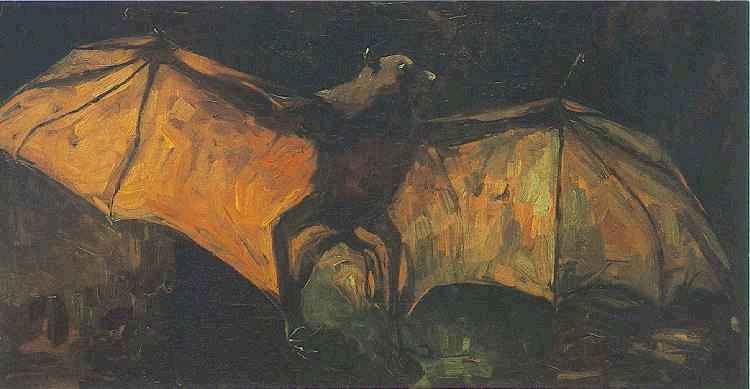
My favorite Van Gogh painting, period, is Flying Fox (1885) from the Nuenen period. I have always wondered why, after so viscerally animating a creature he could never have seen when it was alive and in its natural environment, Van Gogh’s interest never again turned intensively to the many available creatures of the earth in Nuenen, Paris, and Arles who invited the same types of projections of innocence and typicality as the peasants, fieldhands, and café attendants Van Gogh was so fond of. Franz Marc saw something in Van Gogh’s work that made the German painter immediately embark on his canonical horses. I am still curious and will continue to search for whatever this galvanizing influence is.
See: Vojtech Jirat-Wasiutynski, “A Dutchman in the South of France: Van Gogh’s Romance of Arles,” Van Gogh Museum Journal 2002, Van Gogh Museum, Amsterdam. (78-89)

by Jean Marie Carey | 13 Jun 2010 | Art History, Franz Marc, German Expressionism / Modernism
Franz Marc’s best known writing is his public manifesto-ing, and also his correspondence with colleagues and family. But Marc also wrote on the covers of and inside his various sketchbooks all the time. This verse from around 1910 is really trippy in a Rimbaud sort of way. Some of the imagery and words come up again in paintings and painting titles. Thomas de Kayser, the editor of the volume in which this appears, organizes this material by theme very agreeably. Text in French follows the English translation.
Notes in the sketchbook XXVIII
— A pink rain fell over meadows.
— The air is like green glass.
— The girl [observed] looked into the water, the water was clear [as] crystal, the girl was crying.
— Trees had their growth rings, the animals their veins.
Notes in the sketchbook XXXI
The storm roared.
I entered the house and saw all
A tall woman red small black cat [playing] on the green table.
Kraak, lightning strikes the vehicle – the beautiful little cats were playing with the woman, she smiled – ah ah [poor] man and horse are [is] dead. [The man cries] [sky] the angel of fear knocks at the window; the [poor woman] I could shake the red heart of the woman and black kittens knew the green table – what it [?], red and black and green? Three colors give it a thought? If we give to the red heart shape, the black that [one of three interspersed] small kittens, green form of [a large square plate ?…] the square.
I meditate on that thought.
The red heart of the woman breaks.
It [comes] springs a [blood …] [a streak of blood] A stream of blood [across the sky due] which falls into the river, it flows through the now red green pastures grazed by sheep or black.
The storm has withdrawn his hand from the earth.
The blue sky [?] Ogle like a gigantic glass eye the scene [of] red, green, and black, this thought is not it terrible? […] Do you understand what the painters paint?
(more…)
by Jean Marie Carey | 1 Jun 2010 | Art History
Unidentified Coastal Organism
It’s June 2010.
“The end of history involves, then, an ‘epilogue’ in which human negativity is preserved as a ‘remnant’ in the form of eroticism, laughter, joy in the face of death. In the uncertain light of this epilogue, the wise man, sovereign and self-conscious, sees not animal heads passing again before his eyes but rather the acephalous figures of the hommes farouchement religieux, ‘lovers,’ or ‘sorcerer’s apprentices.’ ”
— Giorgio Agamben, The Open: Man and Animal, (Stanford, CA: Stanford University Press, 2004), 7.
by Jean Marie Carey | 26 May 2010 | Art History
Henry Howard, the Earl of Surrey, is credited along with Thomas Wyatt for founding the English sonnet. Henry Howard lived in France for a long time, was frequently in trouble with Henry VIII for his boisterous behavior, and got into all sorts of adventures; he was a cool dude. This verse, thought to be about Anne Stanhope, Lady Hertford, is from about 1542.
A SONG WRITTEN BY THE EARL OF SURREY.
OF A LADY THAT REFUSED TO DANCE WITH HIM.
EACH beast can choose his fere according to his mind,
And eke can show a friendly chere, like to their beastly kind.
A lion saw I late, as white as any snow,
Which seemed well to lead the race, his port the same did show.
Upon the gentle beast to gaze it pleased me,
For still methought he seemed well of noble blood to be.
And as he pranced before, still seeking for a make,
As who would say, ‘There is none here, I trow, will me forsake’,
I might perceive a Wolf as white as whalèsbone,
A fairer beast of fresher hue, beheld I never none ;
Save that her looks were coy, and froward eke her grace :
Unto the which this gentle beast gan him advance apace,
And with a beck full low he bowed at her feet,
In humble wise, as who would say, ‘I am too far unmeet.’
But such a scornful chere, wherewith she him rewarded !
Was never seen, I trow, the like, to such as well deserved.
With that she start aside well near a foot or twain,
And unto him thus gan she say, with spite and great disdain :
‘Lion,’ she said, ‘if thou hadst known my mind before,
Thou hadst not spent thy travail thus, nor all thy pain for-lore.
Do way ! I let thee weet, thou shalt not play with me : (more…) |
by Jean Marie Carey | 3 Jul 2008 | Animals, Animals in Art, Art History
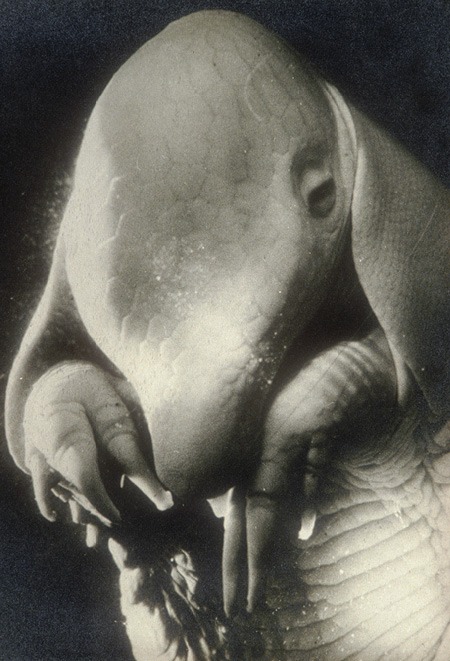
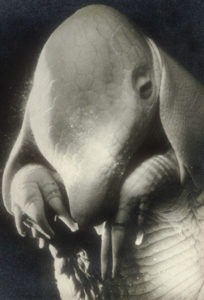
Pére Ubu by Dora Maar, 1936
Authorship by Dora Maar gives this photograph authentic historic and even feminist credibility but I chose it because my main interest in art overall is the representation of animals. This is a very interesting view of a creature commonly seen in Florida (and all over), an armadillo (though this armadillo is of a different species than the nine-banded creatures who sadly cannot navigate traffic).
There is something primitive and otherwordly about armadillos and whatever Maar’s intent may have been in elevating such a seemingly lowly creature into this eerie portrait it is quite a lovely study. Since Maar was interested in primitivism, this seems apt.
With respect to technique, placing the pale, scaly armadillo against a grainy dark background removes it from a natural setting and allows for contemplation of the texture of its skin. The shadows on its chest accentuate its claws. There is no way to tell, framed in this manner, how big the armadillo is, whether he is, as Maar’s title suggests, “king” sized, or tiny like a fetus, which the armadillo also resembles.