A Change of Scenery

A Change of Scenery

August Macke, Märchen (Sindelsdorf), 1911, Gouache, Deckweiß, Aquarell August Macke, Märchen (Sindelsdorf), 1911, Gouache, Deckweiß, Aquarell

Franz Marc note to August Macke:


19.12.1910
Sindelsdorf


Du Gauner und alter Kulissenschleicher,


schwelge nur ruhig in den Kulissengeheimnissen anderer, einmal und zwar bald, (hörst Du?), musst Du auch aus Deinen Kulissen heraus vor die Rampe, dann schleich ich hinter Dich und beseh mir die Garderobe dieses Genies. – Übrigens lasse ich jetzt einen F …. nach dem anderen in meiner Malerei, – hörst Du sie nicht? Dröhnend!! Ich rechne nicht mehr auf den Besuch der Leute vor Weihnachten und werde also Deine Sachen nächstens zusammenpacken; es tut mit wahrhaftig leid, – sie sind mir so vertraut und lieb geworden. Soll ich die Sachen von Helmuth auch alle dazupacken? Vielleicht schicke ich das gerahmte Stilleben einmal eigens, wenn es Dir damit nicht eilt. Schreib mir bitte darüber. Grüsse Frau Lisbeth herzlichst. Viel Glück und ›Mut‹! zum Einzug in’s Atelier!


Dein Fz. M.


• • •


Although FM kind of jokes here about it perhaps being time for Helmuth Macke  – who has only just arrived – to depart, FM quickly gets used to having Helmuth around. At the end of the same month, the nurturing, self-possessed teenager makes art history happen…


He’s Laughing

He’s Laughing

Brunnen_Maedchen_mit_Seehund_von_Ferdinand_Liebermann_1930_Muenchen_Hohenzollernplatz-1
This post was actually written quite some time ago and held in reserve with about 50 other little stories under the title “Grendel’s Mother Doesn’t Have a Name!” which is now the title of a book chapter. It is actually only a little confusing, and also my devotion to pinnipeds remains unswerving.

I was inspired to revisit by sequential experiences, the first running across an adorable video of a sea otter playing a sort of tag with an Australian cattle dog. The sea otter is clearly enjoying himself, and as I watched him woof softly as he partially clambered up onto a dock, I heard myself think “…er lacht…” followed by a moment of confusion and then thinking… “… was ist das auf Englisch?” For a second I couldn’t think of the words. I have had a few fragmentary dreams in German, but this is the first time anything like this has ever happened in regular life. It was actually very pleasant and I hope it will begin to happen more often.

The other addition to this post is this image of this astounding statue watching over Hohenzollernplatz. It was made by Ferdinand Liebermann in 1930 and has withstood a lot. This is a very evocative image naturally and also reminds me of the moschophoros, which in turn puts me in mind of Knabe Mit Lamm and the poor unfortunate kids…(just a tiny image here because a whole story is coming along about this painting).

knabemitlamm

Franz Marc’s Birthday: Aphorismen 82

Franz Marc’s Birthday: Aphorismen 82

“I saw what the moorhen sees as it dives: the thousand rings that encircle each little life, the blue of the whispering sky swallowed by the lake, the enraptured moment of surfacing in another place. Know, my friends, what images are: the experience of surfacing in another place.”

{ Ich sah das Bild, das in den Augen des Teichhuhns sich bricht, wenn es untertaucht: die tausend Ringe, die jedes kleine Leben einfassen, das Blau der flüsternden Himmel, das der See trinkt, das verzückte Auftauchen an einem andern Ort, – erkennt, meine Freunde, was Bilder sind: das Auftauchen an einem anderen Ort. }

Franz Marc, Aphorismen 82, 1915.

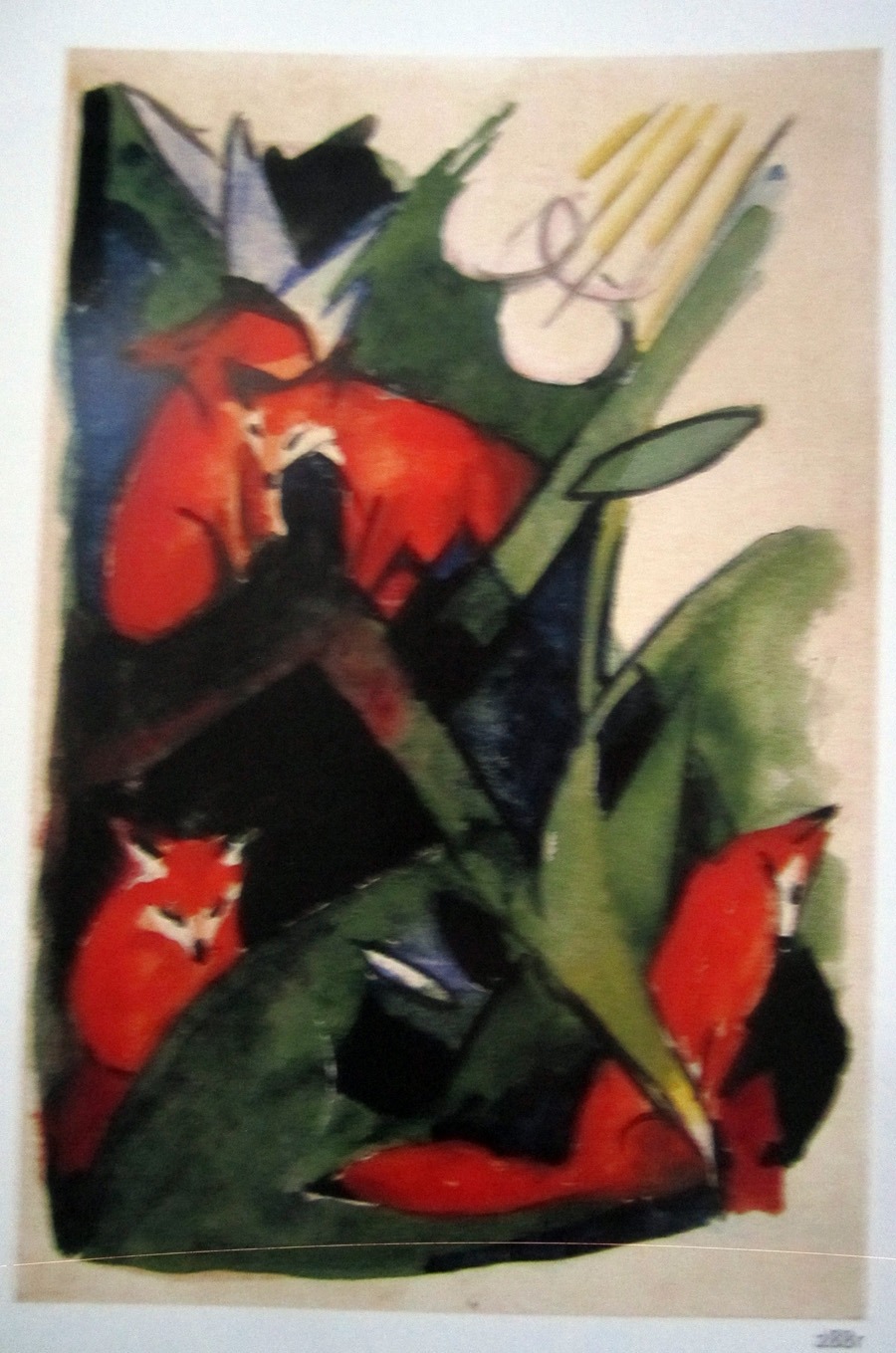
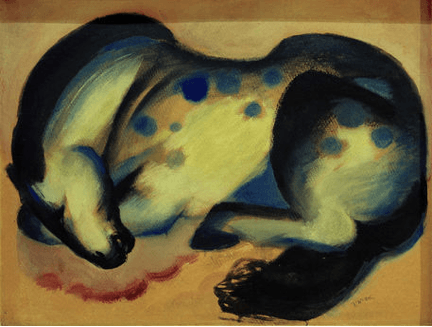
The images are Vier Füchse, a postcard from 1914, and Liegendes Pferd, a water color from 1911.

liegendes Pferd

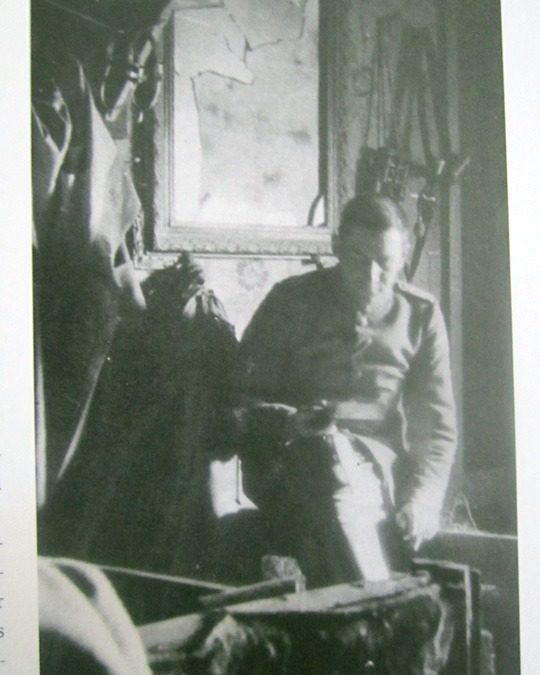
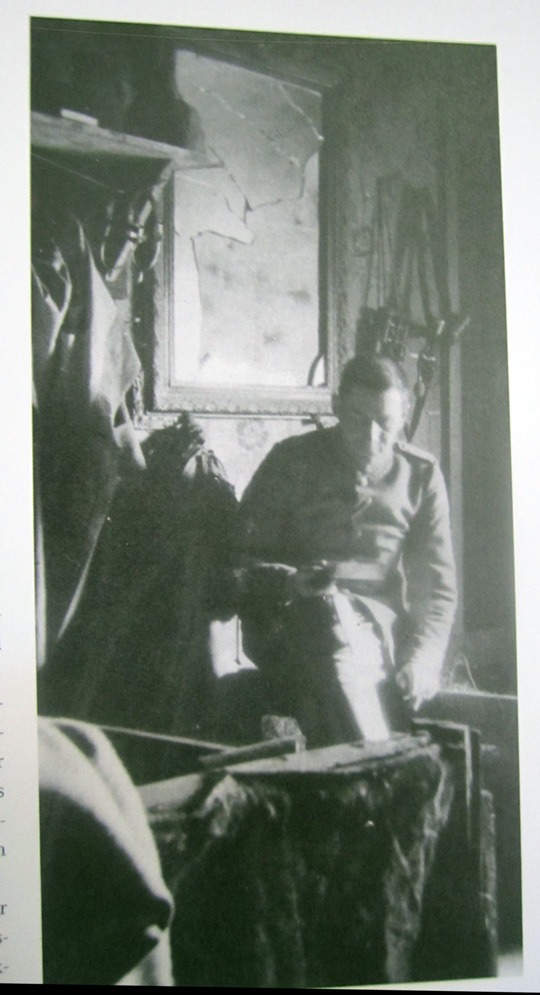
Franz Marc Holding a Cell Phone

Franz Marc Holding a Cell Phone

Franz Marc holding a cell phone, 1915.

Here is a mysterious photograph from Franz Marc – Paul Klee: ein Dialog in Bildern, a volume beautifully illustrated with the artists’ postcards to each other and some interesting photographs. Klee seems more vulnerable and less arch than you might expect in these letters and drawings. Marc, maybe predictably, sort of absorbs and reflects Klee; yet the images and texts on the cards seem both entwined and quotidian. One of the photos is this fascinating unsourced image, captioned “Franz Marc im Unterstand, 1915/1916.” It’s hard to tell what kind of shelter this is…it appears shell-shocked and comfortable at the same time. There are some binoculars and map cases hanging, and an eerie prophetic broken mirror. FM is smoking, of course, but the captivating question is what is he holding?

It looks like a cell phone, the kind you would expect FM to have, not a Blackberry or an iPhone, just a functional Nokia with Alpenlaendische Volksmusik ringtones. Photography professors, librarians, and two photo archivists who specialize in early 20th Century images looked at this photo and everyone was perplexed about the photo shows. That’s just how FM rolls.

What do you think this object is?

This book (which is confusingly cataloged with lots of commas instead of the conjunctions and articles that appear actually in print) forms the combined catalog from three retrospectives from 2010 at
the Franz Marc Museum in Kochel am See;  the Stiftung Moritzburg (“Kunstmuseum des Landes Sachsen-Anhalt” in Halle, the craziest city in Flemish Brabant and the planet); and  Zentrum Paul Klee in Bern.