by Jean Marie Carey | 25 Feb 2019 | Animals in Art, Art History, Expressionismus, Franz Marc, German Expressionism / Modernism, Michelangelost©, Re-Enactments© and MashUps
Raubkunst at the Ringling…
…The Story Continues
Its genesis in 2016 was the glimpse of a fin becoming a feather that ignited a strong intuition at ”Raubkunst als Erinnerungsort,” a research fellowship sponsored by the Zentrum für Historische Forschung der Polnischen Akademie der Wissenschaften in Berlin that same December. Eventually, and with the help of many people, “Raubkunst at the Ringling” ran in the Modernism journal Lapsus Lima on 9 January 2019 and was picked up in the news all the way to the Antipodes that week with, for example, the story “Otago Link to Identifying Art Looted by Nazis.”
On 13 February 2019 I presented this research about Franz Marc’s woodcuts Schöpfungsgeschicte II (1914) and Geburt der Pferde (1913) amid colleagues at the College Art Association conference in New York City. The very next day I learned “Raubkunst at the Ringling” had been formally recognised as a “solved” case of Nazi looted art with the recognition of my findings by the Commission for Looted Art in Europe in the annals of The Central Registry of Information on Looted Cultural Property 1933-1945.
My hope all along has been that the John and Mable Ringling Museum of Art, the State Art Museum of Florida operated by Florida State University, would acknowledge the illicit acquisition of the prints by the American UPI reporter Robert Beattie from the notorious “Kunsthändler to the Third Reich” Bernhard A. Böhmer in 1940, prior to Beattie’s donation of them to the Ringling in 1956, where they have been hidden since, and allow these works to be shared with the public.
But wait: I have subsequently learned that there is potentially even more Raubkunst at the Ringling: Paintings by Christian Rohlfs and George Grosz and bronzes by Ernst Barlach with provenance gaps from 1933-1945 are also locked away at the museum as well as some oils and terracottas from the 16thand 17thcenturies that, while not entartete, were simply stolen or subject to forced “sales” from museums or private owners under the Reich.
To more fully bring this story to light, I would like to compile a volume – half catalogue, half detective story – about these works. Please do contact me if you are interested in working together on this project.
The only social media I participate in; this feed is mostly about art history and animals.
by Jean Marie Carey | 13 Dec 2017 | Animals in Art, Art History
I was pleased to be asked to write a commemorative post for the Humanities Commons Platypus blog in honour of HC’s first anniversary. You can read the full text here or after the jump. (more…)

by Jean Marie Carey | 19 Sep 2016 | Animals in Art, Art History, Franz Marc
SINTRAX Kaffeebereiter, 1932, Gerhard Marcks.
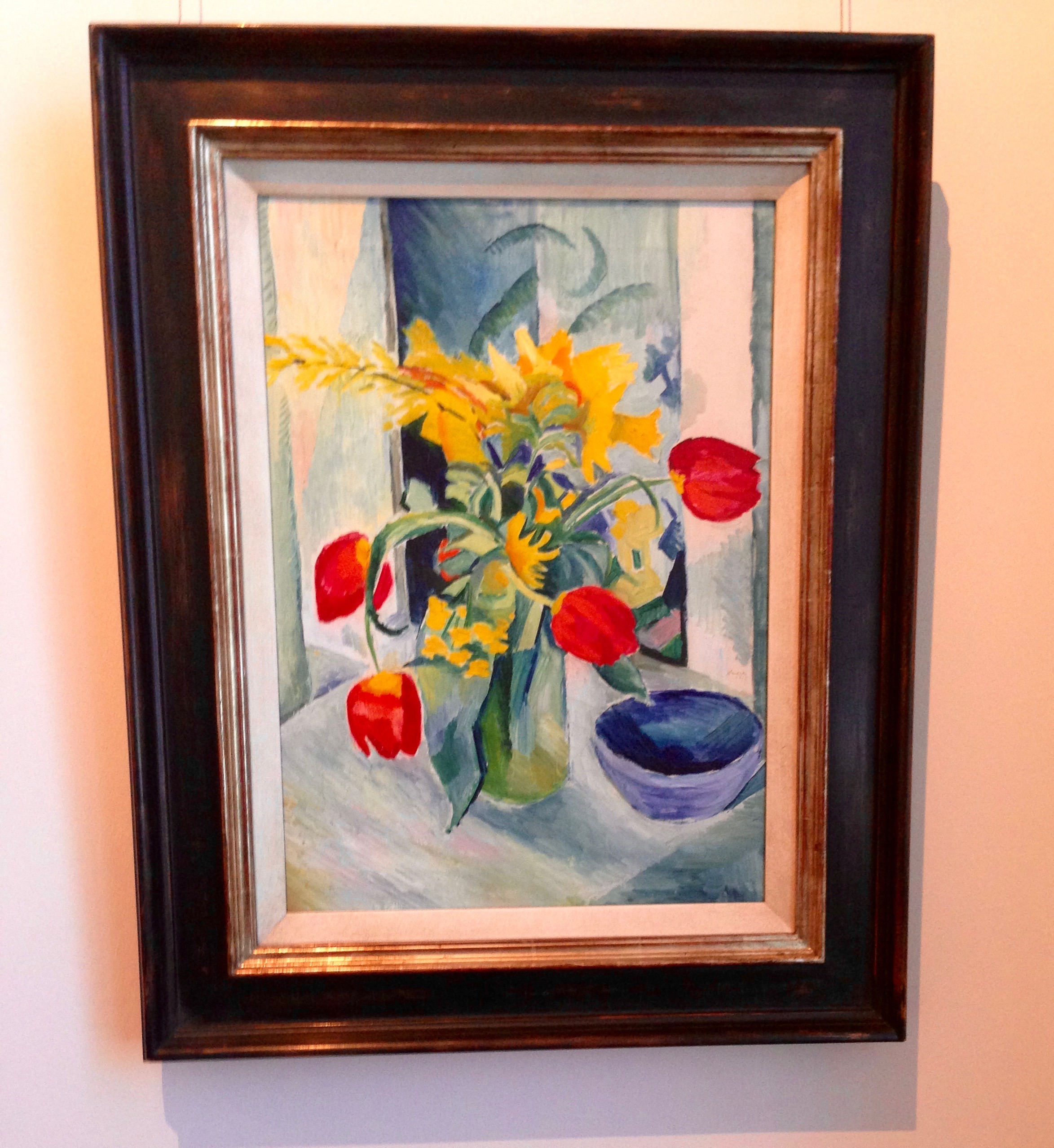
August Macke, Stillleben mit Tulpen, 1912
First I would encourage you to just skip this text and go right to the photos!
Otherwise: I went to Animalia: Interdisciplinary Perspectives and Explorations at the beginning of September mostly to see what the undergraduates and MA candidates were working on. The animal studies program at Carl von Ossietzky Universität Oldenburg is based within the Institute for American / English Studies. Though there was a mix of literary and cultural Human Animal Studies at hand the distinctive approach of this program is to examine the discipline through gender studies.
A highlight of the trip (in fact I devoted a whole day and night and went back the next day for this little side excursion) was visiting the Landesmuseum für Kunst und Kulturgeschichte Oldenburg which is actually three buildings: Oldenburger Schloss, Augusteum, and Prinzenpalais; devoted to regional history, international “Old Masters,” and modern art, respectively.
The museums were fantastic in showcasing some artists you hear less about, or in prominent placement of less-famous works by people who are very well-known. The outstanding discoveries for me were a mournful 1937 still life by Gabriele Münter called Puppe, Katz, Kind; a the cheerful small Stillleben mit Tulpen by August Macke (which I think might be unfinished; it is very uncharacteristic in its facture of his work at this time) from 1912; Wilhelm Lehmbruck’s early Grace (1905); the subdued placement of Kurt Lehmann’s Sinnender Knabe (1948), who had a lot to think about, and a delightful whirligig coffee making device from Gerhard Marcks’s highest Bauhaus phase in 1932.
-
-
Wilhelm Lehmbruck, “Grace,” 1905.
-
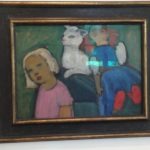
-
Gabriele Münter, “Puppe, Katz, Kind,” 1937
-
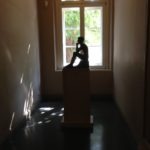
-
Kurt Lehmann, “Sinnender Knabe,” 1948.
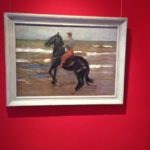
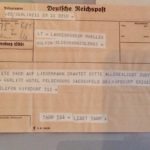
The Prinzenpalais is the collection that recently had its Max Liebermann Reiter am Strand (1909) returned to it, one of the most expeditiously executed rectitudes of the 2013 Cornelius Gurlitt recovery in München. The Prinzenpalais’s reaction to this turn of events seems strangely half-hearted, with just a small vitrine of the correspondence relating to Hildebrand Gurlitt’s involvement in the brokering the resale of the then-Entartete Kunst Reiter, and no explanation of the situational context really anywhere. I asked the docents if they were happy about having the painting back; they clearly weren’t all that happy, and doubly not to have someone ask informed questions.
Oldenburg has a nice Altstadt near the Landesmuseum but as middle-sized German cities go is somewhat difficult to get around in as it has only bus service, no UBahn or even a Straßenbahn or light rail system. Right now there is a lot of road construction with many ersatz Haltestellen and barricaded sidewalks, which the Münster- and Hamburg-aggression level Radler do not seem to be taking into consideration. Excluding Berlin, the farther north I go, the less I like it, and the more I recognize what a confirmed Südländerin I am.
-
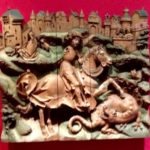
-
Der H. Georg im Kampf mit der Drachen, c. 1512, Meister de Georgeschreins von Zwischenahn Eiche.
-
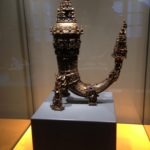
-
Das Wunderhorn, 1655, Fränkisch.
-
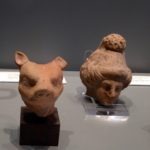
-
Hundekopf, Kopf des Zeus, c. 200 BCE, Tarent, Italien.
-
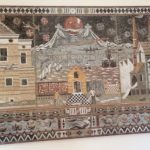
-
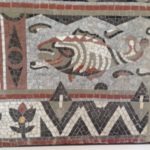
Franz Radziwill, Mosaik, 1948.
-
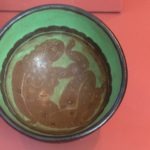
-
Scale mit Kauerndem Frauenakt, 1925, Rena Buthaud.
-
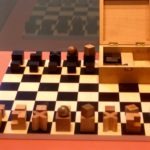
-
Bauhaus Schachspiel, “Model XVI,” 1924. Josef Hartwig.
-

-
Bauhaus Schachspiel, “Model XVI,” 1924. Josef Hartwig.
-

-
-
Franz Radziwill, Mosaik, 1948, Detail.
-
-
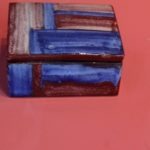
Zigarettendose, Gertrud Kraut, 1928.
-
-
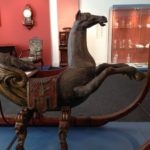
Kinderschlitten um 1730.
-

-
Werbeplakat für Jugend, 1897.
-
-
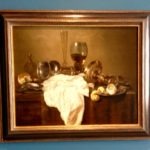
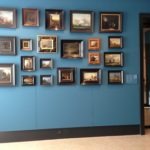
Willem Claesz, Frühstücksstilleben, 1645.
-
-
Clutter.
-

-
Raum für Max Liebermanns Ölgemälde “Reiter am Strand” von 1909.
-
-
-
-
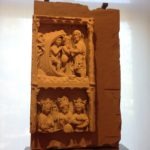
-
-
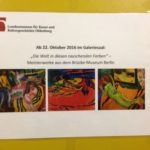
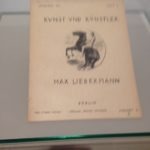
Max Lieberman / Kunst und Künstler.
-
-
Max Liebermanns Ölgemälde “Reiter am Strand” von 1909.
-
-
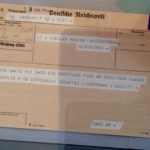
Dokumentation von Familie Gurlitt von Max Liebermanns Ölgemälde “Reiter am Strand” von 1909.
-
-
Dokumentation von Familie Gurlitt von Max Liebermanns Ölgemälde “Reiter am Strand” von 1909.
-
-
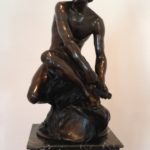
Jean Baptiste Pigalle, Merkur, 1785.
-
-
Detail of building.
-
-
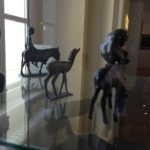
Reneé Sintenis, August Gaul, Ewald Mataré, Richard Scheibe
-
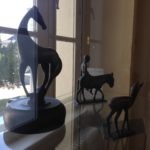
-
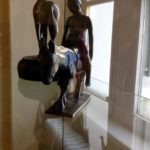
Reneé Sintenis, August Gaul, Ewald Mataré, Richard Scheibe
-
-
Reneé Sintenis, August Gaul, Ewald Mataré, Richard Scheibe
-
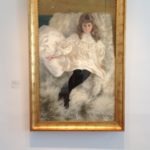
-
Hans Hermann Weyl, Anneliese von Arnim als Kind, 1905.
-
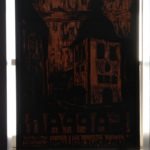
-
Erich Heckel’s plate from Die Brücke catalogue…

by Jean Marie Carey | 18 Feb 2016 | Animals, Animals in Art, Dogs!, Franz Marc, German Expressionism / Modernism, LÖL
During February and March I am a Wissenschaftliche Gäste of sorts at the Universität Kassel’s Tier-Mensch Gesellschaft. I’m doing some research in the dOCUMENTA Archiv, finishing up a chapter in my dissertation, and giving a talk at this first-of-its-kind conference, “Animal Biographies: Recovering Animal Selfhood through Interdisciplinary Narration?”.
The program is incredible and the speakers amazing, each talk as fascinating as the next. There are also several installations and exhibits by Mathias Antlfinger and Ute Hörner and the interspecies collective from CMUK Köln. The program is free and you can register through 25 February through the link above.
I don’t know if I can quite live up to the talents of the other panelists, but I am confident of the attraction, pathos, and intrigue of my animal biographic subject, Russi Marc, whose death exactly 100 years ago this week was noted by his lifelong human companion, Franz Marc, who made many drawings and paintings of Russi through their lives together. Franz Marc himself died just a few weeks later. Studying Russi has taken on a life of its own in my research, and as this was a very well-documented dog and one who had many humorous and thrilling adventures I am very excited to be able to share his story with other animal lovers.
One thing I like so much about animal studies (in discussing the title of our nascent discipline, which is now beginning something like its second wave most of us are happy to jettison the “human-” prefix) is that its adherents are for the most part partisan activists. This challenge to the academy as we fight the losing battle of the Anthropocene and the Sixth Mass Extinction has not gone unnoticed; this week, a sort of prank article was exposed (and one could extrapolate perhaps planted by the same people or person), in the December 2015 issue of the academic journal Totalitarismus und Demokratie. In retrospect, perhaps a “discovery” about the inherited aggression of “German” German Shepherds was too good to be true…but I am very curious to see what the fallout will be, since the “research” depended upon “primary sources” about dogs…another reason to be glad for Russi’s well-established canine celebritude, I guess.

by Jean Marie Carey | 27 Oct 2014 | Animals, Animals in Art, German Expressionism / Modernism
The Cry of Nature: Art and the Making of Animal Rights
I got a note from the nice people at Sehepunkte about the review of Stephen Eisenman’s The Cry of Nature I wrote (which is posted on Sehepunkte’s website):
“Sofern Sie über eine eigene Präsentation im Internet verfügen, würden wir uns freuen, wenn Sie dort Ihre Rezension und unser Journal verlinken würden. Hierfür können Sie gerne auch eines unserer Logos … verwenden…”
…so of course, OK! I really like Sehepunkte and am working on some more stuff for them too.
So here the logo: 🙂

Now a few months after reading it, I should report that this book has had a nice slow burn and even though this is a very positive review I think I would rate it even more highly now, particularly as a teaching text as it covers a broad subject area still with clarity and depth in each chapter. I was able to use Eisenman’s section on the hunting practice of indigenous peoples, for example, as a point of reference in a recent seminar I gave for the Bioethics Centre at the university and in reference to a discussion about the dolphin massacre in Taiji, Japan. (To support my argument against hunting and hunters I mean: Don’t get me wrong; there’s no place for humans who hunt in any universe, and people trying to be “open minded” about hunting are without fail patronizing, paternalistic, and dead inside.)
Anyway, this is an excellent book and here is the review:
(Stephen F. Eisenman: The Cry of Nature. Art and the Making of Animal Rights, London: Reaktion Books 2013, ISBN 978-1-78023-195-2).
Art historical texts, and especially single-authored volumes, should be judged in great measure by how well they fulfill their expressed ambitions. By this rule The Cry of Nature. Art and the Making of Animal Rights, whose central objective is to provide an intellectual and informational resource for readers interested in the intersection of the animal studies and the making of art, and a platform for scholars to reflect on provocative subjects suggested by the twining of these two themes, must be deemed a success.
Each of its chapters contributes to author Stephen F. Eisenman’s goal of addressing and evaluating important issues pertaining to the contemporary discussion of animal rights and the movement’s connection to art and ideas originating in the 18th century as well as, to some extent, before. Organized into five chapters and a strong introduction and conclusion, plus a recommended reading list of some of the foundational volumes of the relatively new discipline of animal studies, the book surveys not only images but historicizing texts and makes a strong claim that something like an animal rights movement has existed since antiquity, springing into cohesion in the 1700s, with artists making and using images as persuasion and propaganda.
The pleasure derived from reading this book lies partially in the richness of Eisenman’s detailed, personal, and confident descriptions of the lives and emotions of real animals, making his prose eminently accessible. Readers will be compelled by the forcefulness of local histories about, for example, a majestic African elephant photographed in a moment of perfect stillness at a watering hole in 2007 who is killed by poachers in 2009, and delighted by anecdotes about Echo, the author’s dog, who learns to stage pratfalls and tumbles in order to make Eisenman laugh. These stories are integrated meticulously within more formal discussions of images – some well-studied, including Rosa Bonheur’s The Horse Fair (1853) and Jean-Baptiste Oudry’s A Hare and a Leg of Lamb (1742), some less famous – such as Clifford Possum Tjapaltjarri’s 1975 painting Eagle Dreaming – which are produced about, and in mindfulness of, the animal.
The book begins with a background chapter defining “What is an Animal?” in terms of societal mores and biological evidence about the commonalities and differences amid living creatures, centering on the ability of animals to communicate, to experience emotions, and to feel pain. This chapter includes pleasantly unexpected exemplars, such as Simon Tookoome’s 1979 linocut I Am Always Thinking of Animals, as it stakes out the moral and practical discussions around how we define language and consciousness.
The chapters “Animals into Meat” and “Counter Revolution” dwell on images of the corpses of animals, shown as food, prey, and sacrificial stand-in for the human figure and body. While the recurring motif of the flayed ox in paintings by Gustave Caillebotte and Rembrandt may arouse as much distancing disgust as identification, Eisenman’s delicate examination of Jean-Baptiste-Siméon Chardin’s The Ray (1728) makes persuasive on the page that these artists intended to convey their beliefs in the existence of the souls and consciousness of animals, and commensurately, the dismal mortality of humans, on their canvases. (more…)