by Jean Marie Carey | 7 Apr 2017 | Art History, Dogs!, Franz Marc, German Expressionism / Modernism, Re-Enactments© and MashUps
Ars Graphica is a group of mostly European scholars who study prints but also photography. The pan-European organization also has a few Gesamtstaaten. Ars Graphica Deutschland recently branched off and began its own activities. The first one was this week, a tour of the In die Dritte Dimension: Raumkonzepte auf Papier vom Bauhaus bis our Gegenwart exhibition at the Städel Museum in Frankfurt given by the curator, Jenny Glaser. You can read more about what transpired here.
Dr. Glaser has organized a really superb show. The low and direct lighting is a bit off-putting at first, but many of the works are cut-outs, collages, incisions, or have subtleties of depth that the creation of shadows augments. The El Lissitzky poster prints from the Bauhaus are the stars of the show and Glaser’s clear favorite, but the less-known miniatures (matchbox sized) by Blinky Palermo placed across from Sol LeWitt’s late (2001) colorful confetti collage are probably more interesting, as is Michael Riedel’s artist book of minute but deep surgical removals.
There was also a look at the Städel’s more traditional Renaissance and Early Modern prints, and we got to visit and share a bit about our research…of course I have a vested interest in something at the Städel that is not a print…
I thought it might be best to just tell the exciting but short story about Liegender Hund im Schnee‘s journey from the Franz Marc estate to entartete to West Palm Beach and back to the Städel. Somehow the actual Germans were able to refrain from exclaiming that “all Germans are Nazis so who really cares if the museum was looted?”*
*Actual crowd responses at two of my last talks. More on this, as I keep promising, shortly; I actually have quite a lot to say about this in reference to the College Art Association in particular and looting apologists in general.

by Jean Marie Carey | 12 Mar 2017 | Art History, Expressionismus, Franz Marc, German Expressionism / Modernism
While I was in New York City for the College Art Association meeting – more on this next post – I was really busy and also sick the entire time. Fortunately though I did get to go to a few museums, and a significant highlight was the Max Beckmann in New York exhibition at the Metropolitan Museum of Art Fifth Avenue. (My review of the catalogue of the show for Museum Bookstore is on their blog, and in part below).
When I last left Beckmann in my research, he had forlornly been rejected by the groundbreaking Köln Sonderbund show of 1912 because his work was deemed too old-fashioned. This was found to be hilarious by Beckmann’s self-appointed foil, Franz Marc, who had withdrawn his own work from the Sonderbund on the grounds that the entire exhibit was too old-fashioned and boring for his animal paintings.
Over the years I’ve come to appreciate Beckmann’s devotion to his own vision and embrace of the sort of contemporary history painting that forms an important aspect of the Neue Sachlichkeit, though beyond its opposition to Expressionism, Beckmann did not think himself a part of that or any school or movement.
Staged at the Met in what turned out to be the last week of employment of director Thomas Campbell, my aesthetic reaction was that the paintings, mostly large portraits and a few of his famous triptychs, would have better served Beckmann by being installed in a single large hall. This is a small complaint though because even on a crowded Saturday it was possible to see the paintings well enough.
People were very interested in “Woman with Mandolin in Yellow and Red,” 1950.
(more…)
by Jean Marie Carey | 20 Jan 2017 | Art History, August Macke, Expressionismus, Franz Marc, German Expressionism / Modernism, Helmuth Macke
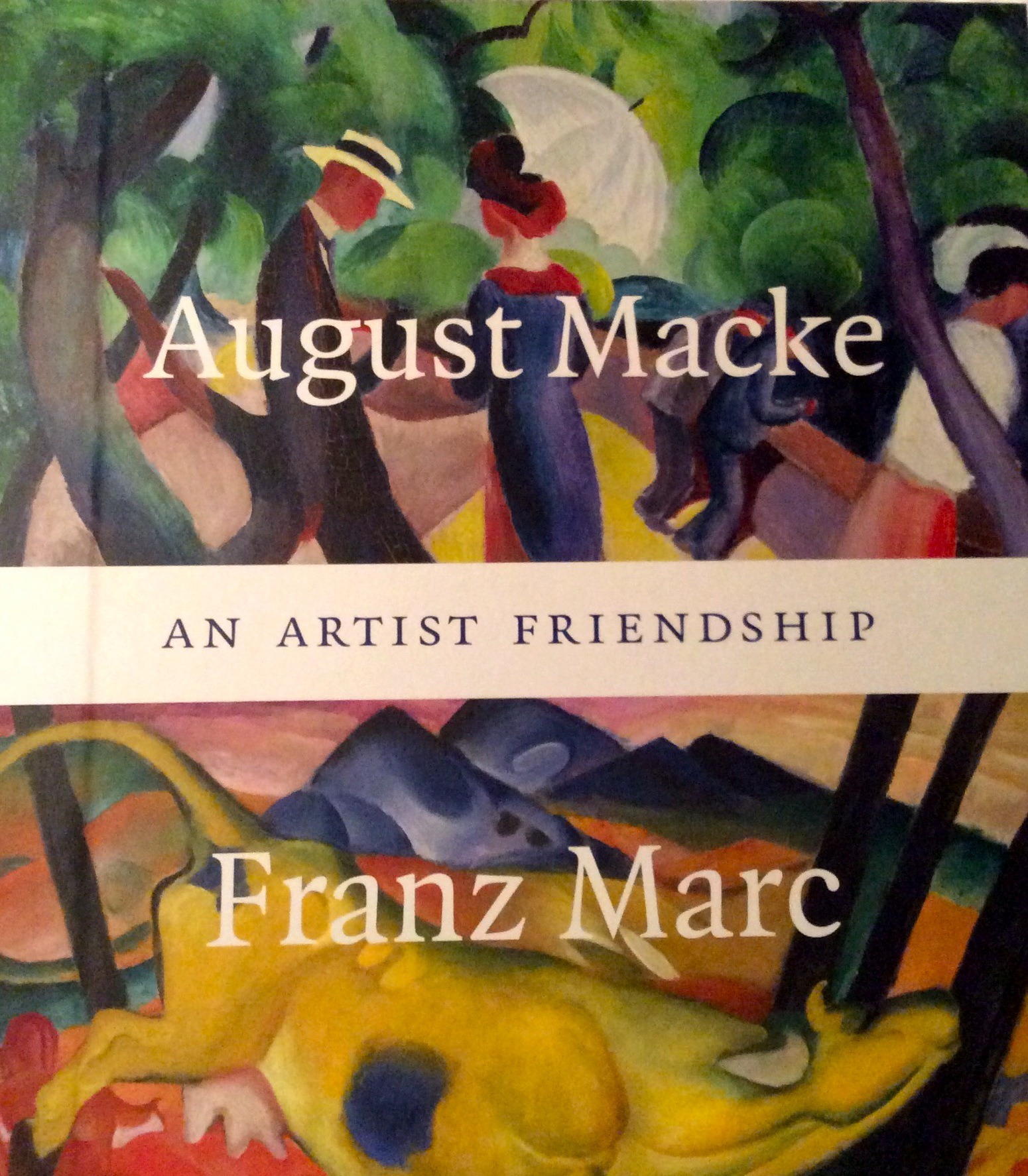
Book Review: August Macke and Franz Marc: An Artist Friendship
Catalog of an exhibition held at the Kunstmuseum Bonn, 25 September 2014 – 4 January 2015; and at the Städtische Galerie im Lenbachhaus und Kunstbau, Munich, 28 January – 3 May 2015; 359 pages with many color illustrations and black and white archival photographs.
I recently began doing some book reviews for Museum Bookstore, an online repository of catalogues and other printed material generated on behalf of museum and gallery exhibitions. My first review is of my favorite book of 2014-2015, the outstanding catalogue presented by the Lenbachhaus and Kunstmuseum Bonn in support of August Macke und Franz Marc: eine Künstlerfreundschaft. Please support this very worthy independent bookstore effort by checking out the companion text on the site.
§ § §
Published on 26 September 1914 to coincide with the 100th anniversary of the death of August Macke as well as the launch of the ambitious cooperative retrospective of Macke’s and Franz Marc’s overlapping oeuvres, the exhibition catalogue August Macke and Franz Marc: An Artist Friendship (August Macke und Franz Marc: eine Künstlerfreundschaft is its twin in the original German from which the English version has been translated) is, perhaps not surprisingly, a tour-de-force of editing and research. What is unexpected is that the editors, longtime Lenbachhaus Blaue Reiter curator Annegret Hoberg and Volker Adolphs of Kunstmuseum Bonn, along with a smartly-assembled team of university- and museum-based German art historians, bring to bear not just a wealth of knowledge but so much compassion to these essays, confronting directly the loss and sadness we naturally feel over the too-short lives of Marc and Macke. Macke, the extroverted Rhinelander, was killed in Champagne, France, at 27, while Marc, the contemplative Bavarian, died aged 36 at Verdun in the spring of 1916.
Despite their frank sentimentality, the catalogue’s chapters and essays are impeccably scholarly. Hoberg’s “August Macke and Franz Marc / Ideas for a Renewal of Painting” and Adolphs’ “Seeing the World and Seeing Through the World / Nature in the Work of August Macke and Franz Marc” are classic art historiography based in peerless analysis. Hoberg focuses on the milieu of the international avant-garde that encouraged Marc and Macke to not only follow the careers of but become personally acquainted with the Parisian Orphist Robert Delaunay and the Italian Futurist Umberto Boccioni. While Marc’s primary subjects directly encompass animals and the pastoral, albeit reframed through a unique pantheistic realism, Macke, who often painted urban scenes, has a less direct relationship to “nature,” which Adolphs teases out, particularly in comparison to Marc.
(more…)

by Jean Marie Carey | 7 Jan 2017 | Art History, August Macke, Expressionismus, Franz Marc, German Expressionism / Modernism
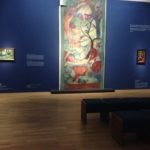
Whatever happens in the future, my time in Münster will be the happiest I can ever remember. I was there for several weeks and finally had a substantial Paradies mural Franz Marc and August Macke made together in Macke’s upstairs atelier in Bonn in 1912.
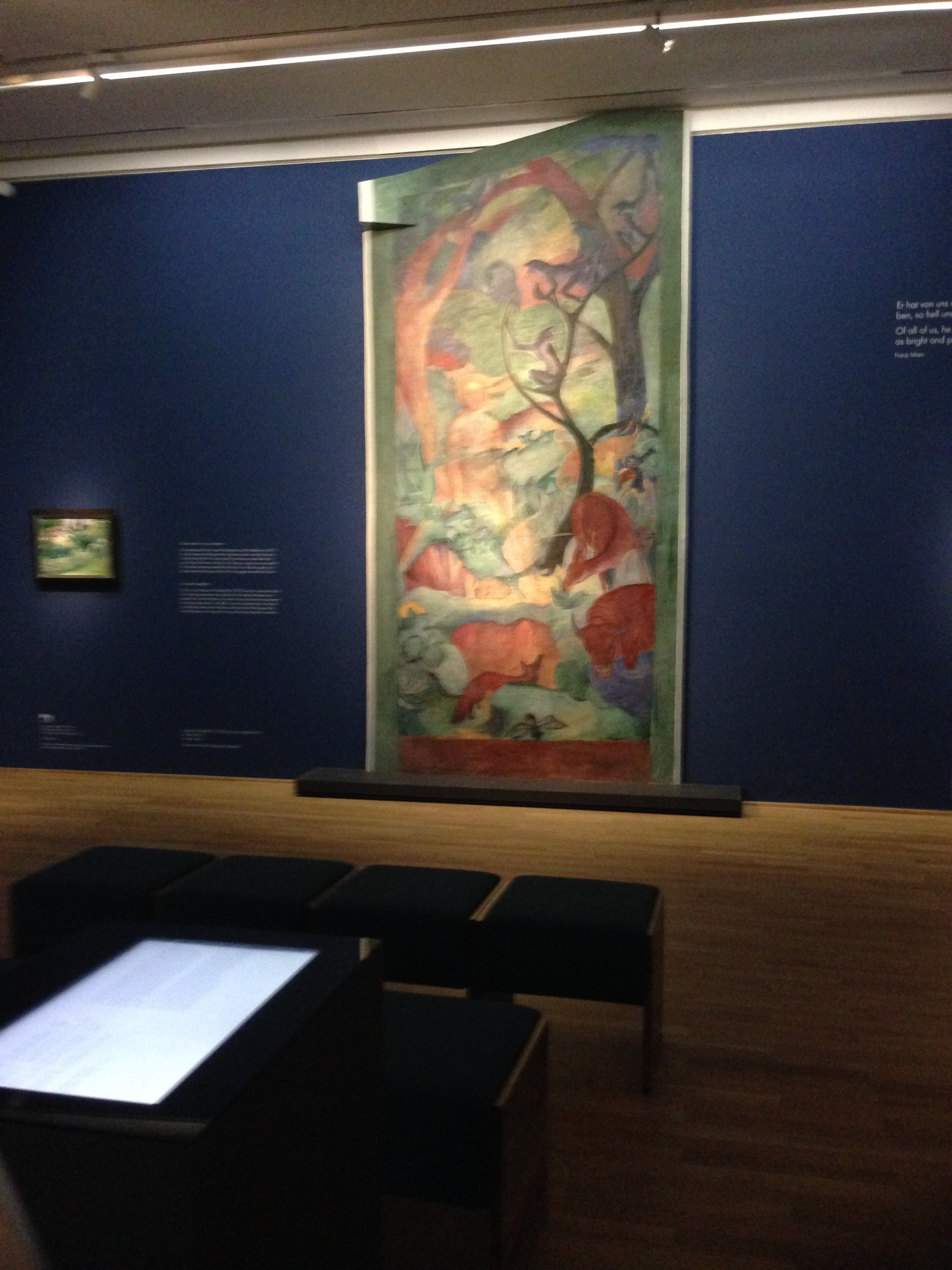
The mural was moved to Münster’s LWL-Museum für Kunst und Kultur in 1984. In a quiet room away from the museum’s main traffic areas, the mural is now the altar of a shrine to Macke and his relationship with his wife Elizabeth but also with Marc, phrases from his many letters to August decorating the blue walls.
The Hanseatic light of the west is stunning and soothing, like a house you’ve lived in your entire life – something almost no one does anymore that seems like a real memory.

by Jean Marie Carey | 16 Oct 2016 | Art History, Franz Marc
Merzbau reimagining at Sprengel Museum, Hannover.
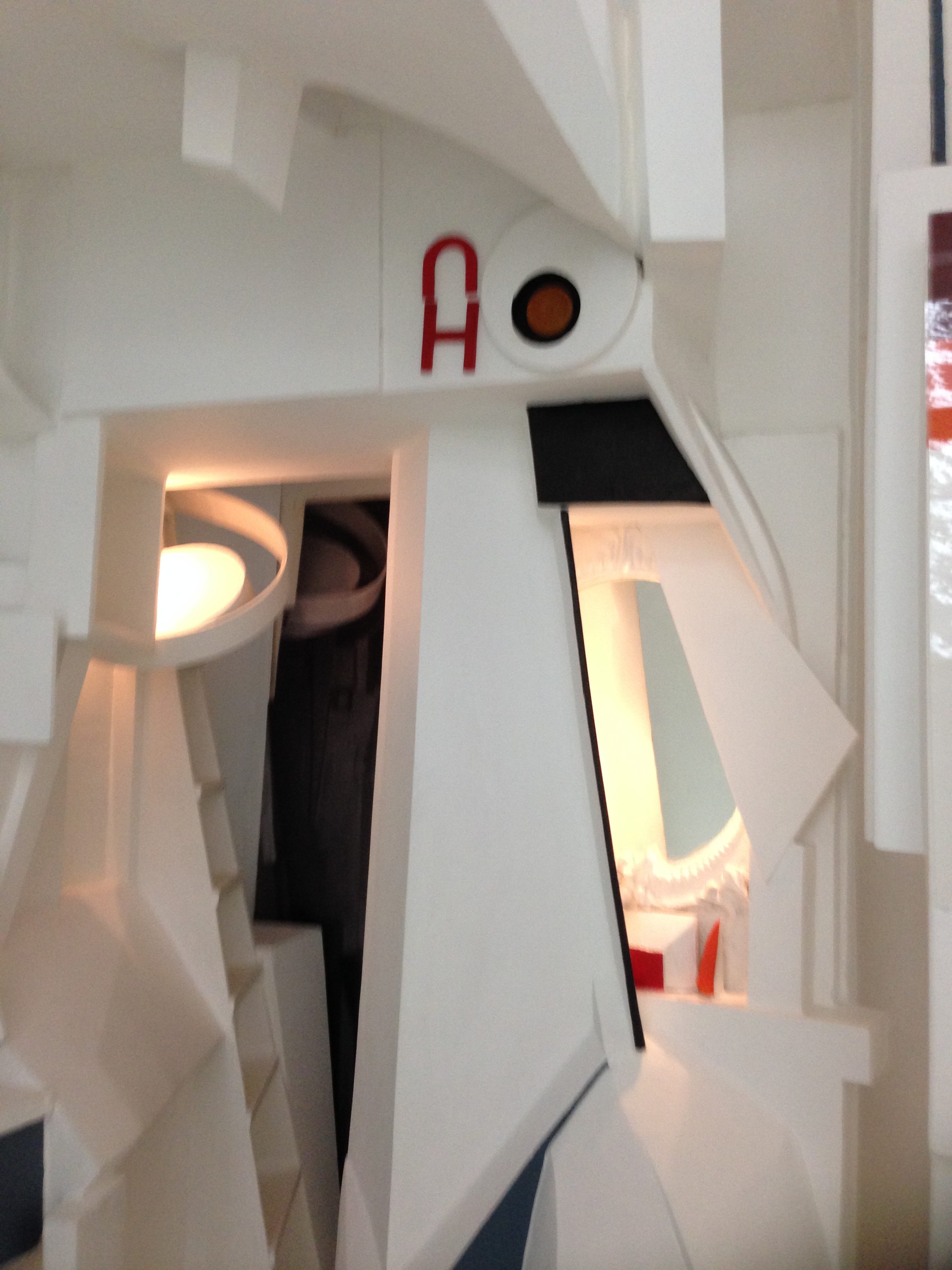
Reconstruction of Kurt Schwitters’ Merzbau.
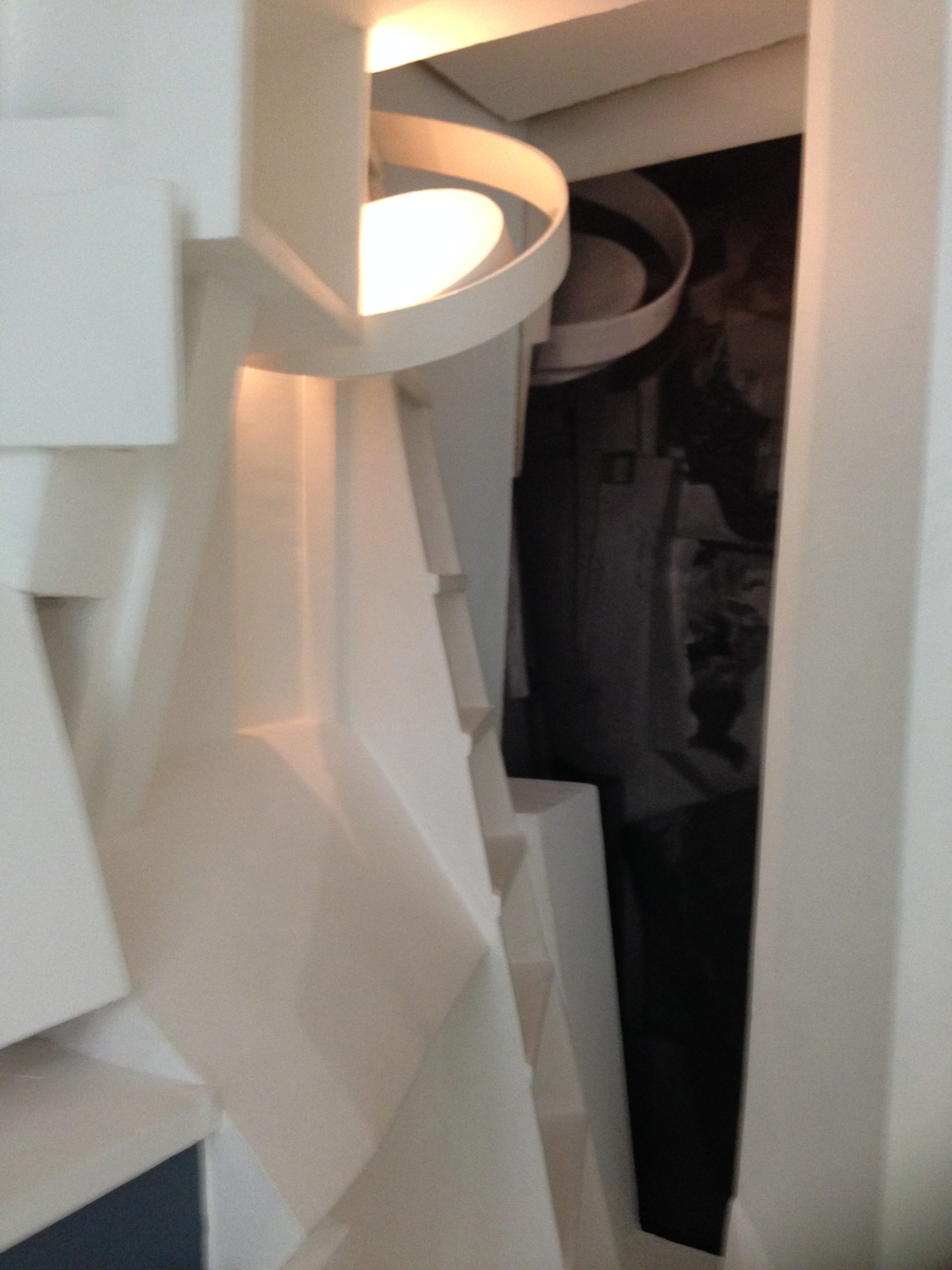
Merzbau Reconstruction at Sprengel Museum Hannover.

Reconstruction of Kurt Schwitters’ Merzbau at Sprengel Museum.
Hannover’s Sprengel Museum is such a fascinating space this most recent visit deserves a series of discrete posts of mostly photos. It was here in 2009 to see the visiting Hund vor der Welt on loan to the Sprengel for “Die Schönheit einer zerbrechenden Welt (1910 – 1914) Franz Marc, August Macke und Robert Delaunay” exhibition that I became very focused on Marc’s portraits of Russi.
The museum still holds some Marcs and Mackes in its permanent collection but there is also much more to see, including a reconstruction the main room of one of Kurt Schwitters’s Merzbauten, created in 1983 by Peter Bissegger. Bissegger, a theatrical designer who has made several Merzbau recreations, based his reconstruction on Wilhelm Redemann’s photographs from the early 1930s. Schwitters lived in Hannover; the apartment building where this version of the Merzbau lived was destroyed in 1943.
Gwendolen Webster has written a wonderful paper full of designs and drawings from Schwitters and information about the Merzbauten in Norway and England call The Reception of the Merzbau which you can read by following the link.

by Jean Marie Carey | 19 Sep 2016 | Animals in Art, Art History, Franz Marc
SINTRAX Kaffeebereiter, 1932, Gerhard Marcks.
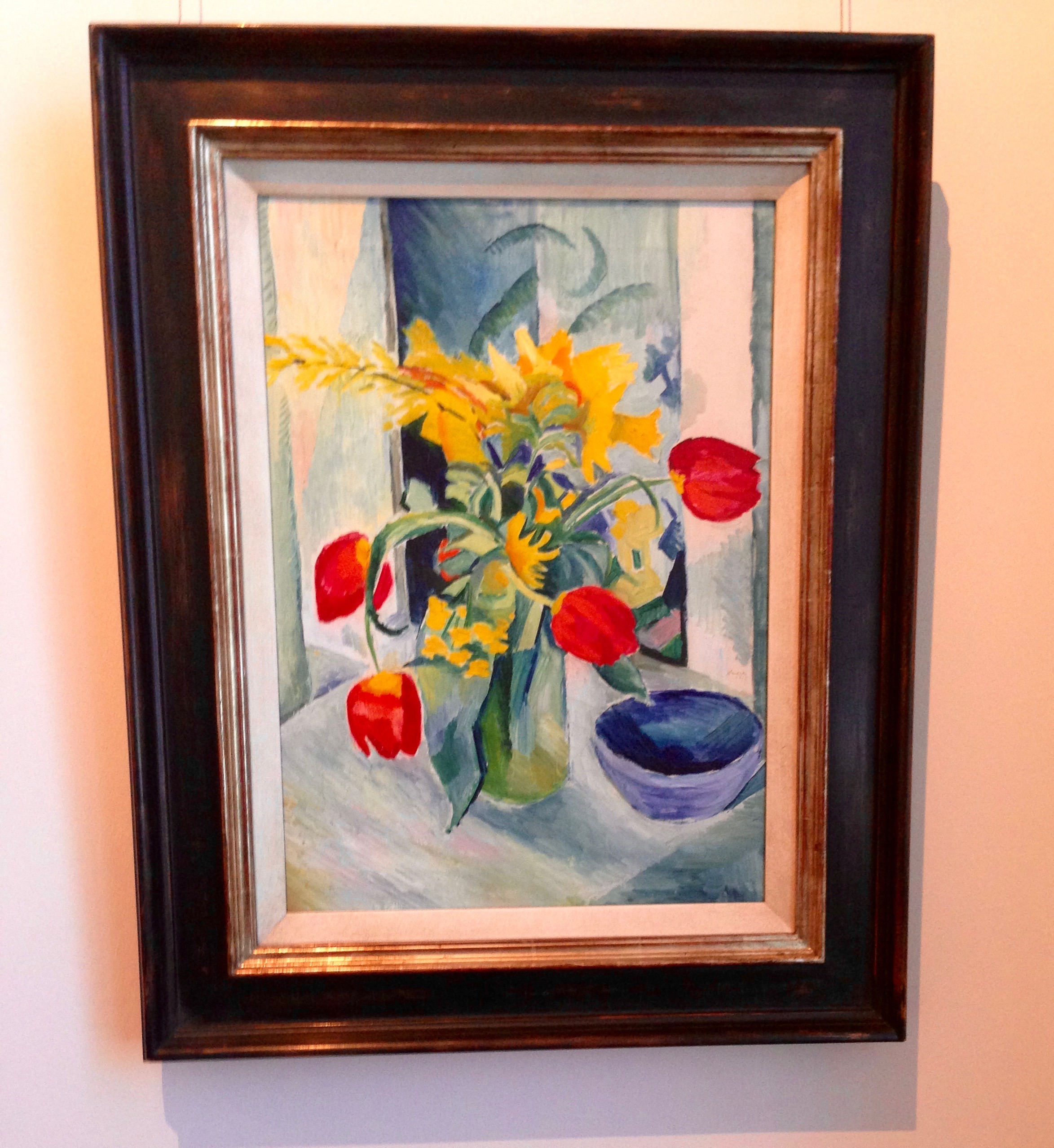
August Macke, Stillleben mit Tulpen, 1912
First I would encourage you to just skip this text and go right to the photos!
Otherwise: I went to Animalia: Interdisciplinary Perspectives and Explorations at the beginning of September mostly to see what the undergraduates and MA candidates were working on. The animal studies program at Carl von Ossietzky Universität Oldenburg is based within the Institute for American / English Studies. Though there was a mix of literary and cultural Human Animal Studies at hand the distinctive approach of this program is to examine the discipline through gender studies.
A highlight of the trip (in fact I devoted a whole day and night and went back the next day for this little side excursion) was visiting the Landesmuseum für Kunst und Kulturgeschichte Oldenburg which is actually three buildings: Oldenburger Schloss, Augusteum, and Prinzenpalais; devoted to regional history, international “Old Masters,” and modern art, respectively.
The museums were fantastic in showcasing some artists you hear less about, or in prominent placement of less-famous works by people who are very well-known. The outstanding discoveries for me were a mournful 1937 still life by Gabriele Münter called Puppe, Katz, Kind; a the cheerful small Stillleben mit Tulpen by August Macke (which I think might be unfinished; it is very uncharacteristic in its facture of his work at this time) from 1912; Wilhelm Lehmbruck’s early Grace (1905); the subdued placement of Kurt Lehmann’s Sinnender Knabe (1948), who had a lot to think about, and a delightful whirligig coffee making device from Gerhard Marcks’s highest Bauhaus phase in 1932.
-
-
Wilhelm Lehmbruck, “Grace,” 1905.
-
-
Gabriele Münter, “Puppe, Katz, Kind,” 1937
-
-
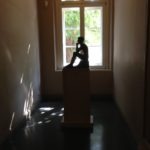
Kurt Lehmann, “Sinnender Knabe,” 1948.
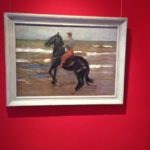
The Prinzenpalais is the collection that recently had its Max Liebermann Reiter am Strand (1909) returned to it, one of the most expeditiously executed rectitudes of the 2013 Cornelius Gurlitt recovery in München. The Prinzenpalais’s reaction to this turn of events seems strangely half-hearted, with just a small vitrine of the correspondence relating to Hildebrand Gurlitt’s involvement in the brokering the resale of the then-Entartete Kunst Reiter, and no explanation of the situational context really anywhere. I asked the docents if they were happy about having the painting back; they clearly weren’t all that happy, and doubly not to have someone ask informed questions.
Oldenburg has a nice Altstadt near the Landesmuseum but as middle-sized German cities go is somewhat difficult to get around in as it has only bus service, no UBahn or even a Straßenbahn or light rail system. Right now there is a lot of road construction with many ersatz Haltestellen and barricaded sidewalks, which the Münster- and Hamburg-aggression level Radler do not seem to be taking into consideration. Excluding Berlin, the farther north I go, the less I like it, and the more I recognize what a confirmed Südländerin I am.
-
-
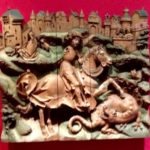
Der H. Georg im Kampf mit der Drachen, c. 1512, Meister de Georgeschreins von Zwischenahn Eiche.
-
-
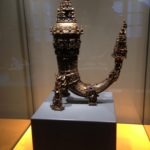
Das Wunderhorn, 1655, Fränkisch.
-
-
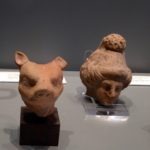
Hundekopf, Kopf des Zeus, c. 200 BCE, Tarent, Italien.
-
-
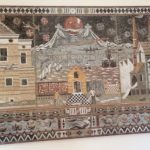
Franz Radziwill, Mosaik, 1948.
-
-
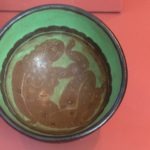
Scale mit Kauerndem Frauenakt, 1925, Rena Buthaud.
-
-
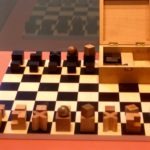
Bauhaus Schachspiel, “Model XVI,” 1924. Josef Hartwig.
-
-
Bauhaus Schachspiel, “Model XVI,” 1924. Josef Hartwig.
-
-
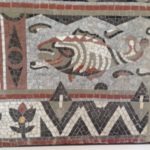
-
Franz Radziwill, Mosaik, 1948, Detail.
-
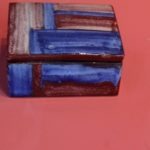
-
Zigarettendose, Gertrud Kraut, 1928.
-
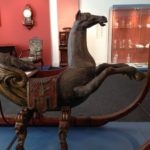
-
Kinderschlitten um 1730.
-

-
Werbeplakat für Jugend, 1897.
-
-
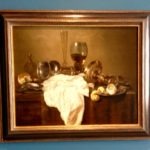
Willem Claesz, Frühstücksstilleben, 1645.
-
-
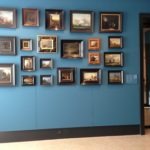
Clutter.
-

-
Raum für Max Liebermanns Ölgemälde “Reiter am Strand” von 1909.
-
-
-
-
-
-
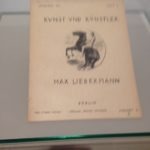
Max Lieberman / Kunst und Künstler.
-
-
Max Liebermanns Ölgemälde “Reiter am Strand” von 1909.
-
-
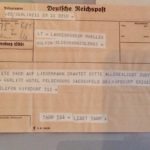
Dokumentation von Familie Gurlitt von Max Liebermanns Ölgemälde “Reiter am Strand” von 1909.
-
-
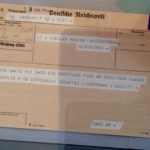
Dokumentation von Familie Gurlitt von Max Liebermanns Ölgemälde “Reiter am Strand” von 1909.
-
-
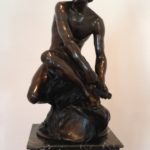
Jean Baptiste Pigalle, Merkur, 1785.
-
-
Detail of building.
-
-
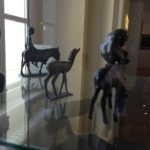
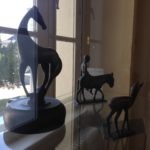
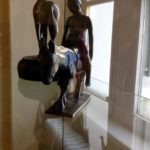
Reneé Sintenis, August Gaul, Ewald Mataré, Richard Scheibe
-
-
Reneé Sintenis, August Gaul, Ewald Mataré, Richard Scheibe
-
-
Reneé Sintenis, August Gaul, Ewald Mataré, Richard Scheibe
-
-
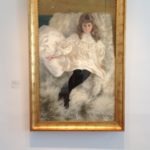
Hans Hermann Weyl, Anneliese von Arnim als Kind, 1905.
-
-
Erich Heckel’s plate from Die Brücke catalogue…