by Jean Marie Carey | 1 Sep 2013 | Animals, Animals in Art, Art History, Franz Marc, German Expressionism / Modernism
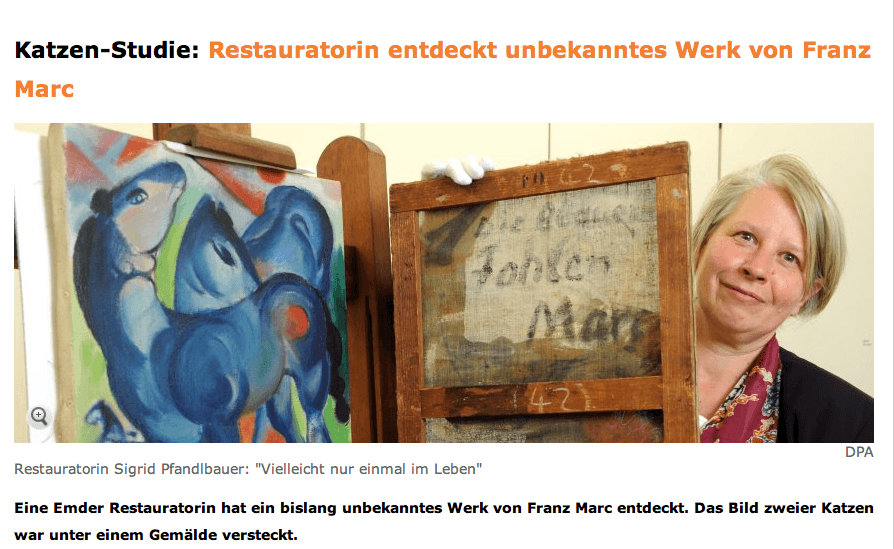
Der Spiegel online had a story today about an art restorer’s amazing discovery of a new Franz Marc painting on the reverse of 1913’s Blauen Fohlen. Sigrid Pfandlbauer of the Kunsthalle Emden found the study of two cats bearing Marc’s signature while restoring Blauen Fohlen for an upcoming exhibition. What an incredible, exciting discovery…how much there is still to be learned about Marc.

by Jean Marie Carey | 20 Aug 2013 | Art History, Franz Marc, German Expressionism / Modernism, LÖL
Postkarte am Bubi, Franz Marc and Auguste Macke, 1911. This looks like mostly AM really. I love the way the feathers become the fish…
“We actually had many more exciting exchanges back-and-forth, most of which were very unproductive and very unbecoming of two grown men.” LÖL.
by Jean Marie Carey | 26 Jun 2013 | Animals in Art, Art History, Franz Marc, German Expressionism / Modernism
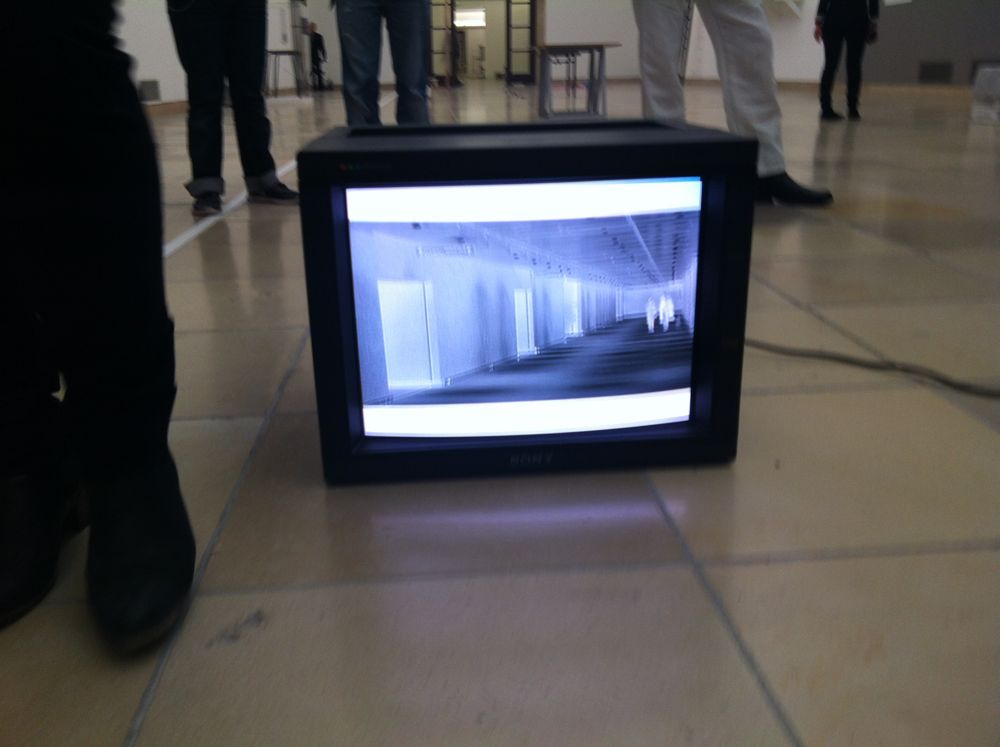
Video is a small but strong component of Joëlle Tuerlinckx’s exhibition at Haus der Kunst.
The legendary documentary Degenerate Art: The Nazis vs. Expressionism is available now (and probably not for long, so, Greasemonkey extension for Firefox, if you know what I mean) on youtube. Part of the mythical status of this program that originally aired in 1993 on the BBC is that it was never converted from VHS to DVD or digital download and has thus been difficult to locate and view.
As you might guess from the title this documentary by David Grubin is about the famous 1937 art exhibit held in Munich called Entartete Kunst, intended by the Nazis to show, collected, the most non-enobling effects of “degenerate art.” (Der Turm der blauen Pferde was part of this exhibit in Munich, and then removed when the show traveled to Berlin, beginning its period of being missing and presumed destroyed. I wonder sometimes if it would make Franz Marc scholars more happy or more sad if it is ever recovered…).
(more…)

by Jean Marie Carey | 17 Feb 2013 | Animals, Animals in Art, Franz Marc, German Expressionism / Modernism, Re-Enactments© and MashUps
It was actually a very solemn week and past few days but in recounting some stories it’s easier to begin with flashes of humor, and there were a few extremely funny episodes to report.
The first was while visiting the Cloisters. After viewing the very disturbing (to me) tapestries of the allegorical (but very graphically woven) hunting of the unicorn we came upon this:
Called a Palmesel; this model dated 1470 is from a church in Mellrichstadt – perhaps I should have guessed that such a fun crazy object would come from Bavaria – and apparently they continued to be quite popular in the beautiful south to the relatively modern times, protected from the Reformation.
We went to the Metropolitan Museum of Art which is another whole story I will get to…but, in trying to dash through the rooms and rooms of Impressionism to come out in the relatively tiny alcove of the good stuff, out of the corner of my eye, I spotted this:

I think he means “peniche.”
M^2 knew what time it was but the group of admirers who were lingering to count the dots or whatever were perplexed by our laughter so as you can see I had to share this important re-enactment with them. It’s kind of hard to explain anyway, but the people seemed amused and we were also very cheerful.
by Jean Marie Carey | 7 Feb 2013 | Animals, Animals in Art, Art History, Franz Marc, German Expressionism / Modernism, Re-Enactments© and MashUps
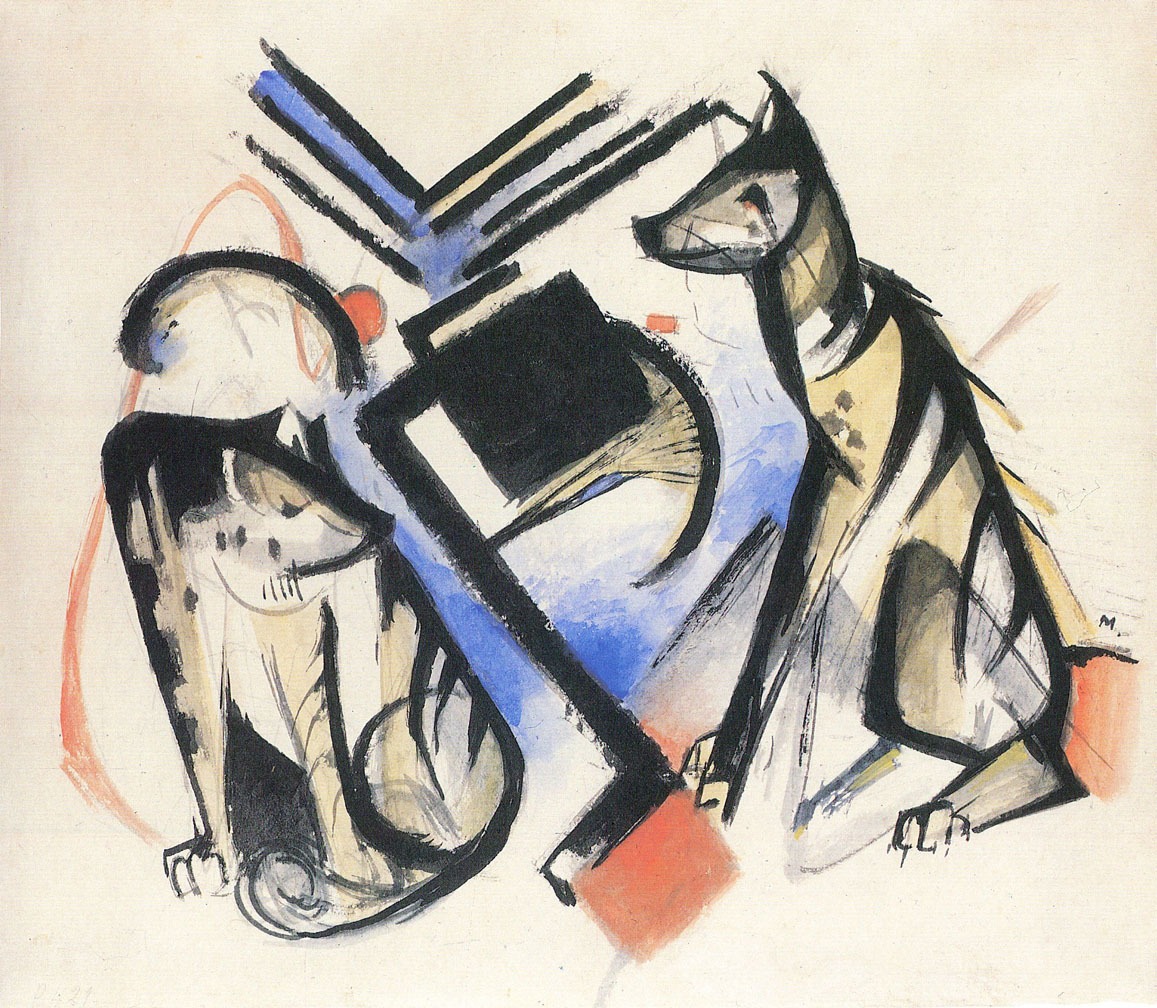
Zwei Wölfe, Franz Marc, 1913
“Furr” – Blitzen Trapper
Yeah, when I was only 17,
I could hear the angels whispering
So I droned into the words and
wandered aimlessly about till
I heard my mother shouting through the fog
It turned out to be the howling of a dog
or a wolf to be exact.
The sound sent shivers down my back
but I was drawn into the pack.
And before long, they allowed me
to join in and sing their song.
So from the cliffs and highest hill, yeah
we would gladly get our fill,
howling endlessly and shrilly at the dawn.
And I lost the taste for judging right from wrong.
For my flesh had turned to fur, yeah
And my thoughts, they surely were turned to
instinct and obedience to God.
You can wear your fur
like the river on fire.
But you better be sure
if you’re makin’ God a liar.
I’m a rattlesnake, babe,
I’m like fuel on fire.
So if you’re gonna’ get made,
don’t be afraid of what you’ve learned.
On the day that I turned 23,
I was curled up underneath a dogwood tree.
When suddenly a girl
with skin the color of a pearl,
wandered aimlessly,
but she didn’t seem to see.
She was listenin’ for the angels just like me.
So I stood and looked about.
I brushed the leaves off of my snout.
And then I heard my mother shouting through the trees.
You should have seen that girl go shaky at the knees.
So I took her by the arm
we settled down upon a farm.
And raised our children up as
gently as you please.
And now my fur has turned to skin.
And I’ve been quickly ushered in
to a world that I confess I do not know.
But I still dream of running careless through the snow.
An’ through the howlin’ winds that blow,
across the ancient distant flow,
it fill our bodies up like water till we know.
§ § §
*(Actually February 8) This year’s anecdote: In the frustration of inertia I went back to as yet untranslated Marc letters, and I found some correspondence that looked interesting about when FM went to visit the Brücke at the beginning of 1912. FM was only supposed to be gone for a few days but actually disappeared for, like, three weeks – this was noted by KBoyV who wrote annoyed notes almost every day commenting on the the situation, i.e. “You left on 2 January and were supposed to return on 5 January and it is now 12 January!”
FM sent some cheerful postcards but made no mention of being in any hurry to return to being, as FM put it, “henpecked.” (FM went to Berlin around the holidays anyway, to visit his perplexed in-laws, camp out on the doorstep of the von Eckhardts, continue investigating the musems, and generally “see what was going on.”)
FM was very intrigued by the crazy goings-on at the Brücke hangout, trying to remain unfazed in the midst of what must have been, even by FM standards, extreme partying situations, nonetheless reporting breathlessly in letters (“OMG these guys are doing DRUGS and stuff!..” and [this is an actual quote, not my interpretation for the modern times] about people “doing goblin-like gymnastics and cartwheels.”
The Brücke had made all their own furniture, wall hangings, murals, even ceramics, lamps, glassware and stuff, and despite the CD cases, pizza boxes and beer bottles strewn around it looked like kind of a cool studio to hang out in. Anyway, a repeated theme in people’s observations and sometimes FM’s own about himself is that he was, sometimes, kind of clumsy or as KBoyV frequently remarks “awkward.” The Brücke dudes finally agree to let FM put some of their stuff in the second Blue Rider show. Meanwhile, FM keeps accidentally busting up their handmade furniture. On 19 January 1912, there was actually the classic sit-down-on-a-chair-and-it-breaks pratfall.
HM was finally dispatched to Berlin to get FM detoxed from opium, teenagers, or whatever, and back on the train home to Bavaria (this lead to a typically digressive and huffy mini-festo on the annoying tendency of trains to go, you know, directly from place to place instead of just cruising around for a while). FM remarked to HM upon departing that even though the place was pretty much already trashed when he got there, it looked like “a couple of giant bears had turned everything over” by the time he left…
From (more or less): Franz Marc: Briefe, Schriften, Aufzeichnungen. Leipzig: Gustav Kiepenheuer, 1989, S. 60-66
by Jean Marie Carey | 6 Dec 2012 | Animals in Art, Art History, Franz Marc, German Expressionism / Modernism, Italian Greyhounds, Stuff Found in Library Books
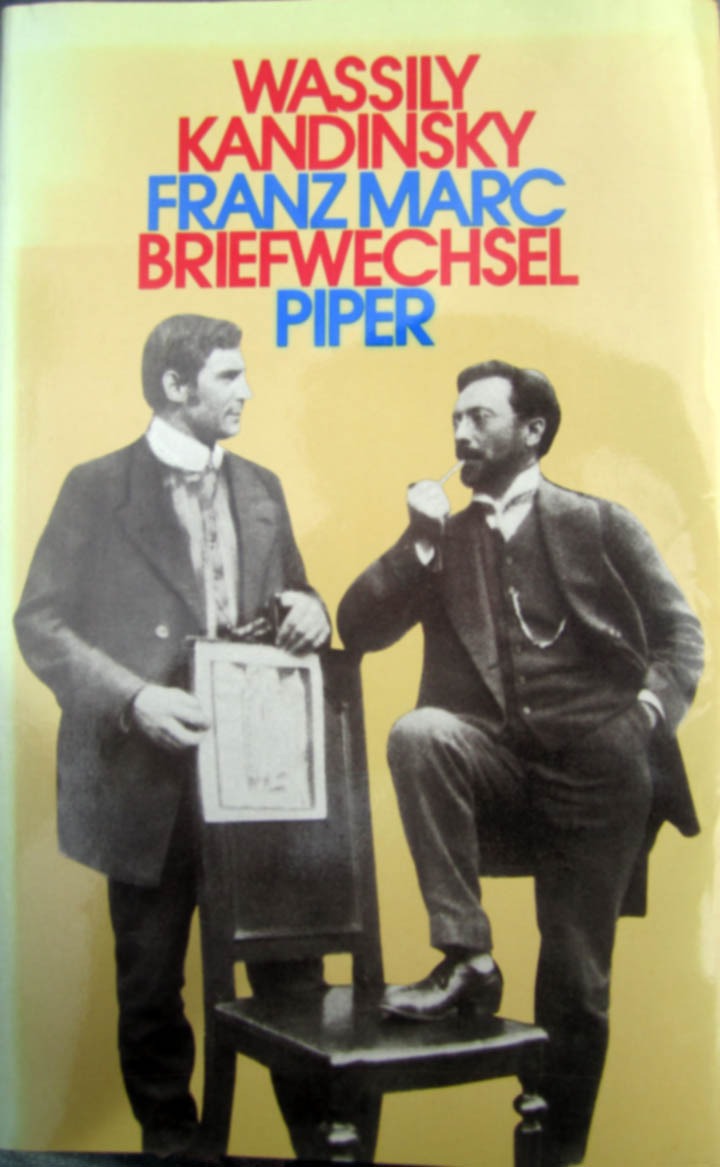
 Wassily Kandinsky, Franz Marc, Briefwechsel : mit Briefen von und an Gabriele Münter und Maria Marc
…After several years of seeking this book and not being able to find it, or finding it and having it be a million Euros or something, I was surprised to locate it in a German used bookstore’s inventory and not too crazily dear. It came in a package from Frankfurt am Main with probably the most Luftpost and other sticker adornments ever in the history of mail. I liked the wrapping so much that I just left the book in it for like a month and kept admiring it. Finally I actually needed to look something up and I had this week to open it. I was beyond thrilled to see that it had a dust jacket with fantastic 1980s typography and an X-acto bladed cutout of the “Show Him the Picture!” photo. The pages aren’t highlighted or written in, but they are pretty beat up and smell like bourbon and tobacco; I am always happy to find someone has really been reading a book hard.
I have been reading, listening to Bayern 2, and conversing with my two patient friends auf Deutsch a bit more diligently and was very pleased to be able to just sit down and read the book without too much difficulty, a far different experience from when first I met it. There are a lot more references to August Macke than I remember, and to AM’s influence…FM was always agitating on AM’s behalf.
I see from looking in Worldcat that this is something of a rare book (rarer now that the Little Mermaid dragged the USF copy to the bottom of the ocean or something – way to stay classy). I wonder why Piper never issued another edition, because in addition to the text of the letters there are extensive notations about the context of the references in the letters, and, very helpfully, descriptions of what was on the obverses of the postcards FM sent that he didn’t make himself. Between the paint, the content, and the terrible writing and incomplete addresses, FM was a real terror to the kingdom’s postal service – they regularly sent his stuff back or just handed it back and refused to deal with it – and they must have been relieved to see just normal “art” postcards such as people send today.


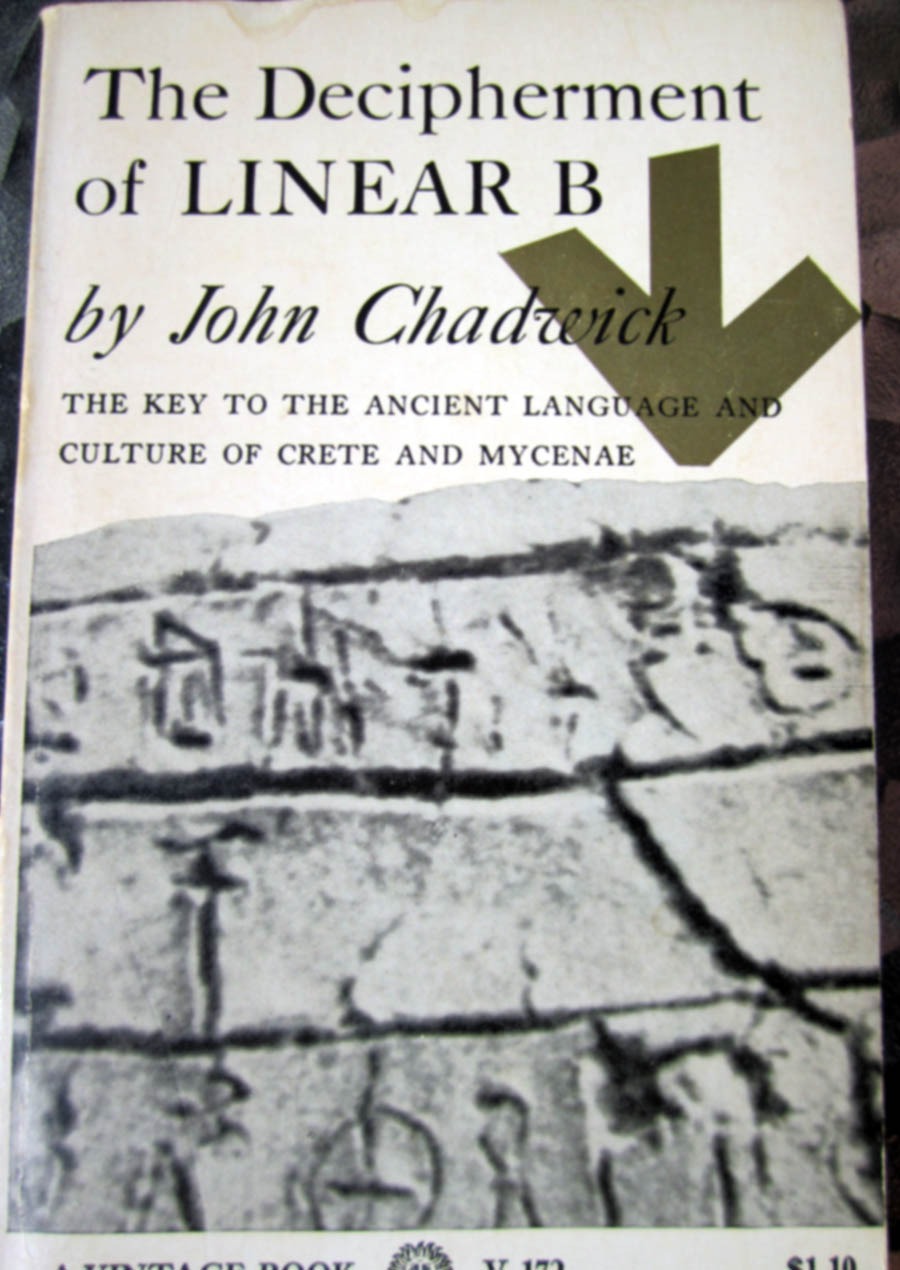
The other text I came across when I was organizing some shelves of books was this: The Decipherment of Linear B. I have always been very fascinated with cuneiform and with the work of Michael Ventris. The author, John Chadwick, was a friend and colleague of Ventris and though this is a very staid account of the process of identification and transcription of the cuneiform characters as both compared with Phoenician and Egyptian and deductively derived, Chadwick mentions Ventris’ untimely death in the introduction. I snatched this book from the trash and am very glad to have it now.