by Jean Marie Carey | 3 Jan 2014 | Art History, Franz Marc, German Expressionism / Modernism, Re-Enactments© and MashUps
One hundred years ago today, August Macke celebrated his 27th birthday – his last.
I spend a lot of research time excavating lost, unpublished, and little-known writings and facts about August Macke and his cousin (more like a little brother) Helmuth Macke. Franz Marc really loved the Mackes and his interactions with them are important for many reasons. But the Mackes are amazing on their own.
Famous Hyperbolic Color Chart
Like Franz Marc, August Macke was incredibly prolific across a number of mediums. As Marc notes from their first meeting, August is inescapably a benthic Capricorn, materialistic and practical. Yet his prose reads like verse, exploding with jokes (especially at the expense of Marc to whom he often “mit seinen im Ulk treiben”), imagery, sounds, and cheerful energy.

by Jean Marie Carey | 24 Dec 2013 | Art History, Franz Marc, German Expressionism / Modernism, LÖL, Re-Enactments© and MashUps
August Macke, Märchen (Sindelsdorf), 1911, Gouache, Deckweiß, Aquarell August Macke, Märchen (Sindelsdorf), 1911, Gouache, Deckweiß, Aquarell
Franz Marc note to August Macke:
19.12.1910
Sindelsdorf
Du Gauner und alter Kulissenschleicher,
schwelge nur ruhig in den Kulissengeheimnissen anderer, einmal und zwar bald, (hörst Du?), musst Du auch aus Deinen Kulissen heraus vor die Rampe, dann schleich ich hinter Dich und beseh mir die Garderobe dieses Genies. – Übrigens lasse ich jetzt einen F …. nach dem anderen in meiner Malerei, – hörst Du sie nicht? Dröhnend!! Ich rechne nicht mehr auf den Besuch der Leute vor Weihnachten und werde also Deine Sachen nächstens zusammenpacken; es tut mit wahrhaftig leid, – sie sind mir so vertraut und lieb geworden. Soll ich die Sachen von Helmuth auch alle dazupacken? Vielleicht schicke ich das gerahmte Stilleben einmal eigens, wenn es Dir damit nicht eilt. Schreib mir bitte darüber. Grüsse Frau Lisbeth herzlichst. Viel Glück und ›Mut‹! zum Einzug in’s Atelier!
Dein Fz. M.
• • •
Although FM kind of jokes here about it perhaps being time for Helmuth Macke – who has only just arrived – to depart, FM quickly gets used to having Helmuth around. At the end of the same month, the nurturing, self-possessed teenager makes art history happen…
by Jean Marie Carey | 8 Dec 2013 | Animals, Animals in Art, Art History, Franz Marc, German Expressionism / Modernism
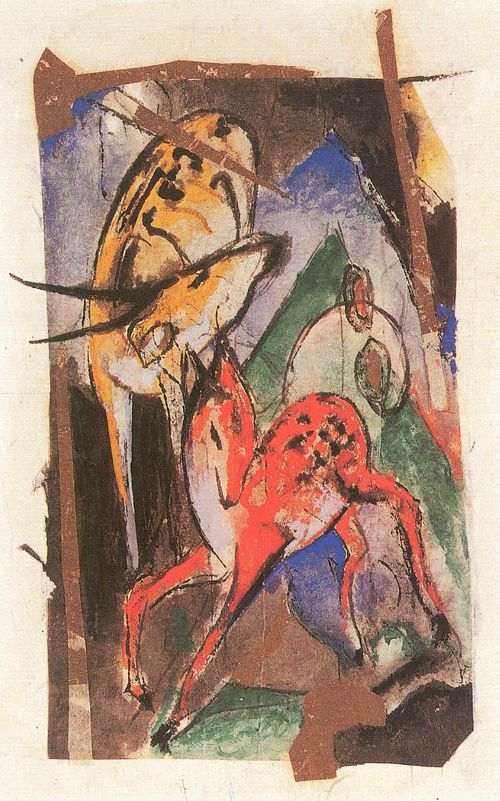
Franz Marc, Rotes Reh und gelbe Antilope, 1913, Mischtechnik und Collage (Silberpapier)
So, Franz Marc always said he was from the future…he amended the amount of how far in the future to 50, then 150, then “about 150 to 500 years” as his own time ran out, and often when saying this was expressing a complaint about his contemporaries that in 2013 we could characterize as: Haters gonna hate.
The recent (and continuing unabated in München) interest over the paintings stolen and hoarded by Hildebrand Gurlitt and his son, Cornelius Gurlitt, has turned to a conversation about the meaning of ‘ownership’ of priceless artworks probably at the very, very, very least obtained via coercive means, and the role of art dealers in the procuring of art and broker of deals for artists.
I began to think about this discussion, in an earlier version though informed by perspicacity, in terms of Marc, who always had a lot to say about art dealers, ranging from the fatalistic to a kind of grudging respect to affection and back, in the case of Hans Goltz, to sputtering but somewhat amused indignation. It seemed beyond the realm of possibility that Marc had encountered the Gurlitts, as Hildebrand Gurlitt was not born until 1895. However I should learn never to ‘bet’ against Marc’s knack for knowing somehow what someday would be meaningful. So, of course he knew the Gurlitts, in the form of the Fritz Gurlitt Gallery, through the eponymous owner and Fritz Gurlitt’s son, Wolfgang (the first cousin of Hildebrand), who had taken over the Berlin gallery and brokerage in 1907.
I was very excited to discover in revisiting Marc’s correspondence with August Macke the followng passage, in which Marc describes his interaction, with Wolfgang Gurlitt (the entire letter follows the break):
Sindelsdorf bei Penzberg, den 12. III. 13 Oberbayern
Lieber August,
… Das Beispiel Pechstein ist für mich typisch. Ich habe kein reines Gefühl mehr vor seiner Persönlichkeit. Mir ist höllisch Angst vor einer Popularität wie der seinen. Nolde tut auch keinesfalls mit, die ›Brücke‹ hat sich bis jetzt auch gesträubt. Aber was die tun, ist mir schliesslich auch nicht ausschlaggebend; wenn sie mittun, ist es ›der Not gehorchend, nicht dem eignen Triebe‹. Meier-Graefe hielt letzthin in München einen Vortrag, in dem er uns alle als Geschäftsmacher bezeichnete und das Publikum aufforderte, es solle sich gegen uns verbinden etc.!! Und Cassirer denkt im Grunde genau so. Mit diesem Kreis will ich nichts zu tun haben. Ich habe die Erfahrung gemacht, dass, wer was von mir haben will, zu mir selber kommt. Wer sich für mich und uns alle interessiert, geht sehr wohl in den ›Sturm‹ und kauft auch dort; der ›Sturm‹ ist als Ausstellungsraum glänzend, riesengross, gutes Licht, dunkle Wände; Ich hab recht gut dort verkauft; tout Berlin braucht gar nicht hinzugehen, ist mir viel lieber so. Gurlitt bedrängt mich seit Monaten, ich soll doch nur bei ihm ausstellen; ich habe ihm jetzt durch Niestlé sagen lassen, wenn er mich durchaus für seinen Salon braucht, soll er mit kaufen anfangen. Auf dem Ohr scheint er aber taub zu sein; wozu soll ich dann bei ihm statt im ›Sturm‹ ausstellen? Ich war dreimal in Berlin (wegen Niestlé) dort und habe, glaube ich, einen einzigen Besucher dort getroffen. Legros war ebenfalls öfters in der Niestlé – und gleichzeitig Pechstein-Ausstellung und traf nie einen Menschen dort. Wenn was Interessantes dort ist, geht man hin, so gut wie in den ›Sturm‹. Tu Du, wie es Dir am besten scheint; ich will mich zurückhalten; ich fühle es als Pflicht gegen meine Ideen über das Ziel unserer Arbeit, das nicht über den Weg der Berliner ›Sommerausstellungen‹ zu erreichen sein wird. Du schimpfst oder lachst, – ich bin nun einmal so. Dass Du Kandinskys Vier Klänge ›schlecht‹ findest, ist mir vollkommen unverständlich; ich denke das Gegenteil: sehr gut. …
One of the things I always like about Marc is that although he is (vaguely) aware of the practical importance of money and often worries about not having any, neither can he be easily enticed or motivated by it (no one seems ever to tried the ‘immediate gratification’ tactic of food, alcohol, cigarettes ‘oder sonst was.’). Also, for a mostly guileless and impetuous person, Marc could sometimes machinate fairly well…
Here Marc tells August of Gurlitt’s persistence in trying to have some dealings with him. On the one hand, Marc doesn’t really have any intention of bailing on the Der Sturm enterprise, but on the other, he wants to keep a line into Gurlitt on behalf of his longtime friend, neighbor, and fellow animal lover and animal painter, Jean-Bloé Niestlé, whose drawings of birds, while very skillful, fell somewhat outside the concern of the avant-gardes. He says Gurlitt actually seems a bit out of it in terms of critical culture, and that, further, no one ever seemed to be at the gallery anyway. It’s interesting that Marc expends a lot of effort trolling Gurlitt for Niestlé, and also that (this is a long and very affctionate letter) that he takes the opportunity to inject a comment preemptively defending Wassily Kandinsky to August, who was not a fan: ‘I think the opposite: very good.’
Actually, in the next few months, the Gurlitt gallery, which had already seen the first and only Brücke group show in 1912, will have a very successful Henri Matisse solo show, followed in 1914 by consecutive spaces devoted to Ernst Ludwig Kirchner, Erich Heckel, and Karl Schmidt-Rottluff, and the handling of all of Lovis Corinth’s prints, and printing portfolios and catalogues of work by Pechstein and Oskar Kokoschka. This probably goes to show that Marc was right to trust his instincts…
In any case it is quite amazing that Marc was very aware of the family who would one day sell Tierschicksale to Kunstmuseum Basel (still waiting to hear the explanation for that) and keep a Blauen Pferde hidden for seven decades. I picked this multimedia print work by Marc because it was made almost exactly 100 years ago, when Marc wrote this letter to August. It’s also very unusual for Marc in that it is truly a collage – the animals are cutouts from another print, and the brown spots are pieces of colored paper.
(more…)
by Jean Marie Carey | 10 Nov 2013 | Art History, Franz Marc, German Expressionism / Modernism
Atlas Mikromega @ the Lenbachhaus
A few years ago I went through a phase of being consumed with interest in Gerhard Richter’s cycle of 15 paintings, Baader-Meinhof (18. Oktober 1977). Writing this now my obsession seems doubly strange because I did not then have the geographic or cultural context for these works I have in 2013. One spring break I had seen the paintings – based upon photographs of Ulrike Meinhof, Holger Meins, Gudrun Ensslin, Andreas Baader; the funeral of Jan-Carl Raspe, and Baader’s books and record player – at the Museum of Modern Art and had a very strong reaction to them. I think I explored this subject so intently because my response was the opposite from my feelings for Franz Marc’s animals. The blurred details of the black and white photographs of portraits, news stills, and police snapshots made the subjects abjectly lifeless. The effect was like the dream of freezing; cold, sad, and bitterly empty. The paintings made me drained and ill. Yet I was fascinated by the tension – and desire – that was generated by being repelled by images whose subjects I was very drawn to.
(more…)

by Jean Marie Carey | 5 Nov 2013 | Animals, Animals in Art, Art History, Franz Marc, German Expressionism / Modernism, LÖL
Recovered Blue Horses
So you have probably heard by now the incredible story of how hundreds of amazing paintings were recovered right here in München – right here in Schwabing! – from the derelict apartment of an “art dealer” who had stored them in haphazard fashion amid cans of apricots and bottles of sherry. Included in the cache are long-missing works by Max Beckmann, Picasso, Renoir, Matisse. Of course most happily found is the painting above, one of Franz Marc’s Blue Horses missing for more than 70 years.
It has been super-exciting to be so lucky to be here for this momentous occasion. Everyone – not just at the museum but everyone in the city – is talking about the fantastic aspects of the story (please read up on it; it’s sure to become even more fascinating) but what is most awesome is the jubilation and delight people are expressing. I can’t think of many places where a city-wide celebration would erupt over such a story.
Of course I am not unmoved. FOCUS magazine broke this story on Monday. When I saw the headline in the Süddeutsche Zeitung’s Twitter feed I ran out to the news vendor to get a copy and snagged the last one, and the last print SZ in the stack too. I am very happy to have these print artifacts of this wonderful occasion.
Here are links from the Daily Mail (UK); Time Magazine (US); and Süddeutsche Zeitung (DE).
I am thrilled that one of the missing Blue Horses was found period, but it’s beyond overwhelming to be right here…Hopefully Turm der Blauen Pferde is hanging out in someone’s garage or wine cellar or something.

by Jean Marie Carey | 13 Sep 2013 | Animals in Art, Franz Marc, Stuff Found in Library Books
When I was little I was lucky to find my way very young to The Black Stallion books by Walter Farley. I read every single book (they appeared every other year or so from 1941 to 1983; the original book was made by into a stunning film of the same name) many times and like the Jim Kjelgaard dog books (Snow Dog, Big Red) I still read them once in a while. As a child I had Breyer horses and Barkies dogs and the scale of the models was compatible enough that I created an early kind of fan fiction diorama series in which the dogs from the Kjelgaard books met the horses from the Farley books.
Of the horses, I actually preferred The Island Stallion, Flame, and Black Minx, the Black’s (Shêtân) daughter. Also some of the “supporting” horse characters, particularly Wintertime and Sunraider. Of course Eclipse and the Piebald were fantastic villains. Unlike Kjelgaard, who told his stories from the perspective of the animals alone, Farley mixed the narratives voices between humans and horses mostly to good effect. Generally both these series of books are underrated and understudied; they are every bit as elegant and meaningful as Call of the Wild without the violence and free from the burden of having to explain the stereotypes of the time; so they remain free for children to enjoy today.
I was thinking about the Black Minx on and off for the past few weeks and even had a dream about the race with Eclipse that is the set piece of The Black Stallion’s Courage.
The Black Minx and Eclipse… Black Minx is the one horse whose speed potential we never really learn. Only “the boy”, Alec Ramsay, can inspire obedience in the headstrong filly. She was a poky frontrunner…she would get out in front of the other horses in every race, put lengths and lengths of distance between herself and the pack, and then…begin daydreaming until she wandered across the finish, albeit still the winner. She is also a bit romantic in other ways, falling in love with her colt rival Wintertime (who like Flame is a solid chestnut) and always wanting to play around with the other horses and guide ponies. Alec decides to “make” Black Minx more competitive by running her with Eclipse (who is dark bay), the wonder colt she bests in the Kentucky Derby but who rapidly thereafter matures into both a magnificent athlete and a terror, speedier (for a spell) even than the Black and cruel, toying with and breaking the spirits of his rivals.
But this plan backfires. The Black Minx bitterly resents having her dedication tested and the forced competition with Eclipse, whom she loathes. She never trusts Alec again. Moreover in these trials she is faster; Black Minx knows all along that even though Eclipse is very fast, she is too far ahead – all she has to do is hold her lead, which she does. Eclipse is bitter about Black Minx’s ease. Finally, in the Belmont Stakes, when all the horses (except the Black) race, Black Minx protests. Wintertime can’t keep the pace Black Minx and Eclipse set, so Black Minx simply slows down and keeps pace with Wintertime. Eclipse surges across the finish line breaking a track and world record. But as Alec races to Black Minx to make sure everything is OK, Eclipse realizes that Alec loved her best no matter what, win or lose. So for Alec and Eclipse, this is a sad story in terms of people-horse relations. For Black Minx, following her refusal to compete, she is retired, as is Wintertime, and they spend the rest of their days together. (In the very last books of the series, Wintertime and Black Minx have a daughter who is also unruly, Black Pepper.)
Tim Farley, Walter Farley’s son, maintains a Black Stallion Website that has a very fun forum, a lot of beautiful images of horses, naturally, stills and clips from the movies, and a real treasure – the vintage covers from the first editions of each of the books.