
by Jean Marie Carey | 12 Nov 2017 | Art History, Re-Enactments© and MashUps
Funerary shroud of Tasherytwedjahor from Roman Egypt, c. 150. Tempera on linen. Museum of Fine Arts, Boston, Nr. 54.993
Funerary imagery permeated Roman culture and riddled the visual landscape. Representations of death in the form of monuments and statuary are the best-known artifacts of Roman Imperial customs surrounding death, but these static glyphs complemented a “lively” practice of ancient Roman funerary practices in honor of the deceased and his or her family. During the city’s Caesarian and Julian centuries, roads leading into the city were lined with tombs, and to walk Roman streets meant encounters with representations of the dead on a daily basis. In Rome, the dead were ever-present.
However the civic perception was by no means entirely morbid. Rather than only mourn the death or commemorate the deceased, the Roman funerary cityscape offered opportunities for the display of familial, political, and personal symbolic capital. The accouterments of the funeral – chariots, triumphal regalia, the garb of magisterial office, and the display of past familial accomplishments – were intended to underscore the accomplishments of the deceased and demonstrable clout of aristocratic, wealthy, and politically connected citizens. In turn, the family could use funerary imagery as an internal yardstick that would present clear goals for its younger members to achieve. The dead offered exempla of past success, and reminders of one’s own place within the generational power structure of the family.
As the empire extended in all directions, Roman visual culture mixed with that of Egypt, Britain, and Byzantium, producing painted shrouds, sarcophagi, and mosaics. Some iconographic meanings are yet lost to us, such as a Roman sarcophagus depicting the Greek myth of Medea.
“[She] marries a Greek prince, a hero, goes back to Greece with him, they have two kids, but later on, her husband — a hero named Jason — has a mid-life crisis,” Dr. Mont Allen of Southern Illinois University has said. “He wants to jilt his wife, get a hot Ferrari and a hot trophy bride, and he essentially jilts Medea and her two kids there and she’s totally stranded, she’s a foreigner and here she is in Greece.”
Because Medea was a divorced woman, she had no protection in the ancient world.
“So she has her vengeance by killing her own two kids and then escaping, that’s the story of Medea,” Allen said. “What would [the sarcophagus] have cost, translated into modern dollars, $600,000? You think, ‘Why would an ancient Roman woman spend roughly $600,000 so that all her future generations of descendants could see the story of Medea on her coffin?’ Like, who on Earth would want to be remembered as a killer of children? The people looking at this are going to be your own family members.”

Roman Severan-Era Medea Sarcophagus, front view, c.190-200. Photo: University of California, San Diego
(more…)

by Jean Marie Carey | 20 Oct 2017 | Art History, Re-Enactments© and MashUps
During 2013 when I lived in München Gillian Wearing had a mid-career retrospective at Museum Brandhorst and a poster of the image you see here, “Self Portrait at Seventeen Years Old” (2003) was on placards all over the city as well as a huge replica on the side of the museum.
Gillian Wearing, “Self Portrait at Seventeen Years Old,” 2003; Claude Cahun, Self-Portrait, 1928.
The capstone nature of the show at least intimated that Wearing was moving on to subjects other than herself and I remember thinking that perhaps at last we had reached “peak self portrait.” This proved not to be the case specifically or generally.
I decided to review the catalogue of this exhibition in the hopes of re-examining Wearing and also setting the record correct about one of my favorite photographers, Claude Cahun. I feared when Gillian Wearing and Claude Cahun: Behind the Mask, Another Mask was announced at the National Portrait Gallery in London that is would offer yet another opportunity for female erasure, which is what happened in reviews such as this one from Aindrea Emelife of the BBC shrieking: “Claude Cahun: The Trans Artists Years Ahead of Her Time.”
In fact Cahun was a woman, a lesbian woman, who was perfectly comfortable with her biological sex. She was sentenced to death during her time on Nazi-occupied Jersey for refusing to renounce her lifetime lover, Marcel Moore, so it seems especially egregious to suggest Cahun wavered in her “identity.”
One of the most distinctive aspects of Cahun’s auto-portraits is that her strong features are never obscured, she is always recognisably herself, no matter what the costume or haircut. This is something Wearing, in her response to Cahun’s oeuvre, seems also to diminish, as the series made for this exhibition find Wearing immersed in full disguises as Cahun, Robert Mapplethorpe, Dian Arbus, and others.

Claude Cahun, “Untitled (I Am in Training, Don’t Kiss Me,” 1929; Gillian Wearing, “Self Portrait as Claude Cahun,” 2015.
(more…)

by Jean Marie Carey | 22 Sep 2017 | Animals, Animals in Art, Art History, Dogs!, Franz Marc, German Expressionism / Modernism
My article related to Franz Marc and his dog, “To Never Know You: Archival Photos of Russi and Franz Marc” has been published in the Fall 2017 issue of Antennae: The Journal of Nature in Visual Culture.
Here is the abstract for the story about Franz Marc and his dog, which also contains some valuable personal insights on vernacular photography from other scholars and benefited from the questions and comments from my Doktormutter Cecilia Novero:
-
This essay examines photographs of the German Expressionist artist, writer, and Tierliebhaber Franz Marc and his dog, Russi, taking the position that one of the most obvious characteristics of Marc’s life his – affectionate and respectful relationship with Russi – has been largely overlooked, though its documentation is clear. I extol the value of what are normally categorised as snapshots in reconstructing animal and human biographies. This raises questions about what photographs are valuable to such research, and why some are used repeatedly and others ignored. Significantly, a previously unknown photograph of Marc taken by his brother Paul in is published for the first time.
Mainly I had wanted to write about discovering this photo of Franz Marc in the DKM/GNM, so here it is again:
Franz Marc, 1914, in Munich. Photo by Paul Marc. Germanisches Nationalmuseum | Des Deutschen Kunstarchivs | Nürnberg
by Jean Marie Carey | 24 Aug 2017 | Art History, LÖL, Re-Enactments© and MashUps
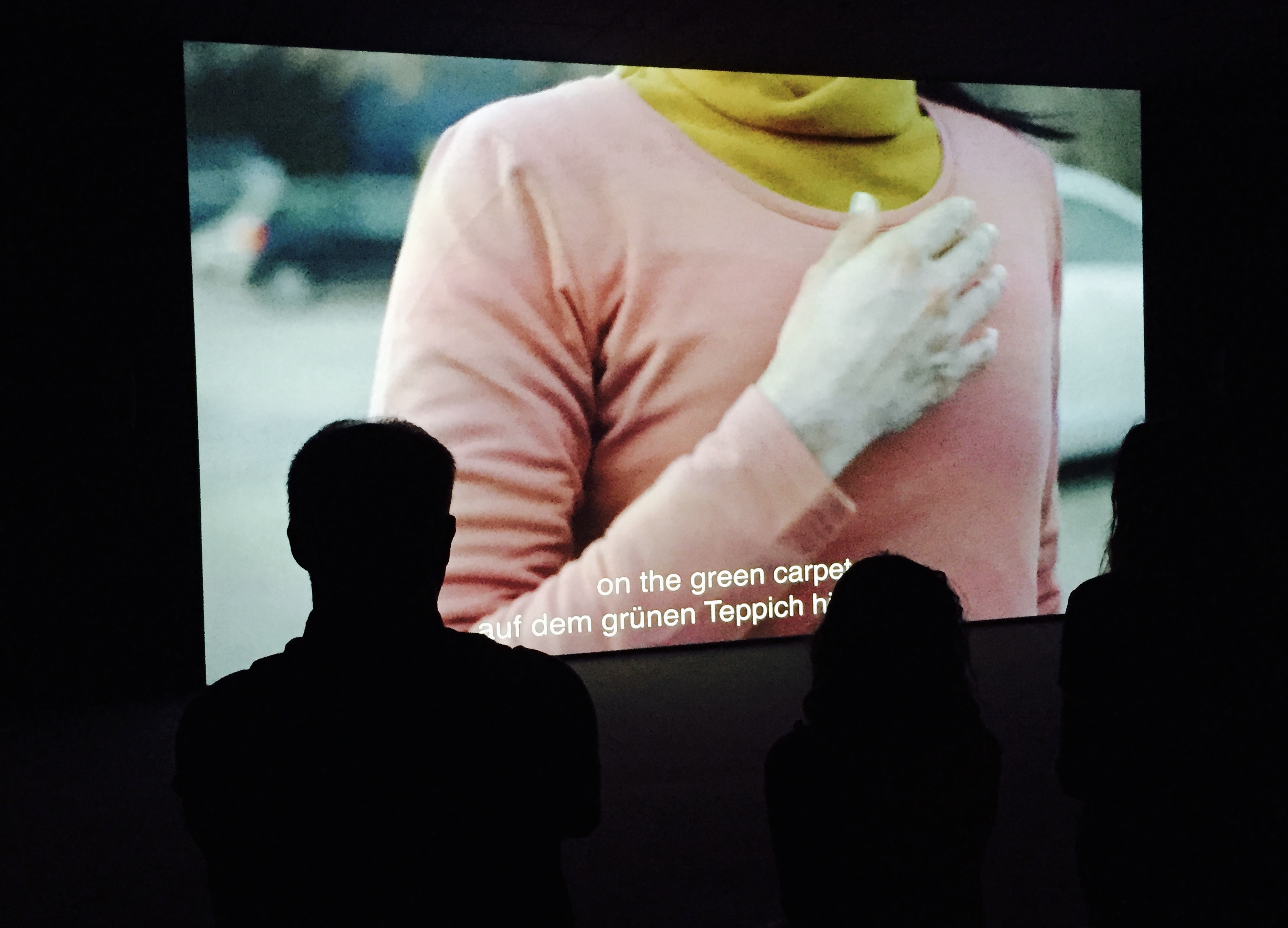
Arin Rungjang, 246247596248914102516 … And then there were none (2017). Video still.
The German friend I went with said aloud what I was thinking: “Whoever at Documenta decided to call this the ‘Neue Neue Galerie’…just…shouldn’t…ever…” accompanied by a grim sächsische head-shake. Restyling the already-interesting and well-known Brutalist Neue Post building in this way is so typical of Documenta 14: It’s that Mentos-commercial “humor” that isn’t funny and also isn’t nostalgic, ironic, kitschy, or whatever else might have settled the account with the “marketing team.” Nonetheless despite being afflicted by branding and the continuing curatorial confusion that has muddled much of Documenta 14, some of the art inside the former mail-sorting center ascends on its own merits.
The most interesting, and centrally important to Kassel, entries in all of Documenta is the project by the Society of Friends of Halit, a group of artists and researchers who apply pressure to the investigation into the 2006 murder of 21-year-old Halit Yozgat. Yozgat was shot to death in the Internet café his family ran on Höllandischestraße, just around the corner from the Neue Post, the ninth in a string of Neo-Nazi hate crimes. Hessian undercover detective Andreas Temme was in the café yet claims to have seen and heard nothing. With 77sqm_9:26min (2017), the Society reveals their findings – reconstructed through forensic architectural, olfactory projection (!), and sound renderings; interviews with passersby, and film clips of testimony and evidence. Finally an example of the ability of art to change and influence events in the world, and even render justice.

Arin Rungjang (geb. 1974, Bangkok) 246247596248914102516 … And then there were none (2017) Digitalvideo, Farbe, Ton; Holz- und Blechplastik; 2 Malereien und 2 Arbeiten auf Papier Video: 30 min
Perhaps the lone Documenta installation aspiring to Gesamtkunstwerk is Arin Rungjang’s 246247596248914102516… And then there were none (Democracy Monument) (2017). The installation is composed of a wood and brass panel-frieze, sculpture, photographic portraits, video installation, paintings, drawings, and books. The video itself includes an original modern dance performance about World War II historic sites in Berlin and Munich, the manufacture of the frieze, and an attendant controversy in Thailand, and – rare for Documenta Kassel – an acknowledgment of the fair’s earlier iteration in Athens. 246247596248914102516 is a reach that might not have worked, but Rungjang’s combination of precision and sincerity is peerless.
(more…)
by Jean Marie Carey | 21 Jul 2017 | Art History, Franz Marc, German Expressionism / Modernism, LÖL, Re-Enactments© and MashUps
Much as I enjoy burying the lede, the headline on this story is that I found a heretofore unpublished photo, and this is the Franz Marc photo, taken in the spring of 1914 by the artist’s brother, Paul Marc, in Munich:
Franz Marc, 1914, in Munich. Photo by Paul Marc. Germanisches Nationalmuseum | Des Deutschen Kunstarchivs | Nürnberg
The whole story of finding the Franz Marc photo and a thorough analysis of why it might be that significant images of people and animals are overlooked is forthcoming in the second part of the “Exposing Animals” sequence of Antennae: The Journal of Nature in Visual Culture in September, and this photograph and some others will be reproduced there, but it is also appearing in a different kind of work I did for Empty Mirror Books that comes out this week, so I decided to post it, finally (I first found it in 2015!), here today.
Beyond standing as a strong reminder that there is so much we have not yet learned about the historical avant-garde, this is just a wonderful photograph, “eerie and magnificent,” as Marc would say, so I will just leave it at that for now.
