by Jean Marie Carey | 19 Jun 2017 | Art History, Re-Enactments© and MashUps
One of the paradoxes that has emerged from documenta 14 is that many of its spectacular installations make very simple statements about global consumerism using enormous material expenditures. In fact it can be difficult to see past the pyramids, windmills, and tents erected to comment on issues such as migration and the market-possessed-body – elaborate efforts to illustrate political generalities – to documenta’s truer theme, an attempt by curator Adam Szymczyk to assail, or at least supplement, canonical art history with work by indigenous and overlooked artists.
iQhiya, Monday, 2017, Performance und Installation, Ehemaliger unterirdischer Bahnhof (KulturBahnhof), Kassel, documenta 14, Foto: Fred Dott
But the contemporary art fair world floats above scholarship on a bubble of self-satisfaction. The documenta participants who are the big draws – Mona Hatoum and Pierre Huyghe for example – aren’t worried about posterity. So what was meant to be exposure becomes competition for a footnote. Some of this lesser-known work also really struggles when removed from its local context. Poor facture and inappropriate plinths meant as faux–naïf comes across as a weird form of doubled sociological good intentions gone awry, and, amid Kassel’s half-hearted Brutalist buildings, calls to mind Bernd and Hilla Becher’s photographs of Bavarians dressed as Native Americans. In this respect, perhaps it was afterall an important achievement, and more consistent with Szymczyk’s goal, to move the most of documenta to Athens.
One excellent work, shown above, is iQhiya’s Monday (2017), which unfortunately was performed only once on 13 June. Staged in Kassel’s “little” Bahnhof, the spoken, moved, video, books, saws, pens, needles cloth, and film endurance piece used an eight-hour projection loop of Sarafina! (1992) to examine the “hidden curriculum” experience of black, South African women college students. Mimicking the rhythm of a real school day, naturally people wandered in and out. The coming and goings of the Eurobahn and Regio trains moving through the station plinked the hour glass and also made a rumbling vibration that was unsettling and comforting at the same time. I’m not sure if the reference to Pascale Marthine Tayou’s Human Being @Work (2009) was intentional or ephemeral coincidence, but the eleven-member iQhiya troupe made use of sound and light in a similar way as Tayou’s (also very successful) occupation of the Biennale di Venezia’s Arsenale – only with real trains.
Now, about Olu Oguibe…
(more…)
by Jean Marie Carey | 8 Jun 2017 | Art History
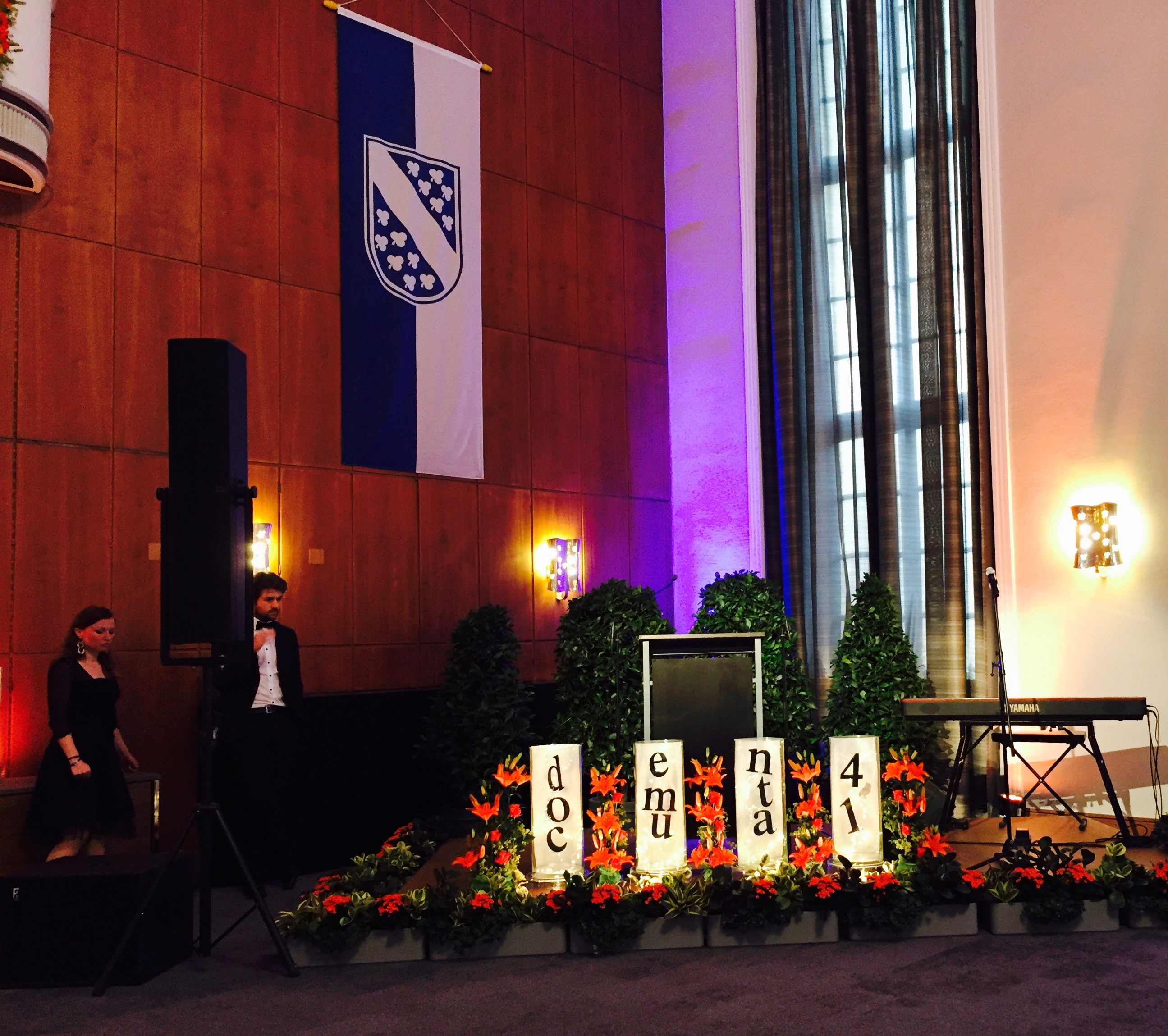
For the first installment of documenta diaries…here is George Baker’s “The Globalization of the False: A Response to Okwui Enwezor” (2004). Much of the work seen thus far at the German quinquennial, having liberated itself from theory and history, is therefore very literal, in a Thelma-Golden’s-1993-Whitney-Biennal way. There is more going on at documenta, of course, than granular personal narrative…but the emphasis is definitely on identity and by extension individuality. (more…)
by Jean Marie Carey | 7 Jun 2017 | Animals, Animals in Art, Art History, Dogs!, Franz Marc, German Expressionism / Modernism, LÖL, Re-Enactments© and MashUps
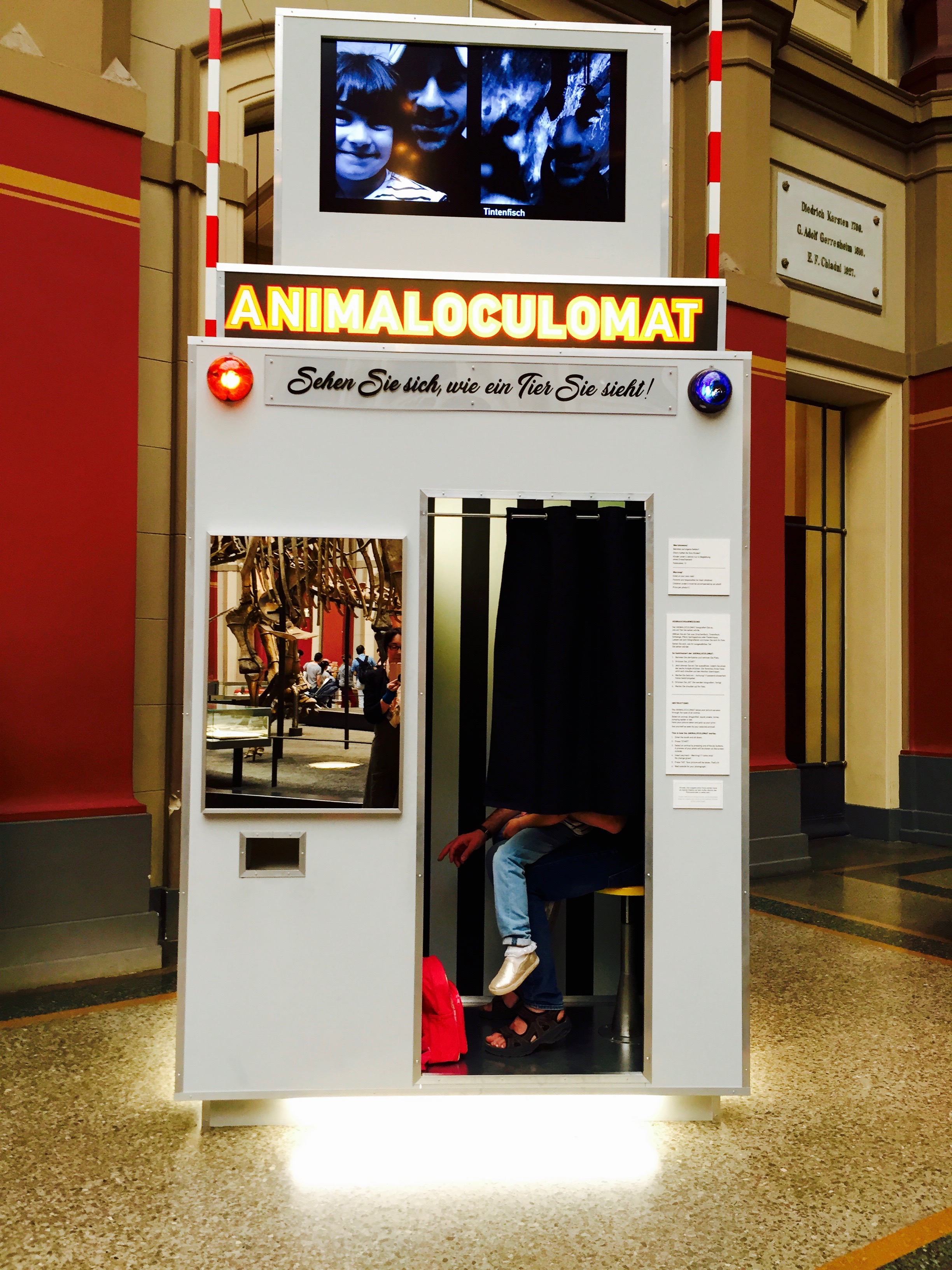
Klara Hobza, Animaloculomat, 2017
Already by 1909 Jakob Johann von Uexküll had, in Umwelt und Innenwelt der Tiere, given a great deal of consideration to the „Innenleben“ of animals. For Franz Marc this led to the question of how a horse, an eagle, a deer, or a dog saw and experienced the world, prompting the reflection „die Tiere in eine Landschaft zu setzen, die unsren Augen zugehört, statt uns in die Seele des Tieres zu versenken, um dessen Bildkreis zu erraten“.[1]
A painting like Liegender Hund im Schnee, a depiction of Marc’s dog Russi, radiates the oneness between the surrounding nature and the resting dog – „eine gemeinsame Stille von belebter und unbelebter Natur.“[2] .“ But Marc was interested in the actual physical reality of the dog’s vision as well.

Inside Klara Hobza’s Animaloculomat

by Jean Marie Carey | 3 Jun 2017 | Animals, Animals in Art, Art History, Franz Marc, German Expressionism / Modernism, Re-Enactments© and MashUps
“Vermisst: Der Turm der blauen Pferde von Franz Marc” at Haus am Waldsee, Berlin
Marcel van Eeden, High Mountains, a Rainbow, the Moon and Stars, 2017
I really wanted to like Haus am Waldsee’s thematic “Vermisst: Der Turm der blauen Pferde von Franz Marc,” but was also nervous about all the expectations of the referenced Franz Marc painting that I would bring to the exhibition. To (un)prepare, I imposed a media blackout upon myself, not reading up on who the artists were or any other reviews,[1] avoiding a seminar and joint show co-sponsored by the Pinakothek der Moderne in München. Vermisst’s concept was to pair some scholarly discussions of Marc’s missing 1913 masterwork with the expansions of contemporary artists upon its theme.
Franz Marc Painting Still Missing
Beyond mild speculation, a purpose of Vermisst did not seem to be to offer any type of meaningful investigation into where the painting might actually be. It is not incumbent upon Haus am Waldsee, where the Franz Marc painting was last seen in 1949, to conduct such an inquiry…and yet the stubborn refusal, still, of German museums and art historians to grapple with the issue of Raubkunst, particularly in a case as famous as that of Turm der blauen Pferde, where someone knows something, is a real problem. (I have an article coming out on this very subject, so I’ll just leave this here for now.)
Of contributions by a dozen artists, one seemed to address both the absent presence of TdbP and also the circumstances of its disappearance. In fact if Marcel van Eeden’s High Mountains, a Rainbow, the Moon and Stars (2017), a series of 26 prints including the text of a short story revealing some fantastical open-ended conclusions about what happened to the painting, had been the only component of the exhibition, that would have been fine. Only two of Eeden’s panels are in color, both reproductions of aspects of TdbP, which makes a nice allusion to the Wizard of Oz (1939), both in temporality and in the vibrancy of the world of dreams, and of lost alternative futures. (more…)