by Jean Marie Carey | 5 Mar 2015 | August Macke, Expressionismus, Franz Marc, German Expressionism / Modernism, Re-Enactments© and MashUps
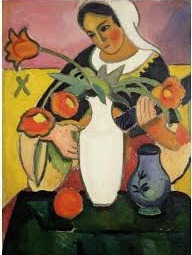
Die Lautenspielerin, August Macke, 1910
“Recent publications” is in quotes because all of the great opportunities to preach the gospel of Marc lately have come to me strictly through the generosity of other people, so I will quickly get to the point of thanking Trang Vu Thuy and the curatorial staff at the Lenbachhaus and Janine Arnold of Notes About Art. (Please click through the links to view the articles themselves.)
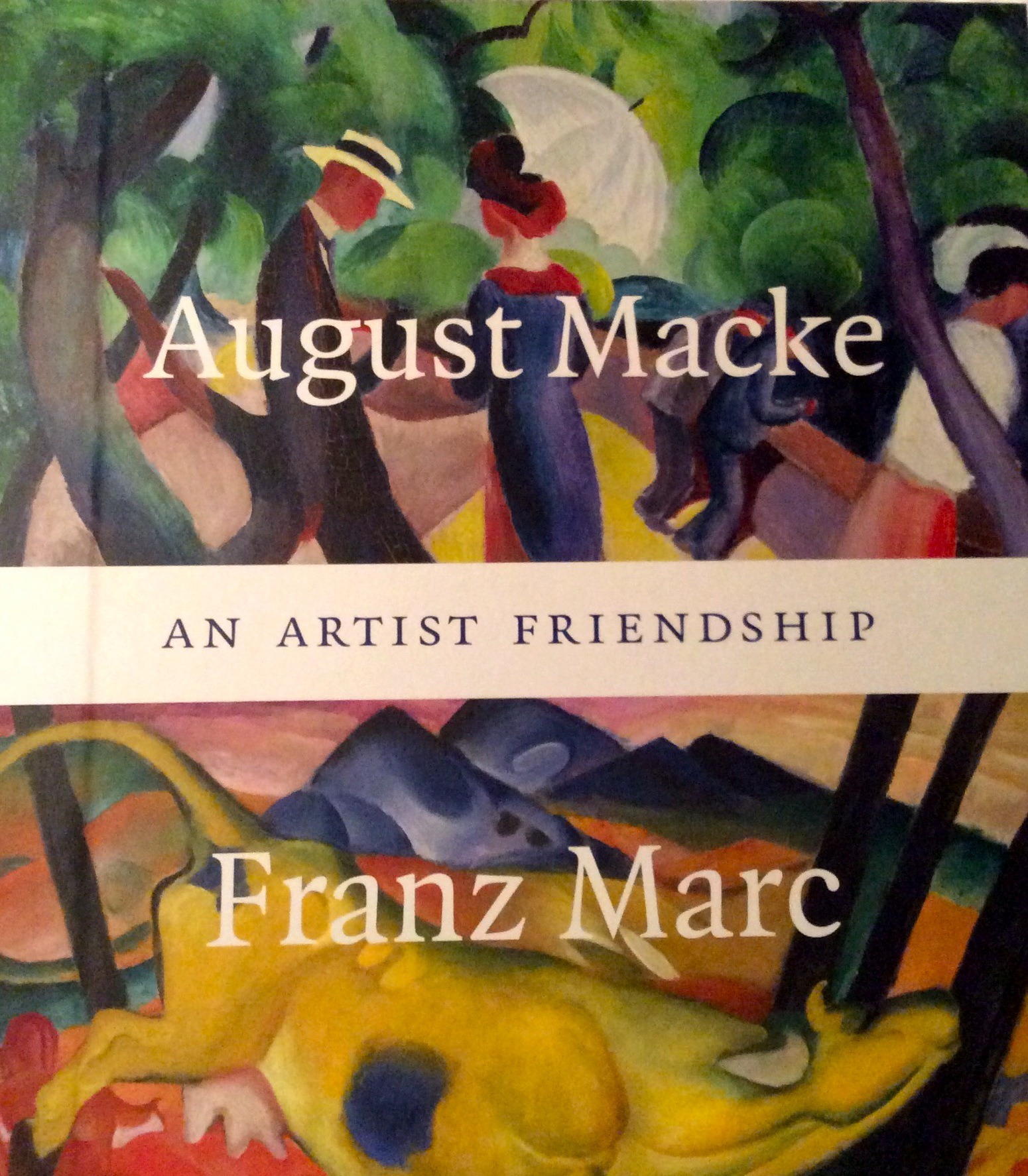
My post (which is present entirely owing to the patience of Vu Thuy) “Ein Manifest der Freundschaft” is in honor of the August Macke und Franz Marc: Eine Künstlerfreundschaft exhibition (on through 3 May 2015 in the Lenbachhaus Kunstbau) and concerns one of my favorite subjects, the Paradies mural.
“Von »Köstlichen Figürchen« und »Wunderherlichen Farben«” by assistant curator Monika Bayer-Wermuth is actually the most wonderful post, though, on the gifts sent by the Marcs to the Mackes and is told in the same thoughtful, personal vein as are many of the chapters in the companion catalogue.
Thanks to the generous invitation of Arnold, I have two entries on her Notes About Art website, one called “Confrontations & Reconciliations” about my interpretation of Franz Marc’s gift of the painting Blaues Pferdchen, Kinderbild to August Macke and the other a bit about the history of Marc’s two Turm der blauen Pferde.
I am very happy to see art historians collaborating across distance and language just because we like the art and want for other people to be able to know about and appreciate the work of Der Blaue Reiter. (more…)

by Jean Marie Carey | 3 Mar 2015 | Animals in Art, Art History, August Macke, Franz Marc
Today is the 99th anniversary of the death of Franz Marc. (Marc would have really liked someone who also died this week, Leonard Nimoy and Nimoy’s Mr. Spock character from Star Trek.) I didn’t write my normal “Franz Marc’s Birthday” post (Marc’s birthday is 8 February) this year because the idea of the grief we feel for Marc and August Macke has been much on my mind. This is partly owing to my own research, but also to do with the publication of the catalogue attendant to the Lenbachhaus’s current exhibition, August Macke und Franz Marc: eine Künstlerfreundschaft (August Macke and Franz Marc: An Artist Friendship in English).
The catalogue is, not surprisingly, a tour-de-force of editing and research by longtime Lenbachhaus Blaue Reiter curator Annegret Hoberg and Volker Adolphs of Kunstmuseum Bonn. What is unexpected is that the editors and included authors bring to bear not just a wealth of knowledge but so much compassion to these essays, confronting directly the loss and sadness we naturally feel over the too-short lives of Marc and Macke.
This is not to say the entries are not impeccably scholarly; Hoberg’s “August Macke and Franz Marc / Ideas for a Renewal of Painting” and Adolphs’ “Seeing the World and Seeing Through the World / Nature in the Work of August Macke and Franz Marc” are classic art historiography based in peerless analysis. Gregor Wedekind’s “The Masks of the Savages / Primitivism and Cultural Critique in the Work of August Macke and Franz Marc” was of particular interest to me as it underscores how the work of the avant-gardes was received in its time as a shocking departure from what the world then considered “civilized” painting. There are a few small errors marring Klara Drenker-Nagels’ otherwise illuminating discussion of the relationship between Maria Marc and Elisabeth Erdmann-Macke that I’m sure will be corrected in subsequent editions.
Of special delight in terms of the arrangement and presentation of the catalogue are some shorter, data-packed chapters on the Paradies (1912) mural and other anecdotes about Marc’s and Macke’s overlapping but very different lives.
Of course the catalogue is rich with the paintings, weavings, sketches, and photos that grace the exhibition itself. As a discrete publication, this is one that must truly be enjoyed as a book – I received it on a Friday afternoon and spent the entire weekend poring over every image, footnote, and phrase, alternately smiling and wiping away tears. Turning the last page, I was filled with admiration for this Lenbachhaus-Kunstmuseum Bonn collaboration, every word written with love.