
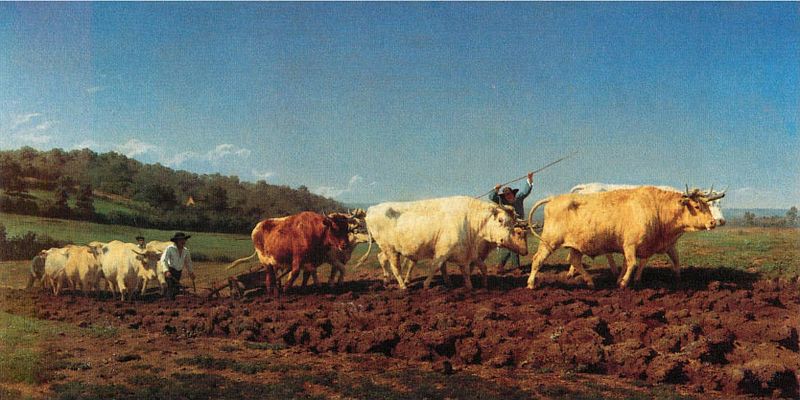
“Labourages Nivernais” by Rosa Bonheur
Rosa Bonheur – Labourage nivernais.
If 19th century French painter Rosa Bonheur believed in reincarnation, she would surely have chosen to return to life not as one of the regal lions or leggy gazelles she shared her Bordeaux estate with, but as a sturdy, common barnyard bull. The slyly successful painter had great affection for domestic animals, and enjoyed her greatest artistic success depicting them.
Bonheur was especially adept at imbuing cattle with nobility without giving them airs of humanity.
Though best known for The Horse Fair (1853), a canvas from a few years later in her career, Labourages Nivernais, completed in 1850, is actually a less derivative, more personal, visually individualistic image of Bonheur’s favorite creatures. Nivernais also marks the beginning of a period of commercial and public success for Bonheur, a good fortune enjoyed by few women artists then as now.
At first glance, Nivernais seems a relatively innocuous, though beautifully rendered, ode to agrarian life, and there is nothing “incorrect” with that interpretation. However, Nivernais offers much more to viewers who, like the team of oxen shown, take the time to turn over the well-trodden earth.
Rosa Bonheur, was born in Bordeaux, France on March 16, 1822, the eldest child of Sophie Marquis and Raimond Oscar-Marie Bonheur. The couple called the baby Marie Rosalie, but she almost immediately came to be known as Rosa.
Her father, himself a painter and philosopher, and artists with whom he was friends captured many images of the youthful RB.
Her father shows RB the infant idolized as a cherub in a crib in a painting in 1823. By the time Raimond Bonheur captured Rosa at Four, the child had the set jaw, solemn gaze, erect posture and short tousled hair that would identify her for the rest of her life.
One alleged portrait of RB, showing a square-jawed, serious child in a brimmed hat with feather trim, was painted by Jean Baptiste Camille Corot. After RB’s death, though, her companion Anna Klumpke, came forward to say that she thought the sitter for the portrait was instead a male. Such confusion regarding appearance and gender shadowed RB all her life.
(more…)
