by Jean Marie Carey | 9 Jun 2010 | Art History
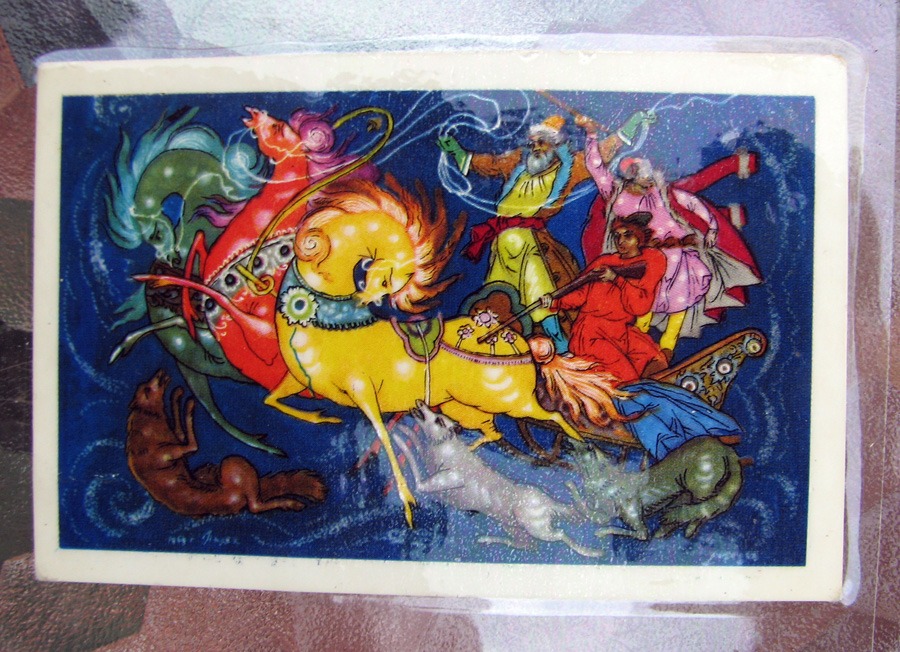
CCCP Calendar Card, 1971
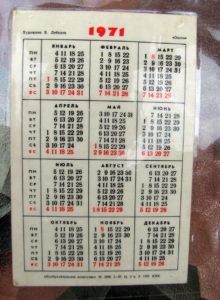
Soviet Calendar Card, 1971
Documenting odd things found in library books begins; this project is called The Lure of Salvage. Our inaugural item, this small (7 cm by 10.2 cm) calendar card from Moscow cicrca 1971 was found in a book of Russian poety printed in 1942. The photo does not do the image of the curly horses and leaping wolves justice but it is very dreamy and lovely.
‘There is no document of culture that is not at the same time a document of barbarism.’ – Walter Benjamin
by Jean Marie Carey | 25 Sep 2008 | Art History
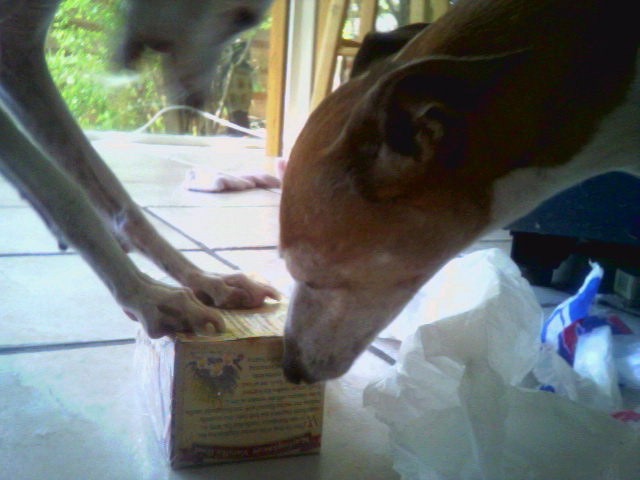
“Enraged by Tea,” one of my all-time photophone favorites, from 2005.
The three essays discussed in this response paper relate to contemporary concepts around the analysis of visual culture through the interpretation of the philosophies of history, commodification, and language as refracted by The Man’s capitalistic hijacking of the involuntary human practice of looking.
While Karl Marx and Friedrich Engels use the terminology typically associated with the social proposals of communism including the expected references to the “proletariat” and the “bourgeois,” these selections from German Ideology constitute less a political manifesto than an intellectual proposal for the active reconfiguring of the recording and interpretation of history. Marx and Engels (and, for the consideration of these works, Barthes) are not particularly known for easily comprehensible prose styles. German Ideology capitalizes, so to speak, on the even more opaque writing of the greatest German ideologue of the time, Georg Wilhelm Friedrich Hegel. Marx and Engels propose that while there is some fundamental correctness to the Hegelian principle of the dialectic – ascertaining an absolute truth through logical dissection and argument – historians and philosophers following Hegel had simply got everything wrong. Rather than intangible evolved yearnings for “immanence” and “transcendence,” humanity is a material manifestation controlled by economics. This definition of “historical materialism” is preceded by “dialectic materialism,” which establishes both the sole existence of the physical (as opposed to ephemeral) world, and, more significantly in connection to visual culture studies, the establishment of the thesis/antithesis paradigm which eventually becomes known as “binary opposition.” (Marx – more Marx than Engels – also takes exception to other “Hegel deconstruction” scholars such as Ludwig Feuerbach and Max Stirner). In a certain titular and textual respect, these selections undercut some of the assumptions endemic to the concepts of alterity politics and false constructions of Otherness raised during the heights of Post-Modernism simply by presuming that such a thing as an ideology based not upon colonial dynamics or Western European cultural dominance but on the national identity of Germans.
(more…)

by Jean Marie Carey | 27 Jul 2008 | Animals, Art History
[Green turtle, albino. By David Monniaux]
“To photograph is to appropriate the thing photographed.”
On Photography, Susan Sontag’s exhaustive critique of photography, which excoriated photographers even as it elevated the art form, opens (in the 1977 book form of the collected essays) with the chapter “In Plato’s Cave.” Arranged and edited in this manner this chapter is meant to serve as the introduction to Sontag’s collection of ideas on the sociological implications of the medium of photography.
So much has been written by and about Sontag with respect to the construction and importance of these essays, and so much biographical detail about Sontag has come to light since her death a few years ago, that is it difficult to consider “In Plato’s Cave” unto itself, separate from that information, let alone separate from the other essays in the collection.
Basically, Sontag takes humankind to task, as did Plato, for sitting around accepting whatever images that happen to dance past as a perfect mirror (or projection) of reality and judges photographers equally harshly for approaching their subjects with acquisitiveness and predation. Sontag investigates the simile of the cave but more deeply the metaphor of the mirror.
I was interested to learn that Sontag had also written extensively about Persona, the 1966 Ingmar Bergman film, probably around the same time she began the series of essays that are collected in On Photography. Persona can also be construed as being about mirroring, and also about a kind of (seemingly) passive transmission and reception of knowledge, as well as a complicated examination about the relationship between the beholder and the beheld. Persona is open to interpretation as a horror movie rather than a psychological study, one in which a very modern sort of vampire sucks the being from a similar but not identical human. (more…)