by Jean Marie Carey | 7 Jun 2015 | Animals in Art, Art History, Franz Marc
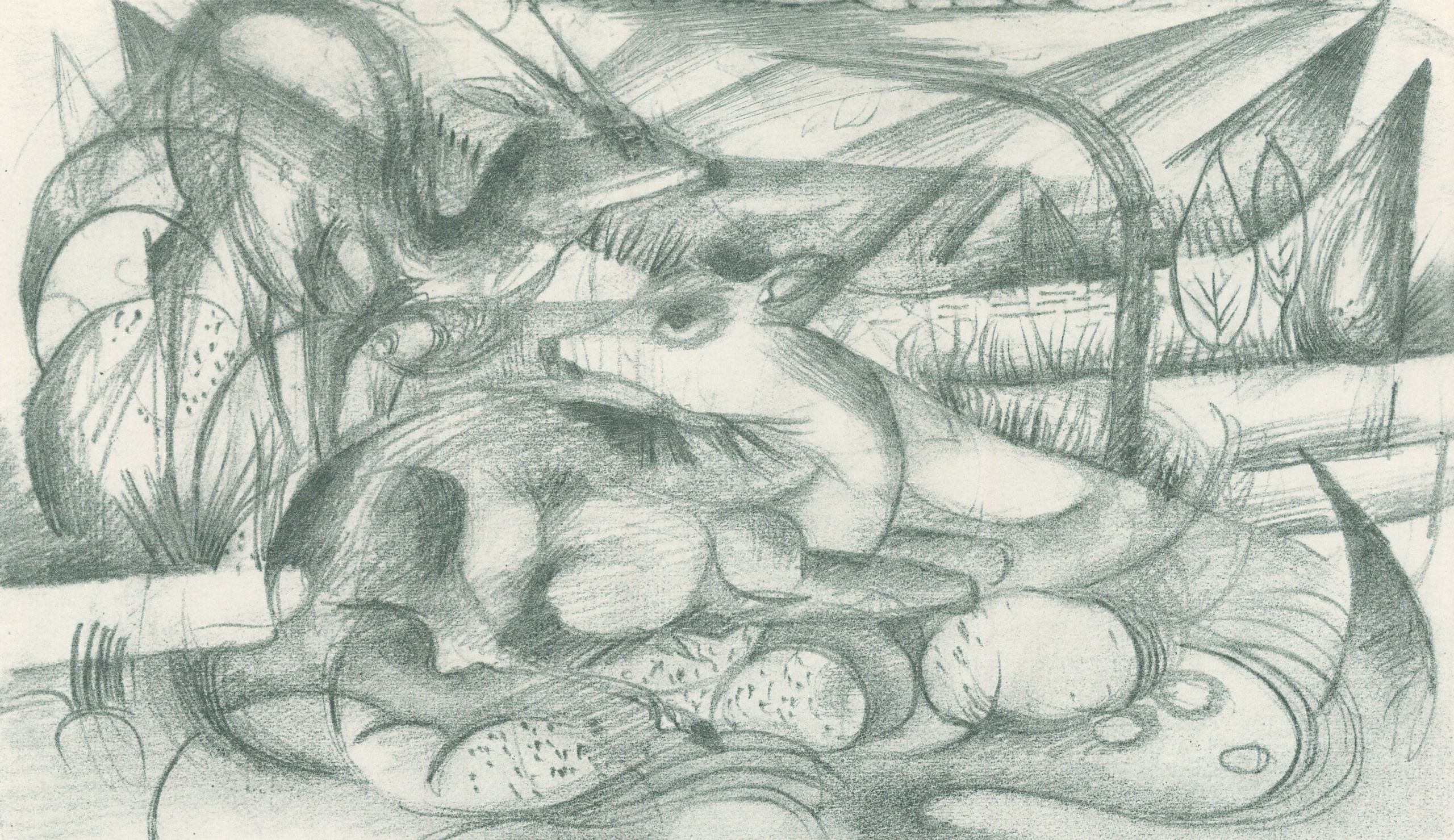
Franz Marc, Skizzenbuch aus dem Felde, Skizze 24, 1915
I recently looked harder at Franz Marc’s experiments with poetry. I think you could say that much of Marc’s writing borrows structurally from poetry, and Marc read a lot of poetry, including all of the classics you’d expect, work by people he actually knew, such as Gottfried Benn and Else Lasker-Schüler. He was also interested in French Symbolist Stéphane Mallarmé, particularly Un coup de dés jamais n’abolira le hasard of 1897, having extensively annotated a copy of the text; contact with Hugo Ball, who was influenced by Mallarmé’s text/design, probably heightened Marc’s attention.
From 1912 Marc made doodles of lines of the following poem here and there, and of course the last line is what Marc had originally intended to be the title of the painting we know as Tierschicksale (1914). But it was not until 1915 he wrote these phrases down all together in his small portfolio of drawings made in Germany and France, during the war. It’s hard to say what the poem means, especially in the context of the (approximately – some leaves may be lost) 35-page sketchbook’s compact animal images, it is very interesting. A translation is elsewhere but here is the original poem:
“…ein rosafarbner Regen viel [sic] / auf grüne Wiesen. / die Luft war wie grünes Glas. / das Mädchen [sah auf’s] blickte ins Wasser; das Wasser war klar [rein] wie Kristall; da weinte das Mädchen. / die Bäume zeigten ihre Ringe; die Tiere ihre Adern”.
(Abgedruckt in: Klaus Lankheit: Franz Marc: sein Leben und seine Kunst. Köln: DuMont 1976, S. 124.)
by Jean Marie Carey | 26 Aug 2012 | Animals in Art, Art History, Franz Marc, German Expressionism / Modernism, Music, Re-Enactments© and MashUps
Apollinaire was very popular in Bonn and in Berlin, where he befriended Herwarth Walden, who, among other things, occupied a societal role similar to that of Apollinaire. Apollinaire also wrote and drew quite prolifically, of course, in addition to being a tastemaker around whom a circle of other artists and authors coalesced.
In early 1913, August Macke was very excited when not only Apollinaire but Robert Delaunay (and later Max Ernst) came to hang out at his place. Apollinaire spoke German very well, also. Anyway, AM just loved these guys, and generally began trailing them around and writing to them all the time and so on.
There is much more to this story, some of it very exciting, and be assured I will get to it all shortly…
However not everyone was enchanted by Apollinaire. That “not everyone” included, well… for the immediate subject at hand, Franz Marc. FM actually had little use for Delaunay, after a (short) while, either. During 1913, FM pesters Delaunay with tons of perplexing, unsolicited criticism, finally in one outburst declaring that RD wasn’t a very good writer, either.
Apollinaire did like FM’s work, but FM kept a distance. Today upon discovering that it is Apollinaire’s birthday, well, what can I say? It explains a lot. Here is a very comprehensive if somewhat outdatedly designed Website about Apollinaire.
AM finally told FM, basically, to stop embarrassing him in front of his cool new friends. FM pointed out that it was he who had introduced these three to one another, and, that also, RD was kind of a jerk, refusing to give AM anything but a scrap of used drawing paper (like literally AM was begging for any type of memento and that was what RD let him have!). Anyway, RM and AM fought all the time as it was, so this altercation of course could not be resolved swiftly or in a few words and continued over the course of some petulant correspondence and huffy silences…full citations to come. FM was jealous, of course, but also he hated to see AM fall in with people he thought embodied the worst characteristic of all, that of being fake.
Fortunately, since everything that has happened before will happen again, this throwdown has been re-enacted by two parallel characters in one of the most important documentaries of our time (it had to be peddled as fiction because of the potency of its truth), Mean Girls (2004).
Above is the epic scene in which Janis Ian (as FM) confronts Cady Heron (as AM) [we won’t even get into the whole LiLo thing here, or about… nevermind) about being plastic…
With a special guest appearance by Damian as Helmuth Macke.

by Jean Marie Carey | 13 Jun 2010 | Art History, Franz Marc, German Expressionism / Modernism
Franz Marc’s best known writing is his public manifesto-ing, and also his correspondence with colleagues and family. But Marc also wrote on the covers of and inside his various sketchbooks all the time. This verse from around 1910 is really trippy in a Rimbaud sort of way. Some of the imagery and words come up again in paintings and painting titles. Thomas de Kayser, the editor of the volume in which this appears, organizes this material by theme very agreeably. Text in French follows the English translation.
Notes in the sketchbook XXVIII
— A pink rain fell over meadows.
— The air is like green glass.
— The girl [observed] looked into the water, the water was clear [as] crystal, the girl was crying.
— Trees had their growth rings, the animals their veins.
Notes in the sketchbook XXXI
The storm roared.
I entered the house and saw all
A tall woman red small black cat [playing] on the green table.
Kraak, lightning strikes the vehicle – the beautiful little cats were playing with the woman, she smiled – ah ah [poor] man and horse are [is] dead. [The man cries] [sky] the angel of fear knocks at the window; the [poor woman] I could shake the red heart of the woman and black kittens knew the green table – what it [?], red and black and green? Three colors give it a thought? If we give to the red heart shape, the black that [one of three interspersed] small kittens, green form of [a large square plate ?…] the square.
I meditate on that thought.
The red heart of the woman breaks.
It [comes] springs a [blood …] [a streak of blood] A stream of blood [across the sky due] which falls into the river, it flows through the now red green pastures grazed by sheep or black.
The storm has withdrawn his hand from the earth.
The blue sky [?] Ogle like a gigantic glass eye the scene [of] red, green, and black, this thought is not it terrible? […] Do you understand what the painters paint?
(more…)