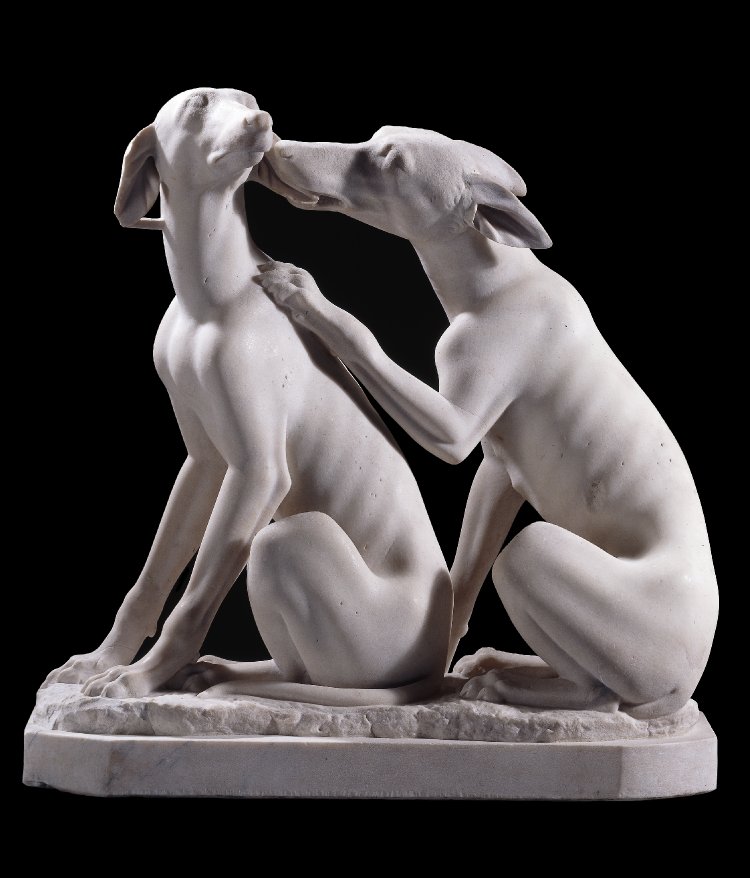
Sighthounds in the Art of the Ancient World
The Townley Greyhounds
The artistic expression of human relationships with animals has been and remains deeply complex and shifting. From the shaggy predators of the Lascaux Cave paintings to the costumed, hyperreal Weimareiners in the photos of William Wegman, the canine form has been especially popular with artists as both an ad hoc subject and a highbrow icon. A particular type of dog, the Cirneco dell Aetna, or Italian Greyhound, appears quite often in the art of ancient Greece and Rome, enjoying a commonality shared only with cattle and horses.
The Italian Greyhounds, however (as we shall call them henceforth), literally crossed the threshold in the ancient world, entering households not as steeds for work and war or sacrificial offerings, but as companions and objects of beauty.

The aim of this paper is to point out for consideration some examples of Italian Greyhound imagery from several ancient eras and geographical locations, to describe the history of this breed of dog in relation to its popularity in Greece and Italy, to draw a few conclusions about the dogs’ visual evolution and the reasons for its prevalence, and to show how both the animal and its image continued as both an influence and a viable species beyond the end of the Roman Empire. A starting point is to describe the nature and appearance of the Italian Greyhound, a species which exists fundamentally unchanged from its earliest days.