by Jean Marie Carey | 8 Feb 2014 | Animals, Animals in Art, Art History, Franz Marc, German Expressionism / Modernism, LÖL, Re-Enactments© and MashUps
Tierschicksale, 1914, Franz Marc
Was kann man thun zur Seligkeit als alles aufgeben und fliehen? als einen Strich ziehen zwischen dem Gestern und dem Heute? – Franz Marc, February 1914, from the intended introduction to the second edition of the Blaue Reiter Almanac. First printed in Der Blaue Reiter. Dokumentarische Neuausgabe by Klaus Lankheit. München, 1965, p. 325.
One of the most frequently cited articles about Franz Marc in popular literature is Frederick S. Levine’s “The Iconography of Franz Marc’s Fate of the Animals” from a 1976 issue of The Art Bulletin, and, subsequently, a short book on the same subject. Apparently there are some issues with the accuracy of the translations presented in both. What’s interesting to me is the creative idea Levine had to analyze Marc’s enormous 1913 painting Tierschicksale (mysteriously residing in the Kunstmuseum Basel) as an expression of Ragnarök, the apocalypse of Norse mythology. My opinion is that despite being generally familiar with the Eddas and with Der Ring des Nibelungen Marc wasn’t that interested in these sagas and didn’t consider them as particularly German.
A few years ago Andreas Hüneke, researching at the Lenbachhaus, discovered that the inscription on the back of the painting, „Und alles Sein ist flammend Leid“ is from a volume of the Buddhist Dhammapada of the Pali Canon of Buddha Siddhartha Gautama given to Marc by Annette von Eckardt. So it doesn’t seem to refer to Ragnarök directly as Levine (not having the benefit of Hüneke’s recent work) asserts. It seems more likely that Marc was very distressed, in the summer of 1913 when he made Tierschicksale, about von Eckardt’s move away from Munich to Sarajevo. It explains a little bit about why, upon seeing the painting again a few years later, Marc says he doesn’t even remember creating it and ascribes its meaning to the more external conflagration at hand.
In any case, Levine was not discouraged by his translating experience and went on to the faculty at Palomar College in California and also spent a lot of time studying and teaching at the University of Tasmania in Hobart.
Today, on Marc’s birthday, with so many animals imperiled, Tierschicksale doesn’t really need any overdetermining; it would be very tempting to just turn and flee, if only there was somewhere to go.

by Jean Marie Carey | 24 Dec 2013 | Art History, Franz Marc, German Expressionism / Modernism, LÖL, Re-Enactments© and MashUps
August Macke, Märchen (Sindelsdorf), 1911, Gouache, Deckweiß, Aquarell August Macke, Märchen (Sindelsdorf), 1911, Gouache, Deckweiß, Aquarell
Franz Marc note to August Macke:
19.12.1910
Sindelsdorf
Du Gauner und alter Kulissenschleicher,
schwelge nur ruhig in den Kulissengeheimnissen anderer, einmal und zwar bald, (hörst Du?), musst Du auch aus Deinen Kulissen heraus vor die Rampe, dann schleich ich hinter Dich und beseh mir die Garderobe dieses Genies. – Übrigens lasse ich jetzt einen F …. nach dem anderen in meiner Malerei, – hörst Du sie nicht? Dröhnend!! Ich rechne nicht mehr auf den Besuch der Leute vor Weihnachten und werde also Deine Sachen nächstens zusammenpacken; es tut mit wahrhaftig leid, – sie sind mir so vertraut und lieb geworden. Soll ich die Sachen von Helmuth auch alle dazupacken? Vielleicht schicke ich das gerahmte Stilleben einmal eigens, wenn es Dir damit nicht eilt. Schreib mir bitte darüber. Grüsse Frau Lisbeth herzlichst. Viel Glück und ›Mut‹! zum Einzug in’s Atelier!
Dein Fz. M.
• • •
Although FM kind of jokes here about it perhaps being time for Helmuth Macke – who has only just arrived – to depart, FM quickly gets used to having Helmuth around. At the end of the same month, the nurturing, self-possessed teenager makes art history happen…
by Jean Marie Carey | 2 Dec 2013 | Art History
Lorna Simpson @ Haus der Kunst
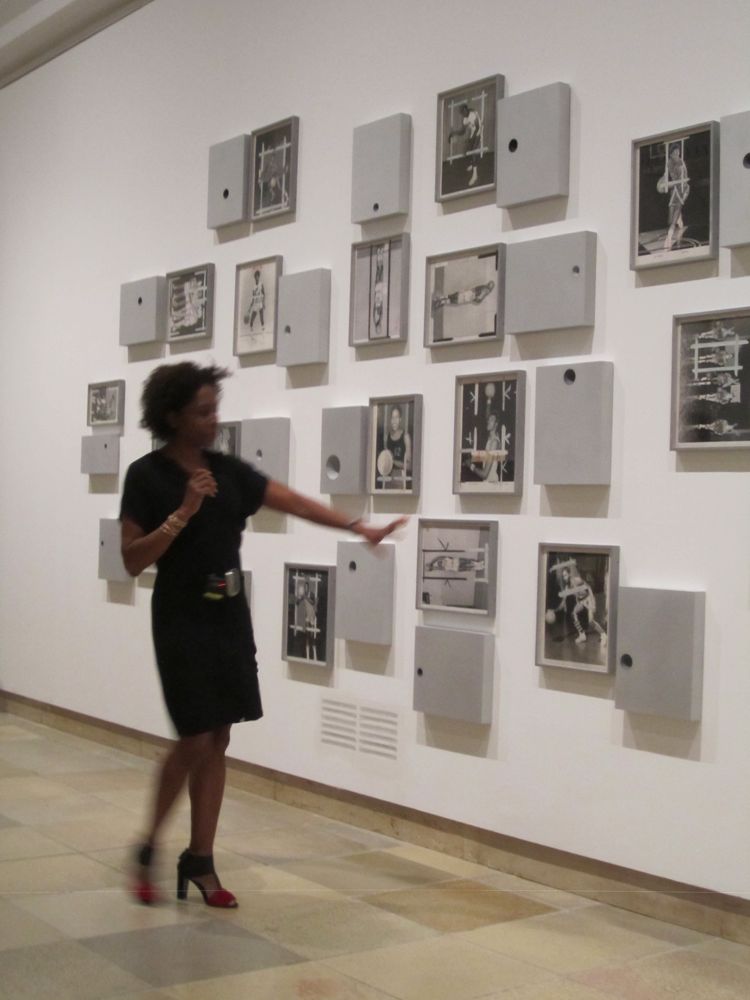
One of the aspects of Lorna Simpson’s work I have always admired is the technical quality of her photographs. At her recent press conference at Haus der Kunst she confirmed what you’d expect from examining the gelatin prints in particular but really, upon close in-person inspection, her oeuvre: that Simpson develops, prints, mounts and even frames most of her photos by herself in a darkroom/studio in New York City.
This sort of mid-career retrospective represents more than 30 years of of photography, film, video, and drawing. Known (as in these photos have entered the canon) for her mid-1980s for her language driven large-scale works combining photographs and text, Simpson’s effective enigmas are clearly coded but spacious enough to still wonder about. One of the most interesting works on view in München are a series from the 1990s of large multi-panel photographs printed on felt, accompanied by text panels describing their locations and the intimate encounters that are described but only hinted at visually. At the edge of the Englischer Garten where something exactly as described is probably happening right now only not as well concealed, the effect was actually humane and tender as opposed to amusing. The exhibit, which unfortunately overlaps with some other very strong show and with Haus der Kunst’s interactive festival also showcases Simpson’s film and video works, a group of watercolors, and an archive of found photographs from the 1950s, which Simpson has embellished by creating replicas of, posing herself to mimic the originals.
by Jean Marie Carey | 10 Nov 2013 | Art History, Franz Marc, German Expressionism / Modernism
Atlas Mikromega @ the Lenbachhaus
A few years ago I went through a phase of being consumed with interest in Gerhard Richter’s cycle of 15 paintings, Baader-Meinhof (18. Oktober 1977). Writing this now my obsession seems doubly strange because I did not then have the geographic or cultural context for these works I have in 2013. One spring break I had seen the paintings – based upon photographs of Ulrike Meinhof, Holger Meins, Gudrun Ensslin, Andreas Baader; the funeral of Jan-Carl Raspe, and Baader’s books and record player – at the Museum of Modern Art and had a very strong reaction to them. I think I explored this subject so intently because my response was the opposite from my feelings for Franz Marc’s animals. The blurred details of the black and white photographs of portraits, news stills, and police snapshots made the subjects abjectly lifeless. The effect was like the dream of freezing; cold, sad, and bitterly empty. The paintings made me drained and ill. Yet I was fascinated by the tension – and desire – that was generated by being repelled by images whose subjects I was very drawn to.
(more…)

by Jean Marie Carey | 5 Nov 2013 | Animals, Animals in Art, Art History, Franz Marc, German Expressionism / Modernism, LÖL
Recovered Blue Horses
So you have probably heard by now the incredible story of how hundreds of amazing paintings were recovered right here in München – right here in Schwabing! – from the derelict apartment of an “art dealer” who had stored them in haphazard fashion amid cans of apricots and bottles of sherry. Included in the cache are long-missing works by Max Beckmann, Picasso, Renoir, Matisse. Of course most happily found is the painting above, one of Franz Marc’s Blue Horses missing for more than 70 years.
It has been super-exciting to be so lucky to be here for this momentous occasion. Everyone – not just at the museum but everyone in the city – is talking about the fantastic aspects of the story (please read up on it; it’s sure to become even more fascinating) but what is most awesome is the jubilation and delight people are expressing. I can’t think of many places where a city-wide celebration would erupt over such a story.
Of course I am not unmoved. FOCUS magazine broke this story on Monday. When I saw the headline in the Süddeutsche Zeitung’s Twitter feed I ran out to the news vendor to get a copy and snagged the last one, and the last print SZ in the stack too. I am very happy to have these print artifacts of this wonderful occasion.
Here are links from the Daily Mail (UK); Time Magazine (US); and Süddeutsche Zeitung (DE).
I am thrilled that one of the missing Blue Horses was found period, but it’s beyond overwhelming to be right here…Hopefully Turm der Blauen Pferde is hanging out in someone’s garage or wine cellar or something.