
by Jean Marie Carey | 12 Mar 2017 | Art History, Expressionismus, Franz Marc, German Expressionism / Modernism
While I was in New York City for the College Art Association meeting – more on this next post – I was really busy and also sick the entire time. Fortunately though I did get to go to a few museums, and a significant highlight was the Max Beckmann in New York exhibition at the Metropolitan Museum of Art Fifth Avenue. (My review of the catalogue of the show for Museum Bookstore is on their blog, and in part below).
When I last left Beckmann in my research, he had forlornly been rejected by the groundbreaking Köln Sonderbund show of 1912 because his work was deemed too old-fashioned. This was found to be hilarious by Beckmann’s self-appointed foil, Franz Marc, who had withdrawn his own work from the Sonderbund on the grounds that the entire exhibit was too old-fashioned and boring for his animal paintings.
Over the years I’ve come to appreciate Beckmann’s devotion to his own vision and embrace of the sort of contemporary history painting that forms an important aspect of the Neue Sachlichkeit, though beyond its opposition to Expressionism, Beckmann did not think himself a part of that or any school or movement.
Staged at the Met in what turned out to be the last week of employment of director Thomas Campbell, my aesthetic reaction was that the paintings, mostly large portraits and a few of his famous triptychs, would have better served Beckmann by being installed in a single large hall. This is a small complaint though because even on a crowded Saturday it was possible to see the paintings well enough.
People were very interested in “Woman with Mandolin in Yellow and Red,” 1950.
(more…)
by Jean Marie Carey | 5 Dec 2013 | Animals, Animals in Art, Art History, Dogs!, Italian Greyhounds, Re-Enactments© and MashUps
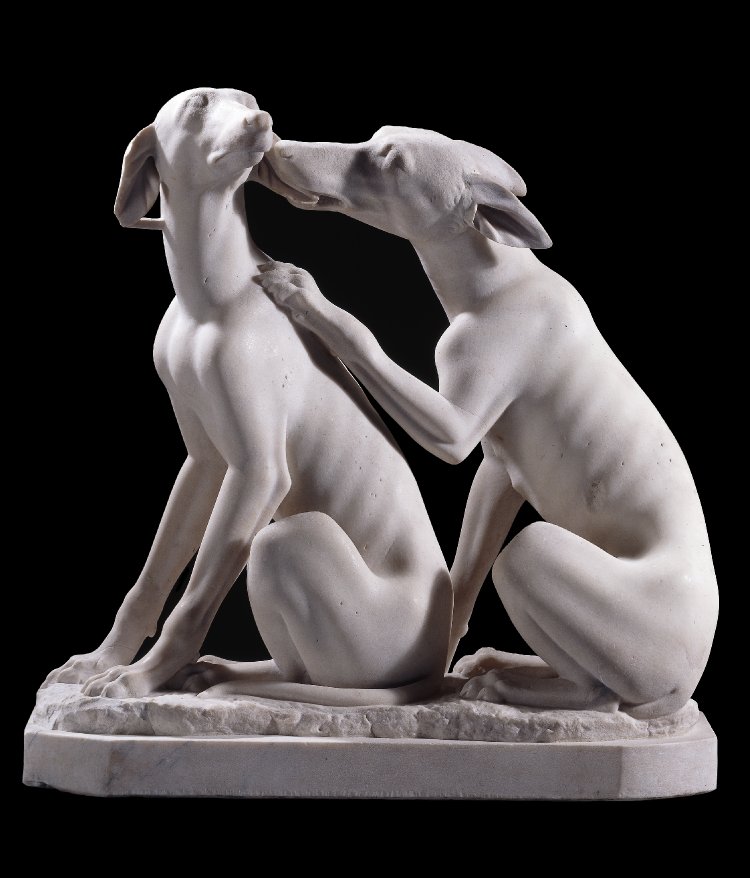
The Townley Greyhounds
The artistic expression of human relationships with animals has been and remains deeply complex and shifting. From the shaggy predators of the Lascaux Cave paintings to the costumed, hyperreal Weimareiners in the photos of William Wegman, the canine form has been especially popular with artists as both an ad hoc subject and a highbrow icon. A particular type of dog, the Cirneco dell Aetna, or Italian Greyhound, appears quite often in the art of ancient Greece and Rome, enjoying a commonality shared only with cattle and horses.
The Italian Greyhounds, however (as we shall call them henceforth), literally crossed the threshold in the ancient world, entering households not as steeds for work and war or sacrificial offerings, but as companions and objects of beauty.

The aim of this paper is to point out for consideration some examples of Italian Greyhound imagery from several ancient eras and geographical locations, to describe the history of this breed of dog in relation to its popularity in Greece and Italy, to draw a few conclusions about the dogs’ visual evolution and the reasons for its prevalence, and to show how both the animal and its image continued as both an influence and a viable species beyond the end of the Roman Empire. A starting point is to describe the nature and appearance of the Italian Greyhound, a species which exists fundamentally unchanged from its earliest days.
(more…)

by Jean Marie Carey | 17 Feb 2013 | Animals, Animals in Art, Franz Marc, German Expressionism / Modernism, Re-Enactments© and MashUps
It was actually a very solemn week and past few days but in recounting some stories it’s easier to begin with flashes of humor, and there were a few extremely funny episodes to report.
The first was while visiting the Cloisters. After viewing the very disturbing (to me) tapestries of the allegorical (but very graphically woven) hunting of the unicorn we came upon this:
Called a Palmesel; this model dated 1470 is from a church in Mellrichstadt – perhaps I should have guessed that such a fun crazy object would come from Bavaria – and apparently they continued to be quite popular in the beautiful south to the relatively modern times, protected from the Reformation.
We went to the Metropolitan Museum of Art which is another whole story I will get to…but, in trying to dash through the rooms and rooms of Impressionism to come out in the relatively tiny alcove of the good stuff, out of the corner of my eye, I spotted this:

I think he means “peniche.”
M^2 knew what time it was but the group of admirers who were lingering to count the dots or whatever were perplexed by our laughter so as you can see I had to share this important re-enactment with them. It’s kind of hard to explain anyway, but the people seemed amused and we were also very cheerful.
