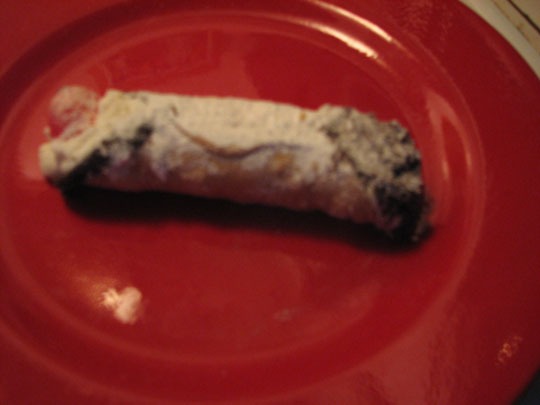
Most Decorated Cannoli Ever
Purchased at Publix on East Lake Road in Palm Harbor. Adorned with cherries, chocolate sprinkles, chocolate icing, and powdered sugar.

Purchased at Publix on East Lake Road in Palm Harbor. Adorned with cherries, chocolate sprinkles, chocolate icing, and powdered sugar.

Still Life With Parrots, Still Life with Parrots Jan Davidz. de Heem 1606-1684
Formal Analysis: Still Life With Parrots
Jan Davidsz. de Heem, who also fixed his signature as Johannes de Heem and J D de Heem ((Ildikó Ember, Delights for the Senses: Dutch and Flemish Still-Life Paintings from Budapest (Seattle, WA.: University of Washington Press, 1989) xiv)) , worked in Antwerp, Utrecht, and Leiden during the middle decades of the 17th Century, distinguishing himself from his mentor Balthasar van der Ast ((Arie Wallert, Still Lifes: Techniques and Styles: The Examination of Paintings from the Rijksmuseum (Zwolle, The Netherlands.: Waanders Publishers, 1999) 61.)) by pushing the form of the still life to include not just a signature patch
of angled lighting but elements and objects in his reflective collections arcane to the point of being obviously grotesque. Though many of de Heem’s canvases are simply beautiful — Communion Cup and Host, Encircled with a Garland of Fruit and Vanitas — Still Life With Parrots though produced during the same approximate period, does not fall into this category. Rather its disharmonious florid colors, strategically chaotic placement of objects, and zoological inaccuracies create tensions and puzzles which are depthlessly fascinating.
Still Life With Parrots is an oil painting measuring approximately five feet high and four feet across — enormous, particularly by the standards of its date of creation sometime in the latter half of the 1640s.
In another break with his habit of observing strict and straight diagonal composition lines, Parrots is filled with jagged, broken planes and difficult, harsh contours, this despite the presence of many objects — oysters, plums, lemons — with rounded, convex surfaces unto themselves. Several objects — a extraordinarily large gold and silver tazza, a conch shell, and a macaw are presented in unrealistic perspectival distance, competing for dominance. The single level surface shown is a horizontal tabletop splitting the canvas in its lower third, but only a single, flat, right-angle of the table is shown at the left of the painting, the rest of the furniture shrouded in a cloth.
(more…)

“Mega-Exhibitions and the Antimonies of a Transnational Global Form” by Okwui Enwezor vs. “The Globalization of the False: A Response to Okwui Enwezor” by George Baker
Theorist and curator Okwui Enwezor, who had written and published this paper on the emerging globalization of the art market and its relationship for better and worse to capitalism as the universally dominant system of commerce, repurposed and edited his original piece to accommodate a tandem presentation at Columbia University’s 2002 Sawyer Seminar. Presenting an opposing and decidedly more personal address was art critic George Baker.
Anolis carolinensis, green anole
Anolis carolinensis, the green anole, Florida’s only native anole species, May 2007
Enwezor allows that the so-called globalization of the art market is not seen be a positive by all ((“Mega-Exhibitions and the Antimonies of a Transnational Global Form†by Okwui Enwezor. 4)), but proposes, basically, that the world globalization be associated not just with the economic hegemony of the very wealthy individuals and institutions who collect and purchase art objects and support their creation but with a true internationalization of the art world. In this new and improved postmodernist art world, the old canon of art stars and art history would implode what would now occur would be the “broadening … of international participation across a range of cultural, social, and political spheres. ((ibid., 4))â€
(more…)
“One Place After Another: Notes on Site Specificity” by Miwon Kwon reprinted in Theory in Contemporary Art Since 1985 edited by Zoya Kocur and Simon Leung.
Architectural theorist, occasional curator, and UCLA professor of contemporary art history Miwon Kwon dissects the meaning of the word “place” as it pertains to art in public places and the changing role of the installation-maker in “One Place After Another: Notes on Site Specificity.” This essay which originally appeared in the influential journal October in 1997 was such a success in the critical theory community that Kwon published a book-length updated edition in 2002.
Kwon makes several points though her primary thesis is simply that site-specific art has changed greatly since the so-to-speak groundbreaking days of Robert Smithson’s Spiral Jetty and smaller but no less controversial pieces such as Richard Serra’s Tilted Arc ((“One Place After Another: Notes on Site Specificity†by Miwon Kwon reprinted in Theory in Contemporary Art Since 1985 edited by Zoya Kocur and Simon Leung. (Blackwell Publishing Ltd., Malden, Masachusetts, 2005). 32)) along with notions of commerce and integrity.
(more…)