by Jean Marie Carey | 15 Jun 2014 | Animals, Animals in Art, Art History, Franz Marc, German Expressionism / Modernism, LÖL, Re-Enactments© and MashUps
August Macke and Franz Marc packed the friendship of a lifetime into the few short years they had together from early 1910 to the summer of 1914, even with a few breaks for pouting and sulking. Some of their correspondence is recorded in a dedicated volume, and other letters, notes, stories, and recollections of their doings from other people are hidden in unpublished works and Expressionist apocrypha.
Macke and Marc enjoyed working on their art as a pair and in fact they both considered the drawings and sketches they made while just being together to fall into the class of “things we made together” on the same level as the few categorical objects to which we ascribe to their dual provenance, of which the mural Paradies, from 1912, is one. The mural lives now at the Westfalisches Landesmuseum für Kunst und Kultur in Münster, but it was made in the upstairs atelier of the Macke house (now the August Macke Haus ) in Bonn.
Given Macke’s constant scheming and hustling, and the sort of declarations of superficiality he seems to make about all that is admirable in painting, it is easy to think of him as being a sort of light shadow to Marc’s heavy element, but this is not at all true. And Marc often seems supremely naïve and dopey in his out-of-itness, which was also more of an occasional condition. However, the story attendant to the making of this mural finds them both in exactly these roles.
In fact as soon as I learned more about how Paradies was made, I immediately thought of the famous story in Mark Twain’s The Adventures of Tom Sawyer printed below. In fact there is not much I can say about it, or as well.
Paradies, August Macke and Franz Marc, 1912
Excerpt from Tom Sawyer: Chapter 2
“Hi- yi ! You’re up a stump, ain’t you!”
No answer.
Tom surveyed his last touch with the eye of an artist, then he gave his brush another gentle sweep and surveyed the result, as before. Ben ranged up alongside of him. Tom’s mouth watered for the apple, but he stuck to his work. Ben said:
“Hello, old chap, you got to work, hey?”
Tom wheeled suddenly and said:
“Why, it’s you, Ben! I warn’t noticing.”
“Say — I’m going in a-swimming, I am. Don’t you wish you could? But of course you’d druther work — wouldn’t you? Course you would!”
Tom contemplated the boy a bit, and said:
“What do you call work?”
“Why, ain’t that work?”
Tom resumed his whitewashing, and answered carelessly:
“Well, maybe it is, and maybe it ain’t. All I know, is, it suits Tom Sawyer.”
“Oh come, now, you don’t mean to let on that you like it?”
The brush continued to move.
“Like it? Well, I don’t see why I oughtn’t to like it. Does a boy get a chance to whitewash a fence every day?”
That put the thing in a new light. Ben stopped nibbling his apple. Tom swept his brush daintily back and forth — stepped back to note the effect — added a touch here and there — criticised the effect again — Ben watching every move and getting more and more interested, more and more absorbed. Presently he said:
“Say, Tom, let me whitewash a little.”
Tom considered, was about to consent; but he altered his mind:
“No — no — I reckon it wouldn’t hardly do, Ben. You see, Aunt Polly’s awful particular about this fence — right here on the street, you know — but if it was the back fence I wouldn’t mind and she wouldn’t. Yes, she’s awful particular about this fence; it’s got to be done very careful; I reckon there ain’t one boy in a thousand, maybe two thousand, that can do it the way it’s got to be done.”
“No — is that so? Oh come, now — lemme just try. Only just a little — I’d let you , if you was me, Tom.”
“Ben, I’d like to, honest injun; but Aunt Polly — well, Jim wanted to do it, but she wouldn’t let him; Sid wanted to do it, and she wouldn’t let Sid. Now don’t you see how I’m fixed? If you was to tackle this fence and anything was to happen to it — ”
“Oh, shucks, I’ll be just as careful. Now lemme try. Say — I’ll give you the core of my apple.”
“Well, here — No, Ben, now don’t. I’m afeard — ”
“I’ll give you all of it!”
Tom gave up the brush with reluctance in his face, but alacrity in his heart. And while the late steamer Big Missouri worked and sweated in the sun, the retired artist sat on a barrel in the shade close by, dangled his legs, munched his apple, and planned the slaughter of more innocents.

by Jean Marie Carey | 23 Mar 2014 | Animals, Animals in Art, Art History, Dogs!, Franz Marc, German Expressionism / Modernism, LÖL, Re-Enactments© and MashUps
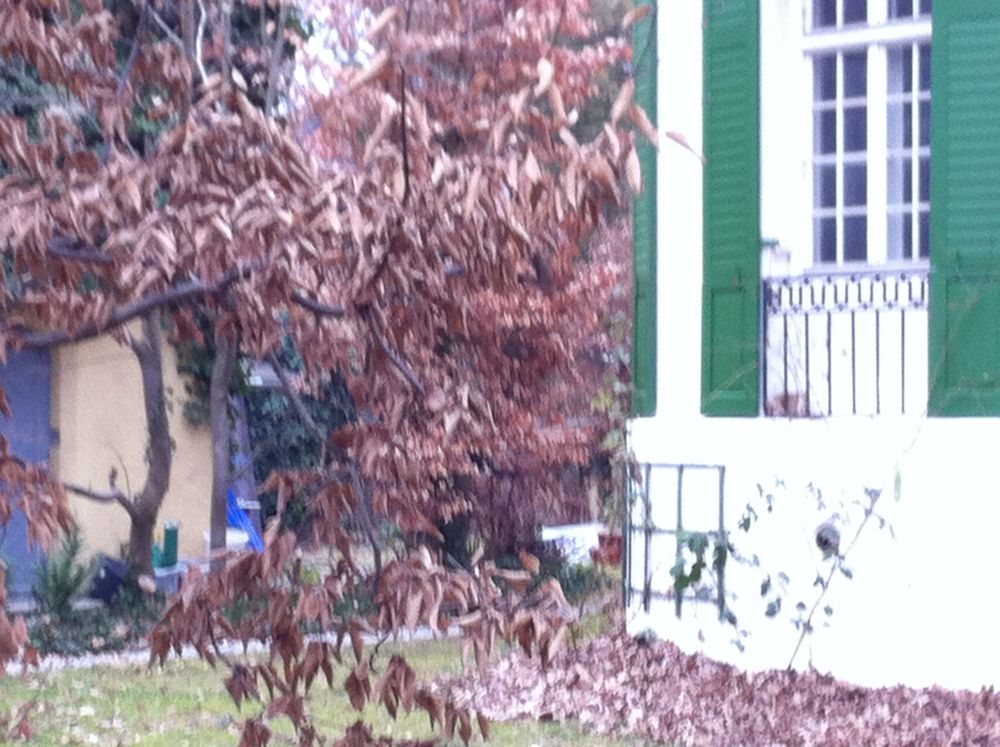
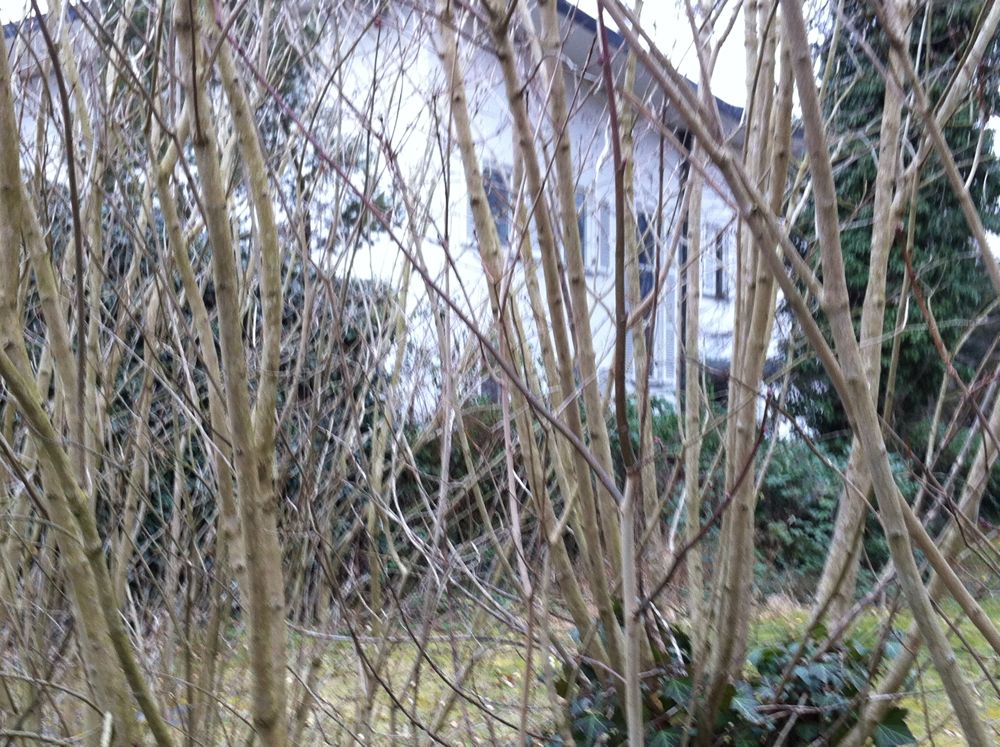
Franz Marc’s family home in the München suburb of Pasing.
I’ve written a little bit about (we’re saving our full repertoire for our even-bigger-screen reveal) the accidental hobby of my creative partner and myself, a sort of reverse geocaching + film. Basically we found out we like to research the addresses of art-historical places and find the spot on the earth where they once stood. In most of these cases, such as the pop-up gallery in Berlin search which ended up being recorded during a blizzard, or the colorful studio here in München destroyed in the war, we had city records and things like invitations to or posters for exhibits to go on, and it was possible to figure out, even where addresses had changed or buildings had been demolished, where they once stood. Sometimes we were able to use GPS coordinates, tagging our own maps as we went along, and sometimes we just used a compass, building keystones, and asking questions. Most of these excursions took a couple days of research and a one-shot hike.
Franz Marc’s family house in the München suburb of Pasing turned out to be our biggest challenge, though, and somewhat unexpectedly since Pasing was never destroyed and a lot of the old buildings have been preserved. However, perhaps not surprisingly, neither were Sophie and Wilhelm Marc, the parents of Franz, nor Paul, Franz’s brother, either very good with managing money nor with keeping records. Thus as it turns out the Marcs owned the house through a chain of convoluted machinations, so the normally very useful city and state records were not helpful. We assembled our clues – fragments of notes and letters mostly, and importantly, photographs showing the house and the yard – and set off to Pasing with only a couple of bottles of water because “how big can Pasing be?”.
Well, Pasing is not that big, but, never underestimate the amount of confusion Franz Marc can cause. On our first journey (like, on the Straßenbahn Linie 19 so not that far) we walked around the neighborhood with the most Altbauten – nothing. The second day we knew to bring some snacks, but, still, after many hours – nothing. We were getting a bit anxious time-wise, and looked over all our notes again. I kept going back to the photographs, which showed very clear views of the property including which way the shadows were falling, and, since they photos were clearly taken in summer, and then in winter, you could see which way the house itself faced. We decided on the third trip to just be more playful and counterintuitively left everything at home but the camera, and getting off the tram just walked in a direction that seemed, for lack of a better way to describe, enticing and pleasant.
Not even half an hour into the walk, we turned a corner, and there it was. The other times we had been going completely in the wrong directions, by the way. Even if I didn’t know from the photographs, I would have just known, I think, that this was a place the Marc family would have lived. It’s a comfortably large enough home, but kind of secluded, even though it’s on city block, with many trees that were saplings in the photographs, a sort of open gazebo, and many eaves and places for birds to live. It definitely had an aura and I was very happy to have found the place – it made me feel very light at heart – and happy that the Marcs had lived there. Sophie Marc stayed on at the house after Wilhelm Marc died in 1907 until she went to stay with Maria Marc later in 1914 (yes, Sophie Marc outlived Franz by just a few months).
Unfortunately, as you can see from the photos, the home is abandoned and in desperate need of some repairs. It’s probably not habitable the way it is now. I dearly hope someone will lovingly restore this historic treasure. If that person is you, please write to me and I will send you the address!
Once my heart had turned to being interested in “recovered biography” I realized how important it is to actually physically experience places and things important in the life of Franz Marc. It’s incredible to me that in a place as self-consciously “historic” as Bayern so many things are falling away. In 2013, the Goltz book store closed its physical location on the Türkenstraße, which should really have been outlawed or something. We did make some documentation of that location, too, though. But that is another story.
UPDATE: May 2015
In some recent research I was doing about some other property records and dates of births and things, I ran across an interesting fact: Around 1885-1900, Annette von Eckardt and her family, which then would have included her baby daughter Helene and husband Richard Simon, a professor at Ludwig-Maximilians Universität, lived in Pasing. By this time Richard Simon would’ve known Paul Marc, Franz Marc’s brother who also taught at the university, and who still lived with the family in Pasing, too. I’m writing something for publication about these interconnected relationships for soon, so…watch this space. The implications are interesting, and a little disturbing, too, but my intuition has been givine me this message for a long time…
by Jean Marie Carey | 30 Oct 2008 | Art History, Italian Greyhounds
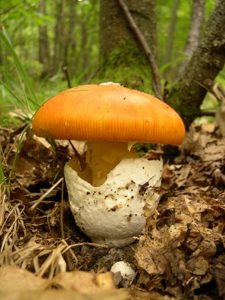
Caesarea Mushroom
This post is concerned with “Out of the Closet and into the Universe: Queers and Star Trek” by Henry Jenkins. Even though this piece is nominally about homosexuality vis a vis popular culture, the writer’s unifying field is not an idea, however, but an emotion, the unmoored nostalgia for an unrealized past that manifests as an incurable yearning projected upon the present and future.
Jenkins article, reprinted in 2004 without updates that would have allowed for the recognition of another Star Trek spin-off television series, Deep Space Nine, which provided a deeper consideration of gendering and alterity subjects, discusses a sort of popularly-based movement fomented by fans of the sequel to the original Star Trek, Star Trek: The Next Generation, to have an “openly” gay character join the multicultural, multispecies Enterprise crew. Further wishes included incidental portrayals of gay behavior, such as ambient, non-storyline driven asides to shots of men kissing and so on. There is certainly a genuine sweetness to the Trekkie fandom community amid the fanaticism attendant to the science fiction/fantasy core crowd.
(more…)

by Jean Marie Carey | 27 Jul 2008 | Animals, Art History
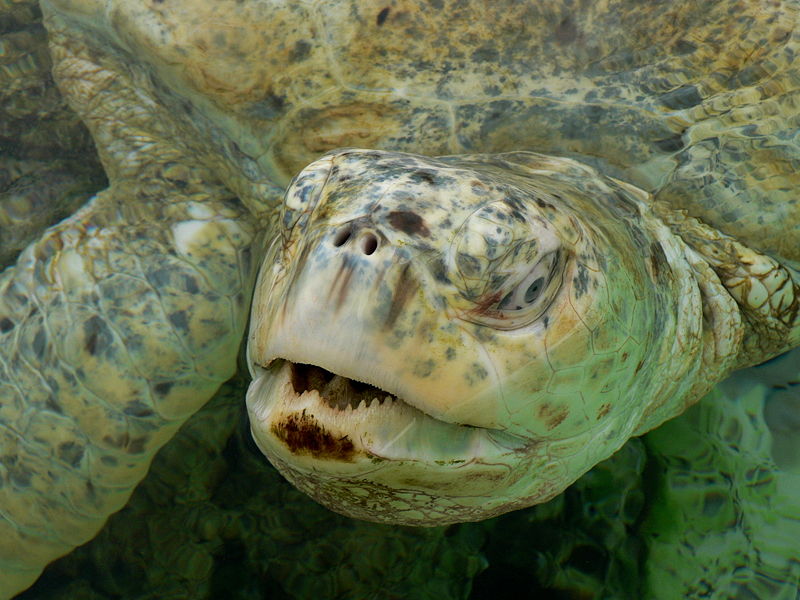
[Green turtle, albino. By David Monniaux]
“To photograph is to appropriate the thing photographed.”
On Photography, Susan Sontag’s exhaustive critique of photography, which excoriated photographers even as it elevated the art form, opens (in the 1977 book form of the collected essays) with the chapter “In Plato’s Cave.” Arranged and edited in this manner this chapter is meant to serve as the introduction to Sontag’s collection of ideas on the sociological implications of the medium of photography.
So much has been written by and about Sontag with respect to the construction and importance of these essays, and so much biographical detail about Sontag has come to light since her death a few years ago, that is it difficult to consider “In Plato’s Cave” unto itself, separate from that information, let alone separate from the other essays in the collection.
Basically, Sontag takes humankind to task, as did Plato, for sitting around accepting whatever images that happen to dance past as a perfect mirror (or projection) of reality and judges photographers equally harshly for approaching their subjects with acquisitiveness and predation. Sontag investigates the simile of the cave but more deeply the metaphor of the mirror.
I was interested to learn that Sontag had also written extensively about Persona, the 1966 Ingmar Bergman film, probably around the same time she began the series of essays that are collected in On Photography. Persona can also be construed as being about mirroring, and also about a kind of (seemingly) passive transmission and reception of knowledge, as well as a complicated examination about the relationship between the beholder and the beheld. Persona is open to interpretation as a horror movie rather than a psychological study, one in which a very modern sort of vampire sucks the being from a similar but not identical human. (more…)
by Jean Marie Carey | 3 Jul 2008 | Animals, Animals in Art, Art History
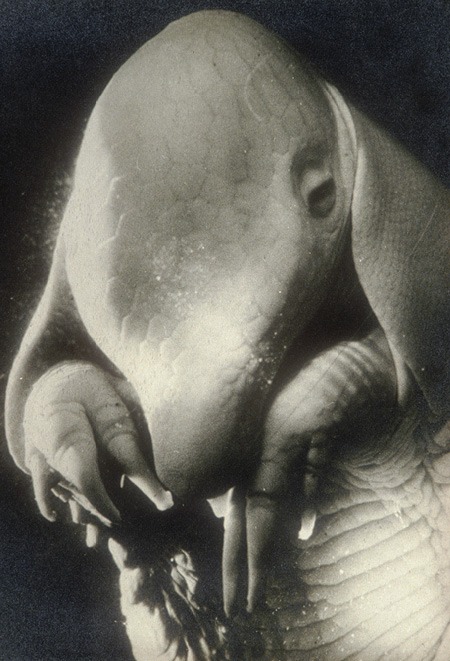
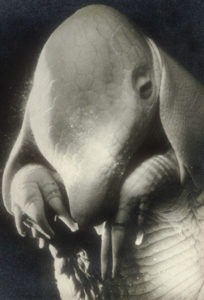
Pére Ubu by Dora Maar, 1936
Authorship by Dora Maar gives this photograph authentic historic and even feminist credibility but I chose it because my main interest in art overall is the representation of animals. This is a very interesting view of a creature commonly seen in Florida (and all over), an armadillo (though this armadillo is of a different species than the nine-banded creatures who sadly cannot navigate traffic).
There is something primitive and otherwordly about armadillos and whatever Maar’s intent may have been in elevating such a seemingly lowly creature into this eerie portrait it is quite a lovely study. Since Maar was interested in primitivism, this seems apt.
With respect to technique, placing the pale, scaly armadillo against a grainy dark background removes it from a natural setting and allows for contemplation of the texture of its skin. The shadows on its chest accentuate its claws. There is no way to tell, framed in this manner, how big the armadillo is, whether he is, as Maar’s title suggests, “king” sized, or tiny like a fetus, which the armadillo also resembles.