
by Jean Marie Carey | 20 Oct 2017 | Art History, Re-Enactments© and MashUps
During 2013 when I lived in München Gillian Wearing had a mid-career retrospective at Museum Brandhorst and a poster of the image you see here, “Self Portrait at Seventeen Years Old” (2003) was on placards all over the city as well as a huge replica on the side of the museum.
Gillian Wearing, “Self Portrait at Seventeen Years Old,” 2003; Claude Cahun, Self-Portrait, 1928.
The capstone nature of the show at least intimated that Wearing was moving on to subjects other than herself and I remember thinking that perhaps at last we had reached “peak self portrait.” This proved not to be the case specifically or generally.
I decided to review the catalogue of this exhibition in the hopes of re-examining Wearing and also setting the record correct about one of my favorite photographers, Claude Cahun. I feared when Gillian Wearing and Claude Cahun: Behind the Mask, Another Mask was announced at the National Portrait Gallery in London that is would offer yet another opportunity for female erasure, which is what happened in reviews such as this one from Aindrea Emelife of the BBC shrieking: “Claude Cahun: The Trans Artists Years Ahead of Her Time.”
In fact Cahun was a woman, a lesbian woman, who was perfectly comfortable with her biological sex. She was sentenced to death during her time on Nazi-occupied Jersey for refusing to renounce her lifetime lover, Marcel Moore, so it seems especially egregious to suggest Cahun wavered in her “identity.”
One of the most distinctive aspects of Cahun’s auto-portraits is that her strong features are never obscured, she is always recognisably herself, no matter what the costume or haircut. This is something Wearing, in her response to Cahun’s oeuvre, seems also to diminish, as the series made for this exhibition find Wearing immersed in full disguises as Cahun, Robert Mapplethorpe, Dian Arbus, and others.

Claude Cahun, “Untitled (I Am in Training, Don’t Kiss Me,” 1929; Gillian Wearing, “Self Portrait as Claude Cahun,” 2015.
(more…)
by Jean Marie Carey | 2 Dec 2013 | Art History
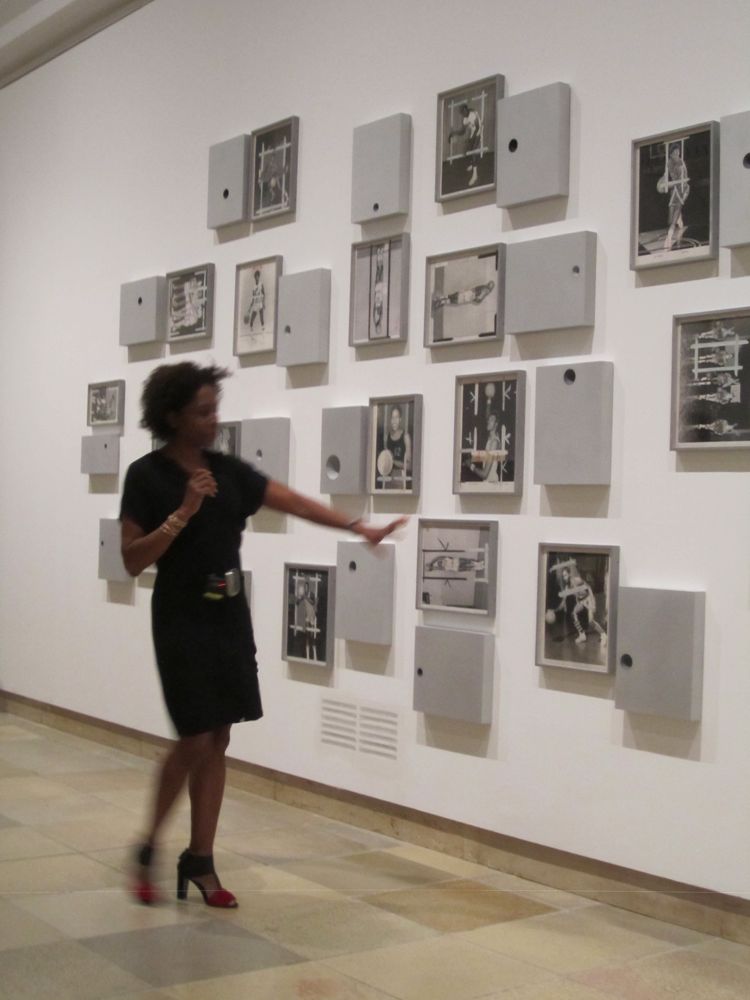
Lorna Simpson @ Haus der Kunst
One of the aspects of Lorna Simpson’s work I have always admired is the technical quality of her photographs. At her recent press conference at Haus der Kunst she confirmed what you’d expect from examining the gelatin prints in particular but really, upon close in-person inspection, her oeuvre: that Simpson develops, prints, mounts and even frames most of her photos by herself in a darkroom/studio in New York City.
This sort of mid-career retrospective represents more than 30 years of of photography, film, video, and drawing. Known (as in these photos have entered the canon) for her mid-1980s for her language driven large-scale works combining photographs and text, Simpson’s effective enigmas are clearly coded but spacious enough to still wonder about. One of the most interesting works on view in München are a series from the 1990s of large multi-panel photographs printed on felt, accompanied by text panels describing their locations and the intimate encounters that are described but only hinted at visually. At the edge of the Englischer Garten where something exactly as described is probably happening right now only not as well concealed, the effect was actually humane and tender as opposed to amusing. The exhibit, which unfortunately overlaps with some other very strong show and with Haus der Kunst’s interactive festival also showcases Simpson’s film and video works, a group of watercolors, and an archive of found photographs from the 1950s, which Simpson has embellished by creating replicas of, posing herself to mimic the originals.
by Jean Marie Carey | 18 May 2008 | Art History
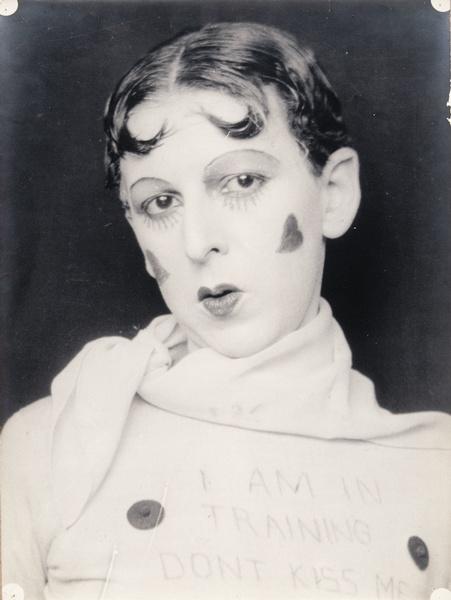
Claude Cahun Self Portrait, 1927. Collection Musée des beaux-arts, Nantes.
In her essay “In Our Glory: Photography and Black Life,” bell hooks uses a story about the relationship she and her two sisters “V.” and “G.” have to a photograph of their father, Veodis Watkins, taken before the girls were born, to set up a general dialogue about the function of snapshot collection displays in African American households and the role these photos play in construction and possession of black identity. Though a very prolific writer who mostly espouses disengagement from the concept of “the enemy,” hooks frequently chooses unusual adversaries (among them rapper Lil’ Kim and filmmaker Wim Wenders). In “In Our Glory” hooks’s rival is her sister “V.”
(more…)

by Jean Marie Carey | 15 Jan 2008 | Art History
Catherine Opie, Papa Bear, Chief, Jake, and Chicken from “Being and Having” series, 1991.
One of my goals this year is to be more intellectually open to works I find aesthetically challenging. Catherine Opie is one photographer whose portraits of others and self-portraits I just cannot appreciate, not because I take exception to her context, agenda, or stated subject matter, but because my eyes just don’t love the juxtaposition of flesh against patterned or fabric backgrounds.
The image “Chicken” (lower right) has entered a larger popular culture forum because it is used prominently in promotional materials and in the opening credits of the cable television series The L Word (one of the characters is a museum curator in California). When I first saw this photo I didn’t realize the person in the photograph was a woman but I did peg it as an Opie because the Chromagenic prints are easily identifiable and the camera available to just a few elite photographers. The intentionally forced and obviously faked identities in this series speak to our recent discussions of photography as an arbiter of “the real.”
The technology, to me, is more interesting than the image itself, and it adds a level of construction, predetermination, and staging that exceeds even Opie’s elaborate theatrics.
