by Jean Marie Carey | 5 Dec 2013 | Animals, Animals in Art, Art History, Dogs!, Italian Greyhounds, Re-Enactments© and MashUps
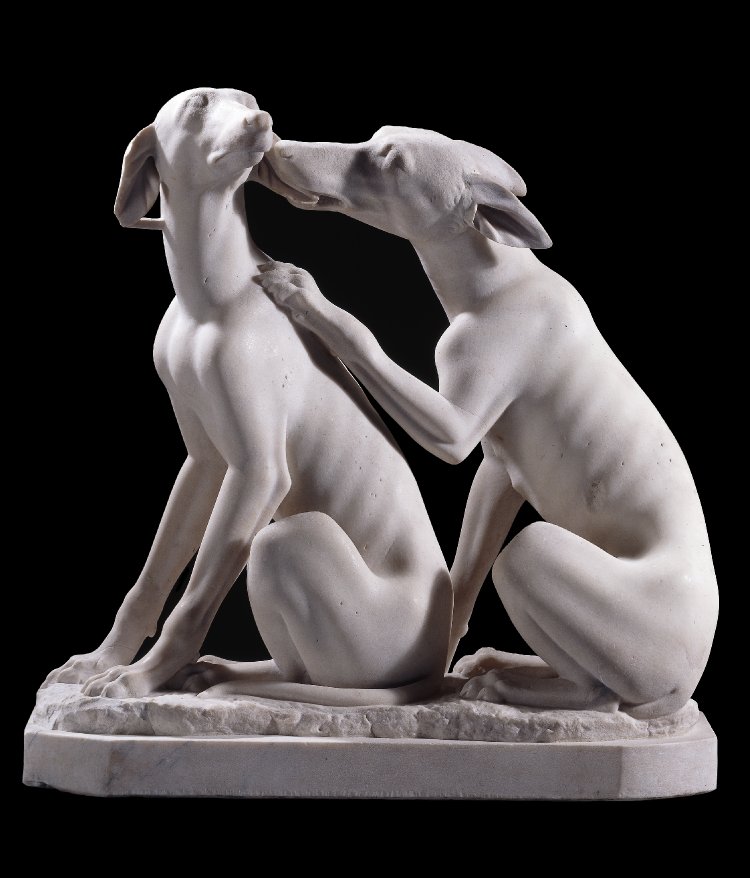
The Townley Greyhounds
The artistic expression of human relationships with animals has been and remains deeply complex and shifting. From the shaggy predators of the Lascaux Cave paintings to the costumed, hyperreal Weimareiners in the photos of William Wegman, the canine form has been especially popular with artists as both an ad hoc subject and a highbrow icon. A particular type of dog, the Cirneco dell Aetna, or Italian Greyhound, appears quite often in the art of ancient Greece and Rome, enjoying a commonality shared only with cattle and horses.
The Italian Greyhounds, however (as we shall call them henceforth), literally crossed the threshold in the ancient world, entering households not as steeds for work and war or sacrificial offerings, but as companions and objects of beauty.

The aim of this paper is to point out for consideration some examples of Italian Greyhound imagery from several ancient eras and geographical locations, to describe the history of this breed of dog in relation to its popularity in Greece and Italy, to draw a few conclusions about the dogs’ visual evolution and the reasons for its prevalence, and to show how both the animal and its image continued as both an influence and a viable species beyond the end of the Roman Empire. A starting point is to describe the nature and appearance of the Italian Greyhound, a species which exists fundamentally unchanged from its earliest days.
(more…)
by Jean Marie Carey | 11 Nov 2007 | Art History
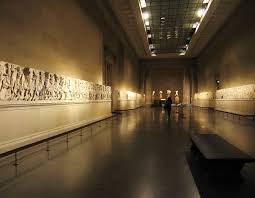
The Parthenon Friezes at the British Museum
At the end of the summer of 2007, the week before fall university classes began, Greece was on fire. The Peloponnese was uniformly scorched, nearly a hundred people were killed, rural economies were displaced, and flora and fauna indigenous only to Greek pine forests and mountainsides were burned, perhaps beyond any eventual recovery. Though the fires were barely held back from the famous antiquities of Olympia and Athens, other archaeologically priceless sites were not so fortunate .
Though some of the fires were attributed at their source to arsonists, Greek Prime Minister, Kostas Karamanlis, whose New Democracy party was returned to office this past September, is partially culpable in this tragedy. Karamanlis and other Greek officials were slow to acknowledge the severity of the fire emergency and have yet to admit the true extent of the damage.
“There are several well known ‘arsonists’ in Greece — garbage dumps (burning spontaneously), farmers burning brush, animal farmers burning land to sprout fresh grass for grazing,” Nikos Charalambides, director of Greenpeace in Greece, told a reporter from Reuters on October 1.
“But the biggest arsonist is the state, which has not clarified the use of land, leaving suburban forests vulnerable to rogue developers,” he added in the same piece.
“The lack of a national land registry and national zoning laws leave room for doubt about the characterization of land, whether it is forest or not,” told Reuters.
It is not a good time for antiquities, and the dire circumstances are of course more attributable to the traditional colonial superpowers than to Grecian malfeasance.
The blame for the theft of treasures from the Baghdad Archaeological Museum, the burning of Baghdad’s National Library, and the looting of more than 10,000 Ur, Sumerian, and Babylonian archaeological sites may be laid, in the name of Operation Iraqi Freedom, on the doorstep of the United States and bullied ally Great Britain.
(more…)
