by Jean Marie Carey | 8 Dec 2013 | Animals, Animals in Art, Art History, Franz Marc, German Expressionism / Modernism
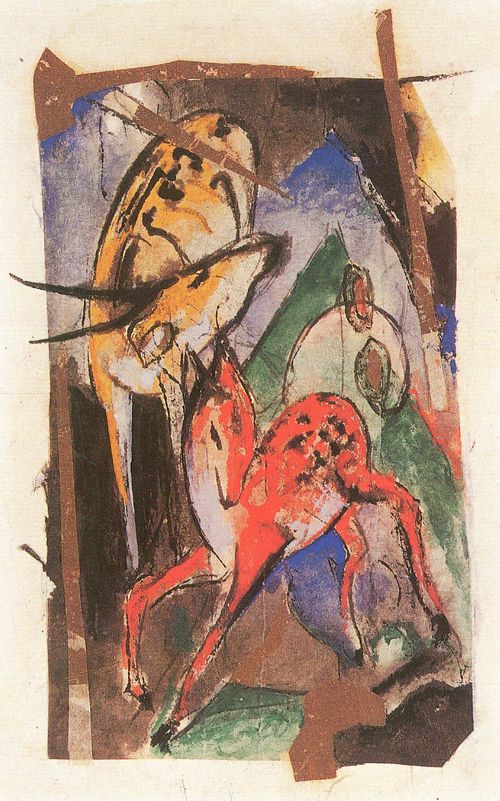
Franz Marc, Rotes Reh und gelbe Antilope, 1913, Mischtechnik und Collage (Silberpapier)
So, Franz Marc always said he was from the future…he amended the amount of how far in the future to 50, then 150, then “about 150 to 500 years” as his own time ran out, and often when saying this was expressing a complaint about his contemporaries that in 2013 we could characterize as: Haters gonna hate.
The recent (and continuing unabated in München) interest over the paintings stolen and hoarded by Hildebrand Gurlitt and his son, Cornelius Gurlitt, has turned to a conversation about the meaning of ‘ownership’ of priceless artworks probably at the very, very, very least obtained via coercive means, and the role of art dealers in the procuring of art and broker of deals for artists.
I began to think about this discussion, in an earlier version though informed by perspicacity, in terms of Marc, who always had a lot to say about art dealers, ranging from the fatalistic to a kind of grudging respect to affection and back, in the case of Hans Goltz, to sputtering but somewhat amused indignation. It seemed beyond the realm of possibility that Marc had encountered the Gurlitts, as Hildebrand Gurlitt was not born until 1895. However I should learn never to ‘bet’ against Marc’s knack for knowing somehow what someday would be meaningful. So, of course he knew the Gurlitts, in the form of the Fritz Gurlitt Gallery, through the eponymous owner and Fritz Gurlitt’s son, Wolfgang (the first cousin of Hildebrand), who had taken over the Berlin gallery and brokerage in 1907.
I was very excited to discover in revisiting Marc’s correspondence with August Macke the followng passage, in which Marc describes his interaction, with Wolfgang Gurlitt (the entire letter follows the break):
Sindelsdorf bei Penzberg, den 12. III. 13 Oberbayern
Lieber August,
… Das Beispiel Pechstein ist für mich typisch. Ich habe kein reines Gefühl mehr vor seiner Persönlichkeit. Mir ist höllisch Angst vor einer Popularität wie der seinen. Nolde tut auch keinesfalls mit, die ›Brücke‹ hat sich bis jetzt auch gesträubt. Aber was die tun, ist mir schliesslich auch nicht ausschlaggebend; wenn sie mittun, ist es ›der Not gehorchend, nicht dem eignen Triebe‹. Meier-Graefe hielt letzthin in München einen Vortrag, in dem er uns alle als Geschäftsmacher bezeichnete und das Publikum aufforderte, es solle sich gegen uns verbinden etc.!! Und Cassirer denkt im Grunde genau so. Mit diesem Kreis will ich nichts zu tun haben. Ich habe die Erfahrung gemacht, dass, wer was von mir haben will, zu mir selber kommt. Wer sich für mich und uns alle interessiert, geht sehr wohl in den ›Sturm‹ und kauft auch dort; der ›Sturm‹ ist als Ausstellungsraum glänzend, riesengross, gutes Licht, dunkle Wände; Ich hab recht gut dort verkauft; tout Berlin braucht gar nicht hinzugehen, ist mir viel lieber so. Gurlitt bedrängt mich seit Monaten, ich soll doch nur bei ihm ausstellen; ich habe ihm jetzt durch Niestlé sagen lassen, wenn er mich durchaus für seinen Salon braucht, soll er mit kaufen anfangen. Auf dem Ohr scheint er aber taub zu sein; wozu soll ich dann bei ihm statt im ›Sturm‹ ausstellen? Ich war dreimal in Berlin (wegen Niestlé) dort und habe, glaube ich, einen einzigen Besucher dort getroffen. Legros war ebenfalls öfters in der Niestlé – und gleichzeitig Pechstein-Ausstellung und traf nie einen Menschen dort. Wenn was Interessantes dort ist, geht man hin, so gut wie in den ›Sturm‹. Tu Du, wie es Dir am besten scheint; ich will mich zurückhalten; ich fühle es als Pflicht gegen meine Ideen über das Ziel unserer Arbeit, das nicht über den Weg der Berliner ›Sommerausstellungen‹ zu erreichen sein wird. Du schimpfst oder lachst, – ich bin nun einmal so. Dass Du Kandinskys Vier Klänge ›schlecht‹ findest, ist mir vollkommen unverständlich; ich denke das Gegenteil: sehr gut. …
One of the things I always like about Marc is that although he is (vaguely) aware of the practical importance of money and often worries about not having any, neither can he be easily enticed or motivated by it (no one seems ever to tried the ‘immediate gratification’ tactic of food, alcohol, cigarettes ‘oder sonst was.’). Also, for a mostly guileless and impetuous person, Marc could sometimes machinate fairly well…
Here Marc tells August of Gurlitt’s persistence in trying to have some dealings with him. On the one hand, Marc doesn’t really have any intention of bailing on the Der Sturm enterprise, but on the other, he wants to keep a line into Gurlitt on behalf of his longtime friend, neighbor, and fellow animal lover and animal painter, Jean-Bloé Niestlé, whose drawings of birds, while very skillful, fell somewhat outside the concern of the avant-gardes. He says Gurlitt actually seems a bit out of it in terms of critical culture, and that, further, no one ever seemed to be at the gallery anyway. It’s interesting that Marc expends a lot of effort trolling Gurlitt for Niestlé, and also that (this is a long and very affctionate letter) that he takes the opportunity to inject a comment preemptively defending Wassily Kandinsky to August, who was not a fan: ‘I think the opposite: very good.’
Actually, in the next few months, the Gurlitt gallery, which had already seen the first and only Brücke group show in 1912, will have a very successful Henri Matisse solo show, followed in 1914 by consecutive spaces devoted to Ernst Ludwig Kirchner, Erich Heckel, and Karl Schmidt-Rottluff, and the handling of all of Lovis Corinth’s prints, and printing portfolios and catalogues of work by Pechstein and Oskar Kokoschka. This probably goes to show that Marc was right to trust his instincts…
In any case it is quite amazing that Marc was very aware of the family who would one day sell Tierschicksale to Kunstmuseum Basel (still waiting to hear the explanation for that) and keep a Blauen Pferde hidden for seven decades. I picked this multimedia print work by Marc because it was made almost exactly 100 years ago, when Marc wrote this letter to August. It’s also very unusual for Marc in that it is truly a collage – the animals are cutouts from another print, and the brown spots are pieces of colored paper.
(more…)
by Jean Marie Carey | 1 Sep 2013 | Animals, Animals in Art, Art History, Franz Marc, German Expressionism / Modernism
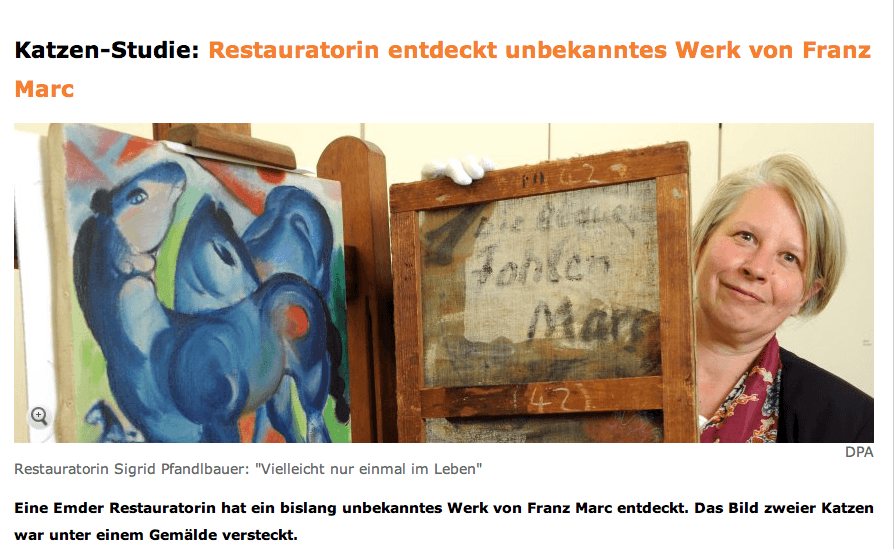
Der Spiegel online had a story today about an art restorer’s amazing discovery of a new Franz Marc painting on the reverse of 1913’s Blauen Fohlen. Sigrid Pfandlbauer of the Kunsthalle Emden found the study of two cats bearing Marc’s signature while restoring Blauen Fohlen for an upcoming exhibition. What an incredible, exciting discovery…how much there is still to be learned about Marc.
by Jean Marie Carey | 7 Feb 2013 | Animals, Animals in Art, Art History, Franz Marc, German Expressionism / Modernism, Re-Enactments© and MashUps
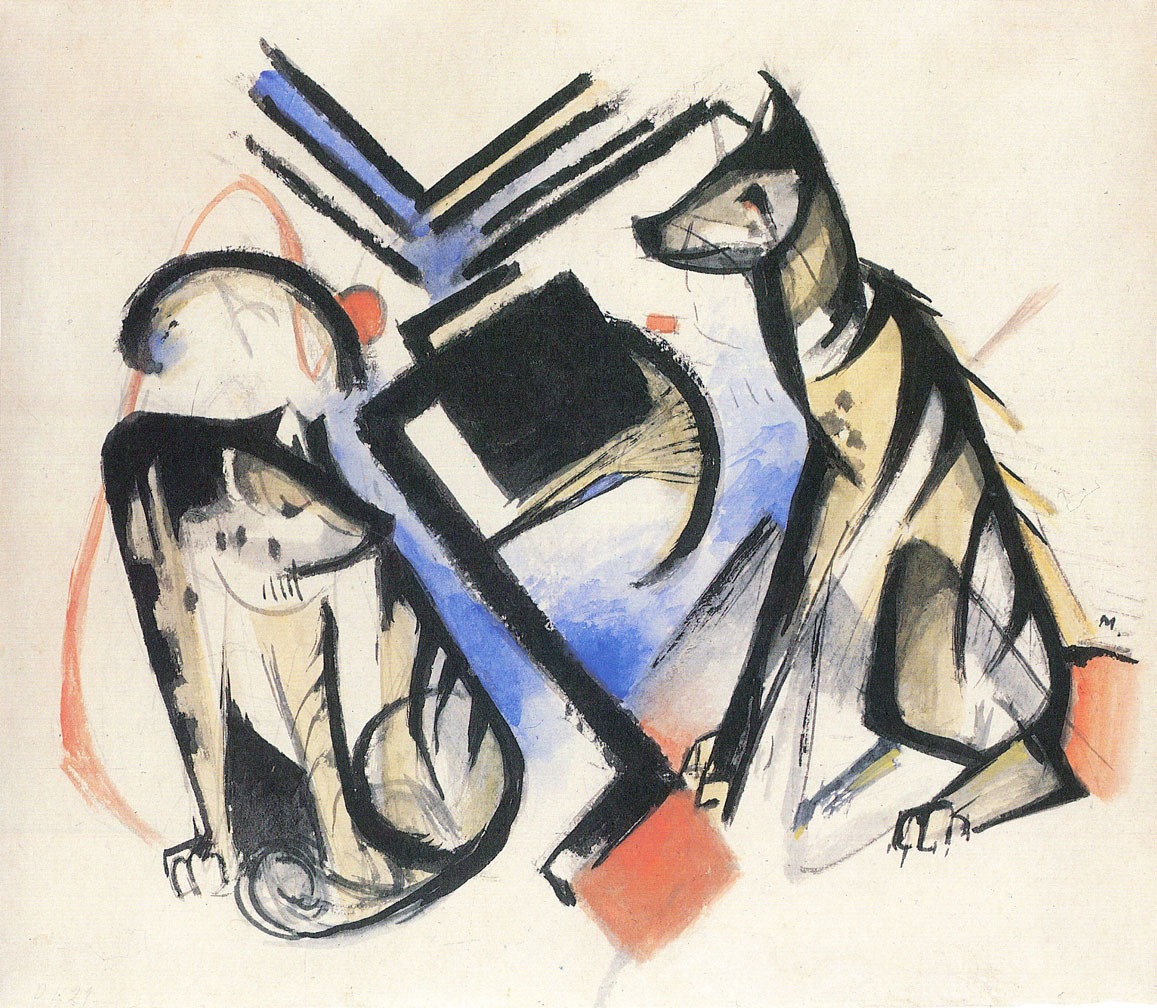
Zwei Wölfe, Franz Marc, 1913
“Furr” – Blitzen Trapper
Yeah, when I was only 17,
I could hear the angels whispering
So I droned into the words and
wandered aimlessly about till
I heard my mother shouting through the fog
It turned out to be the howling of a dog
or a wolf to be exact.
The sound sent shivers down my back
but I was drawn into the pack.
And before long, they allowed me
to join in and sing their song.
So from the cliffs and highest hill, yeah
we would gladly get our fill,
howling endlessly and shrilly at the dawn.
And I lost the taste for judging right from wrong.
For my flesh had turned to fur, yeah
And my thoughts, they surely were turned to
instinct and obedience to God.
You can wear your fur
like the river on fire.
But you better be sure
if you’re makin’ God a liar.
I’m a rattlesnake, babe,
I’m like fuel on fire.
So if you’re gonna’ get made,
don’t be afraid of what you’ve learned.
On the day that I turned 23,
I was curled up underneath a dogwood tree.
When suddenly a girl
with skin the color of a pearl,
wandered aimlessly,
but she didn’t seem to see.
She was listenin’ for the angels just like me.
So I stood and looked about.
I brushed the leaves off of my snout.
And then I heard my mother shouting through the trees.
You should have seen that girl go shaky at the knees.
So I took her by the arm
we settled down upon a farm.
And raised our children up as
gently as you please.
And now my fur has turned to skin.
And I’ve been quickly ushered in
to a world that I confess I do not know.
But I still dream of running careless through the snow.
An’ through the howlin’ winds that blow,
across the ancient distant flow,
it fill our bodies up like water till we know.
§ § §
*(Actually February 8) This year’s anecdote: In the frustration of inertia I went back to as yet untranslated Marc letters, and I found some correspondence that looked interesting about when FM went to visit the Brücke at the beginning of 1912. FM was only supposed to be gone for a few days but actually disappeared for, like, three weeks – this was noted by KBoyV who wrote annoyed notes almost every day commenting on the the situation, i.e. “You left on 2 January and were supposed to return on 5 January and it is now 12 January!”
FM sent some cheerful postcards but made no mention of being in any hurry to return to being, as FM put it, “henpecked.” (FM went to Berlin around the holidays anyway, to visit his perplexed in-laws, camp out on the doorstep of the von Eckhardts, continue investigating the musems, and generally “see what was going on.”)
FM was very intrigued by the crazy goings-on at the Brücke hangout, trying to remain unfazed in the midst of what must have been, even by FM standards, extreme partying situations, nonetheless reporting breathlessly in letters (“OMG these guys are doing DRUGS and stuff!..” and [this is an actual quote, not my interpretation for the modern times] about people “doing goblin-like gymnastics and cartwheels.”
The Brücke had made all their own furniture, wall hangings, murals, even ceramics, lamps, glassware and stuff, and despite the CD cases, pizza boxes and beer bottles strewn around it looked like kind of a cool studio to hang out in. Anyway, a repeated theme in people’s observations and sometimes FM’s own about himself is that he was, sometimes, kind of clumsy or as KBoyV frequently remarks “awkward.” The Brücke dudes finally agree to let FM put some of their stuff in the second Blue Rider show. Meanwhile, FM keeps accidentally busting up their handmade furniture. On 19 January 1912, there was actually the classic sit-down-on-a-chair-and-it-breaks pratfall.
HM was finally dispatched to Berlin to get FM detoxed from opium, teenagers, or whatever, and back on the train home to Bavaria (this lead to a typically digressive and huffy mini-festo on the annoying tendency of trains to go, you know, directly from place to place instead of just cruising around for a while). FM remarked to HM upon departing that even though the place was pretty much already trashed when he got there, it looked like “a couple of giant bears had turned everything over” by the time he left…
From (more or less): Franz Marc: Briefe, Schriften, Aufzeichnungen. Leipzig: Gustav Kiepenheuer, 1989, S. 60-66
by Jean Marie Carey | 26 Aug 2012 | Animals in Art, Art History, Franz Marc, German Expressionism / Modernism, Music, Re-Enactments© and MashUps
Apollinaire was very popular in Bonn and in Berlin, where he befriended Herwarth Walden, who, among other things, occupied a societal role similar to that of Apollinaire. Apollinaire also wrote and drew quite prolifically, of course, in addition to being a tastemaker around whom a circle of other artists and authors coalesced.
In early 1913, August Macke was very excited when not only Apollinaire but Robert Delaunay (and later Max Ernst) came to hang out at his place. Apollinaire spoke German very well, also. Anyway, AM just loved these guys, and generally began trailing them around and writing to them all the time and so on.
There is much more to this story, some of it very exciting, and be assured I will get to it all shortly…
However not everyone was enchanted by Apollinaire. That “not everyone” included, well… for the immediate subject at hand, Franz Marc. FM actually had little use for Delaunay, after a (short) while, either. During 1913, FM pesters Delaunay with tons of perplexing, unsolicited criticism, finally in one outburst declaring that RD wasn’t a very good writer, either.
Apollinaire did like FM’s work, but FM kept a distance. Today upon discovering that it is Apollinaire’s birthday, well, what can I say? It explains a lot. Here is a very comprehensive if somewhat outdatedly designed Website about Apollinaire.
AM finally told FM, basically, to stop embarrassing him in front of his cool new friends. FM pointed out that it was he who had introduced these three to one another, and, that also, RD was kind of a jerk, refusing to give AM anything but a scrap of used drawing paper (like literally AM was begging for any type of memento and that was what RD let him have!). Anyway, RM and AM fought all the time as it was, so this altercation of course could not be resolved swiftly or in a few words and continued over the course of some petulant correspondence and huffy silences…full citations to come. FM was jealous, of course, but also he hated to see AM fall in with people he thought embodied the worst characteristic of all, that of being fake.
Fortunately, since everything that has happened before will happen again, this throwdown has been re-enacted by two parallel characters in one of the most important documentaries of our time (it had to be peddled as fiction because of the potency of its truth), Mean Girls (2004).
Above is the epic scene in which Janis Ian (as FM) confronts Cady Heron (as AM) [we won’t even get into the whole LiLo thing here, or about… nevermind) about being plastic…
With a special guest appearance by Damian as Helmuth Macke.

by Jean Marie Carey | 18 Mar 2012 | Animals, Animals in Art, Art History, Franz Marc, German Expressionism / Modernism
