by Jean Marie Carey | 20 May 2013 | Art History, German Expressionism / Modernism, LÖL, Re-Enactments© and MashUps
Should We Go In?
I have followed Kunstraum München for some time and now that I’m here have been eager to investigate, a plan somewhat impeded by the Verein’s tendency to announce events through the city (which supports the venue/group for contemporary art and criticism – its 40th anniversary is this year) i.e. a bit slowly, and sporadically through a social media platform owned by someone with the initials MZ I do not often participate in (more on social media at the end), and also since I am often busy on the Wednesdays when meetings and lectures take place.
In any case being free on Pfingstenmontag allowed a friend visiting from Brussels and I to haunt tonight’s talk „Warum im Kollektiv?“ by members of Hamburg’s 8. Salon. Visually this also served as a near-to-closing reception for the Mahlergruppe Austellung Of Two Minds (the actual end date is 26 May). You can see some Mahlergruppe work on its low-key Website. The emphasis on group (founded in 2008 at Munich’s Akademie der Bildenden Künste) and the lack of artists’ statements and biographies is very refreshing, and the powerful graphite-and-acrylic bilder – somewhere between drawings and paintings, are, to me distinctively Munchneresque.
Of Two Minds also includes a sculpture, Bellestar, a craft of formed and draped corrugated framing, and a few photographs of Zurich’s “Needle Park,” circa the 1980s and 1990s at the beginning and then height of needle-borne infection. Of Two Minds isn’t a conceptually straightforward rumination on dystopia, though. Perhaps as the name implies it asks about how we remember these types of weirdly hermetic thought/images that may or may not be indexical. (Of course for Americans the first thing that comes to mind is Al Pacino’s laconic junkie in Panic in Needle Park, the film school staple from 1971.) Thinking about how much Zurich has changed in the past decades doesn’t diminish these images which aren’t exactly memories, though they do form the strong impression of something personally experienced (another film analogy would be the impression of Marseille and Brest from The French Connection and Querelle, though the French coastal cities haven’t been like that in … forever, and were already “not like that” when Genet was writing and Fassbinder and Friedkin were filming).
(more…)
by Jean Marie Carey | 12 May 2013 | Art History, German Expressionism / Modernism
There’s a moment when the super-creative but detached suddenly open up and reveal actually, they do know what’s going on. It’s a brave thing to do because it both raises the stakes for intellectual performance and blows away the dandelion dander of the potentially naive. Maybe partly involuntarily but resolutely nonetheless, Liam Gillick’s two works arranged in careful complement in the subterranean Lenbachhaus annex achieve this emergence, perhaps more substantively than at their dates of creation in the ‘aughts.
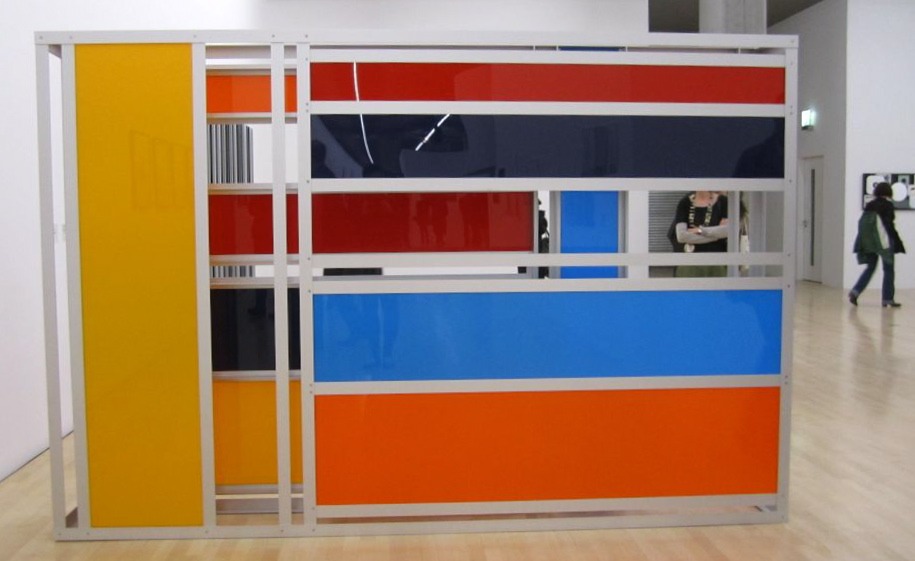
Part of the KiCo Stiftung comprising the very deep “Kunst nach 1945” Sammlung, Gillick’s Screened Reduction (2001) and Glanced in the Midst of a Legislative Break (2006) are opaque Plexiglas and aluminum structures, sculptures poised at the edge of painting. In reference to the latter they clearly hearken to Kenneth Noland’s high Straight Edge (think Bridge circa 1964) and are also thematically in sync with an earlier guest in the Kunstbau, Piet Mondrian, and as such more than nod to the historical commitment to abstraction.
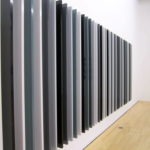
Gillick, who is also a composer and musician (he actually made the sampling loop of the Smiths’ How Soon is Now? you will remember – if you are a former club kid – from Soho’s 1990 nightclub single Hippy Chick!), tends to characterize his work in careful Global Art Fair-speak as being about the questioning of political authority and so on. However taking at visual and bodily encounter value, Screened Reduction and Glanced in the Midst of a Legislative Break are hardly obscurantist, inviting inspection and delectation in simple optics.
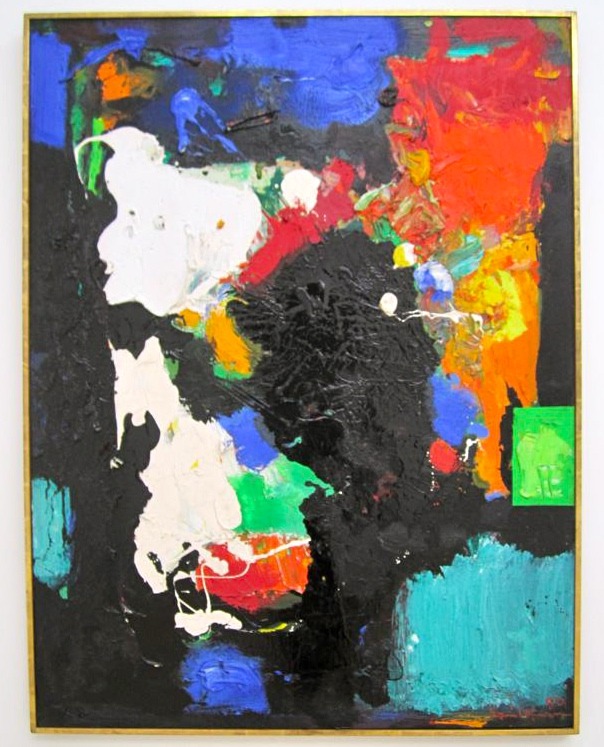
I decided to take this sort of sideways approach to writing about “Das Neue Lenbachhaus” when on a subsequent visit I saw for the first time, for a long time, and up very close, Hans Hoffman’s The Conjurer (1959). Hoffman is very collected but quite under-studied, and this painting is historically significant as well as quite lovely. I hope you can see in the adjacent image the toned translucency and balance of the aqua swatch, which is so carefully balanced on the canvas that the bright color does not preoccupy the eye, and also the charcoal impasto and general texture of the canvas, which is both thick and lustrous.
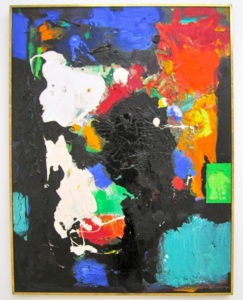
The Bavarian-born Hoffman traveled back and forth between Munich and the United States, and like Kandinsky once opened his own school for artists. Hoffman had many talented students, including Louise Nevelson, Allan Kaprow and Helen Frankenthaler. The Conjurer, made some years after Frankenthaler became well-known for her vertical soak-stain paintings, suggests maybe Hoffman, like Morris Louis, got some ideas from Frankenthaler, too.
by Jean Marie Carey | 14 Apr 2013 | Art History, Re-Enactments© and MashUps
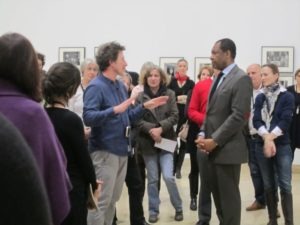
Gideon Mendel and Okwui Enwezor at Haus der Kunst.
I approached the tour of the exhibition The Rise and Fall of Apartheid (10 April 2013 at Haus der Kunst) featuring curator Okwui Enwezor and photographer Gideon Mendel with equal parts hopefulness and skepticism. The conversation and the galleries of photographs and videos were very interesting and relatively straightforwardly informational, and impressively accessible.
The event was arranged in quite a different manner than other “conversations” of this type I’ve attended before. Enwezor and Mendel actually occupied the same space as the 30 or so low-key attendees who surrounded the speakers attentively but not crushingly, giving listening and looking but not acting at all starstruck from being inches away from one of the most influential curators in the world.
The centerpiece of the talk was perhaps Mendel’s music and photo installation Yeoville, created especially for this exhibition and featuring the music of Dynamics, a South African band Mendel says he strongly associates with the mid-1980s when many of these photos were taken. Cropped to isolate details alternating with full-frame shots, these projections show Johannesburg residents during these years interacting in leisure and daily life in quotidian activities that nonetheless show, through the engagement of the mix of races and generations, the gradual, natural, erosion of the Apartheid system.
Mendel has much other work in the exhibition including a stunning color series of some Afrikaans “heritage” re-enactors. South African Jürgen Schadeberg’s work spanning 50 years is also wide-ranging. Most stunning, to me, were some of the covers and images from the 1950s magazine Drum, one of which stunningly restored the recently deceased Miriam Makeba to vibrant zenith. (more…)

by Jean Marie Carey | 28 Mar 2013 | Art History, German Expressionism / Modernism
As a reward for learning to respond to numbers and count change better, and for Schönes Ostern! as we say here, this awesome egg from the vegetable vendor at the Hans-Mielich-Platz market.
by Jean Marie Carey | 7 Feb 2013 | Animals, Animals in Art, Art History, Franz Marc, German Expressionism / Modernism, Re-Enactments© and MashUps
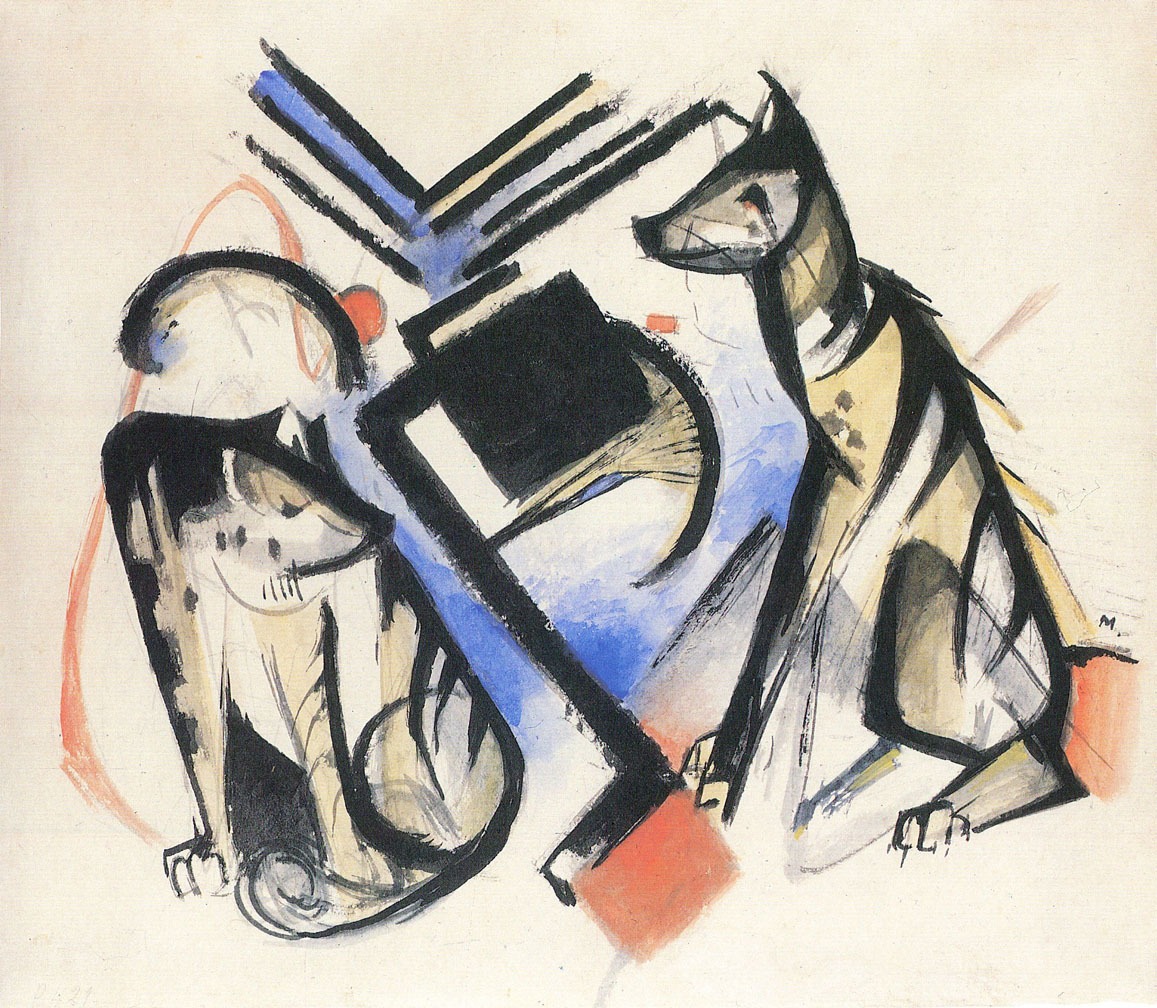
Zwei Wölfe, Franz Marc, 1913
“Furr” – Blitzen Trapper
Yeah, when I was only 17,
I could hear the angels whispering
So I droned into the words and
wandered aimlessly about till
I heard my mother shouting through the fog
It turned out to be the howling of a dog
or a wolf to be exact.
The sound sent shivers down my back
but I was drawn into the pack.
And before long, they allowed me
to join in and sing their song.
So from the cliffs and highest hill, yeah
we would gladly get our fill,
howling endlessly and shrilly at the dawn.
And I lost the taste for judging right from wrong.
For my flesh had turned to fur, yeah
And my thoughts, they surely were turned to
instinct and obedience to God.
You can wear your fur
like the river on fire.
But you better be sure
if you’re makin’ God a liar.
I’m a rattlesnake, babe,
I’m like fuel on fire.
So if you’re gonna’ get made,
don’t be afraid of what you’ve learned.
On the day that I turned 23,
I was curled up underneath a dogwood tree.
When suddenly a girl
with skin the color of a pearl,
wandered aimlessly,
but she didn’t seem to see.
She was listenin’ for the angels just like me.
So I stood and looked about.
I brushed the leaves off of my snout.
And then I heard my mother shouting through the trees.
You should have seen that girl go shaky at the knees.
So I took her by the arm
we settled down upon a farm.
And raised our children up as
gently as you please.
And now my fur has turned to skin.
And I’ve been quickly ushered in
to a world that I confess I do not know.
But I still dream of running careless through the snow.
An’ through the howlin’ winds that blow,
across the ancient distant flow,
it fill our bodies up like water till we know.
§ § §
*(Actually February 8) This year’s anecdote: In the frustration of inertia I went back to as yet untranslated Marc letters, and I found some correspondence that looked interesting about when FM went to visit the Brücke at the beginning of 1912. FM was only supposed to be gone for a few days but actually disappeared for, like, three weeks – this was noted by KBoyV who wrote annoyed notes almost every day commenting on the the situation, i.e. “You left on 2 January and were supposed to return on 5 January and it is now 12 January!”
FM sent some cheerful postcards but made no mention of being in any hurry to return to being, as FM put it, “henpecked.” (FM went to Berlin around the holidays anyway, to visit his perplexed in-laws, camp out on the doorstep of the von Eckhardts, continue investigating the musems, and generally “see what was going on.”)
FM was very intrigued by the crazy goings-on at the Brücke hangout, trying to remain unfazed in the midst of what must have been, even by FM standards, extreme partying situations, nonetheless reporting breathlessly in letters (“OMG these guys are doing DRUGS and stuff!..” and [this is an actual quote, not my interpretation for the modern times] about people “doing goblin-like gymnastics and cartwheels.”
The Brücke had made all their own furniture, wall hangings, murals, even ceramics, lamps, glassware and stuff, and despite the CD cases, pizza boxes and beer bottles strewn around it looked like kind of a cool studio to hang out in. Anyway, a repeated theme in people’s observations and sometimes FM’s own about himself is that he was, sometimes, kind of clumsy or as KBoyV frequently remarks “awkward.” The Brücke dudes finally agree to let FM put some of their stuff in the second Blue Rider show. Meanwhile, FM keeps accidentally busting up their handmade furniture. On 19 January 1912, there was actually the classic sit-down-on-a-chair-and-it-breaks pratfall.
HM was finally dispatched to Berlin to get FM detoxed from opium, teenagers, or whatever, and back on the train home to Bavaria (this lead to a typically digressive and huffy mini-festo on the annoying tendency of trains to go, you know, directly from place to place instead of just cruising around for a while). FM remarked to HM upon departing that even though the place was pretty much already trashed when he got there, it looked like “a couple of giant bears had turned everything over” by the time he left…
From (more or less): Franz Marc: Briefe, Schriften, Aufzeichnungen. Leipzig: Gustav Kiepenheuer, 1989, S. 60-66