Vincent Van Gogh’s Landscape With Snow (1888) is a bit of an oddity amid the nearly 200 paintings Van Gogh made during his relatively brief (fifteen months) but exceedingly productive sojourn to the outskirts of Arles, France, following his immersion in Parisian café culture. As with the canvas depicting the storm on the shore at Scheveningen, Landscape With Snow seems to have recorded a real weather event, a heavy and rare blizzard that happened just as Van Gogh arrived in what he must have been surprised to find was not a sunny early spring day in the south of France. Of greater interest for my research, however, is the rare appearance of an animal – a dog – in this painting.
The dog and his man are walking away from the viewer, and the painter, on the left side of the raised rut between a slushy dirt road and an adjacent fallow field, also patched with snow and maybe ice, though the cold and precipitation seems not to have discouraged the emergence of a few early bursts of foliage. The sky overhead is the cold grey of a European late afternoon, but the village, not too far distant, offers the shelter of steadfast trees and some inviting-looking structures. Still it is the presence of the dog that lends this canvas a sense of comfort – the man and the dog are just out walking and will soon reach the village – rather than the foreboding and isolation a solitary figure would indicate.
Vojtech Jirat-Wasiutynski describes Van Gogh’s fascination with Arlesian agrarian labor practices (and the impingement upon those practices as evidence by the occasional appearance of modern machinery) in a way that echoes Griselda Pollock’s pieces (supported by an even greater amount of first-source historical data) about Van Gogh and the peasant population around Nuenen. Both scholars more than suggest that Van Gogh was a bit clueless as to the actual monotonous particularities of the type of manual labor required by life on a farm, with or without the assistance of efficiency-making devices. However, while Pollock’s interest in Van Gogh is more or less in envisioning the social practices of capitalism realized in painting with the painter as the generalized fulcrum, Jirat-Wasiutnski concentrates on a favorable understanding of Van Gogh’s intentions. I say intentions because while Jirat-Wasiutnski intuits a good bit of bonhomie from Van Gogh’s visions of companionship with like-minded artists as he imagined existence in Japan and an almost Futurist-like faith in the benefits of embracing modernity, the landscape paintings do not precisely, in many cases, reflect this sense of community and optimism. In fact despite its chilly setting, Landscape With Snow (because of the dog) is much more emotionally vibrant than, for example, the invitingly titled but simultaneously cluttered and barren Orchard With Blossoming Apricot Trees (1988) from just one month later.
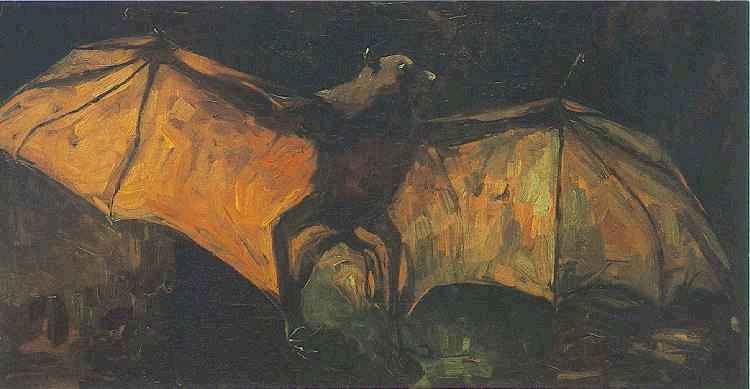
Flying Fox
My favorite Van Gogh painting, period, is Flying Fox (1885) from the Nuenen period. I have always wondered why, after so viscerally animating a creature he could never have seen when it was alive and in its natural environment, Van Gogh’s interest never again turned intensively to the many available creatures of the earth in Nuenen, Paris, and Arles who invited the same types of projections of innocence and typicality as the peasants, fieldhands, and café attendants Van Gogh was so fond of. Franz Marc saw something in Van Gogh’s work that made the German painter immediately embark on his canonical horses. I am still curious and will continue to search for whatever this galvanizing influence is.
See: Vojtech Jirat-Wasiutynski, “A Dutchman in the South of France: Van Gogh’s Romance of Arles,” Van Gogh Museum Journal 2002, Van Gogh Museum, Amsterdam. (78-89)
So for the sake of completeness, here is a story about Marcie Carey and her dental adventures, which actually compare okay to those of her sisters.
Marcie had kind of unfortunate childhood and young adulthood in a puppy mill. Most of the dogs who were recovered with her — 11 of the 16 — died shortly after they were seized by animal services in Georgia. I can only imagine that her taciturn nature is both a result of the horrible experiences she had (three litters of puppies before she was 18 months old among other things) and part of her survival strategy. Marcie is very reserved and quiet — she had lived with me for three years before I ever heard her make a sound — and very loving with cats and people she knows well; I wonder sometimes if she is completely cheerful but she seems content most of the time.
Anyway, like a lot of puppy mill dogs, Marcie has always had terrible teeth. They’ve been extracted one by one over the years, but today, recognizing that all of her canine teeth were practically parrallel to the jawbone and that none of the molars met, the very nice dog dentist Dr. Michael Peak recommended that it was time for total toothlessness. (Also, the spaces around the teeth accumulate bacteria which affect dogs’ health in other ways.)
This is a challenging procedure not just because of the tiny bones of Italian Greyhounds but because their low body fat makes anesthesia tricky. Dr. Peak used only light sedation (isoflurane) with Marcie and some nerve blocking shots around the gumline. And of course Marcie had plenty of dog tranquilizers and painkillers plus subcutaneous and IV fluids.
Also, Marcie is simply much younger — Astra was 16 years old when she had her major extraction and bone graft! — than her sister was undergoing the same procedure.
Naturally I asked to keep the teeth, which you see here, and to have lots of photos.
However I do not think either Marcie nor myself was prepared for embarking on the new adventure of canine cuisine we are now faced with addressing. Marcie already was used to a lot of food — soup, stew, oatmeal, various kinds of cooked vegetables — she just sort of slurped up (not to mention the diet staples of ice cream and yogurt — what can I say?) but if people have ideas about what else a tooth-free IG might subsist on, that would be great.
The excision of Marcie’s tusks are certainly a loss to the world of Italian Greyhound glamour but I think you can see she is going to quickly make a good showing of the “tongue as accessory” thing.
Something very evil had clutched the residence at 704 Howser Street. Something that hung over the little home like a black widow’s veil. Indeed, something hideous. Sure, it had happened before, but not in Astoria. This was spooky.
Inside the home, she could feel the presence of the evil force as it hovered over her. She could feel it. None of the appliances were working properly, the children had taken up the practice of walking through solid walls while chanting “Go Wisconsin!”, and sirens were piercing the air, their source unknown. This was most definitely frightening.
Actually, this evening was not unlike the previous few.
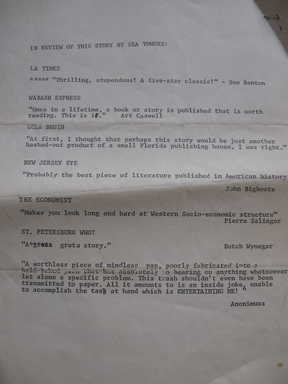
The original texts and drawings from 1987.
Only too clearly came the images of the hamsters in the bathroom, and the sailors in the atticway. She also knew the house still reeked of cheap beer and nachos. The smell was overbearing.
Her mind reeled back a few days as she tried to recall the event that might have triggered all of this, but all she could remember was the fight she had with her husband after he replaced their conventional front door with a paper barrier.
As she thought of the incident, her husband, coincidentally, came crashing through the barrier. The tearing of the paper was loud enough that it could have been a truck driving through the door.
Next came THAT voice.
“Hey! I caught that ball!” He exclaimed.
Immediately she knew that Frostie’s Angels had lost the big ball game. Her husband kept babbling about the outcome of the final play, but when he settled down, he asked her where his supper was. She pointed to the recession of the ceiling/wall above the refrigerator. There he saw a drooping wad of spaghetti, clinging for its survival.
“What’d ya do dat fer?” He asked, pointing his finger at her. There was a brief pause.
“I think we got ghosts.” She said, erupting into tears.
“What have you been smokin’?” he retorted.
With those words, the kitchen floor began crackling and crumbling beneath him. Through the crevice that developed, a little green man burst onto the scene. Was this an alien visitor?
No. It was Gumby.
To be continued…
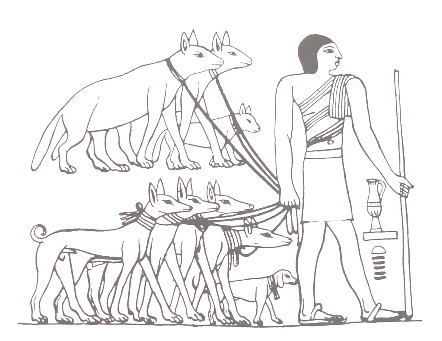
4 Tesems (bas) et 3 hyènes (haut), origine: tombeau de Ptah Hotep à Saqqara.
WARNING!
The Inspector for the Office of Literary Quality, a unit of the British Colonial Office, has determined that the following reading material is of the poorest possible grade, as it is solely structured around nonsense and simply “meaningless words on a page.”
This material is not intended for resale, and is the property of the University of Polyleritae.
Any infringement of the Statuatory Copywright by Dr. Moe Howard and the University is a violation of all applicable laws.
Please note that the names have been changed in order to encourage innocent parties to commit acts that would adulterate their innocence.
This is the first installment of the Tom Selleck/Opus the Penguin Literary Collection.
The University would like to thank you for helping us to establish the finest in InstiLit. Please remember that THIS IS A SECURED BUILDING. NO RIFF-RAFF. NO WHISTLING IN THE HALLS OR PLAYING WITH THE ELEVATORS.