
by Jean Marie Carey | 15 Jun 2014 | Animals, Animals in Art, Art History, Franz Marc, German Expressionism / Modernism, LÖL, Re-Enactments© and MashUps
August Macke and Franz Marc packed the friendship of a lifetime into the few short years they had together from early 1910 to the summer of 1914, even with a few breaks for pouting and sulking. Some of their correspondence is recorded in a dedicated volume, and other letters, notes, stories, and recollections of their doings from other people are hidden in unpublished works and Expressionist apocrypha.
Macke and Marc enjoyed working on their art as a pair and in fact they both considered the drawings and sketches they made while just being together to fall into the class of “things we made together” on the same level as the few categorical objects to which we ascribe to their dual provenance, of which the mural Paradies, from 1912, is one. The mural lives now at the Westfalisches Landesmuseum für Kunst und Kultur in Münster, but it was made in the upstairs atelier of the Macke house (now the August Macke Haus ) in Bonn.
Given Macke’s constant scheming and hustling, and the sort of declarations of superficiality he seems to make about all that is admirable in painting, it is easy to think of him as being a sort of light shadow to Marc’s heavy element, but this is not at all true. And Marc often seems supremely naïve and dopey in his out-of-itness, which was also more of an occasional condition. However, the story attendant to the making of this mural finds them both in exactly these roles.
In fact as soon as I learned more about how Paradies was made, I immediately thought of the famous story in Mark Twain’s The Adventures of Tom Sawyer printed below. In fact there is not much I can say about it, or as well.
Paradies, August Macke and Franz Marc, 1912
Excerpt from Tom Sawyer: Chapter 2
“Hi- yi ! You’re up a stump, ain’t you!”
No answer.
Tom surveyed his last touch with the eye of an artist, then he gave his brush another gentle sweep and surveyed the result, as before. Ben ranged up alongside of him. Tom’s mouth watered for the apple, but he stuck to his work. Ben said:
“Hello, old chap, you got to work, hey?”
Tom wheeled suddenly and said:
“Why, it’s you, Ben! I warn’t noticing.”
“Say — I’m going in a-swimming, I am. Don’t you wish you could? But of course you’d druther work — wouldn’t you? Course you would!”
Tom contemplated the boy a bit, and said:
“What do you call work?”
“Why, ain’t that work?”
Tom resumed his whitewashing, and answered carelessly:
“Well, maybe it is, and maybe it ain’t. All I know, is, it suits Tom Sawyer.”
“Oh come, now, you don’t mean to let on that you like it?”
The brush continued to move.
“Like it? Well, I don’t see why I oughtn’t to like it. Does a boy get a chance to whitewash a fence every day?”
That put the thing in a new light. Ben stopped nibbling his apple. Tom swept his brush daintily back and forth — stepped back to note the effect — added a touch here and there — criticised the effect again — Ben watching every move and getting more and more interested, more and more absorbed. Presently he said:
“Say, Tom, let me whitewash a little.”
Tom considered, was about to consent; but he altered his mind:
“No — no — I reckon it wouldn’t hardly do, Ben. You see, Aunt Polly’s awful particular about this fence — right here on the street, you know — but if it was the back fence I wouldn’t mind and she wouldn’t. Yes, she’s awful particular about this fence; it’s got to be done very careful; I reckon there ain’t one boy in a thousand, maybe two thousand, that can do it the way it’s got to be done.”
“No — is that so? Oh come, now — lemme just try. Only just a little — I’d let you , if you was me, Tom.”
“Ben, I’d like to, honest injun; but Aunt Polly — well, Jim wanted to do it, but she wouldn’t let him; Sid wanted to do it, and she wouldn’t let Sid. Now don’t you see how I’m fixed? If you was to tackle this fence and anything was to happen to it — ”
“Oh, shucks, I’ll be just as careful. Now lemme try. Say — I’ll give you the core of my apple.”
“Well, here — No, Ben, now don’t. I’m afeard — ”
“I’ll give you all of it!”
Tom gave up the brush with reluctance in his face, but alacrity in his heart. And while the late steamer Big Missouri worked and sweated in the sun, the retired artist sat on a barrel in the shade close by, dangled his legs, munched his apple, and planned the slaughter of more innocents.

by Jean Marie Carey | 8 Feb 2014 | Animals, Animals in Art, Art History, Franz Marc, German Expressionism / Modernism, LÖL, Re-Enactments© and MashUps
Tierschicksale, 1914, Franz Marc
Was kann man thun zur Seligkeit als alles aufgeben und fliehen? als einen Strich ziehen zwischen dem Gestern und dem Heute? – Franz Marc, February 1914, from the intended introduction to the second edition of the Blaue Reiter Almanac. First printed in Der Blaue Reiter. Dokumentarische Neuausgabe by Klaus Lankheit. München, 1965, p. 325.
One of the most frequently cited articles about Franz Marc in popular literature is Frederick S. Levine’s “The Iconography of Franz Marc’s Fate of the Animals” from a 1976 issue of The Art Bulletin, and, subsequently, a short book on the same subject. Apparently there are some issues with the accuracy of the translations presented in both. What’s interesting to me is the creative idea Levine had to analyze Marc’s enormous 1913 painting Tierschicksale (mysteriously residing in the Kunstmuseum Basel) as an expression of Ragnarök, the apocalypse of Norse mythology. My opinion is that despite being generally familiar with the Eddas and with Der Ring des Nibelungen Marc wasn’t that interested in these sagas and didn’t consider them as particularly German.
A few years ago Andreas Hüneke, researching at the Lenbachhaus, discovered that the inscription on the back of the painting, „Und alles Sein ist flammend Leid“ is from a volume of the Buddhist Dhammapada of the Pali Canon of Buddha Siddhartha Gautama given to Marc by Annette von Eckardt. So it doesn’t seem to refer to Ragnarök directly as Levine (not having the benefit of Hüneke’s recent work) asserts. It seems more likely that Marc was very distressed, in the summer of 1913 when he made Tierschicksale, about von Eckardt’s move away from Munich to Sarajevo. It explains a little bit about why, upon seeing the painting again a few years later, Marc says he doesn’t even remember creating it and ascribes its meaning to the more external conflagration at hand.
In any case, Levine was not discouraged by his translating experience and went on to the faculty at Palomar College in California and also spent a lot of time studying and teaching at the University of Tasmania in Hobart.
Today, on Marc’s birthday, with so many animals imperiled, Tierschicksale doesn’t really need any overdetermining; it would be very tempting to just turn and flee, if only there was somewhere to go.
by Jean Marie Carey | 2 Dec 2013 | Art History
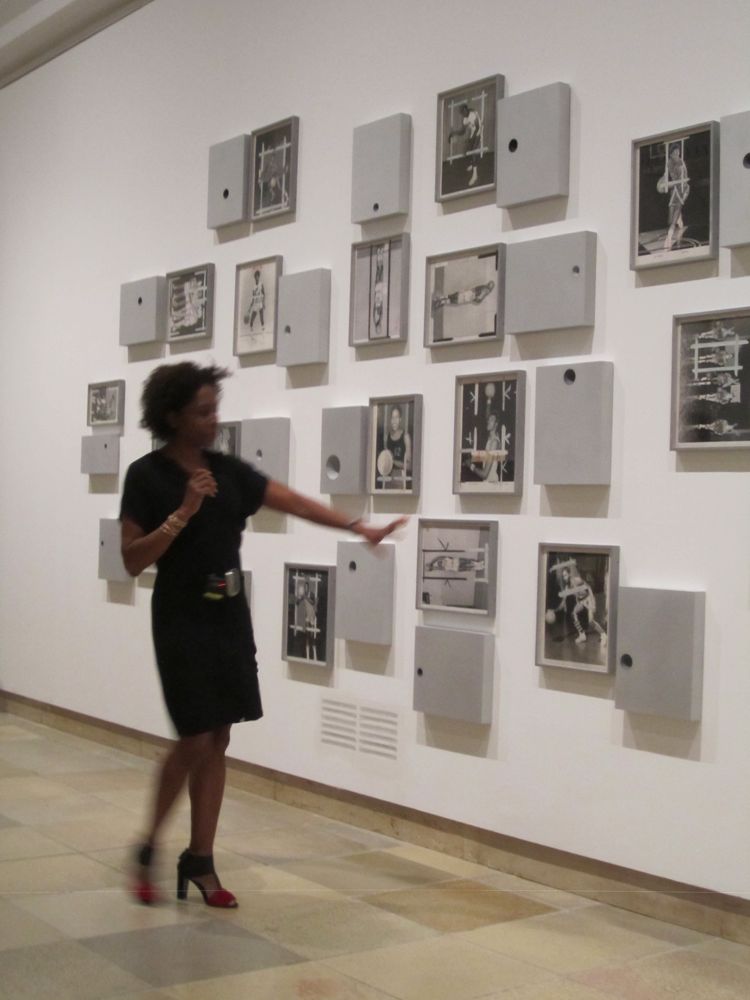
Lorna Simpson @ Haus der Kunst
One of the aspects of Lorna Simpson’s work I have always admired is the technical quality of her photographs. At her recent press conference at Haus der Kunst she confirmed what you’d expect from examining the gelatin prints in particular but really, upon close in-person inspection, her oeuvre: that Simpson develops, prints, mounts and even frames most of her photos by herself in a darkroom/studio in New York City.
This sort of mid-career retrospective represents more than 30 years of of photography, film, video, and drawing. Known (as in these photos have entered the canon) for her mid-1980s for her language driven large-scale works combining photographs and text, Simpson’s effective enigmas are clearly coded but spacious enough to still wonder about. One of the most interesting works on view in München are a series from the 1990s of large multi-panel photographs printed on felt, accompanied by text panels describing their locations and the intimate encounters that are described but only hinted at visually. At the edge of the Englischer Garten where something exactly as described is probably happening right now only not as well concealed, the effect was actually humane and tender as opposed to amusing. The exhibit, which unfortunately overlaps with some other very strong show and with Haus der Kunst’s interactive festival also showcases Simpson’s film and video works, a group of watercolors, and an archive of found photographs from the 1950s, which Simpson has embellished by creating replicas of, posing herself to mimic the originals.

by Jean Marie Carey | 16 Jul 2013 | Art History
The Popular Artist Jeremy Deller…
Felix Burrichter, the editor and creative director of PIN–UP (“the only biannual magazine for architectural entertainment”) and the curator of the current “Paper Weight — Genre-defining Magazines 2000 to Now” at Haus der Kunst explained his work process for the exhibit quite simply. The present-day print artifacts were chosen to reflect a range of well-known and unknown individuals showcased in magazines defiantly having a post-print life “off the reading table.”
More slickly produced and (seemingly) precisely targeted than Nick Logan’s The Face, which arguably is the forerunner, at least in typographic/photographic style of many of these volumes, the periodicals examined in Paper Weight are densely specific.
Visually, the exhibit at Haus der Kunst depends barely at all on a background knowledge of what are essentially very glossy ‘zines. Architect Andreas Angelidakis was clever to blow up the magazine covers to slightly-smaller-than-billboard sizes but particularly to make the finishes completely matte and impermeably saturated; they recall story boards but make visitors feel as if they are moving about the set of Lars von Trier film. (There are a few unfortunate Tracey Emin-recalling pieces of furniture here and there but nothing too invasive.
My favorite scene was the proximal juxtaposition of what happens to be the cover of the current edition of Fantastic Man featuring a stunning portrait of conceptual artist Jeremy Deller in a pink hoodie angled near a 2012 issue of The Gentlewoman featuring Angela Lansbury against a complementary tarama salada background. Fantastic Man of course is obviously trenchant and droll somewhat in the manner of the late Quentin Crisp while The Gentlewoman takes itself quite seriously (the Lansbury cover is somewhat of an anomaly with the usual sitters ranging within Beyonce and Christy Turlington to the same equestrienne-socialites you also don’t know from W and Town & Country.
(more…)
by Jean Marie Carey | 26 Jun 2013 | Animals in Art, Art History, Franz Marc, German Expressionism / Modernism
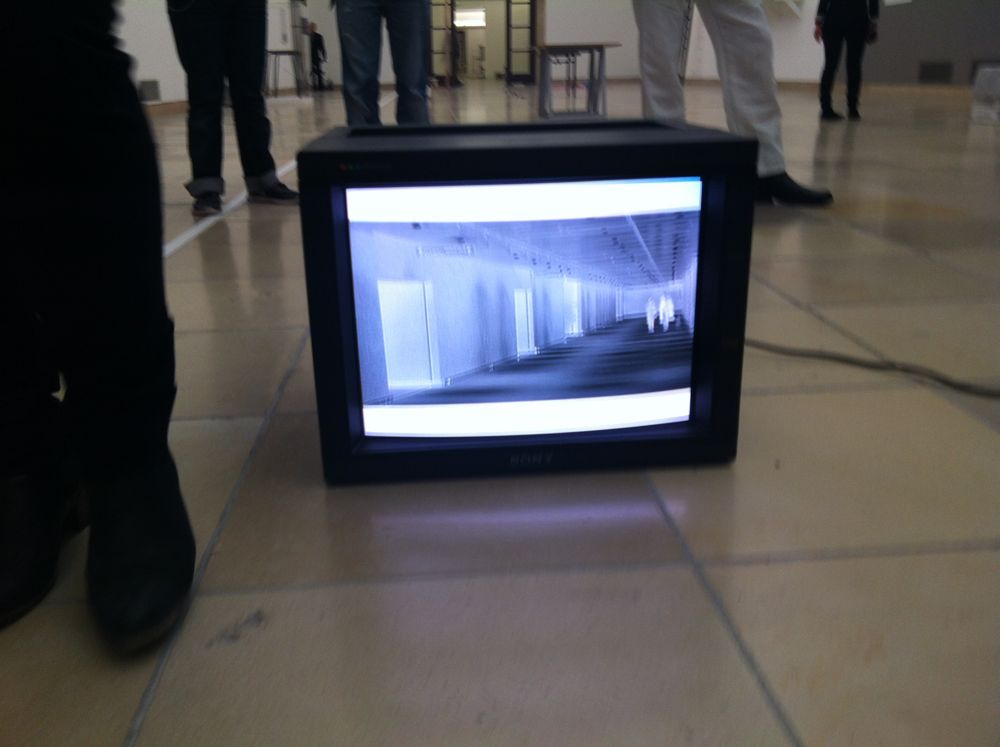
Video is a small but strong component of Joëlle Tuerlinckx’s exhibition at Haus der Kunst.
The legendary documentary Degenerate Art: The Nazis vs. Expressionism is available now (and probably not for long, so, Greasemonkey extension for Firefox, if you know what I mean) on youtube. Part of the mythical status of this program that originally aired in 1993 on the BBC is that it was never converted from VHS to DVD or digital download and has thus been difficult to locate and view.
As you might guess from the title this documentary by David Grubin is about the famous 1937 art exhibit held in Munich called Entartete Kunst, intended by the Nazis to show, collected, the most non-enobling effects of “degenerate art.” (Der Turm der blauen Pferde was part of this exhibit in Munich, and then removed when the show traveled to Berlin, beginning its period of being missing and presumed destroyed. I wonder sometimes if it would make Franz Marc scholars more happy or more sad if it is ever recovered…).
(more…)
