by Jean Marie Carey | 23 Mar 2014 | Animals, Animals in Art, Art History, Dogs!, Franz Marc, German Expressionism / Modernism, LÖL, Re-Enactments© and MashUps
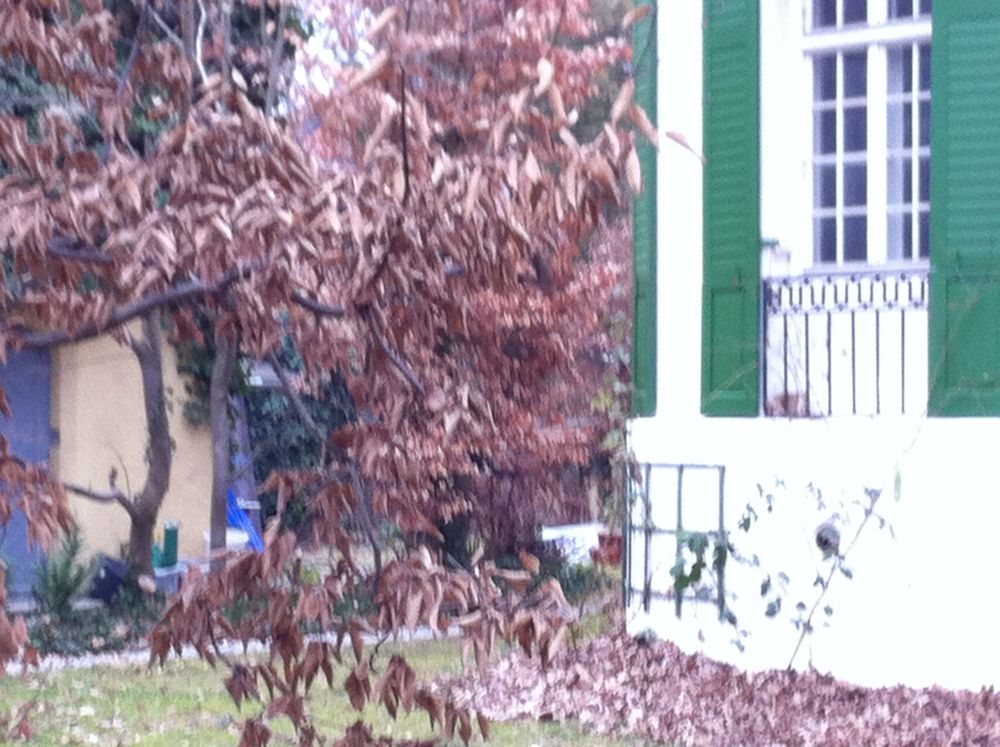
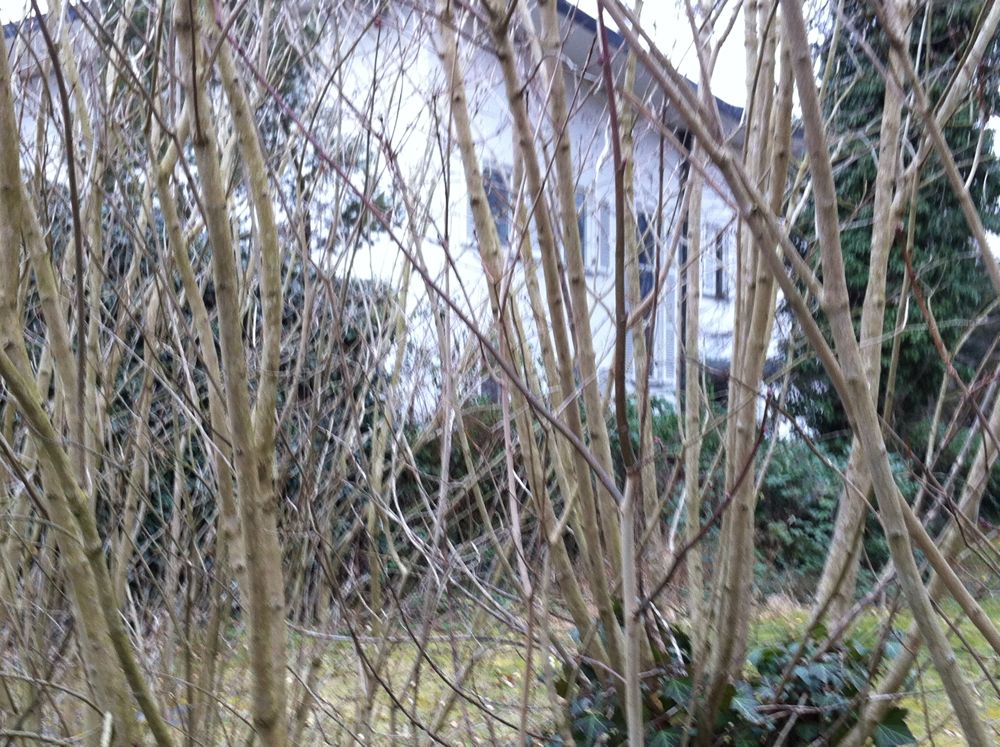
Franz Marc’s family home in the München suburb of Pasing.
I’ve written a little bit about (we’re saving our full repertoire for our even-bigger-screen reveal) the accidental hobby of my creative partner and myself, a sort of reverse geocaching + film. Basically we found out we like to research the addresses of art-historical places and find the spot on the earth where they once stood. In most of these cases, such as the pop-up gallery in Berlin search which ended up being recorded during a blizzard, or the colorful studio here in München destroyed in the war, we had city records and things like invitations to or posters for exhibits to go on, and it was possible to figure out, even where addresses had changed or buildings had been demolished, where they once stood. Sometimes we were able to use GPS coordinates, tagging our own maps as we went along, and sometimes we just used a compass, building keystones, and asking questions. Most of these excursions took a couple days of research and a one-shot hike.
Franz Marc’s family house in the München suburb of Pasing turned out to be our biggest challenge, though, and somewhat unexpectedly since Pasing was never destroyed and a lot of the old buildings have been preserved. However, perhaps not surprisingly, neither were Sophie and Wilhelm Marc, the parents of Franz, nor Paul, Franz’s brother, either very good with managing money nor with keeping records. Thus as it turns out the Marcs owned the house through a chain of convoluted machinations, so the normally very useful city and state records were not helpful. We assembled our clues – fragments of notes and letters mostly, and importantly, photographs showing the house and the yard – and set off to Pasing with only a couple of bottles of water because “how big can Pasing be?”.
Well, Pasing is not that big, but, never underestimate the amount of confusion Franz Marc can cause. On our first journey (like, on the Straßenbahn Linie 19 so not that far) we walked around the neighborhood with the most Altbauten – nothing. The second day we knew to bring some snacks, but, still, after many hours – nothing. We were getting a bit anxious time-wise, and looked over all our notes again. I kept going back to the photographs, which showed very clear views of the property including which way the shadows were falling, and, since they photos were clearly taken in summer, and then in winter, you could see which way the house itself faced. We decided on the third trip to just be more playful and counterintuitively left everything at home but the camera, and getting off the tram just walked in a direction that seemed, for lack of a better way to describe, enticing and pleasant.
Not even half an hour into the walk, we turned a corner, and there it was. The other times we had been going completely in the wrong directions, by the way. Even if I didn’t know from the photographs, I would have just known, I think, that this was a place the Marc family would have lived. It’s a comfortably large enough home, but kind of secluded, even though it’s on city block, with many trees that were saplings in the photographs, a sort of open gazebo, and many eaves and places for birds to live. It definitely had an aura and I was very happy to have found the place – it made me feel very light at heart – and happy that the Marcs had lived there. Sophie Marc stayed on at the house after Wilhelm Marc died in 1907 until she went to stay with Maria Marc later in 1914 (yes, Sophie Marc outlived Franz by just a few months).
Unfortunately, as you can see from the photos, the home is abandoned and in desperate need of some repairs. It’s probably not habitable the way it is now. I dearly hope someone will lovingly restore this historic treasure. If that person is you, please write to me and I will send you the address!
Once my heart had turned to being interested in “recovered biography” I realized how important it is to actually physically experience places and things important in the life of Franz Marc. It’s incredible to me that in a place as self-consciously “historic” as Bayern so many things are falling away. In 2013, the Goltz book store closed its physical location on the Türkenstraße, which should really have been outlawed or something. We did make some documentation of that location, too, though. But that is another story.
UPDATE: May 2015
In some recent research I was doing about some other property records and dates of births and things, I ran across an interesting fact: Around 1885-1900, Annette von Eckardt and her family, which then would have included her baby daughter Helene and husband Richard Simon, a professor at Ludwig-Maximilians Universität, lived in Pasing. By this time Richard Simon would’ve known Paul Marc, Franz Marc’s brother who also taught at the university, and who still lived with the family in Pasing, too. I’m writing something for publication about these interconnected relationships for soon, so…watch this space. The implications are interesting, and a little disturbing, too, but my intuition has been givine me this message for a long time…

by Jean Marie Carey | 8 Feb 2014 | Animals, Animals in Art, Art History, Franz Marc, German Expressionism / Modernism, LÖL, Re-Enactments© and MashUps
Tierschicksale, 1914, Franz Marc
Was kann man thun zur Seligkeit als alles aufgeben und fliehen? als einen Strich ziehen zwischen dem Gestern und dem Heute? – Franz Marc, February 1914, from the intended introduction to the second edition of the Blaue Reiter Almanac. First printed in Der Blaue Reiter. Dokumentarische Neuausgabe by Klaus Lankheit. München, 1965, p. 325.
One of the most frequently cited articles about Franz Marc in popular literature is Frederick S. Levine’s “The Iconography of Franz Marc’s Fate of the Animals” from a 1976 issue of The Art Bulletin, and, subsequently, a short book on the same subject. Apparently there are some issues with the accuracy of the translations presented in both. What’s interesting to me is the creative idea Levine had to analyze Marc’s enormous 1913 painting Tierschicksale (mysteriously residing in the Kunstmuseum Basel) as an expression of Ragnarök, the apocalypse of Norse mythology. My opinion is that despite being generally familiar with the Eddas and with Der Ring des Nibelungen Marc wasn’t that interested in these sagas and didn’t consider them as particularly German.
A few years ago Andreas Hüneke, researching at the Lenbachhaus, discovered that the inscription on the back of the painting, „Und alles Sein ist flammend Leid“ is from a volume of the Buddhist Dhammapada of the Pali Canon of Buddha Siddhartha Gautama given to Marc by Annette von Eckardt. So it doesn’t seem to refer to Ragnarök directly as Levine (not having the benefit of Hüneke’s recent work) asserts. It seems more likely that Marc was very distressed, in the summer of 1913 when he made Tierschicksale, about von Eckardt’s move away from Munich to Sarajevo. It explains a little bit about why, upon seeing the painting again a few years later, Marc says he doesn’t even remember creating it and ascribes its meaning to the more external conflagration at hand.
In any case, Levine was not discouraged by his translating experience and went on to the faculty at Palomar College in California and also spent a lot of time studying and teaching at the University of Tasmania in Hobart.
Today, on Marc’s birthday, with so many animals imperiled, Tierschicksale doesn’t really need any overdetermining; it would be very tempting to just turn and flee, if only there was somewhere to go.
by Jean Marie Carey | 12 Oct 2013 | Art History, German Expressionism / Modernism, LÖL, Re-Enactments© and MashUps, Stuff Found in Library Books
The Blue Flask: A Story Told in Text Message
Pt. 1
A few nights ago, I had a dream in which one of the key objects later appeared in physical form during the day. I thought this was a bit unusual, in that the object, while quotidian, is not something you would see every day, let alone find on the street…
The object is this: a blue thermos type aluminum flask. The dream was actually a fragment of memory about something that had actually happened: a battle of petty ecological one-uppersonship and unintentionally amusing symbolism. Seeking to appear both more recycly than thou and also make a statement of personal taste, this guy had dispensed with plastic water bottles for a flask that looked exactly like the one in the picture, except I am sure minus the millions of microbes. The guy’s sort of but not really rival, a female, at the first opportunity produced her own personal power statement water bottle, ornately patterned in some sort of pink, green, and brown-over aluminum paisley. Also, this bottle was significantly larger.
Because I was in fourth grade (not really it was only a few years ago), and had a clear line of sight to the bottle duel, I poorly concealed some giggling. Observing this my friend across the room looked at me questioningly, whereupon I silently pointed out the comparison. My friend also began quietly laughing, and later, in another location, we both laughed quite a bit.
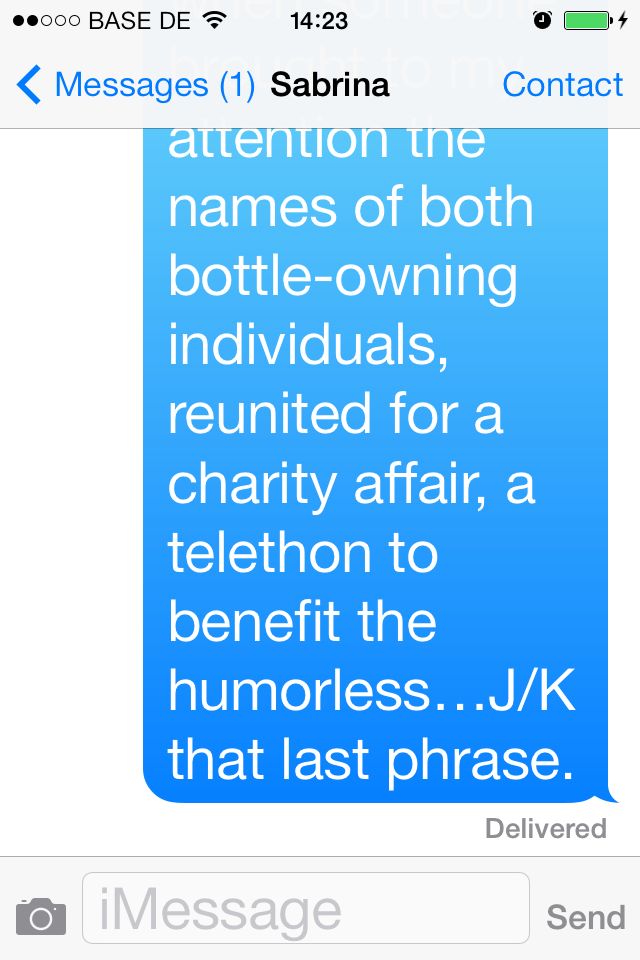
This was a tiny episode in a sprawling “big fish”-type saga, and I have not thought about it in some time, until this week when someone brought to my attention the names of both bottle-owning individuals, reunited for a charity affair, a telethon to benefit the humorless…J/K those last two phrases.
Pt. 2
The dream about the bottle was very fleeting, and it was about the incident, and then I dreamed about other unrelated stuff. But when I woke up I could see those bottles through my lashes before I quite opened my eyes. IKR! But it was a dream.
Pt. 3
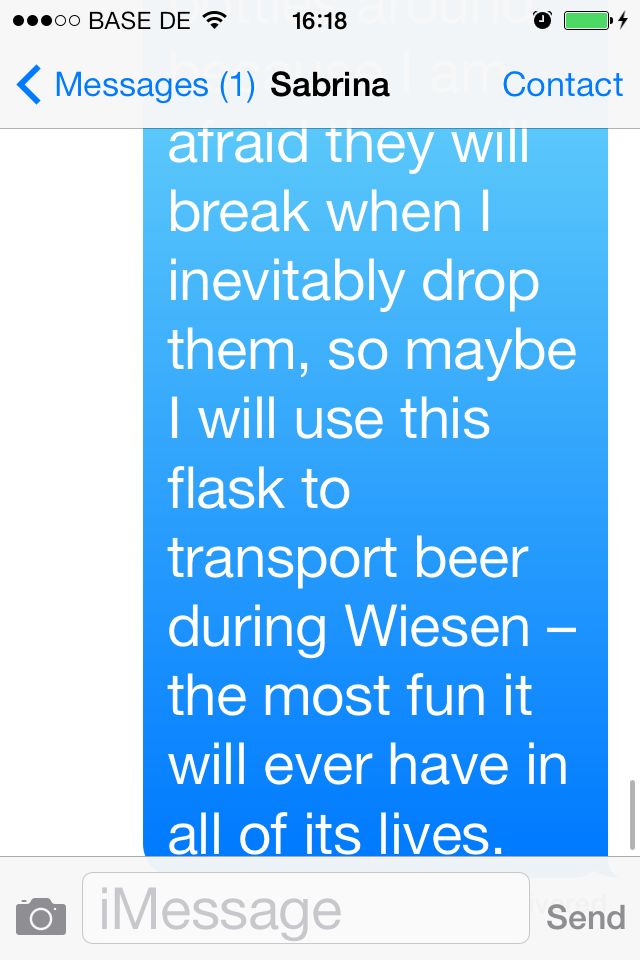
Later the day of the morning/night of the dream, I went to the Bayerische StaatsBibliothek. This is not unusual, I go there almost every day. What is unusual is to see a blue aluminum water bottle wedged into the space between a windowsill and a window on the second floor in a rarely used reading room (and in fact by a window that is rarely opened since it is always winter). Instead of fleeing in distress I leaned out over the parapet and window frame and fished the bottle in with the help of my scarf. I brought it home and I still have it, figuring that like in The Grudge there is no point in getting rid of it since it has already located me. Even though I can drink as much Löwenbrau Triumphator as anyone in my adopted kingdom I don’t like to carry glass bottles around because I am afraid they will break when I inevitably drop them, so maybe I will use this flask to transport beer during Wies’n – the most fun it will ever have in all of its lives.
The Blue Flask: Postscript
The blue flask/dream incident last week was one of a series of very strange things that have happened to me this year, so though it was “haunting,” I didn’t freak out. While I was in the library, I remembered suddenly that I wanted to check out The Author of Himself, the autobiography of Marcel Reich-Ranicki. I got the book and have been reading it instead of packing. On Friday it was reported that Ranicki had died after a long illness.
by Jean Marie Carey | 1 Sep 2013 | Animals, Animals in Art, Art History, Franz Marc, German Expressionism / Modernism
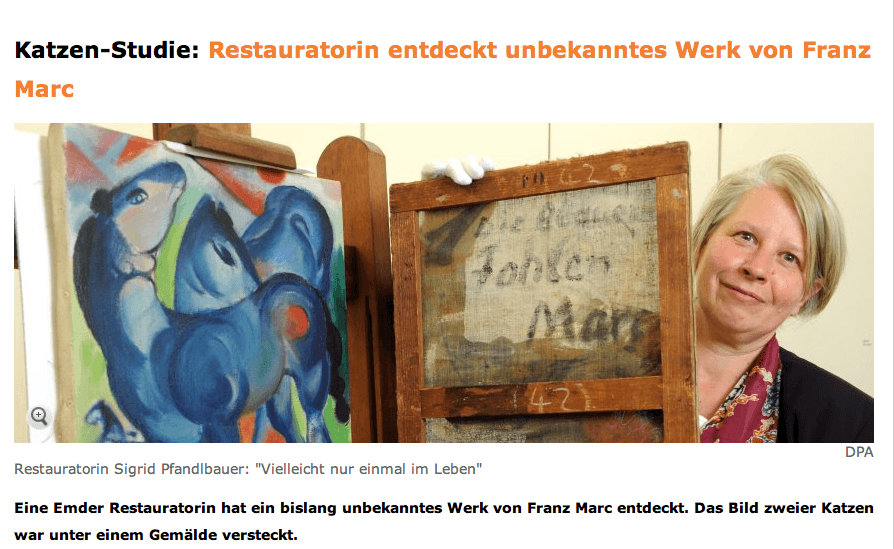
Der Spiegel online had a story today about an art restorer’s amazing discovery of a new Franz Marc painting on the reverse of 1913’s Blauen Fohlen. Sigrid Pfandlbauer of the Kunsthalle Emden found the study of two cats bearing Marc’s signature while restoring Blauen Fohlen for an upcoming exhibition. What an incredible, exciting discovery…how much there is still to be learned about Marc.
by Jean Marie Carey | 15 May 2013 | Animals, Animals in Art, Re-Enactments© and MashUps
Somewhere embedded on the candlestick chart of historic tragedies, between, say, the Armenian Genocide and the Andrea Doria, is this: receiving an email from the responder ceviche.com.
Waking up to this missive brought me back to the day when I had a John S. Knight Journalism Fellowship for coverage of animal and environmental issues…now I realize that this is not the same occupational caliber of the Fourth Estate, as, for example, writing about visiting the homes of the wealthy and repeatedly giving shouts-out to one’s friends in the pages of a free weekly shopper magazine, but, still.
In any case one of the stories I wrote back in the day was about the infestation by roaches of some of Atlanta’s downtown landmarks. One of the things I learned was about roach housing, or harborage, in (for another example) restaurants housed in older structures amid a fairly high building density adjacent to bodies of water and a connected estuarial sewer system (this probably does not resonate at all!) was that, because the static population of roaches is always relatively high and self-managing through nice roach habits like juvenile cannibalism, and is also largely nocturnal, something really extraordinary has to happen in order for roaches to come out and be seen during the day (like, say, in a bustling bright loud kitchen during a health inspection?), there have to be so many roaches, such an explosion of the roach population, that, basically, they have to come out and forage to prevent from starving (and as you probably also know roaches can go a good while without eating).
So in such a situation, in addition to the stray visible roaches, we are talking about an infestation of, like, millions of roaches. If you took the lid off the nearest manhole cover and shot a leaf blower into it, the sky would turn black with flying roaches… So, that. PR might be able to spin the Benghazi situation, but all the consulting in the world can’t make millions of roaches go away. Except for the gullible in-crowd wannabes, who, in an obverse of the Emperor’s New Clothes, will simply will themselves into not seeing or thinking about them. The roaches, I mean… For a breakdown of roach-related health issues, please see this totally legit publication from the World Health Organization.
(more…)